

Did you know that 59 percent of large-scale Indian organizations have integrated Artificial Intelligence (AI) into their core operations, yet nearly a third still struggle with the fundamental Return on Investment (ROI) of these initiatives? Most executive leadership teams feel the pressure to adopt AI strategy services in India, but the transition often results in fragmented workflows and heightened employee anxiety rather than systemic health. You likely recognize that technical implementation alone isn't a strategy; it's a cost center.
This 2026 executive framework moves beyond typical readiness assessments to deliver a rigorous, outcome-based roadmap that guarantees enterprise value and tangible net-profit increases. We'll explore how shifting your focus toward The Art of Problem Finding and governed Agentic AI allows for the seamless deployment of synthetic workers like SARA and NOVA to drive structural excellence.
Key Takeaways
- Understand why elite AI strategy services in India must focus on systemic health and organizational resilience rather than treating Artificial Intelligence (AI) as a mere technical cost center.
- Implement "The Art of Problem Finding" framework to uncover hidden operational gaps and establish a firm net-profit guarantee for your Generative Artificial Intelligence (GenAI) initiatives.
- Leverage the specialized architectures of synthetic workers like SARA and NOVA to automate complex intake and production orchestration within your enterprise workflows.
- Establish a robust Agentic AI Governance policy that balances rapid automation with human oversight to secure a sustainable and measurable Return on Investment (ROI).
Defining AI Strategy Services in India: Beyond Technical Implementation
Effective Artificial Intelligence (AI) strategy is no longer a localized IT project; it's a comprehensive blueprint for structural evolution. Within the Indian corporate ecosystem, which now ranks third globally in AI competitiveness, AI strategy services in India must bridge the gap between ambitious scalability and the region's rigorous demand for cost-efficiency. Unlike traditional IT-led deployments that focus on tool acquisition, a strategy-led approach prioritizes systemic health and organizational resilience. This framework treats Generative Artificial Intelligence (GenAI) as a sophisticated co-thinking partner rather than a mere software utility. It requires a fundamental shift in perspective where technology isn't just used; it's integrated into the very logic of business operations to ensure a sustainable Return on Investment (ROI).
The Shift from Tools to Strategic Co-Thinking
A significant portion of AI initiatives falter because organizations fall into the trap of solution engineering, or building technical fixes before identifying the actual business friction. This reactive posture often leads to fragmented workflows and wasted capital. To navigate the 2026 landscape, leaders must consult The Executive Guide to Generative AI Consulting Services to understand the nuances of high-stakes transformation. This transition requires intensive leadership coaching to prepare the C-suite for the Agentic Era, where success depends on governed, autonomous systems. By anchoring implementation in The Art of Problem Finding, firms can ensure that every investment in AI strategy services in India translates into measurable net-profit increases and long-term stability. It's about building a resilient architecture that anticipates shifts rather than just reacting to them.
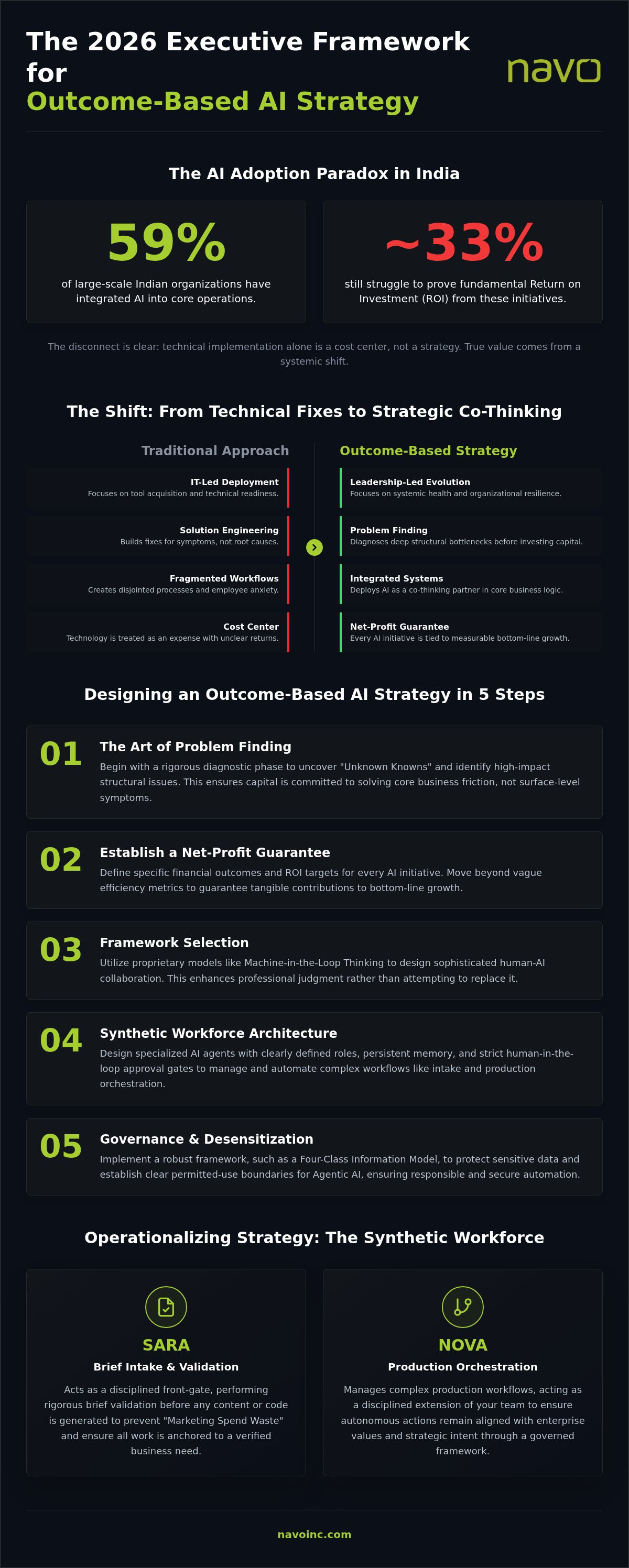
How to Design an Outcome-Based AI Strategy in 5 Steps
Constructing a resilient roadmap for Artificial Intelligence (AI) strategy services in India requires a departure from standard technology adoption cycles. Instead of focusing on technical "readiness," the process begins with a diagnostic phase known as The Art of Problem Finding. This step uncovers "Unknown Knowns," ensuring capital is only committed to solving high-impact structural issues. Once the core problem is identified, leadership must establish a Net-Profit Guarantee, defining specific financial outcomes and Return on Investment (ROI) targets that move beyond vague efficiency metrics toward actual bottom-line growth.
The execution then moves through three critical architectural layers:
- Framework Selection: Utilizing proprietary models like Machine-in-the-Loop Thinking to design sophisticated human-AI collaboration that enhances, rather than replaces, professional judgment.
- Synthetic Workforce Architecture: Designing AI agents with clearly defined roles, persistent memory, and strict human-in-the-loop approval gates to manage production orchestration.
- Governance and Desensitization: Implementing a Four-Class Information Model to protect sensitive internal data while maintaining a governed, responsible framework for Agentic AI usage.
Anchoring Strategy in the Art of Problem Finding
Most enterprise failures stem from "solution engineering," where teams build expensive tools for symptoms rather than root causes. By anchoring your approach in The Art of Problem Finding, you can distinguish between surface-level operational friction and deep systemic bottlenecks. This framework prevents significant "Marketing Spend Waste" by using protocols like SARA for rigorous brief validation before any content or code is generated. This disciplined diagnostic ensures that every automated action is anchored in a verified business need. If you're ready to move beyond generic pilots and secure a profit-driven roadmap, you might consult with our strategic architects to begin your diagnostic.
Operationalizing Strategy: Synthetic Workers and Agentic AI Governance
Operationalizing a high-stakes transformation requires moving beyond isolated pilot projects to a managed synthetic workforce. In the context of AI strategy services in India, this involves deploying specialized Artificial Intelligence (AI) architectures like SARA for brief intake and NOVA for production orchestration. These agents aren't mere software; they're disciplined extensions of your team that require a robust Agentic AI Governance framework. This framework establishes permitted-use boundaries and clear human-ownership mechanisms, ensuring that autonomous actions remain aligned with enterprise values and strategic intent.
Navigating the complex regulatory environments of India and the Gulf Cooperation Council (GCC) states demands a nuanced approach to compliance and cultural sensitivity. For instance, the India AI Governance Guidelines launched in February 2026 mandate strict risk assessments for all high-impact deployments. Simultaneously, GCC states place heavy emphasis on data residency and localized linguistic nuances. To build resilient, long-term capability, organizations should integrate Continuing Professional Development (CPD) UK-certified masterclasses into their evolution plan. It's a method that ensures your leadership remains equipped to manage the systemic shifts inherent in the Agentic Era while maintaining a steady, expert hand over technological frontiers.
Governing the Synthetic Pipeline
Transitioning from a pilot to enterprise-scale synthesis requires more than technical scaling; it necessitates rigorous data safeguards and a Four-Class Information Model. You must establish auditability and accountability rules to manage the risks of un-governed agents. For a deeper analysis of these operational structures within AI strategy services in India, review Synthetic Workforce Development: The 2026 Executive Guide to Agentic AI. By prioritizing these governance layers, firms can ensure their synthetic workers operate within a secure, ethical, and high-performance environment that delivers a guaranteed Return on Investment (ROI).
Architecting the Future of Enterprise Intelligence
Transitioning from isolated pilot projects to a resilient, outcome-based architecture requires a disciplined focus on systemic health. By anchoring your roadmap in the proprietary Art of Problem Finding framework and governing synthetic workers like SARA and NOVA, you secure a pathway to measurable net-profit increases. Navo Inc. provides the elite AI strategy services in India necessary to navigate these complex shifts with professional composure and analytical rigor.
As a winner of the Amazon AI Conclave ML Elevate with CPD (Continuing Professional Development) UK-Accredited leadership coaching standards, we bring three decades of corporate expertise to your transformation. It's time to move beyond technical experimentation and lead with strategic certainty.
The Agentic Era offers a unique opportunity to redefine productivity through governed, human-in-the-loop innovation. Your journey toward structural excellence starts with a single, well-reasoned decision.
Frequently Asked Questions
What is the difference between AI consulting and AI strategy services?
AI consulting often focuses on the tactical implementation of specific tools, while AI strategy services provide a comprehensive blueprint for structural evolution. Similar to enterprise transformation frameworks from organizations like Udyog Guru, strategy services integrate Artificial Intelligence (AI) into core business functions to ensure long-term resilience. This approach moves beyond isolated technical pilots toward an operating model where technology acts as a strategic co-thinking partner, aligning organizational goals with systemic health.
How do AI strategy services in India address data privacy and local regulations?
Elite AI strategy services in India utilize a Four-Class Information Model to categorize data from Public to Restricted. This framework ensures compliance with the 2026 India AI Governance Guidelines and regional mandates in the Gulf Cooperation Council (GCC). By applying twelve repeatable desensitization techniques like tokenization and aggregation, firms can safely utilize Generative Artificial Intelligence (GenAI) while maintaining rigorous data residency and privacy standards.
What is the Art of Problem Finding, and why is it central to AI strategy?
The Art of Problem Finding is a diagnostic framework designed to uncover "Unknown Knowns" and distinguish root causes from surface-level symptoms. It serves as the anchor for any successful strategy by preventing solution engineering before a business friction is validated. This discipline ensures that capital is only committed to high-impact interventions, significantly reducing wasted expenditure on tools that fail to address core organizational challenges.
Can a synthetic workforce really replace human roles in Indian enterprises?
A synthetic workforce is designed to enhance human capability rather than replace it entirely. By deploying agents like SARA for brief intake and NOVA for production orchestration, enterprises automate repetitive, high-volume tasks. This Machine-in-the-Loop Thinking allows professionals to focus on judgment-heavy activities. In the Indian market, this architecture addresses the skill supply gap while maintaining human oversight through strict approval gates and accountability mechanisms.
What should a board-level AI governance policy include?
A board-level policy must establish permitted-use boundaries, accountability rules, and human-ownership mechanisms. It should define clear audit trails and data safeguards to manage the risks of the Agentic Era. Effective AI strategy services in India incorporate these elements into a governance architecture that aligns with international standards, ensuring that every automated process is transparent, auditable, and subject to definitive human authority.
How does Navo Inc. guarantee a net-profit increase for its clients?
Navo Inc. anchors its consulting model in a net-profit guarantee by linking GenAI deployment directly to measurable financial outcomes. Using proprietary diagnostic tools and Return on Investment (ROI) calculators, the firm identifies specific inefficiencies where synthetic workers can reclaim lost capital. This evidence-based discipline ensures that initiatives are judged on commercial impact rather than technical adoption, providing a steady hand for complex organizational shifts.
Disclaimer
The views and opinions expressed in this article are those of the author and do not represent any organisation, client, institution, or professional body with which he may be associated. The content is intended for general information, education, and thought leadership. Readers should seek appropriate professional advice before making legal, financial, investment, regulatory, technology, or business decisions.
The author has taken reasonable care to ensure the accuracy of the information and sources available at the time of publication. Technologies, regulations, market conditions, and industry practices may evolve, and readers are encouraged to verify current information independently. Any examples, cases, or scenarios may have been simplified, anonymised, or adapted to protect confidentiality. The author and publisher accept no liability for decisions or outcomes arising from the use of this content.
Generative AI tools may have been used to support research, structuring, or language refinement, with the final content, judgment, and editorial responsibility retained by the author.