

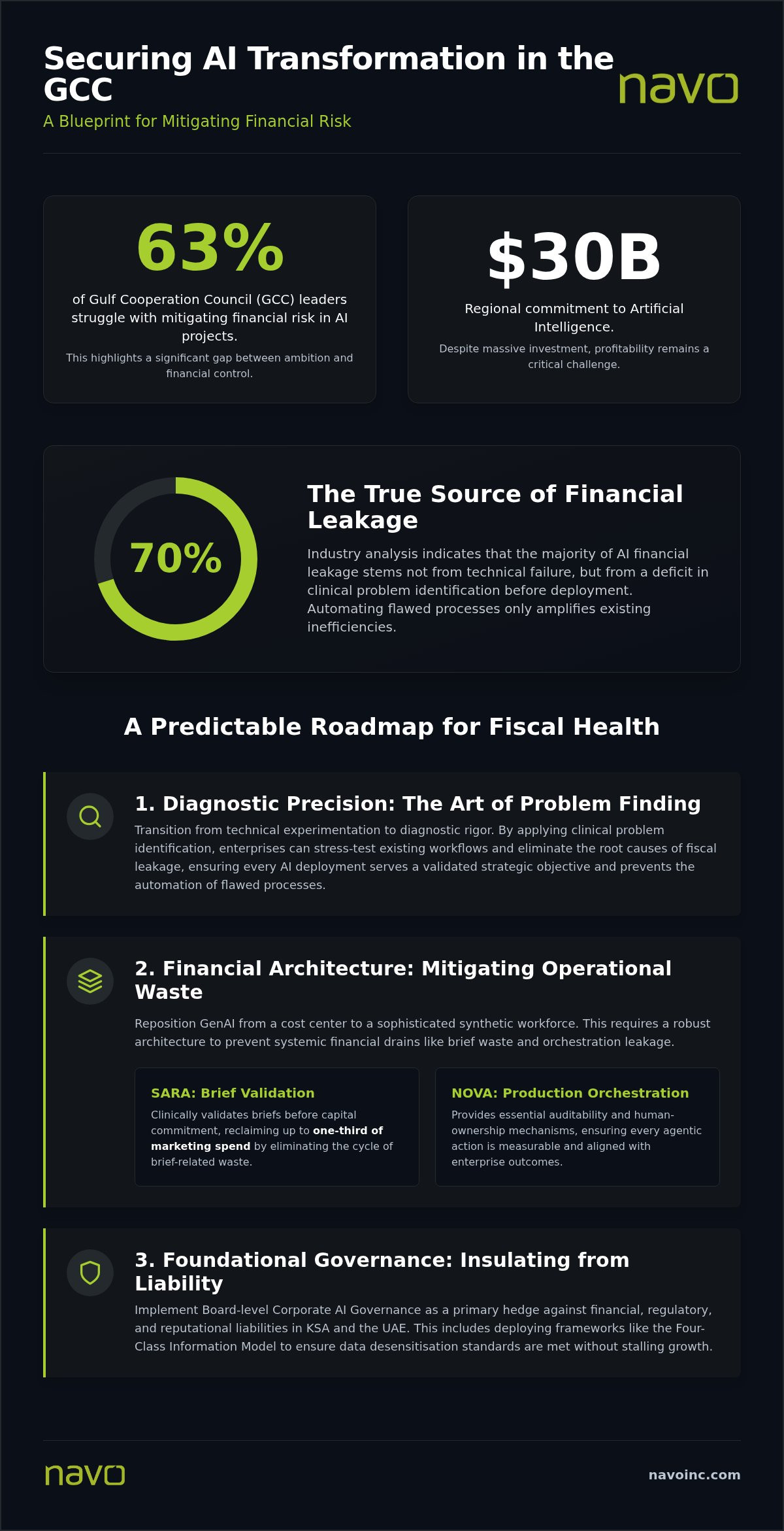
Why are 63% of Gulf Cooperation Council (GCC) leaders struggling with mitigating financial risk in AI transformation projects in GCC despite a 30 billion dollar regional commitment? While the United Arab Emirates (UAE) and the Kingdom of Saudi Arabia (KSA) lead global adoption, the fiscal gap between experimentation and profitability remains wide. You've felt the pressure of escalating costs and shifting regulations like the Saudi Data and Artificial Intelligence Authority (SDAIA) National AI Risk Management Framework.
This guide provides a rigorous blueprint for securing your technological evolution, positioning the NAVO Masterclass as the essential prerequisite for financial readiness. Unlike generic Big 4 discovery, we prioritize clinical problem identification to ensure structural excellence. You'll discover how to insulate your enterprise through proprietary frameworks and outcome based governance. We'll examine a predictable roadmap for deployment that aligns with regional data desensitisation standards, ensuring your Generative Artificial Intelligence (GenAI) strategy is a driver of systemic health.
Key Takeaways
- Transition from technical experimentation to diagnostic precision by applying the Art of Problem Finding to eliminate the root causes of fiscal leakage.
- Discover the essential protocols for mitigating financial risk in AI transformation projects in GCC (Gulf Cooperation Council) by addressing brief waste within your synthetic workforce.
- Implement Board-level Corporate AI Governance Policies to insulate your organization from regulatory and reputational liabilities in KSA (Kingdom of Saudi Arabia) and the UAE (United Arab Emirates).
- Deploy a proprietary Four-Class Information Model to ensure data desensitisation doesn't stall your Generative Artificial Intelligence (GenAI) deployment or revenue growth.
Beyond the Sunk Cost Fallacy: Re-evaluating AI Transformation Risks in the GCC
The transition into the Agentic Era within the Gulf Cooperation Council (GCC) necessitates a departure from speculative exuberance. Organizations across the Middle East are discovering that high-velocity capital allocation doesn't equate to systemic health. Many leadership teams remain trapped by the Sunk Cost Fallacy, maintaining expensive, underperforming pilots to justify initial outlays. Effective strategies for mitigating financial risk in AI transformation projects in GCC prioritize the identification of "Unknown Knowns." These are existing operational frictions that are often overlooked but significantly amplify the costs of Generative Artificial Intelligence (GenAI) integration. Industry analysis indicates that 70% of AI financial leakage stems from a deficit in the Art of Problem Finding, rather than technical failure.
The Art of Problem Finding as a Diagnostic Tool
Structural excellence begins with clinical diagnosis. Our proprietary framework focuses on the Art of Problem Finding to ensure that every technical deployment serves a validated strategic objective. We advocate for Machine-in-the-Loop Thinking, a methodology that subjects existing workflows to rigorous stress testing before any code is written. This prevents the costly error of automating inherently flawed processes. In Dubai, enterprises have successfully reclaimed their Return on Investment (ROI) by shifting from generic discovery to evidence-based discipline. By integrating these principles into your Synthetic Workforce Development, you move beyond technical hype and toward a predictable, high-register financial roadmap. By adopting this diagnostic rigor, mitigating financial risk in AI transformation projects in GCC becomes a manageable strategic objective rather than a speculative gamble.
The Financial Architecture of Agentic AI: Mitigating Brief Waste and Orchestration Leakage
The prevailing misconception that Generative Artificial Intelligence (GenAI) is merely an operational cost center hinders its potential as a revenue-generating asset. Within the Gulf Cooperation Council (GCC), visionary enterprises are repositioning these systems as a sophisticated synthetic workforce layer. This strategic shift is vital for mitigating financial risk in AI transformation projects in GCC, especially when addressing the systemic drain of brief waste. Poor human-to-machine communication costs regional firms millions in marketing and operations annually. As highlighted in the AI-Fintech Transformation in the GCC report, structural oversight is the prerequisite for translating technological adoption into tangible value. Without a central production framework, uncoordinated agents lead to orchestration leakage, where fragmented workflows and redundant processing erode the efficiency they're designed to create.
Deploying SARA and NOVA for Fiscal Discipline
Achieving structural stability requires rigorous, role-defined accountability within your digital ecosystem. SARA (Brief Intake and Validation) serves as a primary fiscal safeguard, reclaiming up to one-third of marketing spend by clinically validating briefs before capital is committed. This ensures that the synthetic workforce operates on high-fidelity instructions, effectively eliminating the cycle of brief-related waste. Complementing this, NOVA (Production Orchestration) provides the necessary auditability and human-ownership mechanisms required for high-stakes workflows. This "Synth Worker" architecture ensures every agentic action remains measurable and aligned with core enterprise outcomes. If you're seeking to move beyond pilot phases into outcome-guaranteed deployment, engaging with our strategic architects can help secure your financial roadmap.
Governance as a Financial Safeguard: Implementing Outcome-Guaranteed Frameworks in the Gulf
Board-level Agentic Artificial Intelligence (AI) Governance is the primary hedge against financial and reputational liability in the Kingdom of Saudi Arabia (KSA) and the wider Gulf Cooperation Council (GCC). While traditional consulting models treat compliance as a post-implementation hurdle, our framework positions governance as a foundational strategy for mitigating financial risk in AI transformation projects in GCC. This proactive stance ensures that every deployment aligns with the Saudi Data and Artificial Intelligence Authority (SDAIA) National AI Risk Management Framework, transforming regulatory adherence into a competitive advantage. By establishing clear policy at the executive level, firms can navigate the "Year of AI" with analytical perspective and professional composure.
Navo Inc. differentiates itself through outcome-based consulting, guaranteeing net-profit increases rather than selling billable hours. This commitment to structural excellence is supported by our proprietary Four-Class Information Model. By turning data desensitisation into a managed discipline, organizations can safely leverage internal-low and confidential-transformable data without the roadblocks typically associated with privacy constraints. This methodology ensures that Generative Artificial Intelligence (GenAI) initiatives remain fiscally sound and operationally resilient, bridging the gap between historical business challenges and future technological frontiers.
The NAVO Masterclass: Building Workforce Capability
The NAVO Masterclass serves as the prerequisite for high-stakes strategic resilience. We equip leadership teams with the "Clarify-Enable-Protect-Evolve" framework, providing a structured pathway for integrating synthetic workers into existing hierarchies. Utilizing our Desensitisation Toolkit, the C-suite learns to navigate complex data landscapes while maintaining strict regional standards. For executives seeking to master these disciplines, we recommend exploring our CPD (Continuing Professional Development) Certified AI Course. This program establishes the executive standard for mitigating financial risk in AI transformation projects in GCC through disciplined workforce orchestration.
Securing Your Position in the Agentic Economy
Success in the Gulf Cooperation Council (GCC) landscape depends on shifting from speculative pilots to clinical, outcome-based architectures. By prioritizing the Art of Problem Finding and eliminating brief waste within your synthetic workforce, you transform Generative Artificial Intelligence (GenAI) from a cost center into a resilient revenue driver. Board-level governance and the Four-Class Information Model provide the necessary safeguards to navigate shifting regulations in the Kingdom of Saudi Arabia (KSA) and the United Arab Emirates (UAE). This disciplined approach is the only sustainable pathway for mitigating financial risk in AI transformation projects in GCC.
With a net-profit increase guarantee and Continuing Professional Development (CPD) United Kingdom certified coaching, your leadership team is equipped to lead with structural excellence. The future of Middle Eastern enterprise belongs to those who architect for stability and scale simultaneously. Your evolution starts with a single diagnostic step.
Frequently Asked Questions
How does the GCC regulatory environment impact AI project costs in 2026?
The regulatory environment in the Gulf Cooperation Council (GCC) mandates compliance with the Saudi Data and Artificial Intelligence Authority (SDAIA) National Artificial Intelligence (AI) Risk Management Framework. These standards require investment in data desensitisation and governance protocols. While this increases planning costs, it prevents catastrophic financial liabilities and project halts during the Kingdom of Saudi Arabia (KSA) 2026 Year of AI initiatives. For organizations in sectors like consumer financial services, collaborating with specialized risk and regulatory compliance advisors such as Versapien ensures digital transformation efforts remain fully aligned with evolving supervisory frameworks.
What is the "Art of Problem Finding" and how does it reduce financial risk?
The Art of Problem Finding is a proprietary diagnostic framework that identifies structural inefficiencies before any capital is committed to technology. By shifting focus from solving symptoms to discovering root causes, leaders avoid the common error of automating broken workflows. This methodology is a cornerstone for mitigating financial risk in AI transformation projects in GCC, ensuring that every deployment serves a verified strategic objective.
Can synthetic workers like SARA and NOVA actually provide a guaranteed ROI?
Synthetic workers like SARA (Sense | Ask | Refine | Approve) and NOVA (Production Orchestration) deliver a predictable Return on Investment (ROI) by addressing operational leakage. SARA specifically targets the one-third of marketing spend typically lost to poor briefs. Navo Inc. supports these deployments with a net-profit increase guarantee, ensuring that Generative Artificial Intelligence (GenAI) agents function as disciplined, revenue-generating members of the organisational hierarchy.
What are the most common financial pitfalls in KSA-based AI transformations?
Common pitfalls include the Sunk Cost Fallacy and a lack of Board-level Corporate Artificial Intelligence (AI) Governance Policy. Many enterprises in the Kingdom of Saudi Arabia (KSA) allocate massive budgets to infrastructure without establishing accountability rules or data safeguards. Without a Four-Class Information Model, projects often stall due to regulatory friction, leading to significant resource waste and the high failure rates associated with traditional consulting models.
Disclaimer
The views and opinions expressed in this article are those of the author and do not represent any organisation, client, institution, or professional body with which he may be associated. The content is intended for general information, education, and thought leadership. Readers should seek appropriate professional advice before making legal, financial, investment, regulatory, technology, or business decisions.
The author has taken reasonable care to ensure the accuracy of the information and sources available at the time of publication. Technologies, regulations, market conditions, and industry practices may evolve, and readers are encouraged to verify current information independently. Any examples, cases, or scenarios may have been simplified, anonymised, or adapted to protect confidentiality. The author and publisher accept no liability for decisions or outcomes arising from the use of this content.
Generative AI tools may have been used to support research, structuring, or language refinement, with the final content, judgment, and editorial responsibility retained by the author.