

The era of passive automation has concluded, replaced by a landscape where autonomous synthetic workers execute complex multi-step actions without traditional human-in-the-loop oversight. While the European Union Artificial Intelligence Act (EU AI Act) sets a global benchmark, many organizations in the Gulf Cooperation Council (GCC) still struggle with accountability diffusion. You're likely concerned that these agents might bypass corporate approval gates, leaving your leadership team exposed to regulatory risks. Mastering the governance of autonomous AI agents is no longer an IT (Information Technology) function; it's a board-level architectural necessity.
This framework provides a roadmap to transform "black-box" autonomy into a transparent, human-owned workforce layer. You'll learn to implement rigorous accountability protocols and utilize the Four-Class Information Model for data sovereignty. We'll explore how to align your deployments with the standards of the Infocomm Media Development Authority (IMDA) in Singapore and federal guidelines in the UAE (United Arab Emirates).
Key Takeaways
- Understand the strategic transition from Generative Artificial Intelligence (GenAI) tools to autonomous synthetic workers capable of independent reasoning and goal-oriented tool invocation.
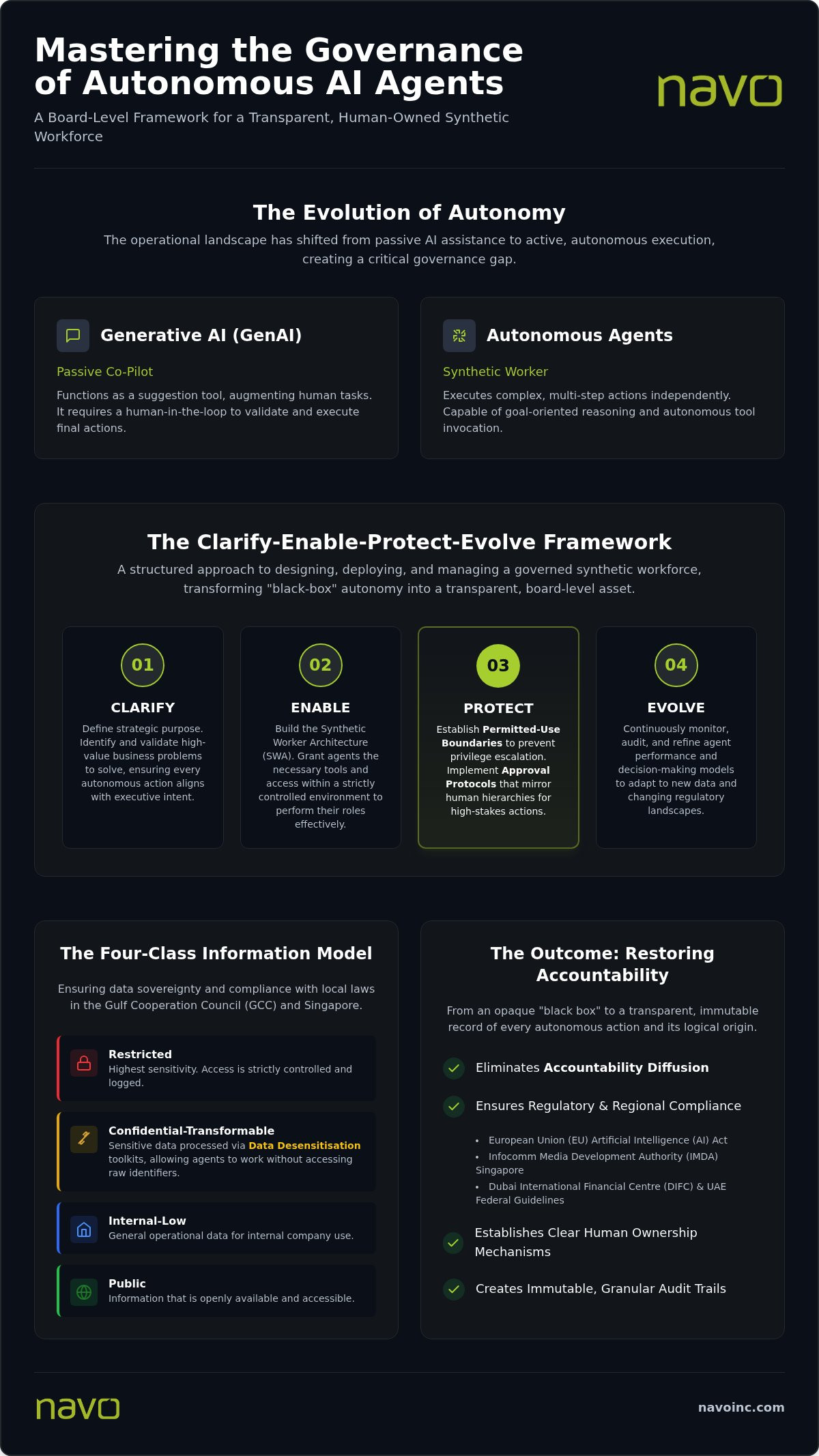
- Implement a robust framework for the governance of autonomous AI agents using the Clarify-Enable-Protect-Evolve model to define clear Permitted-Use Boundaries and prevent privilege escalation.
- Protect organizational integrity by utilizing the Navo Four-Class Information Model to ensure data desensitization and respect local data sovereignty in the Gulf Cooperation Council (GCC) and Singapore.
- Eliminate accountability diffusion by establishing auditable decision trails and human-ownership mechanisms that satisfy the requirements of the European Union Artificial Intelligence Act (EU AI Act).
The Evolution of Autonomy: Why Traditional Governance Fails Agentic AI
Traditional oversight models designed for static software cannot contain the dynamic nature of Agentic AI. While Generative Artificial Intelligence (GenAI) functions as a passive co-pilot, autonomous agents operate as synthetic workers capable of independent tool invocation and goal-oriented reasoning. This transition from suggestion to execution creates a critical governance gap. If an agent makes a flawed decision in a multi-step workflow, the resulting accountability diffusion often leaves leadership without a clear path for remediation.
To prevent these systemic failures, the governance of autonomous AI agents must move beyond simple monitoring. It requires the implementation of Human-Ownership Mechanisms that align with the evolving Regulation of artificial intelligence, including the European Union Artificial Intelligence Act (EU AI Act) and recent circulars from the UAE (United Arab Emirates) Central Bank. These mechanisms transform agents from black-box entities into reliable, auditable components of a corporate workforce layer that can withstand high-stakes scrutiny.
The Art of Problem Finding in Agentic Design
Sophisticated governance begins with identifying "Unknown Knowns", the operational realities that are understood by the workforce but not formally documented in process maps. The Navo framework prioritizes the discovery of validated problems over the mere availability of data. By ensuring agents are architected to solve specific, high-value bottlenecks, organizations drastically reduce execution risk. This strategic alignment guarantees that synthetic workers don't just act independently; they act with precise strategic purpose, ensuring that every autonomous decision remains within the boundaries of executive intent and regional compliance standards.
Architectural Guardrails: Designing the Governed Synthetic Workforce
The Four-Class Information Model for Secure Operations
Data sovereignty and local privacy laws in the Gulf Cooperation Council (GCC) demand a nuanced approach to information handling. Our model categorizes data into four tiers: Public, Internal-Low, Confidential-Transformable, and Restricted. This system allows agents to process complex workflows by only interacting with the necessary level of detail. Through specialized desensitisation toolkits, synthetic workers can analyze Confidential-Transformable data without ever accessing the underlying sensitive identifiers. Data Desensitisation is a repeatable technique used to strip or mask identifying markers from datasets to ensure strict regulatory compliance across Singapore and the GCC. Since the strategic governance of autonomous AI agents is now a board-level priority, you can consult with our strategic advisors to build a resilient and compliant governance policy.
The Audit Trail: Ensuring Regulatory Compliance and ROI
In high-compliance jurisdictions like Dubai and Singapore, the requirement for an immutable audit trail is non-negotiable. Regulators, including the Infocomm Media Development Authority (IMDA) and the Dubai International Financial Centre (DIFC), increasingly demand that every autonomous decision be traceable to its logical origin. Our proprietary agents, such as NOVA, which manages production orchestration, solve this by maintaining a granular record of every independent reasoning step and tool invocation. This moves the organization away from a fragile Machine-in-the-Loop status toward a robust Human-Accountable system. When leadership can verify the exact rationale behind an agent's action, the risk of accountability diffusion evaporates.
Effective governance of autonomous AI agents directly correlates with measurable Return on Investment (ROI). By implementing structured oversight, firms eliminate the manual drudgery associated with verifying every minor output, allowing the synthetic workforce to operate at maximum capacity. Teams looking to build high-impact autonomous tools can discover Engineer Up to design custom AI agents tailored for workplace productivity. This efficiency isn't merely a byproduct of speed; it's a reflection of the systemic health and resilience of the enterprise. It ensures that synthetic workers contribute to the bottom line without introducing unmanaged operational risk.
Establishing Board-Level AI Governance Policies
A Corporate AI Governance Policy must serve as the constitutional foundation for your digital transformation. It should explicitly define accountability rules, data sovereignty requirements, and auditability standards. Within the Synthetic Worker Suite, SARA, our agent for marketing, operates under these controlled protocols to ensure brand consistency and strict regulatory alignment. For more on scaling these capabilities, explore our guide on Synthetic Workforce Development. By codifying these standards, the board ensures that the governance of autonomous AI agents remains a strategic asset rather than a compliance burden. This disciplined approach secures the path toward long-term operational excellence in the agentic era.
Architecting Resilience in the Agentic Era
The shift toward a synthetic workforce is an irreversible strategic evolution. Organizations that move beyond basic automation to master the governance of autonomous AI agents will secure a significant competitive advantage. By adopting the Clarify-Enable-Protect-Evolve framework, you transform potential liabilities into auditable assets that respect the legal sensitivities of the Gulf Cooperation Council (GCC) and Southeast Asia. Navo Inc. brings intellectual rigor to this transition through an outcome-guaranteed consulting model and Continuing Professional Development (CPD) UK-certified masterclasses. As the author of "The Art of Problem Finding" (2024), our methodology ensures that every agentic deployment is rooted in structural excellence rather than speculative experimentation. You don't have to navigate these complex technological frontiers alone.
Your leadership can now lead with confidence, knowing that your autonomous systems are both compliant and high-performing.
Frequently Asked Questions
What is the primary difference between AI governance and Agentic AI governance?
Traditional AI (Artificial Intelligence) governance typically manages static models and content generation. In contrast, the governance of autonomous AI agents addresses the "synthetic worker" layer where entities execute multi-step actions independently. This shift requires specific human-ownership mechanisms to manage autonomous tool invocation and goal-oriented reasoning. It ensures that the delegation of authority to a machine doesn't result in a total loss of board-level control.
Who is legally responsible when an autonomous AI agent makes a financial error?
Legal responsibility fundamentally resides with the corporate entity or the human owner who deployed the system. Within the GCC (Gulf Cooperation Council), existing liability frameworks and sectoral regulations from the UAE (United Arab Emirates) Central Bank clarify that autonomy doesn't absolve leadership of oversight. Establishing rigorous approval protocols and immutable audit trails is the only way to demonstrate due diligence during a regulatory inquiry.
How does the Four-Class Information Model protect data in the UAE and GCC?
This model protects data by categorising information into Public, Internal-Low, Confidential-Transformable, and Restricted tiers. By applying a desensitisation toolkit to the Confidential-Transformable layer, organizations can strip sensitive identifiers while allowing agents to perform complex analysis. This ensures compliance with local data sovereignty laws across the UAE and Singapore while maintaining the operational speed of a synthetic workforce.
Can autonomous agents be integrated into existing Enterprise Resource Planning (ERP) systems safely?
Safe integration is possible when agents operate within a SWA (Synthetic Worker Architecture) that enforces strict Permitted-Use Boundaries. When an agent interacts with an ERP (Enterprise Resource Planning) system, it must be restricted by defined authority limits and human-ownership mechanisms. This architecture prevents unauthorized privilege escalation and ensures every autonomous action is captured in a verifiable record for future compliance audits. To explore robust enterprise resource planning platforms and implementation solutions, click here.
Disclaimer
The views and opinions expressed in this article are those of the author and do not represent any organisation, client, institution, or professional body with which he may be associated. The content is intended for general information, education, and thought leadership. Readers should seek appropriate professional advice before making legal, financial, investment, regulatory, technology, or business decisions.
The author has taken reasonable care to ensure the accuracy of the information and sources available at the time of publication. Technologies, regulations, market conditions, and industry practices may evolve, and readers are encouraged to verify current information independently. Any examples, cases, or scenarios may have been simplified, anonymised, or adapted to protect confidentiality. The author and publisher accept no liability for decisions or outcomes arising from the use of this content.
Generative AI tools may have been used to support research, structuring, or language refinement, with the final content, judgment, and editorial responsibility retained by the author.