

Traditional procurement is dead in the age of agentic intelligence; your next vendor contract is no longer a purchase order but a high-stakes architectural blueprint for your organization's systemic health. You've likely realized that managing AI vendor relationships in the United Arab Emirates requires more than just checking a box for data residency or negotiating a lower rate in UAE Dirham (AED). The complexity of black box models and the enforcement of the European Union (EU) AI Act in August 2026 demand a disciplined response. This article delivers a sophisticated framework for transforming opaque vendor interactions into strategic partnerships through rigorous risk classification and outcome-based governance. We will examine how to apply the Art of Problem Finding to vet partners, establish contractual safeguards against model degradation, and align with the International Organization for Standardization (ISO) 42001 to ensure your AI investments yield a clear path to net-profit outcomes.
Key Takeaways
- Transition from traditional Software as a Service (SaaS) procurement to an Agentic Governance framework that treats AI systems as dynamic, autonomous entities within your corporate structure.
- Strengthen your approach to managing AI vendor relationships by adopting a Four-Class Information Model to maintain rigorous data desensitisation and regional regulatory compliance.
- Deploy the Art of Problem Finding methodology to conduct technical due diligence, leveraging the Artificial Intelligence Bill of Materials (AIBOM) to ensure full transparency of 'black box' model behaviors.
- Orchestrate complex, multi-vendor environments through synthetic workers such as SARA and NOVA to maintain human ownership and guarantee measurable net-profit outcomes.
The Strategic Shift from Procurement to Agentic Governance
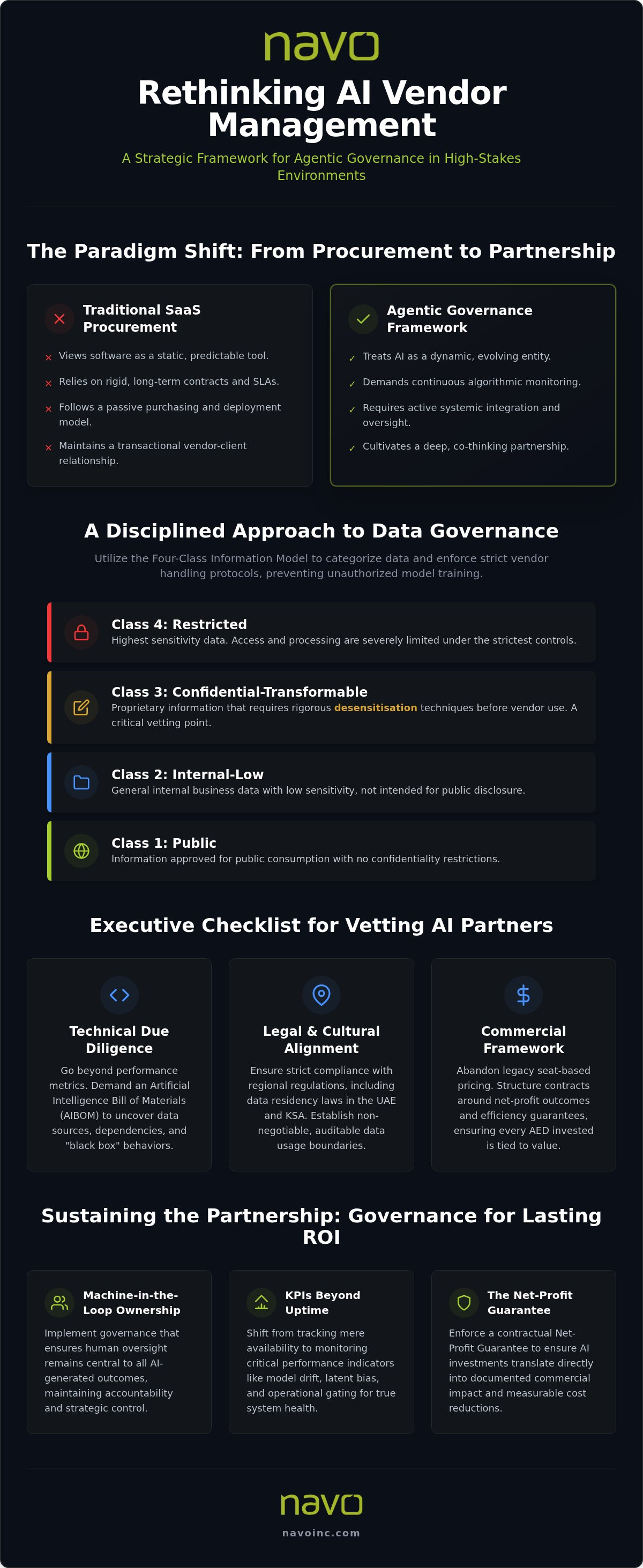
Traditional Software as a Service (SaaS) procurement models have become obsolete in the era of Generative Artificial Intelligence (GenAI). These legacy frameworks treat software as a static tool; however, modern AI systems function as dynamic, evolving entities. Managing AI vendor relationships effectively requires a transition toward Agentic Governance. This framework establishes the necessary oversight for autonomous and semi-autonomous AI agents that operate within your corporate structure. It moves beyond simple service level agreements to a model of algorithmic governance, where the behavior and decisions of third-party models are continuously monitored. It's a fundamental shift from passive purchasing to active systemic integration.
Successful orchestration requires shifting from a vendor-client relationship to a co-thinking partnership. This ensures that the AI is not just a peripheral utility but an integrated component of your organizational resilience. Engaging with enterprise specialists like pronix.ai helps organizations bridge this gap by moving beyond exploratory AI pilots to secure, scalable production outcomes. By treating vendors as strategic partners, firms can better navigate the rapid technological shifts that render long-term, rigid contracts ineffective.
The Art of Problem Finding in Vendor Selection
Before drafting a Request for Proposal (RFP), executives must engage in the Art of Problem Finding. This proprietary methodology identifies the "Unknown Knowns" and "Unknown Unknowns" within your technological roadmap, preventing the common pitfall of acquiring expensive solutions for the wrong challenges. By aligning vendor capabilities with the Six Lanes of Working, firms in the United Arab Emirates (UAE) can ensure structural stability across every operational layer. This diagnostic approach clarifies whether a vendor's model can actually deliver net-profit outcomes or if it merely introduces new layers of complexity. Without this foundational step, procurement becomes a high-stakes gamble rather than a strategic investment. This process ensures that every UAE Dirham (AED) spent is mapped to a documented business necessity.
An Executive Checklist for Vetting and Onboarding AI Partners
Rigorous vetting is not a mere formality; it's a structural assessment of model integrity. Organizations should reference official AI procurement guidelines to establish a baseline for rigorous selection. Technical due diligence must extend beyond performance metrics to include the Artificial Intelligence Bill of Materials (AIBOM). This document reveals the underlying data sets and third-party dependencies that define a model's risk profile. Managing AI vendor relationships effectively involves verifying latency and transparency to ensure the system doesn't become a "black box" liability for the enterprise.
Cultural and legal alignment is paramount in the Gulf Cooperation Council (GCC) region. Vendors must demonstrate strict compliance with specific data residency regulations in the United Arab Emirates (UAE) and the Kingdom of Saudi Arabia (KSA). Negotiating these contracts requires a departure from legacy seat-based pricing. Instead, focus on net-profit and efficiency guarantees that justify the investment in UAE Dirham (AED).
The Four-Class Information Model for Vendor Vetting
The Four-Class Information Model categorizes data into Public, Internal-Low, Confidential-Transformable, and Restricted tiers. Evaluate how a vendor handles "Confidential-Transformable" data through desensitisation techniques. Establishing permitted-use boundaries and auditable trails is a non-negotiable contractual requirement to prevent unauthorized model training on proprietary data. This granularity is vital when managing AI vendor relationships. If you're seeking to formalize these standards, you might consider consulting with our governance architects to refine your onboarding protocols.
Sustaining the Co-Thinking Partnership: Governance and ROI
Post-deployment governance requires a fundamental shift toward 'Machine-in-the-Loop' thinking, ensuring human ownership remains central to AI-generated outcomes. Managing AI vendor relationships effectively involves setting rigorous Key Performance Indicators (KPIs) that track model drift, latent bias, and operational gating rather than mere uptime. This diagnostic approach facilitates successful AI vendor partnerships that evolve alongside the rapidly shifting technological frontier. It's essential that executives don't settle for abstract technical metrics. Instead, enforce a Net-Profit Guarantee to ensure that every investment in UAE Dirham (AED) translates into documented commercial impact, measurable cost reductions, and enhanced structural efficiency within the Gulf market.
Orchestrating the Synthetic Workforce
Bridge the gap between disparate AI vendor platforms by leveraging a sophisticated synthetic workforce. Agents like SARA and NOVA act as intelligent orchestrators, managing complex multi-vendor environments to prevent the formation of fragmented operational silos. Integrating the Navo Synthworker Suite enables the seamless management of client reporting and market intelligence across diverse vendor Application Programming Interfaces (APIs), providing a unified view of performance. This orchestration layer ensures that your synthetic workers remain a cohesive, high-performance extension of your human capital, capable of executing complex tasks with precision. By centralizing governance through agentic orchestration, firms maintain strategic agility while mitigating the significant risks associated with managing AI vendor relationships, such as vendor lock-in, proprietary data leakage, or model degradation over time. This architectural discipline secures the long-term Return on Investment (ROI) by ensuring that disparate systems communicate through a unified, governed framework.
Architecting the Future of Agentic Governance
The transition toward agentic intelligence requires a departure from passive procurement in favor of disciplined, architectural oversight. Successfully managing AI vendor relationships in 2026 demands the application of the proprietary Art of Problem Finding framework to ensure every technological investment is rooted in structural necessity. By moving beyond technical vanity metrics and prioritizing a net-profit increase guarantee, organizations can secure measurable value in UAE Dirham (AED). Navo Inc. provides the strategic expertise needed to navigate these complex shifts, offering CPD UK-certified (Continuing Professional Development United Kingdom) masterclasses that empower your leadership team to master the nuances of algorithmic governance.
Your organization's resilience depends on the quality of its strategic partnerships. Take the lead in defining the future of your synthetic workforce today.
Frequently Asked Questions
What is an Artificial Intelligence Bill of Materials (AIBOM) and why is it required for vendor management?
An Artificial Intelligence Bill of Materials (AIBOM) is a formal record detailing the components, libraries, and data origins of an Artificial Intelligence (AI) system. It's essential for managing AI vendor relationships because it provides the transparency required to conduct security audits and verify model integrity. Without this inventory, organizations remain blind to the supply chain risks and third-party dependencies inherent in modern models.
How do Dubai and Singapore regulations impact the selection of international AI vendors?
Regulatory frameworks in Dubai and Singapore impose strict mandates regarding data residency and sovereign control over information. Firms must verify that international vendors can comply with specific localization requirements and cross-border data transfer laws. This necessitates a rigorous due diligence process to ensure that vendor infrastructures respect the cultural and legal sensitivities of the Gulf Cooperation Council (GCC) and ASEAN regions.
What are the primary risks of vendor lock-in with Large Language Model (LLM) providers?
The primary risks include prohibitive switching costs and a loss of strategic agility if a provider's Large Language Model (LLM) underperforms or changes its pricing in UAE Dirham (AED). Organizations often find themselves trapped by proprietary Application Programming Interfaces (APIs) that don't allow for easy migration. To mitigate this, leaders should implement tool-agnostic orchestration layers that facilitate the use of multiple models simultaneously.
How can an organisation guarantee a net-profit increase through AI vendor relationships?
Securing a net-profit increase requires the implementation of outcome-based contracts that prioritize commercial results over technical performance. By utilizing the Art of Problem Finding, executives can identify specific operational inefficiencies before selecting a partner. This disciplined approach ensures that managing AI vendor relationships leads to a documented Return on Investment (ROI) by tying every deployment to measurable cost savings or revenue generation.
Disclaimer
The views and opinions expressed in this article are those of the author and do not represent any organisation, client, institution, or professional body with which he may be associated. The content is intended for general information, education, and thought leadership. Readers should seek appropriate professional advice before making legal, financial, investment, regulatory, technology, or business decisions.
The author has taken reasonable care to ensure the accuracy of the information and sources available at the time of publication. Technologies, regulations, market conditions, and industry practices may evolve, and readers are encouraged to verify current information independently. Any examples, cases, or scenarios may have been simplified, anonymised, or adapted to protect confidentiality. The author and publisher accept no liability for decisions or outcomes arising from the use of this content.
Generative AI tools may have been used to support research, structuring, or language refinement, with the final content, judgment, and editorial responsibility retained by the author.