

What if the primary threat to your enterprise resilience in 2026 is not the technology itself, but the proliferation of ungoverned, unaccredited digital agents within your operational core? For executives in Dubai and across the Gulf, the search for a legitimate CPD certified AI course is often clouded by confidentiality paralysis and the high cost of training budgets wasted on unaccredited hype. This hesitation is a logical response to a market saturated with superficial solutions that fail to address the complexities of data security and systemic governance.
This article provides an intellectually rigorous guide to selecting a Continuing Professional Development (CPD) accredited program designed to bridge the gap between technical literacy and strategic enterprise transformation. We will examine the architecture of the synthetic workforce, the establishment of robust internal governance frameworks, and the practical deployment of agentic artificial intelligence (AI) within the specific regulatory landscape of the United Arab Emirates. You will gain a clear pathway toward obtaining a globally recognized credential that empowers you to lead with professional composure and visionary discipline.
Key Takeaways
- Understand the strategic necessity of a CPD certified AI course for establishing professional legitimacy and governing autonomous digital agents within your organization.
- Implement the proprietary 'Clarify-Enable-Protect-Evolve' architecture to ensure your enterprise's technological adoption remains resilient and tool-agnostic.
- Evaluate the tangible return on investment through an outcome-guaranteed coaching model that accelerates project acceptance and enhances operational efficiency.
- Address the critical regulatory and data security sensitivities unique to the United Arab Emirates and the broader Middle Eastern corporate landscape.
- Explore a structured activation pathway that transforms executive leadership from passive observation to active synthetic workforce orchestration.
What is a CPD Certified AI Course and Why Does It Matter in 2026?
The institutionalization of Continuing Professional Development (CPD) within the technological sector has transitioned from a voluntary enhancement to a fundamental requirement for executive stability. In the context of 2026, a CPD certified AI course represents a rigorous educational standard that validates an individual's commitment to maintaining contemporary expertise amidst rapid systemic shifts. As the United Kingdom moves toward statutory codes of practice under SI 2026 No. 425 and the European Union enforces strict transparency obligations, the demand for verified proficiency has reached a critical threshold. For leaders in Dubai and the broader Gulf region, this certification serves as a professional anchor, ensuring that internal AI initiatives align with global regulatory benchmarks and regional digital transformation mandates.
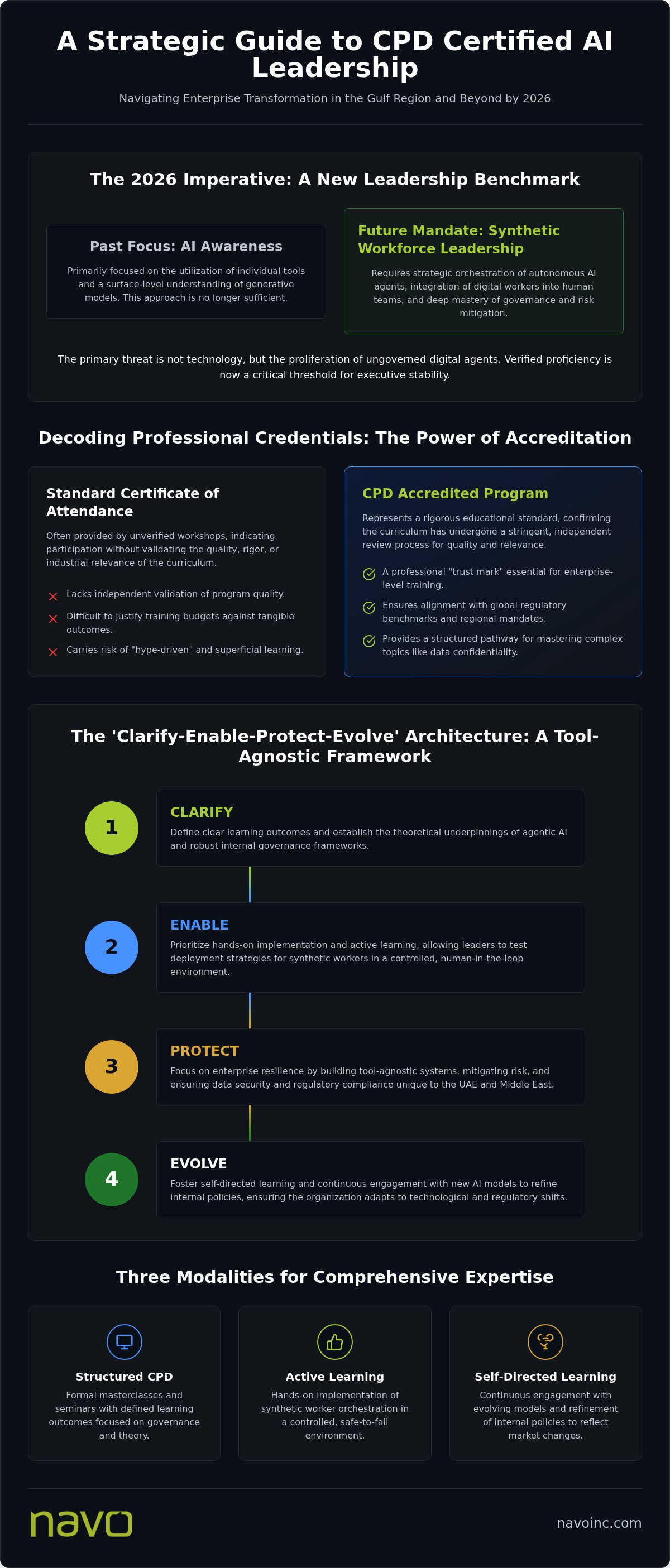
The current corporate environment has evolved beyond simple "AI awareness," which focused primarily on the utilization of individual tools. The 2026 talent benchmark demands a transition toward Synthetic Workforce Leadership. This discipline involves the strategic orchestration of autonomous AI agents and the integration of digital workers into existing human hierarchies. Achieving this level of sophistication requires more than a cursory understanding of generative models; it necessitates a deep mastery of governance, risk mitigation, and the "Clarify-Enable-Protect-Evolve" architecture. Without a recognized credential, an executive's ability to lead these high-stakes shifts is often undermined by a lack of institutional trust and the perceived risk of "hype-driven" decision-making.
The Distinction Between Certification and Accreditation
Accreditation functions as the independent validation of a program's pedagogical quality and industrial relevance. While many workshops offer a simple certificate of attendance, a CPD certified AI course through a body like CPD UK ensures the curriculum has undergone a stringent review process. This "trust mark" is essential for enterprise-level training where training budgets must be justified against tangible organizational resilience. At Navo Management Consultants, we emphasize that accredited coaching provides a structured pathway that unverified, tool-agnostic workshops cannot replicate, particularly regarding the nuances of data confidentiality and systemic health.
Types of Learning in an AI Curriculum
A comprehensive professional curriculum in 2026 is categorized into three distinct modalities to ensure a holistic development of expertise:
- Structured CPD: This involves formal masterclasses and seminars with clearly defined learning outcomes, focusing on the theoretical underpinnings of agentic AI and governance frameworks.
- Active Learning: This modality prioritizes the hands-on implementation of synthetic worker orchestration, allowing leaders to test deployment strategies within a controlled, "human-in-the-loop" environment.
- Self-Directed Learning: This encompasses the continuous engagement with evolving generative AI models and the refinement of internal policies to reflect the latest regulatory changes in the Middle East and international markets.
The Core Pillars of a Rigorous AI Professional Training Program
A CPD certified AI course in 2026 isn't a mere elective; it's a structural necessity for maintaining institutional stability. It mandates a shift from passive observation to active orchestration, utilizing the 'Clarify-Enable-Protect-Evolve' architecture as the definitive roadmap for enterprise adoption. This framework ensures that technological integration isn't just a series of isolated experiments but a disciplined evolution toward systemic health. By prioritizing a tool-agnostic approach, leaders protect their organizations from the volatility of specific software lifecycles, focusing instead on the underlying logic of agentic systems that will persist regardless of which platform leads the market.
Modern professional development in the age of AI must also integrate Environmental, Social, and Governance (ESG) principles. This isn't about simple compliance; it's about the ethical sustainability of a synthetic workforce and the long-term impact of automated decision-making on human capital. Rigorous programs have replaced the traditional, passive certificate of attendance with evidence-based assessments. Executives must now demonstrate their ability to govern AI agents and mitigate algorithmic bias before receiving accreditation, ensuring that the professional "trust mark" carries genuine weight in the boardroom.
Human-to-Machine Communication and Natural Prompting
The focus of executive training has shifted from simple command-line prompting to sophisticated co-thinking models. This evolution requires the 'Art of Problem Finding' to identify high-value use cases that actually warrant AI intervention rather than applying technology to non-existent issues. Machine-in-the-Loop Thinking is a core synthetic skill for 2026, where the human remains the primary strategist while the AI serves as a high-velocity co-processor. This partnership demands a level of linguistic precision and strategic clarity that basic workshops often ignore, yet it's the foundation of effective human-machine collaboration.
Corporate AI Governance and Accountability
Security isn't a peripheral concern; it's the foundation of any legitimate CPD certified AI course. Training must detail specific data safeguards and permitted-use boundaries to prevent intellectual property leakage within the UAE's competitive landscape. The 'Human-Ownership' mechanism ensures that for every action taken by an AI agent, there's a designated human accountable for the outcome, maintaining a clear chain of responsibility. For a deeper analysis of these operational shifts, executives should review our guide on Scaling Generative Artificial Intelligence in Enterprise. If your organization requires a bespoke roadmap for these transitions, you may consult our strategic advisory team for a tailored evaluation of your current governance maturity.
Evaluating the ROI of a Certified AI Masterclass
Determining the fiscal return on a CPD certified AI course requires a departure from traditional educational metrics. While generic workshops focus on tool familiarity, an executive masterclass prioritizes an 'Outcome-Guaranteed' model where the success of the program is measured by the tangible implementation of strategic frameworks. This shift is critical for Middle Eastern enterprises where the rapid pace of digital transformation demands immediate operational utility. By moving away from passive certificates, organizations can quantify the reduction in 'Time-to-Acceptance' for complex client briefs; a direct result of the strategic clarity gained through rigorous training.
Certification also serves as the primary antidote to 'confidentiality paralysis.' Many UAE leaders hesitate to deploy generative systems due to legitimate fears regarding data sovereignty and proprietary leakage. A certified program provides the necessary governance guardrails to navigate these risks, transforming a perceived liability into a competitive advantage. The long-term value is reinforced by a 24-month credential validity period. This requirement for periodic renewal ensures that an executive's expertise remains synchronized with the relentless evolution of the technological landscape, maintaining a steady hand over systemic shifts.
Measuring Profit and Efficiency Gains
High-level coaching targets net-profit increases rather than superficial productivity metrics. By utilizing sophisticated ROI calculators, firms can validate the impact of AI integration on their bottom line. When evaluating training providers, executives should use the following checklist to ensure commercial grounding:
- The existence of an outcome-guaranteed framework that ties learning to specific business objectives.
- The inclusion of a practical playbook for synthetic workforce deployment within the UAE regulatory context.
- A curriculum that emphasizes the 'Art of Problem Finding' to avoid wasted training budgets on irrelevant use cases.
The Role of Synthetic Workers in Professional Growth
The orchestration of synthetic workers like SARA and NOVA represents the pinnacle of modern professional growth. These archetypes, mastered during an advanced CPD certified AI course, allow for the automation of complex, multi-step workflows within a governed environment. The auditability of outcomes provided by these agents ensures that every automated decision is traceable and compliant with regional regulations. For those seeking to identify the right strategic partners for this journey, The Executive Guide to Generative AI Consulting Services offers a comprehensive framework for selection and partner evaluation.
Regional Considerations for AI Certification: Gulf, India, and SE Asia
The implementation of generative systems within the Gulf Cooperation Council (GCC) requires a sophisticated understanding of regional data sovereignty and cultural nuances that Western-centric training often overlooks. In the United Arab Emirates, Saudi Arabia, and Qatar, the regulatory environment is characterized by a dual commitment to rapid technological acceleration and stringent protection of national data assets. Navo Inc., headquartered in Dubai, leverages this local presence to provide governance training that isn't just theoretically sound but operationally viable within the specific legal frameworks of the Middle East. A CPD certified AI course tailored for this region must align with international benchmarks like the NIST Privacy Framework and the UK Information Commissioner's Office (ICO) anonymization guidance while respecting the local sensitivities of the Gulf's corporate landscape.
Beyond the Middle East, the demand for certified expertise is surging in the financial nerve centers of Singapore and Mumbai. These hubs operate under intense global scrutiny, where the margin for error in automated decision-making is non-existent. For executives in these markets, obtaining a CPD certified AI course credential is a strategic move to validate their ability to lead synthetic workforce initiatives without compromising institutional integrity. The focus here isn't merely on adoption; it's on the disciplined orchestration of AI agents within highly regulated sectors where auditability is the primary currency of trust.
Compliance and Professional Standards in the GCC
The Securities and Commodities Authority (SCA) in the UAE has established a precedent for professional excellence through mandatory learning hours, a model that is increasingly relevant for AI governance. 'Responsible AI' training is no longer an optional ethical exercise; it's a structural requirement to meet regional data protection laws and ensure long-term systemic health. In the often conservative corporate cultures of the GCC, peer-to-peer executive coaching provides a safe yet rigorous environment for leaders to navigate high-stakes transitions. This high-level partnership ensures that the shift toward automation is handled with professional composure and a steady hand.
Bridging Global Standards with Local Implementation
International accreditation from bodies like CPD UK plays a vital role in building local workforce capacity from Riyadh to Kuala Lumpur. It provides a universal "trust mark" that facilitates the movement of talent and the standardization of processes across global teams. Our 'Natural Prompting Framework' is specifically designed to transcend linguistic and cultural barriers, allowing diverse teams to communicate with AI systems with consistent precision. By merging these global standards with a deep understanding of local market conditions, Navo Inc. enables enterprises to evolve from passive observers of technology to bold architects of change.
Request a regional governance assessment for your leadership team
Selecting Your Pathway: The Navo CPD-Accredited AI Masterclass
The transition from tactical experimentation to strategic leadership requires a structured methodology that transcends the limitations of standard "bootcamp" training. The Navo 5-week transformation journey provides this through three distinct phases: Preparation, Masterclass, and Activation. This is a CPD certified AI course that functions as a catalyst for systemic impact, moving beyond simple tool familiarity toward the orchestration of a synthetic workforce. By initiating the journey with a rigorous diagnostic preparation, we ensure that the subsequent masterclass is grounded in the specific organizational realities of your enterprise.
Learning from a practitioner-author like Vasudevan Kidambi ensures the curriculum reflects high-stakes crisis management and genuine organizational innovation. This isn't theoretical instruction; it's a transfer of battle-tested expertise. The 'Playbook' approach is central to this evolution, providing a structured pathway to move from fragile pilot programs toward governed, scalable profit. For those in the academic sector, the GenAI SkillUp modular pathway offers a specialized track, maintaining a 24-month renewal requirement to ensure educators remain at the vanguard of technological evolution.
Tailored Coaching for the C-Suite and Boardroom
Executive leadership requires a focus on strategic consequence, economics, and risk management rather than technical minutiae. Our coaching for the boardroom emphasizes the 'Machine-in-the-Loop' philosophy as a decisive competitive advantage, ensuring that human intelligence remains the primary architect of change. This high-level partnership addresses the complexities of data sovereignty and governance within the UAE's unique regulatory environment. We invite you to Contact Navo Inc. for a diagnostic readiness survey to evaluate your organization's current maturity level.
Future-Proofing Your Career with Synthetic Skills
The 2026 talent benchmark has shifted toward the role of the Synthetic Workforce Architect. This professional standard demands a sophisticated balance of technological proficiency and strategic governance. Navo provides ongoing support and a rigorous renewal process for all certified professionals, ensuring your expertise doesn't stagnate as generative models evolve. Securing this credential is a definitive statement of professional composure and visionary leadership in a landscape defined by rapid systemic shifts.
Secure your place in the next CPD-certified masterclass
The Architectural Shift Toward Synthetic Leadership
The transition toward a synthetic workforce in 2026 demands a disciplined departure from superficial tool adoption toward a governed, systemic architecture. A CPD certified AI course provides the professional trust mark necessary to navigate high-stakes organizational shifts while ensuring that data sovereignty within the Gulf remains uncompromised. By integrating the proprietary Art of Problem Finding framework, leaders move beyond speculative pilots toward outcome-guaranteed strategy consulting that delivers tangible enterprise resilience and fiscal health.
The integration of agentic intelligence within the United Arab Emirates necessitates a steady, expert hand and a commitment to structural excellence. It's no longer sufficient to merely observe technological shifts; executives must become the bold architects of their organization's digital evolution. Our CPD-UK Accredited Masterclass bridges the gap between technical literacy and sophisticated boardroom strategy. It provides a clear, resource-driven pathway for those ready to lead with professional composure and visionary discipline.
The future of enterprise leadership isn't found in the tools we use, but in the rigorous frameworks we build to govern them. We look forward to partnering with you as you establish a new standard for organizational excellence.
Frequently Asked Questions
Is a CPD certified AI course recognized globally?
Yes, the Continuing Professional Development (CPD) Certification Service is a globally recognized accreditation body. Its standards are respected by professional institutions and regulatory bodies across the United Kingdom, Europe, the Middle East, and Asia. This universal recognition ensures that your credentials facilitate professional mobility and institutional trust regardless of your geographic location.
What is the difference between an AI certificate and a CPD-accredited AI course?
An AI certificate often signifies mere attendance, whereas a CPD certified AI course represents an independent validation of pedagogical quality and industrial relevance. Accreditation ensures the curriculum has undergone a stringent review process to meet international professional standards. This distinction is critical for justifying training budgets and ensuring the learning is grounded in strategic reality rather than superficial tool usage.
How many CPD hours are typically required for an AI masterclass?
The number of CPD hours varies depending on the depth and duration of the program. A comprehensive executive masterclass typically accounts for 15 to 30 hours of structured learning, encompassing formal workshops, strategic seminars, and hands-on activation sessions. These hours reflect the rigorous commitment required to transition from technical literacy to systemic workforce orchestration within a professional environment.
Can AI training help with corporate governance and risk management?
Advanced AI training is specifically designed to address the complexities of corporate governance and risk mitigation. Rigorous programs incorporate frameworks for data sovereignty, intellectual property protection, and the establishment of "Human-Ownership" mechanisms. This ensures that every action taken by an AI agent remains compliant with regional laws, such as those in the United Arab Emirates, and global standards like the NIST Privacy Framework.
Is the Navo Masterclass suitable for non-technical executives?
The Navo Masterclass is engineered specifically for non-technical executives who require a strategic rather than a coding-centric understanding of technology. We focus on the economics, consequences, and orchestration of synthetic workers rather than technical implementation. This approach allows leaders to maintain professional composure and visionary discipline while managing complex technological shifts without needing a background in computer science.
How long does the CPD-accredited AI certification remain valid?
A CPD certified AI course credential typically remains valid for a period of 24 months. This biennial renewal requirement ensures that your expertise remains synchronized with the relentless evolution of generative models and shifting regulatory landscapes. Maintaining a contemporary certification demonstrates a commitment to systemic health and professional excellence in a field where knowledge depreciates rapidly.
What are the prerequisites for joining a high-level GenAI coaching program?
The primary prerequisite for high-level coaching is a leadership position with a mandate for strategic change. While technical proficiency isn't required, a deep understanding of your organization's operational challenges and a commitment to rigorous inquiry are essential. Participants must be prepared to engage with the 'Clarify-Enable-Protect-Evolve' architecture to drive genuine enterprise transformation.
How does the 'Art of Problem Finding' differ from standard prompt engineering?
Standard prompt engineering focuses on the linguistic structure of a command, while the 'Art of Problem Finding' is a strategic framework for identifying high-value use cases that warrant AI intervention. It's the difference between knowing how to talk to a tool and knowing why to use it. This disciplined approach ensures that training budgets aren't wasted on irrelevant automation but are directed toward solving fundamental business problems.
Generative AI tools may have been used to support research, structuring, or language refinement, with the final content, judgment, and editorial responsibility retained by the author.*
Disclaimer
The views and opinions expressed in this article are those of the author and do not represent any organisation, client, institution, or professional body with which he may be associated. The content is intended for general information, education, and thought leadership. Readers should seek appropriate professional advice before making legal, financial, investment, regulatory, technology, or business decisions.
The author has taken reasonable care to ensure the accuracy of the information and sources available at the time of publication. Technologies, regulations, market conditions, and industry practices may evolve, and readers are encouraged to verify current information independently. Any examples, cases, or scenarios may have been simplified, anonymised, or adapted to protect confidentiality. The author and publisher accept no liability for decisions or outcomes arising from the use of this content.
Generative AI tools may have been used to support research, structuring, or language refinement, with the final content, judgment, and editorial responsibility retained by the author.