

By 2026, the distinction between a digital tool and a digital colleague will have vanished for the region’s most resilient organizations. While many executives have initiated Generative Artificial Intelligence (GenAI) pilots, the transition to a fully operational, governed synthetic workforce implementation Abu Dhabi requires more than just technical curiosity. It demands a rigorous architectural shift that respects local regulatory gravity and human-ownership protocols. You likely recognize that the current gap between Artificial Intelligence (AI) hype and measurable operational reality is widening, particularly as United Arab Emirates (UAE) data residency and AI ethics laws continue to evolve with sophisticated complexity.
This article provides a definitive strategic roadmap for leaders to transition from experimental GenAI projects to a high-performance synthetic workforce layer. We will explore how to align your technological evolution with the Abu Dhabi 2025 to 2027 Digital Strategy while ensuring your talent is equipped for human-to-machine collaboration. You will gain a structured pathway to achieve measurable efficiency gains through a governed framework that prioritizes systemic health and structural excellence. We begin by addressing the fundamental necessity of moving beyond tools toward a co-thinking partner architecture that secures your organization's future in the global digital economy.
Key Takeaways
- Align your organizational roadmap with the United Arab Emirates (UAE) National Strategy for Artificial Intelligence 2031 and Abu Dhabi’s 2025 to 2027 Digital Strategy to ensure long-term regulatory resilience.
- Navigate the complexities of a synthetic workforce implementation Abu Dhabi by utilizing the "Six Lanes of Working" framework to map business processes to specific, high-impact roles.
- Employ "The Art of Problem Finding" to pinpoint the estimated 33% efficiency waste in existing workflows, ensuring your Generative Artificial Intelligence (GenAI) investments target actual operational bottlenecks.
- Implement rigorous Human-Ownership Protocols and a Corporate Artificial Intelligence (AI) Governance Policy that establishes clear accountability and maintains strict compliance with local data residency laws.
- Transition from speculative pilots to a governed synthetic layer by calculating clear Return on Investment (ROI) and establishing human-in-the-loop anchor points for every automated output.
Aligning Synthetic Workforce Strategy with Abu Dhabi’s Digital Vision
The successful orchestration of a synthetic workforce implementation Abu Dhabi requires a departure from the fragmented automation strategies of the past decade. While traditional Robotic Process Automation (RPA) focused on the rigid execution of repetitive tasks, the current shift toward Agentic Artificial Intelligence (AI) introduces a layer of autonomous agents capable of role execution and memory retention. This evolution aligns precisely with the United Arab Emirates (UAE) National Strategy for Artificial Intelligence 2031 and the specific objectives of Abu Dhabi’s 2025 to 2027 Digital Strategy. These frameworks prioritize an AI-native transition that moves beyond isolated pilots toward a systemic, governed architecture. In Abu Dhabi’s unique regulatory environment, where data residency and ethical compliance are non-negotiable, a governance-first approach isn't merely a preference; it's a structural necessity for enterprise resilience.
The Role of Synthetic Workers in the Gulf Enterprise
Synthetic workers represent a fundamental shift in organizational hierarchy. Rather than acting as simple chatbots, agents like SARA (Briefing Specialist) and NOVA (Orchestration Specialist) function as persistent digital colleagues. These entities integrate into existing workflows by assuming specific responsibilities that require contextual understanding and cross-departmental memory. In the context of Gulf enterprises, these agents bridge the gap between high-level executive vision and operational execution, providing a steady hand in complex environments where human-to-machine collaboration is the new standard for professional excellence.
Strategic Problem Finding vs. Tool Adoption
Most organizations fail by rushing into tool acquisition before identifying the structural fractures in their operations. To avoid the stagnation of pilot purgatory, leaders must adopt "The Art of Problem Finding." This proprietary framework shifts the focus from "what can AI do" to "where is the efficiency waste." By diagnosing specific operational bottlenecks before deployment, Abu Dhabi leaders can ensure that their synthetic workforce implementation Abu Dhabi delivers measurable net-profit increases rather than just technological novelty. True innovation begins with a diagnostic rigor that values depth and clarity over the speed of adoption.
The Architectural Blueprint: Designing Your Synthetic Workforce Layer
The transition from diagnostic readiness to operational design requires a precise architectural blueprint. A successful synthetic workforce implementation Abu Dhabi depends on the systematic mapping of business processes to the "Six Lanes of Working" framework. This rigorous approach ensures that agents aren't merely reactive tools but are instead functionally integrated into the corporate hierarchy through formal synthetic job descriptions. These descriptions establish clear feedback loops and approval gates, providing the structural density required for executive oversight. Within this layer, orchestration specialists like NOVA manage multi-agent workflows, often supported by an Enterprise Knowledge Graph from Syntes AI to unify complex data into a structured, actionable format. Blueprints must be precise.
Designing for Human-to-Machine Collaboration
Adoption success is predicated on the Clarify-Enable-Protect-Evolve architecture, which facilitates seamless interaction between human talent and synthetic entities. This model promotes "Machine-in-the-Loop" thinking, where the synthetic layer executes high-volume analytical tasks while human leaders retain the final decision-making authority. This synergy ensures that organizational intelligence is augmented without sacrificing human accountability. If your leadership team is prepared to define these new operational roles, initiating a strategic governance review will provide the necessary clarity.
Data Residency and Local Compliance
For organizations operating within the Gulf, architectural integrity is tied to data sovereignty. Synthetic workforce layers must integrate with Abu Dhabi-based infrastructure, such as G42 or Core42, to ensure strict adherence to residency laws. By implementing anonymization protocols aligned with the National Institute of Standards and Technology (NIST) Privacy Framework, firms can protect sensitive enterprise data while enabling agents to retain the memory required for complex task execution. This commitment to governance secures the organization's systemic health against the evolving regulatory landscape of the United Arab Emirates (UAE).
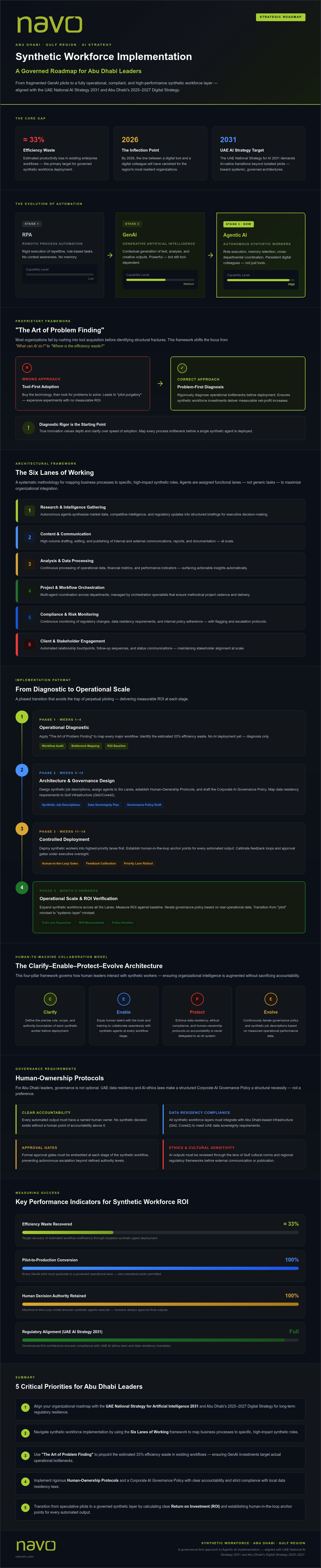
Step-by-Step Implementation: From Diagnostic to Operational Scale
The execution phase begins with a clinical assessment of organizational readiness. The strategic roadmap for synthetic workforce implementation Abu Dhabi follows a four-phase progression designed to minimize risk while maximizing net-profit increases. Phase 1 initiates with a Diagnostic and Readiness Survey to calculate the projected Return on Investment (ROI). This data-driven start is followed by Phase 2, where we apply "The Art of Problem Finding" to pinpoint the estimated 33% efficiency waste currently embedded in manual workflows. Identifying these fractures ensures that the subsequent deployment of specialized agents in Phase 3 addresses real operational needs. For example, deploying SARA (Briefing Specialist) allows for client-briefing validation through dual-approval locks, ensuring that no synthetic output is finalized without human verification. Finally, Phase 4 focuses on Continuous Professional Development (CPD) integration, upskilling the human workforce to effectively manage and audit the synthetic layer. It's a journey of disciplined evolution.
The 5-Week Transformation Journey
Navo Management Consultants utilizes a CPD United Kingdom (UK)-accredited Masterclass approach to activate enterprise capabilities within 35 days. This methodical timeline moves organizations from "Confidentiality Paralysis" to a governed, value-generating state by providing the tools and frameworks necessary for rapid adoption. This journey is designed to be rigorous. It demands commitment. By the end of the fifth week, the synthetic layer isn't just a concept but a functioning part of the business ecosystem, fully integrated into the daily rhythm of the Abu Dhabi enterprise.
Measuring Performance and Profit
Precision requires measurement. We implement dynamic scoring systems to monitor agent accuracy, including the Contextual Briefing Integrity Score (CBIS), the Agentic Behavior Tracking System (ABTS), and the Synthetic Performance Index System (SPIS). These metrics allow executives to track time-to-acceptance and net-profit increases as primary success indicators. When these scores are consistently high, the organization moves from survival to systemic evolution. Success is quantified through clarity, and it's this clarity that builds trust in the machine-in-the-loop model.
Schedule your diagnostic readiness survey
Governance and Human-Ownership Protocols for Abu Dhabi Leaders
The final pillar of a resilient synthetic workforce implementation Abu Dhabi is the establishment of a robust governance layer that ensures institutional accountability. Leaders must move beyond generic compliance toward a Corporate Artificial Intelligence (AI) Governance Policy that reflects the specific ethical standards of the Abu Dhabi government. This framework requires the integration of Human-Ownership Mechanisms, where every synthetic output is anchored by a human-in-the-loop verification process. Governance must be absolute. By creating risk-based decision paths for Agentic AI, organizations can maintain clear auditability and accountability, even as autonomous agents assume more complex roles. Board-level oversight is further strengthened through Continuous Professional Development (CPD)-certified leadership coaching, which equips executives with the analytical tools to supervise a hybrid workforce layer with clinical precision.
Navigating Gulf Cultural and Legal Norms
Success in the region depends on the alignment of AI outputs with local cultural sensitivities and linguistic nuances. Adhering to United Arab Emirates (UAE)-specific data handling boundaries is a non-negotiable requirement for operational legitimacy. Governance protocols must ensure that synthetic agents operate within permitted-use boundaries, respecting the gravity of regional regulations while maintaining the speed of digital execution. This cultural calibration transforms a standard technological deployment into a sophisticated, locally-resonant asset. It's about systemic health.
The Future of Strategic Co-Thinking
The future of enterprise leadership lies in strategic co-thinking, where Generative Artificial Intelligence (GenAI) is positioned as a sophisticated partner rather than a mere replacement for human talent. This collaborative architecture fosters long-term evolution. Navo Inc. guarantees outcomes for enterprise clients by utilizing structured diagnostic tools that bridge the gap between technological potential and measurable net-profit increases. By embracing this architectural rigor, Abu Dhabi leaders can navigate the complexities of 2026 with professional composure and visionary foresight. Strategic clarity is the ultimate competitive advantage.
Orchestrating the Future of Gulf Enterprise Leadership
Transitioning from experimental Generative Artificial Intelligence (GenAI) to a fully operational synthetic workforce implementation Abu Dhabi requires a disciplined shift toward structural excellence. By identifying the estimated 33% efficiency waste through "The Art of Problem Finding" and establishing rigorous human-ownership protocols, organizations can secure their systemic health in an increasingly complex digital landscape. This roadmap ensures alignment with Abu Dhabi’s 2025 to 2027 Digital Strategy while fostering a culture of high-performance human-to-machine collaboration. It's about building resilience through precision.
Under the authoritative guidance of Vasudevan Kidambi, Navo Inc. provides the architectural blueprint needed to achieve guaranteed net-profit outcomes. Our Continuous Professional Development (CPD) United Kingdom (UK)-certified Artificial Intelligence (AI) Masterclasses equip your leadership team with the diagnostic rigor required for this transition. The era of the digital colleague has arrived. Leaders who move with professional composure today will define the competitive frontiers of 2026.
Secure your enterprise's future with a Navo GenAI Masterclass
Frequently Asked Questions
How does a synthetic workforce differ from traditional automation in Abu Dhabi?
Traditional automation, such as Robotic Process Automation (RPA), is task-oriented and follows rigid, pre-defined rules. A synthetic workforce implementation Abu Dhabi utilizes Agentic Artificial Intelligence (AI) to create autonomous entities capable of role execution and memory retention. Unlike static bots, these agents act as co-thinking partners that adapt to context, manage multi-agent workflows, and integrate into organizational hierarchies to provide persistent operational support and strategic value.
What are the key regulatory requirements for implementing AI agents in the UAE?
Implementation must adhere to the United Arab Emirates (UAE) National Strategy for Artificial Intelligence 2031 and specific Abu Dhabi government circulars regarding data residency and ethics. Organizations are required to maintain data sovereignty by utilizing local infrastructure, such as G42 or Core42. Compliance also involves establishing clear Human-Ownership Protocols to ensure accountability and alignment with the National Institute of Standards and Technology (NIST) Privacy Framework.
How do we calculate the Return on Investment (ROI) for a synthetic workforce implementation?
Return on Investment (ROI) is calculated by measuring time-to-acceptance for synthetic outputs and tracking net-profit increases resulting from the elimination of operational waste. We utilize dynamic scoring systems like the Contextual Briefing Integrity Score (CBIS) and the Synthetic Performance Index System (SPIS) to quantify accuracy. This diagnostic approach allows leaders to move beyond speculative pilots toward a governed synthetic workforce implementation Abu Dhabi that delivers measurable financial gains.
What is the "Art of Problem Finding" and why is it critical for Abu Dhabi enterprises?
The Art of Problem Finding is a proprietary diagnostic framework designed to identify the estimated 33% efficiency waste within current manual workflows before deploying technology. It's critical for Abu Dhabi enterprises because it prevents "pilot purgatory" by ensuring that Generative Artificial Intelligence (GenAI) investments target actual structural fractures. This disciplined approach shifts the focus from tool acquisition to strategic problem resolution, securing long-term systemic health and operational resilience.
Is the Navo synthetic workforce training CPD UK-certified?
Yes, all Navo Management Consultants masterclasses and enterprise activation programs are Continuous Professional Development (CPD) United Kingdom (UK)-certified. This accreditation ensures that our training meets international standards for professional excellence. By providing CPD UK-certified coaching, we equip Abu Dhabi executives with the authoritative guidance necessary to manage complex synthetic workforce layers while maintaining Board-level oversight and ensuring the strategic evolution of their human talent.
How can we ensure our data remains secure while using Agentic AI services?
Security is maintained through the integration of risk-based decision paths and strict anonymization protocols within the Agentic Artificial Intelligence (AI) layer. By anchoring every synthetic output with a human-in-the-loop verification lock, organizations prevent unauthorized data leakage. Additionally, hosting Agentic AI services on local, sovereign cloud infrastructure ensures that sensitive enterprise information remains within the legal and geographic boundaries of the United Arab Emirates (UAE) at all times.
Disclaimer
The views and opinions expressed in this article are those of the author and do not represent any organisation, client, institution, or professional body with which he may be associated. The content is intended for general information, education, and thought leadership. Readers should seek appropriate professional advice before making legal, financial, investment, regulatory, technology, or business decisions.
The author has taken reasonable care to ensure the accuracy of the information and sources available at the time of publication. Technologies, regulations, market conditions, and industry practices may evolve, and readers are encouraged to verify current information independently. Any examples, cases, or scenarios may have been simplified, anonymised, or adapted to protect confidentiality. The author and publisher accept no liability for decisions or outcomes arising from the use of this content.
Generative AI tools may have been used to support research, structuring, or language refinement, with the final content, judgment, and editorial responsibility retained by the author.