

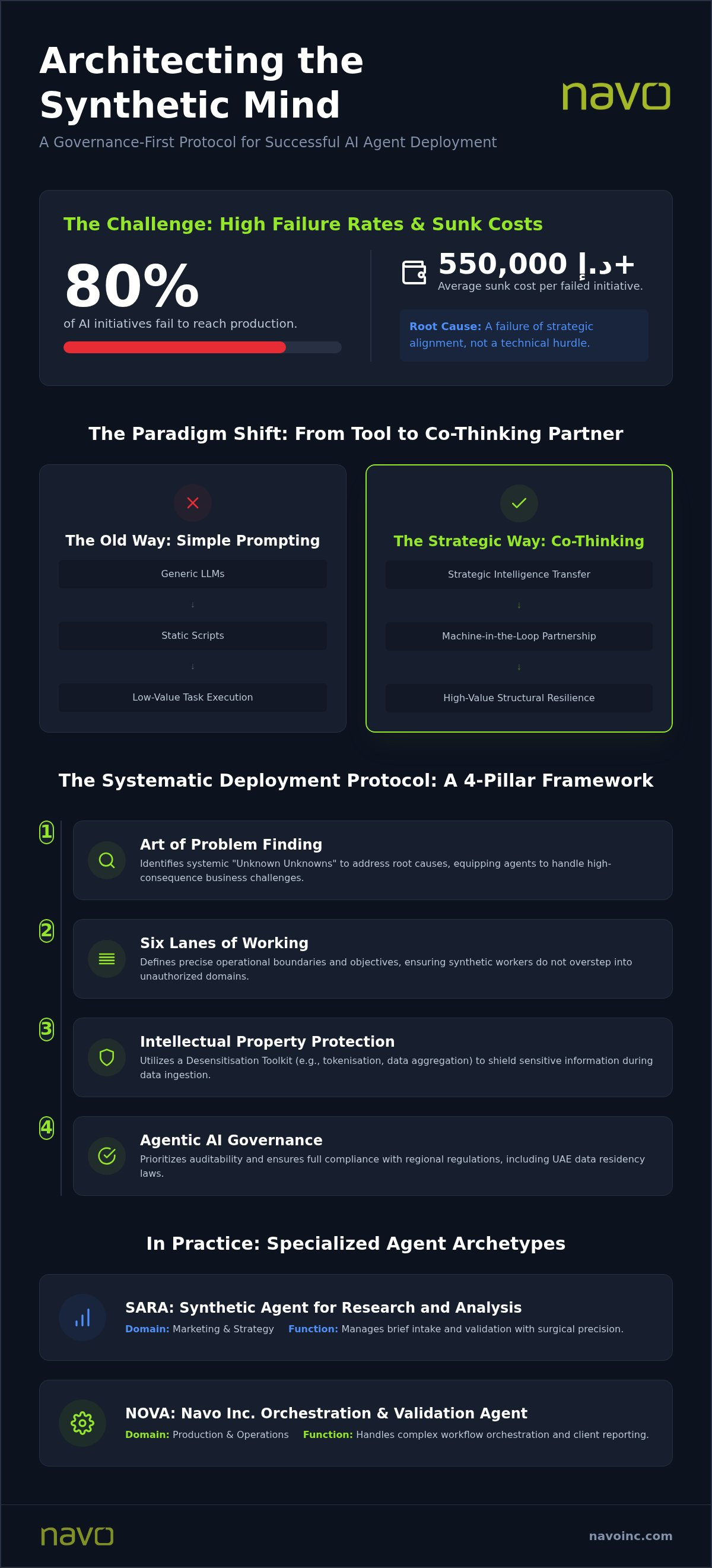
Over 80% of artificial intelligence (AI) initiatives fail to reach production, resulting in an average sunk cost exceeding د.إ 550,000. You likely recognize that the gap between a generic Large Language Model (LLM), such as GPT-5.6, and a specialized synthetic worker isn't a technical hurdle but a failure of strategic alignment. Implementing the best practices for AI agent training is now a prerequisite for addressing the high-stakes environments of the United Arab Emirates (UAE), where hallucinations or residency law breaches are unacceptable.
This framework enables the strategic transfer of institutional intelligence through a governance-first protocol, ensuring agents like SARA or NOVA act as reliable co-thinking partners. We'll utilize the Art of Problem Finding to secure a profit-guaranteed outcome while maintaining full compliance with regional regulations. This methodical pathway allows leadership to transition from passive observation to a disciplined architecture of change.
Key Takeaways
- Apply the Art of Problem Finding to shift from simple prompting to a strategic transfer of institutional intelligence, ensuring Artificial Intelligence (AI) agents act as high-level co-thinking partners.
- Ensure your synthetic workers don't overstep their bounds by using the Six Lanes of Working framework to define precise operational boundaries and objectives across your organization.
- Master the best practices for AI agent training by utilizing a Desensitisation Toolkit to protect sensitive Intellectual Property (IP) through rigorous tokenisation and data aggregation.
- Secure your transformation with an Agentic AI governance policy that prioritizes auditability and ensures full compliance with United Arab Emirates (UAE) data residency regulations.
Beyond Prompting: Architecting the Synthetic Mind through Strategic Training
In the high-stakes corporate landscape of Dubai, viewing AI as a mere automation tool is a strategic miscalculation. True leadership requires a shift toward "Machine-in-the-Loop" thinking, where the agent serves as a co-thinking partner rather than a static script. This evolution necessitates a move beyond basic prompting toward a comprehensive transfer of institutional intelligence. Understanding What is an AI Agent? helps clarify that these systems are autonomous entities capable of goal-directed behavior. This is why best practices for AI agent training must prioritize framework-led architecture over the fleeting features of specific Large Language Models (LLMs). By adopting a tool-agnostic approach, organizations protect their intellectual capital from model obsolescence and ensure operational stability regardless of whether they utilize GPT-5.6 or Claude 5.
The Art of Problem Finding as a Foundational Training Anchor
Effective training doesn't begin with a technical solution; it begins with the Art of Problem Finding. Most AI initiatives fail, often resulting in sunk costs exceeding د.إ 550,000, because they address obvious symptoms rather than systemic "Unknown Unknowns." This proprietary framework ensures that synthetic workers are trained to navigate high-consequence business challenges where the strategic path isn't yet visible. By identifying these hidden complexities first, best practices for AI agent training ensure that agents like SARA are equipped to handle the nuances of Gulf market regulations and corporate governance. This methodical focus moves the needle from low-value task execution to genuine structural resilience, positioning the synthetic mind as a disciplined architect of organizational change.
The Synthetic Workforce Training Checklist: A Systematic Deployment Protocol
Moving from strategic intent to operational reality requires a repeatable protocol. The first step involves rigorous Role Definition. By applying the "Six Lanes of Working," organizations define precise boundaries and objectives, ensuring synthetic workers don't overstep into unauthorized domains. This structural clarity is fundamental to best practices for AI agent training, as it prevents the resource overlap that often plagues early-stage AI deployments.
The second stage focuses on Knowledge Base Curation. Before ingestion, institutional data must pass through a Classification Framework to desensitise confidential information. Aligning with Harvard's AI Best Practices ensures that data privacy and security remain uncompromised during this phase. Finally, Feedback Loop Integration establishes necessary approval gates and audit trails. These mechanisms ensure human leaders retain absolute ownership of agent outputs, transforming the agent from an autonomous black box into a transparent, accountable partner. For firms looking to implement these protocols, consulting with Navo Inc., a strategic advisor, can help bridge the gap between theory and deployment.
Orchestrating SARA and NOVA: Specialized Training Patterns
Deploying specialized archetypes like SARA (Synthetic Agent for Research and Analysis) and NOVA (Navo Inc. Orchestration and Validation Agent) illustrates the power of patterned training. SARA excels in marketing environments, managing brief intake and validation with surgical precision. Conversely, NOVA handles production orchestration and client reporting, acting as the primary validator for complex workflows. These agents utilize sophisticated "Memory" and "Tools" to maintain context across the UAE and Singapore markets, ensuring that regional nuances and data residency requirements are respected in every interaction.
Governing the Synthetic Mind: Security, Privacy, and Auditability
Structural excellence in Artificial Intelligence (AI) deployment is inseparable from rigorous oversight. To protect institutional Intellectual Property (IP), leadership must implement a Desensitisation Toolkit comprising twelve repeatable techniques. Methods such as tokenisation, data aggregation, and suppression ensure that sensitive information remains shielded during the ingestion process. These best practices for AI agent training move beyond generic safety guardrails by providing specific, technical pathways for protecting assets in highly regulated sectors. Establishing formal Agentic AI Governance policies further clarifies permitted-use boundaries and accountability rules, ensuring the C-suite maintains a steady, expert hand over synthetic operations.
The human element remains the final arbiter of systemic health. Relying on CPD (Continuing Professional Development) UK-certified training ensures that managers possess the responsible judgment required to oversee complex agentic workflows. It's a strategy that guarantees institutional intelligence isn't just transferred but actively guarded by seasoned professionals who understand the gravity of their role in the United Arab Emirates (UAE) and beyond.
Navigating Regulatory Standards in the GCC and ASEAN
Compliance requires aligning agent training with the NIST (National Institute of Standards and Technology) framework and specific regional privacy guidance within Dubai and the wider Gulf region. Best practices for AI agent training in 2026 must account for the stringent auditability requirements of the MENA (Middle East and North Africa) and Singaporean legal landscapes. By embedding these data safeguards into the training protocol, organizations ensure their synthetic workforce respects the legal sensitivities of the GCC (Gulf Cooperation Council) and the ASEAN (Association of Southeast Asian Nations) territories. This methodical approach to compliance transforms regulatory pressure into a competitive advantage for resilient organizations.
Architecting the Future of the Synthetic Workforce
Transformation in 2026 demands more than adopting tools; it requires a disciplined shift in organizational architecture. Prioritizing the Art of Problem Finding and systematic deployment protocols allows leadership to bridge the gap between generic models and high-performance synthetic partners. Adhering to best practices for AI agent training ensures intellectual property remains secure through proprietary desensitisation toolkits while maintaining compliance with Gulf residency laws. Our outcome-guaranteed strategy consulting and CPD UK-certified AI Masterclasses provide the steady hand needed to navigate these shifts. This rigorous approach moves your organization from passive observation to visionary leadership. The path toward structural excellence is clear for those who've committed to a governance-first future.
Your journey toward a resilient, profit-guaranteed synthetic workforce begins with a single strategic decision.
Frequently Asked Questions
What is the difference between training a Large Language Model (LLM) and training an AI agent?
Training a Large Language Model (LLM) focuses on broad data ingestion for text prediction, whereas agent training emphasizes goal-directed autonomy and tool integration. Agent training prioritizes the strategic transfer of institutional intelligence to ensure the system executes complex workflows. This requires a "Machine-in-the-Loop" architecture where the agent functions as a co-thinking partner rather than a static text generator.
How does the Art of Problem Finding improve AI agent training outcomes?
The Art of Problem Finding identifies "Unknown Unknowns" and systemic complexities before any instructions are finalized. This framework ensures that best practices for AI agent training address high-consequence business problems rather than low-value tasks. By uncovering the root cause of organizational friction, the training protocol aligns the synthetic worker’s objectives with specific, profit-guaranteed outcomes for the enterprise.
What are the best practices for handling confidential data during agent training?
Protecting sensitive assets requires a proprietary Desensitisation Toolkit employing twelve repeatable techniques like tokenisation, aggregation, and suppression. These best practices for AI agent training safeguard institutional Intellectual Property (IP) while ensuring full compliance with United Arab Emirates (UAE) data residency laws. This approach allows agents to learn from operational patterns without ever exposing raw, identifiable information.
How do you measure the Return on Investment (ROI) of a trained synthetic worker?
Return on Investment (ROI) is measured by net-profit increases and the mitigation of sunk costs, which frequently exceed د.إ 550,000 for failed initiatives. Organizations track the delta in operational efficiency and the deployment success of agents like SARA or NOVA. A positive return typically manifests within 8 to 14 months as the synthetic worker scales institutional intelligence across the organization.
Disclaimer
The views and opinions expressed in this article are those of the author and do not represent any organisation, client, institution, or professional body with which he may be associated. The content is intended for general information, education, and thought leadership. Readers should seek appropriate professional advice before making legal, financial, investment, regulatory, technology, or business decisions.
The author has taken reasonable care to ensure the accuracy of the information and sources available at the time of publication. Technologies, regulations, market conditions, and industry practices may evolve, and readers are encouraged to verify current information independently. Any examples, cases, or scenarios may have been simplified, anonymised, or adapted to protect confidentiality. The author and publisher accept no liability for decisions or outcomes arising from the use of this content.
Generative AI tools may have been used to support research, structuring, or language refinement, with the final content, judgment, and editorial responsibility retained by the author.