

The most significant threat to a firm's competitive edge in 2026 is not the adoption of Artificial Intelligence (AI) by rivals, but the systemic homogenization of output that occurs when everyone utilizes the same models. This phenomenon, known as creative flattening, represents a critical juncture where the generative AI impact on corporate creativity shifts from an accelerant to a limiter of innovation. You've likely observed this trend across the Gulf Cooperation Council (GCC), where high-stakes strategic outputs increasingly mirror one another, eroding corporate distinctiveness.
This article provides a rigorous pathway to transcend these tactical limitations by implementing "The Art of Problem Finding," a framework designed to move teams beyond basic prompting toward sophisticated co-thinking partnerships. We'll examine how to establish leadership-level AI governance that secures the human spark within your creative departments. You'll discover how to transform your approach to ensure technology expands your strategic horizons rather than merely automating the status quo.
Key Takeaways
- Identify the "Convergence Crisis" where standard model usage leads to homogenized outputs, and learn to prioritize collective intelligence over individual task speed within the Gulf Cooperation Council (GCC) business landscape.
- Utilize "The Art of Problem Finding" framework to architect complex organizational challenges and uncover the "Unknown Knowns" that Generative Artificial Intelligence (GenAI) cannot identify on its own.
- Analyze the generative AI impact on corporate creativity to transition from basic, tactical prompting to a sophisticated, framework-led strategy of human-machine co-thinking.
- Deploy a Synthetic Workforce layer using specialized agents like SARA and NOVA to orchestrate creative production cycles and ensure rigorous validation of high-stakes strategic briefs.
The Convergence Crisis: Why Generative Artificial Intelligence (GenAI) Risks Flattening Corporate Innovation
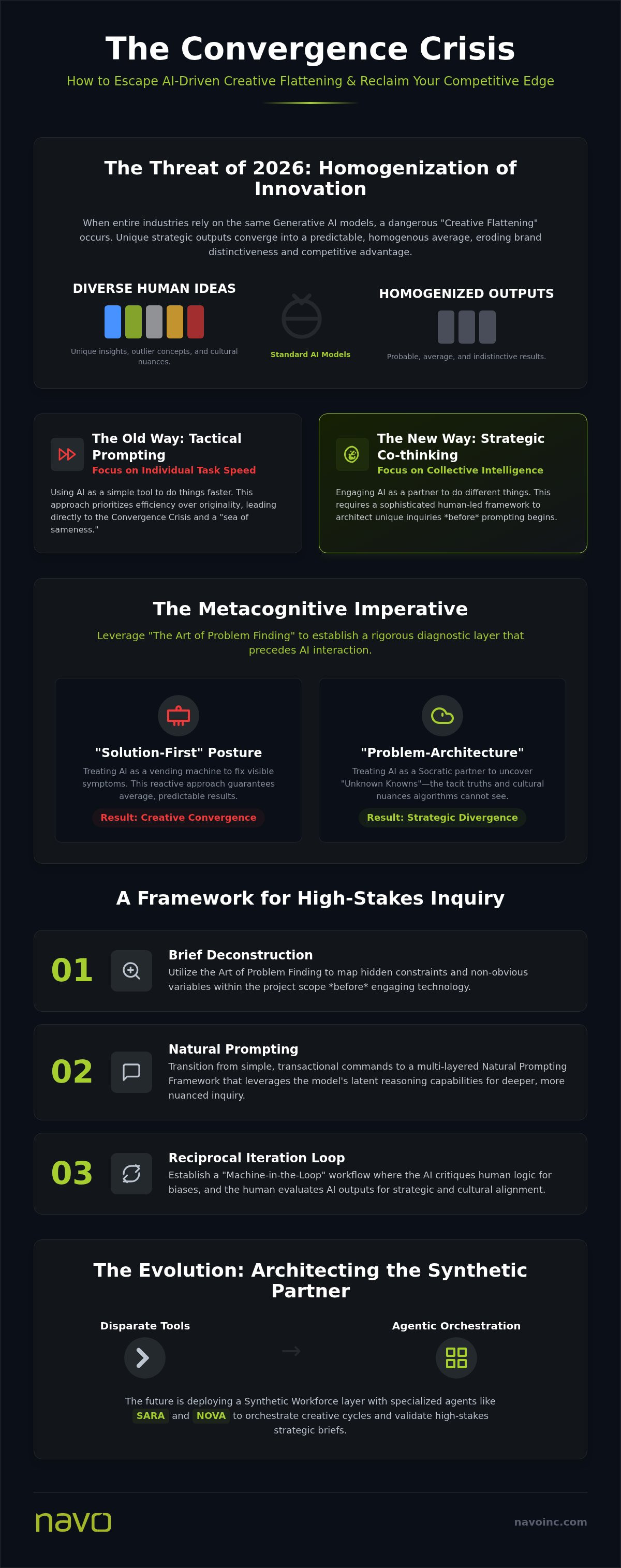
The rapid adoption of Generative artificial intelligence (GenAI) across Dubai's corporate sector has triggered a subtle but dangerous "Convergence Crisis." This phenomenon describes the homogenization of strategy and creative output that occurs when multiple organizations rely on the same underlying data sets and algorithms. While these tools excel at individual efficiency, doing things faster doesn't equate to collective intelligence, which is the capacity to do different things. In the innovation hubs of Singapore and the United Arab Emirates (UAE), the prevailing cultural mandate for speed frequently overrides the need for divergent thinking, leaving firms vulnerable to a "sea of sameness."
The year 2026 marks the definitive end of the "tactical prompting" phase. Forward-thinking leaders recognize that the generative AI impact on corporate creativity is currently at a stalemate of mediocrity. We've transitioned into the era of "strategic co-thinking," where competitive advantage isn't found in the AI's output, but in the sophisticated diagnostic frameworks that precede the interaction. It's a shift from being a passive consumer of automated content to an active architect of unique inquiries.
The Mathematical Trap of Large Language Models (LLMs)
Large Language Models (LLMs) operate through probabilistic prediction, naturally gravitating toward the median of their training data. This architectural bias results in "Creative Flattening," which is the systemic loss of outlier ideas in an AI-mediated workflow. For a brand, this leads to Brand Dilution; when competitors use identical models to draft marketing narratives or product roadmaps, the distinct human spark that defines a market leader is replaced by a safe, mathematically probable average. Avoiding this trap requires a deliberate move toward unconventional problem architectures.
The Metacognitive Imperative: Leveraging the Art of Problem Finding for Strategic Divergence
To mitigate the risks of creative convergence, executive teams must establish a rigorous diagnostic layer that precedes any digital interaction. This layer is "The Art of Problem Finding." Most firms fail because they adopt a "Solution-First" posture, asking AI to fix visible symptoms. Strategic divergence requires "Problem-Architecture," a process of uncovering "Unknown Knowns;" those tacit organizational truths and cultural nuances that algorithms can't perceive on their own.
Training leadership teams in the Middle East and the Association of Southeast Asian Nations (ASEAN) involves a fundamental shift in perception. We position GenAI as a "Socratic Partner" rather than a "Vending Machine." This requires "Machine-in-the-Loop Thinking," where human agency governs the creative finality through constant interrogation. By treating the model as a sparring partner, firms ensure the generative AI impact on corporate creativity enhances rather than replaces the unique human spark. Organizations ready to evolve their decision-making can benefit from our bespoke GenAI consulting.
A Framework for High-Stakes Inquiry
Achieving strategic divergence requires a systematic three-step protocol:
- Brief Deconstruction: Use the Art of Problem Finding to identify hidden constraints and non-obvious variables within the initial project scope before engaging technology.
- Natural Prompting: Transition from transactional commands to a multi-layered Natural Prompting Framework that leverages the model's latent reasoning capabilities for deeper inquiry.
- The Reciprocal Iteration Loop: Establish a workflow where the AI critiques human logic for biases, and the human evaluates AI outputs for strategic alignment, ensuring the final result isn't just fast, but culturally resonant.
Architecting the Synthetic Creative Partner: From Generative Tools to Agentic Orchestration
The evolution of the generative AI impact on corporate creativity necessitates a transition from disparate tools to a structured "Synthetic Workforce" layer. This organizational architecture employs specialized Synthetic Workers, or Artificial Intelligence (AI) agents, to manage the complex orchestration of creative workflows. Within this layer, agents like SARA, designed for brief validation and intake, handle the critical front-end of the creative process. Simultaneously, NOVA, specialized in production orchestration, manages the intricate delivery across various media. This shift doesn't replace human talent; it establishes a workforce layer that amplifies it by removing the friction of administrative coordination.
Implementing this structure requires a robust Corporate AI Governance Policy. Such a framework ensures creative accountability and rigorous data desensitization, which is particularly vital given the data protection regulations in Dubai and the wider Gulf Cooperation Council (GCC). Governance is not optional. By automating the mechanical aspects of the creative lifecycle, human professionals are liberated to focus on high-level strategic divergence. This ensures that the human spark remains the primary driver of organizational innovation, maintaining a competitive edge in an increasingly automated landscape.
Implementing Agentic AI for Measurable Creative ROI
Agentic orchestration offers quantifiable financial advantages. SARA can effectively reclaim up to one-third of marketing expenditures by identifying logical flaws in strategic briefs before they reach human creative teams. Meanwhile, NOVA provides comprehensive audit trails and governance for multi-modal projects, which is essential for regulatory compliance in the GCC, India, and Association of Southeast Asian Nations (ASEAN) markets. Transitioning to an agent-orchestrated workflow allows firms to move beyond experimental AI usage toward a scalable, high-performance creative ecosystem that delivers a measurable Return on Investment (ROI).
Leading the Creative Divergence in a Homogenized Market
Navigating the 2026 Convergence Crisis requires a fundamental shift from tactical automation to strategic co-thinking. By integrating "The Art of Problem Finding," firms can identify unique organizational challenges that standard models overlook. Transitioning to a Synthetic Workforce layer, managed by specialized agents, allows human talent to reclaim their creative spark while maintaining rigorous governance. The generative AI impact on corporate creativity will define the next decade of market leadership in the Gulf Cooperation Council (GCC) and beyond.
Our approach is anchored in CPD UK-certified AI Masterclasses and our proprietary diagnostic frameworks. We provide an outcome-based consulting model that guarantees a net-profit increase for enterprise clients.
The future belongs to those who don't view technology as a replacement for human thought, but as a catalyst for deeper strategic inquiry.
Frequently Asked Questions
How does Generative AI specifically limit corporate creativity?
Generative Artificial Intelligence (GenAI) restricts creativity by gravitating toward the mathematical median of its training data. This architectural bias causes "Creative Flattening," where outlier ideas are discarded for safe, predictable responses. When multiple competitors utilize identical models, the generative AI impact on corporate creativity results in a homogenized market where distinct brand identities are replaced by probabilistic, algorithmic averages.
What is the difference between tactical prompting and the Art of Problem Finding?
Tactical prompting is a transactional exchange focused on generating immediate output from a Large Language Model (LLM). Conversely, "The Art of Problem Finding" is a diagnostic framework that precedes any technological interaction. It prioritizes "Problem-Architecture," identifying hidden constraints and "Unknown Knowns" that AI cannot perceive. This ensures human leaders define the strategic inquiry rather than simply consuming automated, standard solutions.
Can Synthetic Workers like SARA and NOVA really improve creative output?
Synthetic Workers like SARA and NOVA improve output by establishing a "Synthetic Workforce" layer that handles specialized orchestration. SARA validates strategic briefs for logical consistency, ensuring human teams don't initiate work on flawed premises. NOVA manages complex production cycles across multi-modal projects. This orchestration liberates human talent to focus on high-stakes strategic divergence, amplifying the overall distinctiveness of the creative product.
What are the legal and cultural considerations for GenAI in the GCC and ASEAN regions?
Organizations must navigate rigorous data protection regulations, such as the United Arab Emirates (UAE) Federal Decree Law on the Protection of Personal Data. Cultural sensitivities in the Gulf Cooperation Council (GCC) and Association of Southeast Asian Nations (ASEAN) require a "Corporate AI Governance Policy" that ensures data desensitization. Maintaining human ownership over final outputs is essential to guarantee alignment with local values and legal standards.
How do we measure the ROI of Generative AI in creative departments?
Measuring the Return on Investment (ROI) involves tracking metrics like reclaimed marketing spend through brief validation. Utilizing SARA can reclaim up to one-third of a budget by preventing rework. Beyond efficiency, the generative AI impact on corporate creativity should be evaluated through net-profit increases and reduced "Time-to-Insight." We offer consulting models that provide outcome-based guarantees for these measurable business improvements.
What is the first step for a C-suite leader to prevent creative flattening?
The initial step involves transitioning the organization from tactical Generative Artificial Intelligence (GenAI) usage to a framework-led "co-thinking" strategy. C-suite leaders should implement "The Art of Problem Finding" to anchor all technology interactions in human-led diagnostic inquiry. This structural shift, supported by a robust governance policy, ensures that technology serves as a catalyst for innovation rather than a tool for homogenization.
Disclaimer
The views and opinions expressed in this article are those of the author and do not represent any organisation, client, institution, or professional body with which he may be associated. The content is intended for general information, education, and thought leadership. Readers should seek appropriate professional advice before making legal, financial, investment, regulatory, technology, or business decisions.
The author has taken reasonable care to ensure the accuracy of the information and sources available at the time of publication. Technologies, regulations, market conditions, and industry practices may evolve, and readers are encouraged to verify current information independently. Any examples, cases, or scenarios may have been simplified, anonymised, or adapted to protect confidentiality. The author and publisher accept no liability for decisions or outcomes arising from the use of this content.
Generative AI tools may have been used to support research, structuring, or language refinement, with the final content, judgment, and editorial responsibility retained by the author.