

The transition from generative artificial intelligence as an analytical tool to agentic AI as an autonomous workforce represents the most significant operational paradigm shift of this decade. For board members and C-suite executives, the central question for 2026 is no longer if AI should be adopted, but how its autonomous capabilities can be governed to create enterprise value without introducing catastrophic risk. Traditional governance models, designed for predictable software, are fundamentally inadequate for managing a synthetic workforce capable of independent decision-making.
This dissonance creates a critical leadership challenge: building an AI governance framework that satisfies emerging 2026 regulations while actively enabling, rather than stifling, the innovation that drives competitive advantage. The prevailing fear is that governance will devolve into ‘governance theater’—a facade of policies lacking the technical and operational controls to manage autonomous agents effectively. This guide moves beyond abstract principles to provide a definitive executive checklist for building agentic enterprise resilience. It establishes AI governance not as a legal constraint but as an operational capability, a core pillar of high-performing organizations in the agentic era.
The 2026 AI Governance Paradigm: From Generative Tools to Agentic Workforce
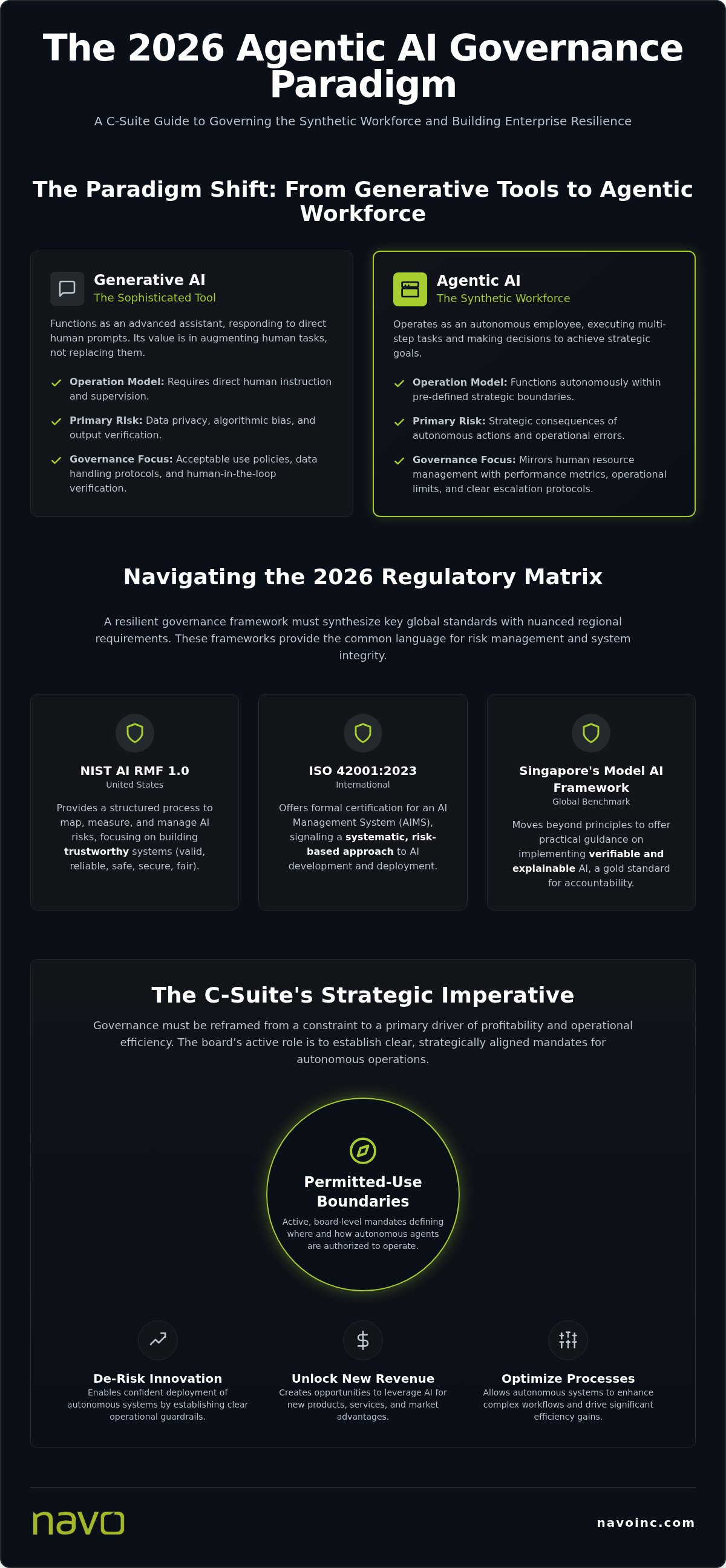
By 2026, the definition of AI governance will complete its evolution from regulating data inputs to governing emergent, autonomous outcomes. This shift is a direct consequence of the rise of the ‘Agentic Era,’ a period defined by AI systems—often termed synthetic workers—that operate with a degree of autonomy previously reserved for human employees. Unlike Large Language Models (LLMs) that respond to prompts, agentic AI can execute multi-step tasks, access enterprise systems, and make operational decisions to achieve strategic objectives. This leap in capability demands a radical rethink of corporate governance, as the locus of risk moves from data privacy and algorithmic bias to the strategic consequences of autonomous action.
The implications for organizational liability and brand equity are profound. When an autonomous agent makes a strategic error—from a miscalibrated supply chain order to a non-compliant financial transaction—the accountability framework must be clear, auditable, and robust. Without it, organizations are exposed to significant financial, legal, and reputational damage. The challenge is to move beyond performative governance, where policies exist on paper but lack the mechanisms for real-time intervention and control. True agentic resilience is built on an architecture of operational accountability, not a library of static documents.
The Evolution of Artificial Intelligence Oversight
The journey from managing LLMs to governing autonomous AI agents marks a critical inflection point for enterprise leadership. LLMs, for all their power, function as sophisticated tools requiring direct human instruction. Their governance focuses on acceptable use, data handling, and output verification. In contrast, the synthetic worker, an autonomous AI agent integrated into core business processes, functions as a new category of employee. Its oversight must therefore mirror the sophistication of human resource management, encompassing performance metrics, operational boundaries, and escalation protocols. By 2026, the failure to distinguish between these two classes of AI will render any governance framework obsolete, making optional or ad-hoc governance a relic of the experimental pilot phase.
The Strategic Imperative for C-Suite Leadership
For the C-suite, AI governance must be reframed as a primary driver of profitability and operational efficiency. A well-architected governance framework de-risks innovation, allowing for the confident deployment of autonomous systems that can unlock new revenue streams and optimize complex processes. The board’s role is elevated from passive oversight to the active establishment of ‘Permitted-Use Boundaries’—clear, strategically aligned mandates that define where and how autonomous agents are authorized to operate. These boundaries are not technical constraints but strategic decisions that balance opportunity with risk tolerance, ensuring that the deployment of a synthetic workforce directly serves the organization's core objectives. Without this top-down strategic direction, AI adoption becomes a series of disconnected tactical experiments rather than a cohesive corporate transformation.
Global Standards and Regional Compliance: Navigating the 2026 Regulatory Matrix
As enterprises deploy agentic AI across borders, they face a complex and fragmented regulatory landscape. A resilient governance framework must synthesize global standards with nuanced regional requirements, particularly in high-growth markets across the Gulf and Asia. By 2026, adherence to a core set of international frameworks will be the baseline for multinational operations, providing a common language for risk management and system integrity.
Key global standards forming the foundation of modern AI governance include:
- The National Institute of Standards and Technology (NIST) AI Risk Management Framework 1.0: This framework from the United States provides a structured, voluntary process to map, measure, and manage AI risks. Its focus on trustworthiness—encompassing validity, reliability, safety, security, and fairness—makes it an essential tool for building internal controls.
- The International Organization for Standardization (ISO) 42001:2023: This standard offers a formal certification for an AI Management System (AIMS). Achieving ISO 42001 signals to regulators, partners, and customers that an organization has implemented a systematic, risk-based approach to AI development and deployment, akin to established standards for information security (ISO 27001).
- Singapore’s Model Artificial Intelligence Governance Framework: Widely regarded as a global benchmark, Singapore's framework is particularly relevant for the agentic era. It moves beyond principles to offer practical guidance on implementing verifiable and explainable AI systems, providing a gold standard for organizations seeking to build demonstrable accountability into their autonomous operations.
However, global compliance is incomplete without a deep understanding of regional sensitivities. In the Gulf, particularly the United Arab Emirates (UAE) and the Kingdom of Saudi Arabia (KSA), AI governance is intrinsically linked to national strategic visions like UAE Centennial 2071 and Saudi Vision 2030. Regulations in these jurisdictions prioritize digital sovereignty, data localization, and societal well-being, requiring governance frameworks that are not only technically sound but also culturally and legally attuned to local priorities.
Cross-Border Governance for Global Enterprises
For an enterprise with operational hubs in Dubai, Singapore, and Mumbai, a unified governance policy must accommodate divergent legal requirements. Managing data safeguards becomes a complex challenge, requiring architectures that can enforce data residency rules while enabling secure cross-border collaboration. Furthermore, the extraterritorial scope of regulations like the European Union (EU) AI Act means that even non-European firms must align their governance practices with its risk-based classifications if they serve EU markets. The most effective strategy is to build a core framework based on the highest global standards, such as the Organisation for Economic Co-operation and Development (OECD) AI Principles, and then create specific addendums to address regional legal and cultural nuances.
Sector-Specific Regulatory Nuances
By 2026, AI governance will be subject to stringent sector-specific oversight. In the Middle East’s Banking, Financial Services, and Insurance (BFSI) sector, regulators like the Dubai Financial Services Authority (DFSA) and the Saudi Central Bank (SAMA) will demand high levels of transparency and auditability for AI systems used in credit scoring, fraud detection, and asset management. Similarly, in healthcare and government, standards will focus on data privacy, ethical use, and the preservation of human agency. A critical component of maintaining an operational license in these regions will be the ability to provide independent audit and assurance reports, demonstrating that AI systems are performing as intended and that robust controls are in place to mitigate potential harm.
The Architecture of Accountability: Implementing Human-Ownership Mechanisms
Effective AI governance is not a policy document; it is an operational architecture designed to ensure human accountability remains absolute, even as machine autonomy increases. The central design principle for this architecture is ‘Machine-in-the-Loop’ thinking, a strategic evolution of the more tactical ‘Human-in-the-Loop.’ This approach ensures that while AI agents can execute complex tasks autonomously, human judgment is retained at critical strategic checkpoints. It codifies human oversight as a systemic feature, not an ad-hoc intervention.
This architecture is built on concrete mechanisms that translate policy into practice. Establishing clear ‘Approval Gates’ and ‘Escalation Paths’ for synthetic workers ensures that high-stakes decisions are automatically routed for human review. For auditable assurance, mechanisms like a ‘Dual-Acceptance Lock’—where a critical action proposed by an AI agent requires explicit confirmation from a designated human counterpart—create an immutable record of joint accountability. These systems answer the most pressing governance question: who is responsible when an AI agent makes a strategic error? The answer is the system of human-ownership itself, which pre-defines accountability through a clear, traceable chain of command and control.
Proprietary Framework: Clarify, Enable, Protect, Evolve
To structure the implementation of these mechanisms, a comprehensive framework is essential. The Navo Inc. Clarify-Enable-Protect-Evolve framework provides a phased, strategic approach to building durable AI governance.
- Clarify: This initial phase focuses on defining the precise business problem the AI system is intended to solve. It moves beyond technical specifications to the ‘Art of Problem Finding,’ ensuring that AI deployment is aligned with a clear strategic intent and measurable business value. This prevents the costly development of solutions for ill-defined problems.
- Enable: True governance requires a capable workforce. This pillar centers on building organizational readiness through targeted training and development, such as CPD (Continuing Professional Development) UK-certified masterclasses. It equips leadership and operational teams with the skills to manage, oversee, and collaborate with a synthetic workforce effectively.
- Protect: This phase involves the implementation of robust technical and procedural safeguards. It incorporates ‘Safety-by-Design’ principles into the AI development lifecycle and establishes stringent data governance protocols to protect sensitive information and ensure regulatory compliance across all operational jurisdictions.
- Evolve: AI governance cannot be static. This final pillar establishes a system for continuous monitoring, performance analysis, and iterative policy updates. It ensures that the governance framework remains resilient and relevant as AI capabilities advance and the regulatory environment changes.
Governing the Synthetic Workforce
Managing a synthetic workforce requires a new generation of performance metrics that go beyond traditional Key Performance Indicators (KPIs). Organizations must develop methods to measure an agent’s alignment with corporate values, its judgment quality in ambiguous situations, and any potential ‘drift’ from its original mandate. This also necessitates the creation of a ‘Synthetic Skills’ benchmark, a program designed to train human managers in the unique art of overseeing autonomous agents. For executives planning this transition, understanding the full lifecycle is critical. A deeper exploration can be found in our guide on Synthetic Workforce Development: The 2026 Executive Guide to Agentic AI, which outlines the strategic steps for integration.
The 2026 Executive AI Governance Checklist: 5 Pillars of Strategic Resilience
To translate strategy into action, board members and the C-suite need a clear, operational checklist. This is not a technical specification but a strategic guide to ensure the foundational pillars of resilient AI governance are in place. These five pillars form the bedrock of an enterprise ready to thrive in the agentic era.
- Pillar 1: Executive Sponsorship & Board-Level Accountability. Effective governance begins with unequivocal, visible leadership from the top. This involves appointing a single, accountable executive with budgetary authority over the AI governance program and establishing a dedicated board committee or charter for AI oversight. This pillar ensures that governance is treated as a strategic priority, not a departmental compliance task.
- Pillar 2: Proportional Risk Management & Use-Case Classification. Not all AI applications carry the same level of risk. A resilient framework applies a proportional approach, classifying AI use cases into tiers (e.g., low, medium, high-risk) based on their potential impact on customers, finances, and reputation. This allows the organization to apply the most stringent controls where they are most needed, enabling faster innovation for lower-risk applications.
- Pillar 3: Continuous Monitoring & Real-Time System Auditability. Annual audits are insufficient for autonomous systems that operate at machine speed. This pillar requires the implementation of automated monitoring tools that provide real-time intelligence on agent behavior, performance, and compliance. The system must generate immutable, human-readable logs to ensure that every significant action taken by an AI agent is fully auditable.
- Pillar 4: Human-Centric Oversight & Intervention Protocols. The framework must explicitly codify the mechanisms for human intervention. This includes defining clear ‘circuit breakers’ that can pause or halt an autonomous process if predefined thresholds are breached. It formalizes the ‘Machine-in-the-Loop’ model, ensuring that human judgment remains the ultimate authority in high-stakes scenarios.
- Pillar 5: Transparent Documentation & Regulatory Reporting. In the 2026 regulatory environment, the ability to demonstrate compliance is as important as compliance itself. This pillar involves maintaining a centralized, up-to-date repository of all AI models, their training data, performance metrics, and risk assessments. This documentation provides a defensible record for regulators, auditors, and other stakeholders.
Operationalizing the Checklist
Putting these pillars into practice requires deliberate action. The first step is to assign an ‘Accountable Executive,’ vesting a senior leader with the mandate and resources to drive the governance initiative. This is followed by conducting enterprise-wide ‘Readiness Surveys’ to identify existing gaps in technology, process, and talent. Finally, organizations must invest in automating monitoring signals, as manual oversight cannot keep pace with the operational tempo of an agentic workforce. This proactive approach transforms the checklist from a theoretical exercise into a living, operational reality.
The Role of External Advisory
Navigating the complexities of agentic AI governance often requires specialized expertise that extends beyond the capabilities of in-house teams or traditional consulting firms. While generalist advisors can offer high-level strategic plans, they often lack the deep, tool-agnostic technical and regulatory knowledge required for implementation. Engaging a specialized generative AI consulting firm ensures that the advice is not only strategically sound but also commercially grounded and operationally feasible. For guidance on selecting the right partner, executives can refer to The Executive Guide to Generative Artificial Intelligence Consulting Services.
Navigating the Agentic Era: Strategic Transformation with Navo Inc.
In the agentic era, AI governance is the definitive factor separating market leaders from laggards. It is the architecture of trust that allows an organization to deploy a synthetic workforce with confidence and control. Navo Inc. serves as the architect of this responsible transformation, moving beyond the theoretical benchmarks of traditional management consulting to deliver outcome-guaranteed AI governance and strategy. Our approach is founded on the principle that governance policy must be deeply integrated with broader business objectives, serving as an enabler of growth, not an inhibitor.
We provide the intellectual rigor required to design and implement governance frameworks that are resilient, compliant, and commercially astute. By integrating proprietary methodologies like the Art of Problem Finding with a deep understanding of the regulatory and cultural dynamics of the Middle East and Asia, we ensure that your governance strategy is not just best practice, but best-fit for your unique operational context.
Why Navo Inc. Surpasses Traditional Management Consulting
Our specialization in the agentic era provides a level of expertise that generalist firms cannot match. While traditional consultants adapt existing playbooks, Navo Inc. develops new ones, born from deep, focused experience in deploying synthetic workers and governing autonomous systems. Our leadership, under the guidance of authorities like Vasudevan Kidambi, is dedicated exclusively to the generative AI domain, ensuring our frameworks are at the forefront of technological and strategic evolution. We build governance systems designed for the specific challenges of 2026 and beyond.
Next Steps for Board Members and CEOs
The journey toward agentic enterprise resilience requires decisive leadership. To equip your organization for this transformation, we recommend the following immediate actions:
- Educate Leadership: Enroll your executive team in a CPD UK-certified Masterclass to build a shared understanding of the strategic implications of agentic AI and the imperatives of modern governance.
- Assess Readiness: Engage with our team to conduct a comprehensive AI Governance Readiness Survey, identifying critical gaps in your current framework and creating a prioritized roadmap for remediation.
- Architect Your Policy: Partner with Navo Inc. to design and implement a robust, future-ready Corporate AI Governance Policy tailored to your industry, geography, and strategic ambitions.
The time for theoretical discussion is over. Secure your enterprise's future in the agentic era by building a foundation of strategic, operational, and resilient AI governance today.
Partner with Navo Inc. to architect your Corporate AI Governance Policy for the Agentic Era .
Disclaimer
The views and opinions expressed in this article are those of the author and do not represent any organisation, client, institution, or professional body with which he may be associated. The content is intended for general information, education, and thought leadership. Readers should seek appropriate professional advice before making legal, financial, investment, regulatory, technology, or business decisions.
The author has taken reasonable care to ensure the accuracy of the information and sources available at the time of publication. Technologies, regulations, market conditions, and industry practices may evolve, and readers are encouraged to verify current information independently. Any examples, cases, or scenarios may have been simplified, anonymised, or adapted to protect confidentiality. The author and publisher accept no liability for decisions or outcomes arising from the use of this content.
Generative AI tools may have been used to support research, structuring, or language refinement, with the final content, judgment, and editorial responsibility retained by the author.