

The 2026 Fashion Landscape: Why Reactive Forecasting is Obsolete
In the relentless world of fashion and apparel, the traditional cadence of seasonal collections has become a strategic liability. The very concept of a predictable, cyclical trend landscape is dissolving under the immense pressure of digital immediacy. For leadership within the Gulf Cooperation Council (GCC), a bloc of nations including the United Arab Emirates, Saudi Arabia, Qatar, Bahrain, Kuwait, and Oman, and across the dynamic markets of Asia, reactive forecasting is no longer a viable operational model. It is a direct path to inventory wastage, brand dilution, and diminished profitability. The future of category growth belongs not to those who can merely predict trends, but to those who can architect outcomes with precision.
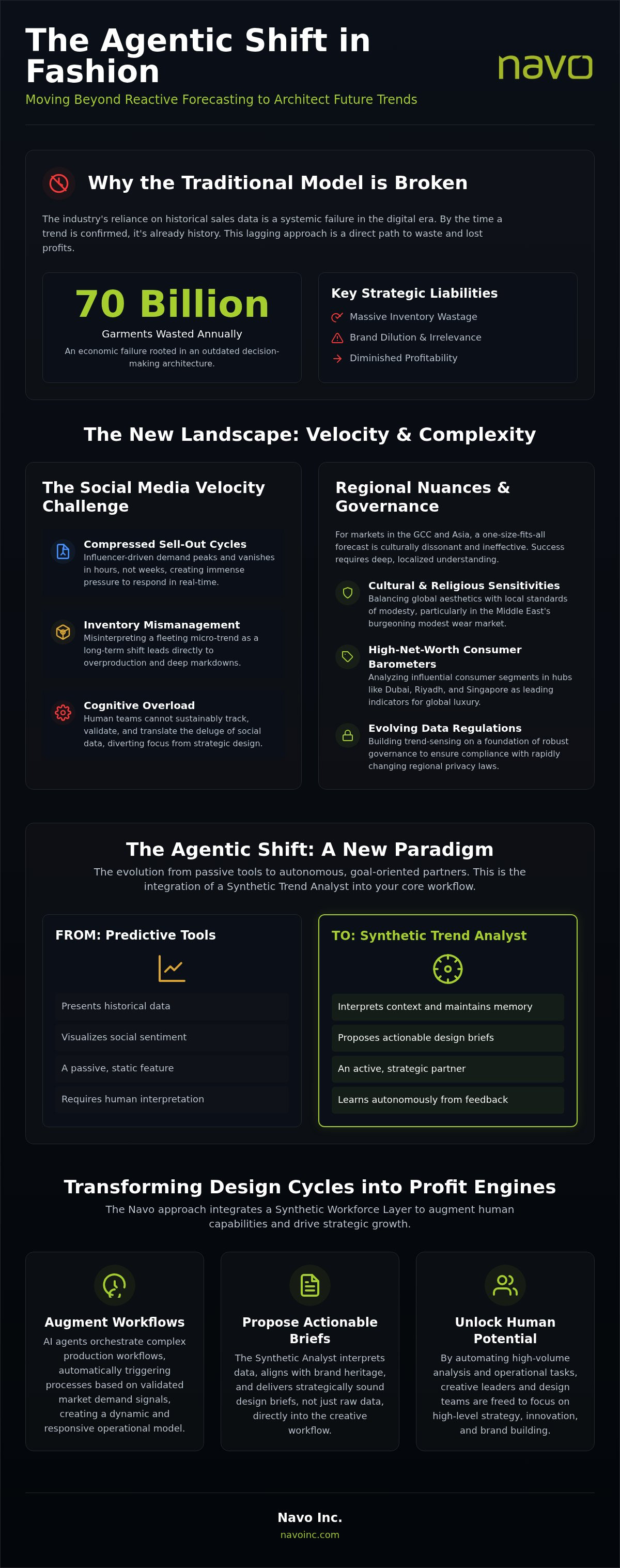
The core challenge is systemic. The industry’s reliance on historical sales data as a primary indicator of future demand is fundamentally flawed in a post-digital era. By the time a pattern is confirmed through sales, the micro-trend that drove it has often been supplanted. This lagging indicator approach is what contributes to the staggering estimate of 70 billion garments wasted annually. This is not just an environmental crisis; it is an economic failure rooted in an outdated decision-making architecture. In 2026, success demands a shift from analyzing the past to autonomously shaping the future, a transition that requires moving beyond simple analytics to embrace a more intelligent, agentic approach to market intelligence.
The Social Media Velocity Challenge
The velocity of trend creation and dissemination has accelerated to a pace that human teams can no longer sustainably manage. Platforms like TikTok and Instagram have democratized influence, creating an environment where aesthetic movements—from ‘cottagecore’ to ‘quiet luxury’—can emerge, peak, and vanish within a single fiscal quarter. This acceleration presents several critical challenges:
- Compressed Sell-Out Cycles: Influencer-driven demand can lead to sell-out times measured in hours, not weeks. A brand’s inability to sense and respond to these signals in real-time results in missed revenue and a perception of being out of touch with the consumer zeitgeist.
- Inventory Mismanagement: The proliferation of ‘aesthetic-core’ trends creates a complex matrix of potential demand signals. Misinterpreting a fleeting fad as a long-term shift leads directly to overproduction, deep markdowns, and significant inventory wastage.
- Cognitive Overload: Expecting creative directors and design teams to manually track, validate, and translate this deluge of social media data is unsustainable. It creates a state of perpetual cognitive load, diverting valuable intellectual capital from strategic design and brand building to reactive trend-spotting.
Regional Nuances in the 'Agentic Era'
For global brands operating within the GCC and key Asian markets like Singapore and Malaysia, this velocity challenge is compounded by deep cultural and regulatory complexities. A one-size-fits-all global trend forecast is not only ineffective but can be culturally dissonant. Navigating this landscape requires a sophisticated understanding of regional nuances:
- Cultural and Religious Sensitivities: In the Middle East, balancing global aesthetic trends with local standards of modesty is paramount. An AI agent for fashion trend forecasting must be trained to understand and respect these nuances, identifying opportunities where global silhouettes can be adapted for regional preferences, such as in the burgeoning modest wear or ‘athleisure’ categories.
- High-Net-Worth Consumer Barometers: The purchasing behaviors of high-net-worth individuals in commercial hubs like Dubai, Riyadh, and Singapore often serve as leading indicators for global luxury trends. Their preference for bespoke excellence—seen in both their wardrobe and their choice of premium services for European journeys like NuVia Travel—requires AI agents to analyze these segments as distinct, influential barometers of demand.
- Evolving Data Regulations: The regulatory frameworks governing data usage and privacy are rapidly evolving across the region. A strategic approach to trend sensing must be built on a foundation of robust governance, ensuring full compliance with local laws while leveraging data to its fullest ethical potential.
From Predictive Tools to Synthetic Trend Analysts: The Agentic Shift
The industry's current discourse on Artificial Intelligence (AI) often conflates passive analytical tools with true autonomous agents. A dashboard that visualizes social media sentiment is not an agent; it is a feature. A system that processes visual content and engagement metrics is a tool, not a strategic partner. The 2026 strategic evolution lies in the deployment of Agentic AI—a paradigm shift from mere content generation to autonomous, goal-oriented execution. This is the transition from predictive tools to the integration of a Synthetic Trend Analyst into the core of the creative and operational workflow.
What defines an Agentic AI, or a Synthetic Worker, in this context? It is a role-based, autonomous entity endowed with memory, access to specialized tools, and the capacity to learn from feedback loops. Unlike a static software program, an agent can perform a sequence of operations to achieve a complex goal. For instance, an Agentic Fashion Analyst is an autonomous entity capable of multi-source synthesis, continuous market monitoring, and proactive strategy formulation. It does not simply present data; it interprets context, maintains alignment with brand heritage through long-term memory, and proposes actionable, strategically sound design briefs.
The Synthetic Workforce Layer in Design
Integrating this synthetic workforce requires a structured operational framework. At Navo Inc., we utilize our proprietary ‘Six Lanes of Working’ model to ensure that AI agents are deployed not as isolated technologies but as integral members of a cohesive team. In this model, agents can be designed to handle specific, high-value tasks, augmenting human capabilities and freeing up creative leaders to focus on high-level strategy.
- Augmenting Workflows: AI agents can be tasked with orchestrating complex production workflows, automatically triggering processes based on validated demand signals from the market. This moves the organization beyond static dashboards and toward a dynamic, responsive operational model.
- Proposing Actionable Briefs: A key function of a Synthetic Trend Analyst is to translate its findings into concrete, actionable proposals. Instead of providing raw data, the agent can generate detailed design briefs that are already aligned with brand DNA, target market sensitivities, and commercial objectives.
- Streamlining Collaboration: By acting as a central intelligence hub, the agent ensures that all stakeholders—from creative directors to supply chain managers—are operating from a single, continuously updated source of truth.
This integration of a synthetic workforce layer is a cornerstone of modern organizational design. For a deeper exploration of this concept, executives may find value in our guide on Deploying Synthetic Workers: The Executive Guide to Agentic Integration.
Memory and Context in Trend Forecasting
One of the most significant weaknesses of traditional predictive tools is their lack of contextual memory. They are often unable to distinguish between a short-lived, viral fad and a durable, long-term aesthetic shift that aligns with a brand’s core identity. Agentic AI overcomes this limitation through the integration of long-term memory.
- Preserving Brand Heritage: An AI agent can be imbued with a deep understanding of a brand’s history, past collections, and core design principles. This ‘memory’ ensures that all trend recommendations are filtered through the lens of the brand’s unique DNA, preventing the dilution that can occur when chasing fleeting trends.
- Differentiating Fads from Trends: By analyzing the lifecycle of past trends and correlating them with a wide array of social, cultural, and economic data, the agent can develop a sophisticated model for distinguishing between ephemeral fads and sustainable macro-trends, enabling more resilient and profitable collection planning.
Strategic Problem Finding in Apparel Design: Navo’s Framework
The prevailing approach to fashion technology focuses almost exclusively on demand sensing and inventory management. While these are critical functions, they address symptoms rather than the root cause of inefficiency. Most design and production errors—and the resulting budget wastage—originate much earlier in the process: at the briefing stage. A poorly defined or strategically misaligned design brief inevitably leads to a collection that misses the mark, regardless of how efficiently it is produced. This is why Navo’s methodology is anchored in the ‘Art of Problem Finding’—a proprietary framework that emphasizes the critical importance of asking the right question before architecting the solution.
Industry analysis suggests that as much as a third of a design budget can be lost to poor briefs, rework, and strategic misalignment. An AI agent, guided by the Art of Problem Finding framework, can help reclaim this lost value by ensuring absolute clarity and alignment from the outset. This is achieved through mechanisms like the ‘Dual-Acceptance Lock,’ a process that establishes a single, auditable source-of-truth between human stakeholders and their AI counterparts, ensuring that every design initiative is locked to a validated strategic objective before resources are committed.
Reclaiming the Third of the Budget
The process of creating a design brief is often fraught with ambiguity, competing stakeholder interests, and a lack of data-driven validation. This ‘brief inflation’ leads to costly course corrections late in the design cycle. Applying a structured, agent-assisted approach to this initial phase can yield significant returns.
- Brief Intake and Validation: An AI agent can be deployed to manage the brief intake process, ensuring all necessary strategic, commercial, and technical parameters are met. The agent can cross-reference proposals against market data, brand guidelines, and production constraints in real-time.
- Dynamic Scoring and Alignment: By implementing a dynamic scoring system, briefs can be evaluated for their strategic alignment before they are approved. This prevents the allocation of resources to projects that do not serve the organization’s primary goals, effectively preventing budget leakage at its source.
- Machine-in-the-Loop Refinement: This approach applies a ‘Machine-in-the-Loop’ thinking model, where the AI agent acts as a co-thinking partner to refine creative prompts and strategic inputs. It challenges assumptions, identifies potential conflicts, and ensures the final brief is robust, clear, and actionable.
Frameworks over Features
Many technology vendors offer proprietary, closed-box software solutions that lock clients into a specific ecosystem. This approach lacks resilience in a rapidly evolving technological landscape. Navo’s philosophy is different: we prioritize frameworks over features. Our approach is tool-agnostic, providing organizations with the strategic architecture and governance models needed to deploy AI agents effectively, regardless of the underlying technology stack.
- The ‘Clarify-Enable-Protect-Evolve’ Framework: This model provides a structured pathway for fashion innovation. It begins with clarifying the core business problem, enabling teams with the right tools and training, protecting the brand’s integrity and data, and establishing a process for continuous evolution.
- Building Internal Capability: Our focus is on building resilient, in-house capabilities. This ensures that our clients are not merely consumers of technology but are architects of their own agentic transformation, capable of adapting and thriving as the AI landscape matures. For more on this strategic partnership model, see The Executive Guide to Generative Artificial Intelligence Consulting Services.
Deploying AI Agents with Regional Integrity and Governance
The deployment of autonomous AI agents within a global fashion enterprise is not merely a technical challenge; it is a profound governance undertaking. For brands operating in the legally and culturally nuanced markets of the Middle East and Asia, a robust Corporate AI Governance Policy is not optional—it is a prerequisite for sustainable success. Generic mentions of ‘data privacy’ are insufficient. True regional integrity requires a deep and demonstrable commitment to respecting local cultural sensitivities, adhering to specific legal frameworks, and maintaining human oversight over all autonomous systems.
This commitment must be woven into the very fabric of the AI models themselves. In the Gulf, for example, it is essential that AI models for trend forecasting are trained on data sets that are representative and respectful of regional aesthetics and modesty standards. In regulatory hubs like Singapore and the United Arab Emirates (UAE), data safeguards and system auditability are not just best practices; they are legal necessities. A successful ‘Agentic Era’ deployment is one where human creativity and accountability—the ‘Golden Thread’—are maintained and enhanced, not abdicated.
Governance as a Competitive Advantage
Forward-thinking organizations understand that rigorous governance is not a constraint but a powerful competitive advantage. It builds trust with consumers, de-risks operations, and future-proofs the business against regulatory shifts.
- Accountability for Autonomous Agents: A clear framework must be established to define accountability for the outputs of autonomous trend agents. This includes transparent rules for decision-making, error correction, and human intervention.
- Independent Oversight: The role of a Certified Independent Director, or a similar governance body, can be instrumental in overseeing the ethical and strategic deployment of AI, ensuring that the transformation aligns with the long-term interests of the organization and its stakeholders.
- Mitigating Algorithmic Bias: Proactive measures must be taken to mitigate algorithmic bias in areas such as silhouette, skin-tone, and body-type representation. This ensures that the AI-driven insights are inclusive and globally relevant.
Implementation Roadmap for Global Brands
Transitioning to an agentic model is a strategic journey, not a one-time installation. A disciplined, phased approach is critical for success.
- Step 1: Conduct a Diagnostic Readiness Survey: The first step is to assess the organization’s current state. A comprehensive readiness survey for your design, merchandising, and IT teams will identify critical gaps in process, skills, and data infrastructure.
- Step 2: Deploy a Pilot Synthetic Worker: Begin with a focused pilot project. Deploy a Synthetic Worker for a specific, high-impact category, such as Athleisure or Modest Wear, to demonstrate value and refine the integration process in a controlled environment.
- Step 3: Scale Through Certified Masterclasses: Lasting transformation is built on internal expertise. Scale the initiative by empowering your internal talent through CPD (Continuing Professional Development) UK-certified masterclasses, building a resilient workforce capable of leading the agentic future.
For a detailed guide on this process, we recommend our executive brief on Synthetic Workforce Development.
Transforming Design Cycles into Profit Engines: The Navo Approach
The ultimate measure of any strategic initiative is its impact on the bottom line. In the Agentic Era, the deployment of an AI agent for fashion trend forecasting must be viewed not as a cost center but as a powerful profit engine. The Navo Inc. approach is built on this principle. We move beyond speculative pilot projects and experimental labs to deliver outcome-guaranteed engagements that produce measurable increases in net profit. This is achieved by transforming the entire design-to-delivery cycle from a series of disjointed, reactive steps into a single, intelligent, and proactive value chain.
The Return on Investment (ROI) of a synthetic workforce in fashion is calculated not just in cost savings but in revenue generation and risk mitigation. It is found in the reduction of inventory markdowns, the increased speed-to-market for winning designs, and the strategic agility to capture market share while competitors are still analyzing last season’s data. However, realizing this potential requires more than technology; it requires a C-suite that is prepared for a new kind of co-thinking partnership with AI. This is why leadership coaching is an integral part of our methodology, ensuring that executives are not just sponsors of the change, but disciplined architects of it.
Measurable Outcomes and Efficiency
Justifying the transition from legacy systems to an agentic framework requires a clear, data-driven business case. Our approach provides the tools and methodologies to build this case with confidence.
- ROI Calculators: We utilize sophisticated ROI calculators to model the financial impact of deploying a synthetic workforce, providing a clear justification for the investment.
- Cycle Time Reduction: Case studies demonstrate that an integrated agentic workflow can reduce the design-to-shelf window by a significant margin, enabling brands to capitalize on trends at their peak.
- Workforce Resilience: Our CPD-accredited training programs do more than just teach skills; they build long-term organizational resilience, ensuring that your team is equipped to leverage AI as a strategic asset for years to come.
Your Next Strategic Move
The future of fashion leadership will be defined by the ability to integrate autonomous AI agents into the strategic core of the business. It is a future that belongs to the disciplined, the visionary, and the bold. Navo Inc. specializes in guiding organizations through this transformation with an outcome-based consulting model that guarantees results.
- We invite you to engage in a high-stakes strategic coaching session with our leadership, including bestselling author Vasudevan Kidambi, to explore how an agentic framework can be tailored to your unique challenges and opportunities.
- Our engagements are structured to deliver guaranteed net-profit increases, moving your organization from a position of uncertainty to one of strategic dominance in the Agentic Era.
Secure your organization’s future in the Agentic Era—Contact Navo Inc. today.
Frequently Asked Questions
What is the difference between an AI tool and a Synthetic Worker in fashion forecasting?
An AI tool is typically a passive system that performs a specific task, like analyzing data or generating a report. A Synthetic Worker, or AI agent, is an autonomous entity capable of performing a sequence of actions to achieve a complex goal. It has memory, can use multiple tools, and functions as a proactive, co-thinking partner rather than a reactive piece of software.
How does Navo Inc. guarantee a net-profit increase for fashion brands?
Our guarantee is based on our proprietary frameworks, such as the 'Art of Problem Finding,' and a disciplined, phased implementation methodology. By focusing on high-value areas like brief optimization and workflow automation, we eliminate systemic inefficiencies and unlock new revenue opportunities. Our outcome-based engagement model contractually ties our success to your financial results.
Can AI agents accurately predict trends for culturally specific markets like the Middle East?
Yes, provided they are designed and trained correctly. A generic, globally trained model will likely fail. An effective AI agent for fashion trend forecasting must be trained on regionally specific data sets and programmed with an understanding of cultural nuances, such as modesty standards and local aesthetic preferences, to provide accurate and respectful insights.
What is the 'Art of Problem Finding' and why is it critical for apparel design?
The 'Art of Problem Finding' is Navo's proprietary framework that focuses on rigorously defining and validating the strategic problem before any design or development work begins. It is critical because the majority of budget and resource wastage in apparel design stems from poorly defined, misaligned, or ambiguous creative briefs. By solving the right problem from the start, the entire downstream process becomes more efficient and effective.
How can AI agents be integrated with existing Product Lifecycle Management (PLM) systems?
AI agents are designed to integrate with existing enterprise systems, including Product Lifecycle Management (PLM) platforms, through Application Programming Interfaces (APIs). The agent can act as an intelligent layer on top of your PLM, pulling data for analysis and pushing actionable insights or automated commands back into the system, thereby enhancing your existing technology investment.
How do we ensure our brand's creative DNA is protected when using AI agents?
Brand protection is built into the agent's core programming. The agent is provided with a 'long-term memory' of your brand's heritage, historical collections, design guidelines, and core values. All of its recommendations and outputs are filtered through this lens, ensuring that it enhances—rather than dilutes—your unique creative DNA.
What certifications do Navo’s AI masterclasses provide for our design team?
Our masterclasses are certified by CPD (Continuing Professional Development) UK, a globally recognized accreditation. This ensures that the training your team receives meets the highest standards of professional development and provides them with valuable, transferable skills for the Agentic Era.
How long does it take to deploy a custom AI agent for trend forecasting?
The timeline varies depending on the complexity and scale of the deployment. A focused pilot project for a specific category can often be deployed within a single fiscal quarter. Our phased approach, starting with a diagnostic survey and a controlled pilot, is designed to deliver value quickly while building a foundation for a scalable, enterprise-wide rollout.
Disclaimer
The views and opinions expressed in this article are those of the author and do not represent any organisation, client, institution, or professional body with which he may be associated. The content is intended for general information, education, and thought leadership. Readers should seek appropriate professional advice before making legal, financial, investment, regulatory, technology, or business decisions.
The author has taken reasonable care to ensure the accuracy of the information and sources available at the time of publication. Technologies, regulations, market conditions, and industry practices may evolve, and readers are encouraged to verify current information independently. Any examples, cases, or scenarios may have been simplified, anonymised, or adapted to protect confidentiality. The author and publisher accept no liability for decisions or outcomes arising from the use of this content.
Generative AI tools may have been used to support research, structuring, or language refinement, with the final content, judgment, and editorial responsibility retained by the author.