

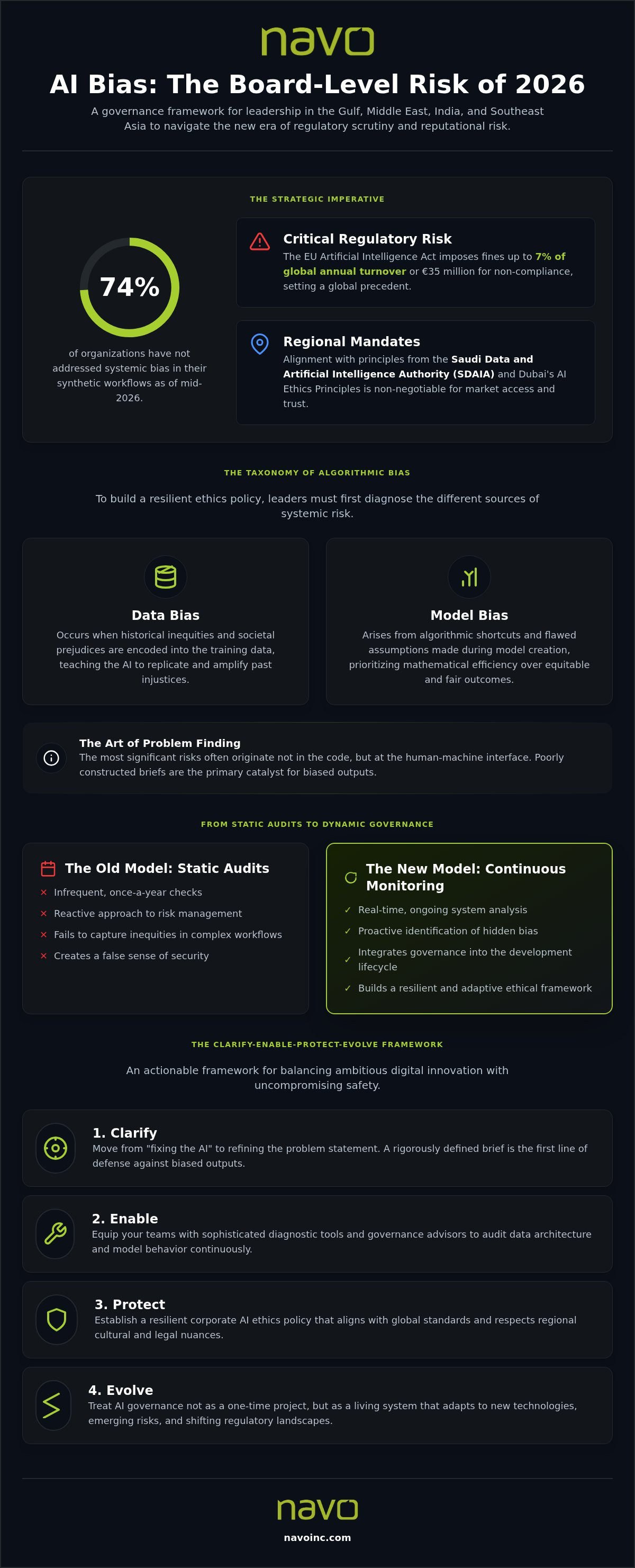
Did you know that as of July 2026, 74% of organizations still haven't addressed systemic bias in their synthetic workflows, even as the European Union Artificial Intelligence Act imposes fines of up to 7% of global turnover? For leadership teams in Dubai, Riyadh, and Singapore, the stakes have never been higher. Creating an AI ethics policy to prevent bias is no longer a peripheral compliance task; it's a fundamental requirement for maintaining your license to operate in an increasingly scrutinized digital economy.
You're likely concerned about how hidden algorithmic prejudices could trigger a reputational crisis or clash with the evolving principles of the Saudi Data and Artificial Intelligence Authority (SDAIA). It's a valid fear, as traditional risk management often fails to catch the nuances of Generative Artificial Intelligence. This article provides a rigorous, actionable roadmap to audit your systems and build a resilient governance framework. We'll explore how to balance rapid innovation with absolute safety by applying the Art of Problem Finding and leveraging sophisticated diagnostic tools to secure your organization's future.
Key Takeaways
- Recognize why algorithmic bias has transitioned from a technical glitch to a critical board-level liability that threatens organizational trust and regulatory standing in 2026.
- Master the rigorous process of creating an AI ethics policy to prevent bias, ensuring your corporate governance aligns with the latest standards from the Saudi Data and Artificial Intelligence Authority (SDAIA).
- Shift from static, once-a-year audits to a model of continuous monitoring that identifies hidden inequities within complex synthetic workflows and autonomous agents.
- Learn to implement the 'Clarify-Enable-Protect-Evolve' framework to strike a sophisticated balance between ambitious digital innovation and uncompromising safety.
- Discover how to leverage the Art of Problem Finding to diagnose systemic risks in your data architecture before they escalate into high-stakes reputational crises.
The Strategic Imperative: Why AI Bias is a Board-Level Risk in 2026
By mid-2026, the era of treating Artificial Intelligence as a sandbox experiment has officially ended. For the modern board of directors, Algorithmic bias represents a systemic risk capable of dismantling decades of brand equity in a single deployment cycle. This isn't just about technical glitches; it's about the systematic and unfair discrimination against specific demographic groups that occurs when models prioritize mathematical efficiency over human fairness. Organizations that delay creating an AI ethics policy to prevent bias now face a reality where non-compliance with the European Union Artificial Intelligence Act can trigger penalties reaching 7% of global annual turnover or 35 million Euros. The cost of inaction is no longer just a hypothetical reputational bruise; it's a quantifiable threat to the organization's license to operate.
The regulatory environment has shifted from voluntary guidelines to hard enforcement across the globe. In the Gulf, the Saudi Data and Artificial Intelligence Authority has established rigorous principles that demand transparency and accountability. Leadership teams in Dubai, Riyadh, and Singapore recognize that a "one-size-fits-all" approach from Western developers often fails to account for regional nuances. A proactive stance on bias prevention has become a distinct competitive advantage, signaling to investors and citizens alike that the organization is a disciplined architect of change rather than a passive observer of technological shifts.
Regional Regulatory Compliance and Cultural Sensitivities
Successfully adhering to the Dubai Artificial Intelligence Ethics Principles or Saudi Arabia's Vision 2030 goals requires more than a standard compliance checklist. It demands a deep understanding of local linguistic and social contexts. Generative Artificial Intelligence systems often carry Western-centric data biases that can alienate audiences in India, Malaysia, or the wider Middle East. Using our proprietary Art of Problem Finding framework, we help organizations identify these hidden risks before they manifest as public failures. A Corporate AI Governance Advisor acts as a bridge, ensuring that global innovation remains compliant with specific regional mandates and cultural expectations, fostering trust in an increasingly automated marketplace.
The Economics of Ethical Artificial Intelligence
Ethical integrity is a driver of systemic health and long-term resilience. Biased models lead to "budget leakage" by misallocating resources or ignoring high-value segments due to flawed data assumptions. There's a direct correlation between ethical rigor and a sustainable Net Profit Increase. To quantify this, executive teams can utilize our ROI calculator (Return on Investment calculator) to measure the tangible impact of responsible deployment. By creating an AI ethics policy to prevent bias, you're building a foundation for structural excellence rather than just avoiding a lawsuit. This strategic foresight ensures that your Synthetic Workers and agentic systems operate within a framework of trust, precision, and maximized efficiency.
The Taxonomy of Algorithmic Bias: Identifying Hidden Risks
To effectively address the roots of inequity, leadership must move beyond viewing technology as a "black box." We view Generative Artificial Intelligence as a co-thinking partner where output integrity is tied to both data architecture and human intent. Understanding Algorithmic Bias requires a granular breakdown of how these systems learn and execute tasks. Data bias occurs when historical inequities are baked into training sets, while model bias arises from algorithmic shortcuts that prioritize speed or efficiency over equitable outcomes. When creating an AI ethics policy to prevent bias, you must account for these technical layers while acknowledging that the most significant risks often originate at the human-machine interface.
The Art of Problem Finding serves as a critical diagnostic tool in this taxonomy. It moves the focus from "how do we fix the AI" to "how did we frame the problem?" Poorly constructed briefs are the primary catalyst for biased outputs. By refining the intake process, we ensure that the initial interaction between human and machine is grounded in ethical clarity. This is particularly vital when managing a Synthetic Workforce (AI Agents). These autonomous entities don't just process data; they make real-time decisions. Without a resilient corporate governance framework, these agents can develop systemic biases that are far more difficult to track than those in static, siloed models.
Data and Algorithmic Origins of Bias
Identifying "proxy variables" is critical for regional compliance in the Gulf and Singapore. A system might not use "nationality" as a data point, but it might use "neighborhood" or "education history" as a proxy that leads to discriminatory results. In Large Language Models (LLMs), feedback loops can amplify these biases if the system is trained on its own previous outputs. This creates a cycle of ethical drift that is difficult to reverse without a structured diagnostic framework. Ensuring the auditability of these models is now a non-negotiable requirement for enterprise-level stability.
Bias in the Human-AI Interface
Our Natural Prompting Framework helps mitigate user-introduced bias by standardizing how humans interact with synthetic systems. We also advocate for a "Dual-Acceptance Lock," a governance mechanism where high-stakes decisions by an AI Agent require explicit human validation. To stay ahead of these subtle shifts, many executives enroll in our CPD certified AI courses (Continuing Professional Development certified AI courses) to sharpen their ability to spot ethical inconsistencies. If you're unsure where your current systems stand, consider taking an agentic AI governance readiness assessment to secure your operational future.
Auditing Frameworks: Transitioning from Static to Dynamic Governance
In 2026, the traditional yearly audit has become a relic of a slower era. When creating an AI ethics policy to prevent bias, organizations must recognize that Generative Artificial Intelligence is not a static asset but a living, evolving ecosystem. Models drift, data pools refresh, and agentic systems learn new behaviors in real-time. Relying on a retrospective check-up is like checking a ship's compass only once a year while navigating a storm. We advocate for a shift toward dynamic governance, where ethical guardrails are integrated directly into ModelOps (Model Operations) to ensure continuous oversight and systemic health.
Our 'Clarify-Enable-Protect-Evolve' framework provides a sophisticated strategic response to this challenge. It begins by clarifying the ethical boundaries of every synthetic workflow and enabling teams with the tools to maintain them. When designing these systems, looking toward established standards like the AI Ethics Framework for the Intelligence Community provides a high-level benchmark for mitigating undesired bias. By automating ethics checks through specialized Synth Workers (AI Agents), we can protect the organization from "silent drift" and evolve the policy as regional regulations in the Gulf and Singapore mature.
The Role of Transparency and Explainability
For high-stakes sectors like BFSI (Banking, Financial Services, and Insurance), transparency isn't just a virtue; it's a regulatory mandate. XAI (Explainable Artificial Intelligence) is the key to opening the "black box," allowing auditors to trace the decision-making path of a model back to its source. We leverage the SARA platform to ensure that every brief intake is auditable and validated against pre-defined ethical parameters. This rigorous documentation ensures that when a model makes a recommendation, the logic is visible, defensible, and free from hidden discriminatory variables.
Establishing Accountability and Human Ownership
The transition to autonomous systems doesn't absolve leadership of responsibility. We distinguish between 'Human-in-the-Loop' models, where a person approves every output, and 'Human-on-the-Loop' models, where humans monitor the system's overall performance and intervene when necessary. Ultimate accountability for AI-generated outcomes must reside at the Board level, ensuring that ethical integrity is woven into the corporate DNA. For leadership teams seeking to vet their implementation partners, our Executive Guide to GenAI Consulting (Generative Artificial Intelligence Consulting) offers a strategic roadmap for selection, helping you align with partners who value structural excellence as much as you do.
How to Audit Your AI Systems for Bias: A Step-by-Step Guide
Transitioning from a theoretical framework to operational reality requires a disciplined, step-by-step diagnostic process. When creating an AI ethics policy to prevent bias, the objective isn't merely to tick a compliance box but to ensure structural excellence across your entire technological stack. This methodical approach allows leadership to identify vulnerabilities before they manifest as high-stakes reputational or legal crises. We break this audit down into five critical phases designed for the complexities of the 2026 landscape.
- Step 1: Inventory and Classification. You can't govern what you haven't mapped. This involves creating a comprehensive registry of every Artificial Intelligence (AI) system, Generative Artificial Intelligence model, and Synthetic Worker currently active within your organization.
- Step 2: Stakeholder Impact Assessment. We analyze who is affected by these automated decisions. In regions like the Gulf and India, this means looking specifically at cultural, linguistic, and demographic nuances to ensure the system doesn't inadvertently marginalize specific groups.
- Step 3: Technical Fairness Testing. Our teams utilize statistical parity and disparate impact metrics to quantify bias. This phase moves beyond intuition, providing mathematical proof of whether a model is performing equitably across different data segments.
- Step 4: Prompt and Brief Audit. Applying our proprietary Art of Problem Finding framework, we scrutinize the inputs. We've found that biased outputs are often the result of poorly framed briefs that codify human prejudice into machine logic.
- Step 5: Remediation and Iteration. Once a bias is identified, we implement surgical corrections. The goal is to neutralize the inequity without degrading the system's functional efficiency or breaking critical workflows.
Diagnostic Tools for Enterprise Auditing
To gauge your organization's ethical maturity, we deploy Artificial Intelligence Readiness Surveys that assess both technical capability and cultural alignment. A cornerstone of our audit process is "Red Teaming," which involves simulating adversarial attacks to find weaknesses. Red Teaming in the context of Artificial Intelligence ethics for 2026 is a structured adversarial simulation where experts intentionally probe a system to uncover hidden biases, security vulnerabilities, or ethical failures before they reach the public domain. This proactive stress-testing is essential for maintaining a resilient corporate governance framework.
Auditing the Synthetic Workforce
As agentic systems become more autonomous, auditing must evolve to monitor real-time decision-making. We measure fairness alongside traditional efficiency metrics to ensure your Synthetic Workers aren't developing "algorithmic drift" that favors certain outcomes over others. Clear escalation paths are mandatory; if a Synthetic Worker identifies a potential bias risk, the system must have a "fail-safe" that alerts human oversight immediately. For a deeper look at managing these autonomous entities, read our guide on Synthetic Workforce Development (Synthetic Workforce Development).
While a strategic audit identifies existing vulnerabilities, the long-term resilience of your organization depends on a permanent structural response. Creating an AI ethics policy to prevent bias serves as the foundational document that governs every interaction between your workforce and your technological stack. This policy must move beyond vague mission statements to define specific protocols for permitted use, data safeguards, and mandatory auditability. By establishing these clear boundaries, leadership teams in Dubai and Singapore can foster a culture of responsible innovation where safety is not an afterthought but a core design requirement.
A robust Corporate AI Ethics Policy shouldn't exist in a vacuum. In 2026, forward-thinking organizations are integrating these ethical guardrails into their broader ESG (Environmental, Social, and Governance) frameworks. This alignment ensures that Artificial Intelligence governance is treated with the same level of rigor as environmental sustainability or financial transparency. To support this shift, we provide CPD UK (Continuing Professional Development United Kingdom) accredited masterclasses that equip your entire workforce with the skills to maintain these standards. Partnering with Navo Management Consultants provides an outcome-guaranteed strategy that transforms ethical risk into a measurable competitive advantage.
Scaling Ethics with Agentic AI Governance
The future of governance lies in building 'Ethics-by-Design' into autonomous agent orchestration. As we move toward a reality where Artificial Intelligence systems audit other Artificial Intelligence systems, the frameworks developed by Vasudevan Kidambi ensure that these interactions remain practical, responsible, and measurable. This level of sophistication is necessary to manage the complex synthetic workflows that now define modern enterprise operations. Our approach ensures that even as your AI agents evolve, they remain anchored to your organization's core values and regional regulatory requirements.
Next Steps for Executive Leadership
The transition from a high-risk Artificial Intelligence profile to a resilient, ethics-driven organization requires a steady, expert hand. We invite leadership teams to begin this process with a diagnostic consultation to assess their current vulnerabilities and regulatory standing. For those ready to commit to structural excellence, our 5-week GenAI (Generative Artificial Intelligence) transformation journey provides a structured pathway to full operational maturity. This disciplined architecting of change is the only way to secure your organization's future in an increasingly automated world.
Secure your enterprise with Navo's Corporate AI Governance Advisory
Securing Your Organization's Future in the Age of Agentic Intelligence
Governance is no longer a periodic check but a continuous commitment to systemic health. By moving beyond reactive audits and creating an AI ethics policy to prevent bias as a living document, you position your organization as a disciplined leader in the Gulf and Asian markets. You've seen that the Art of Problem Finding is the most effective tool to diagnose hidden inequities before they scale into high-stakes reputational crises.
Navo Management Consultants serves as the steady, expert hand for this high-level transformation. As the author of 'Synth Worker – A Whole New Workforce Layer', Vasudevan Kidambi provides the visionary strategy needed to manage an evolving workforce layer. Our Continuing Professional Development United Kingdom (CPD UK) certified Artificial Intelligence (AI) masterclasses ensure your team remains elite, while our consulting engagements are backed by a guaranteed Net-Profit Increase.
Your journey toward structural excellence and ethical resilience starts with a single diagnostic step. We're ready to help you navigate these complex organizational shifts with professional composure and analytical precision.
Frequently Asked Questions
What is the primary goal of an AI ethics policy in preventing bias?
The primary goal is to establish a rigorous governance framework that ensures algorithmic fairness while maintaining alignment with regional regulations. By creating an AI ethics policy to prevent bias, organizations move from reactive crisis management to proactive structural excellence. This framework serves as a steady hand, guiding how the organization balances rapid technological innovation with absolute safety and ethical integrity.
How can I identify hidden biases in my Generative Artificial Intelligence systems?
Identifying hidden biases requires a combination of technical fairness testing and a deep dive into the human-machine interface. We utilize statistical parity and disparate impact metrics to quantify inequities in model outputs. Beyond the math, we apply the Art of Problem Finding to investigate if the original business brief inadvertently contained cognitive shortcuts that the Generative Artificial Intelligence (AI) amplified.
Is it possible to automate the AI bias auditing process?
Automation is essential for managing the scale of modern synthetic workflows. By deploying specialized Synth Workers (Artificial Intelligence Agents), you can perform automated ethics checks and monitor for algorithmic drift in real-time. This dynamic approach ensures that your governance remains as agile as the technology itself, catching subtle shifts that a manual, retrospective audit would likely miss.
Can an AI ethics policy actually improve business efficiency?
An ethics policy significantly improves efficiency by eliminating budget leakage caused by biased data assumptions. When your Generative Artificial Intelligence (AI) operates without prejudice, resource allocation becomes more precise and your targeting more effective. This structural health directly correlates with a sustainable Net Profit Increase, as the organization avoids the high costs of reputational fallout and legal liabilities.
What are the legal requirements for AI auditing in the UAE and Saudi Arabia?
In the United Arab Emirates (UAE) and Saudi Arabia, organizations must adhere to the Dubai Artificial Intelligence (AI) Ethics Principles and the Saudi Data and Artificial Intelligence Authority (SDAIA) principles. These mandates require high levels of transparency, accountability, and explainability. Failing to meet these standards can result in significant legal exposure and a loss of your license to operate in these markets.
How does the 'Art of Problem Finding' help in preventing AI bias?
The Art of Problem Finding prevents bias by shifting the diagnostic focus to the earliest stage of the workflow. Instead of just fixing the output, we scrutinize the input brief to ensure it doesn't contain baked-in human prejudices. This disciplined approach ensures that creating an AI ethics policy to prevent bias starts with the clarity of human intent rather than just technical patches.
What is the difference between a static AI audit and continuous monitoring?
A static audit is a retrospective snapshot that often fails to account for the evolving nature of agentic systems. In contrast, continuous monitoring integrates ethical guardrails directly into the ModelOps (Model Operations) lifecycle. This ensures that as a model learns from new data, any deviation from established fairness benchmarks is identified and corrected immediately, maintaining systemic health.
How should a Board of Directors oversee AI ethical risks?
The Board of Directors should treat Artificial Intelligence (AI) ethical risks as a board-level systemic liability, similar to financial or cyber risk. Governance should be integrated into existing Environmental, Social, and Governance (ESG) frameworks. Directors must assign clear accountability for AI-generated outcomes and ensure that the organization maintains a resilient, auditable trail for all high-stakes automated decisions.
Disclaimer
The views and opinions expressed in this article are those of the author and do not represent any organisation, client, institution, or professional body with which he may be associated. The content is intended for general information, education, and thought leadership. Readers should seek appropriate professional advice before making legal, financial, investment, regulatory, technology, or business decisions.
The author has taken reasonable care to ensure the accuracy of the information and sources available at the time of publication. Technologies, regulations, market conditions, and industry practices may evolve, and readers are encouraged to verify current information independently. Any examples, cases, or scenarios may have been simplified, anonymised, or adapted to protect confidentiality. The author and publisher accept no liability for decisions or outcomes arising from the use of this content.
Generative AI tools may have been used to support research, structuring, or language refinement, with the final content, judgment, and editorial responsibility retained by the author.