

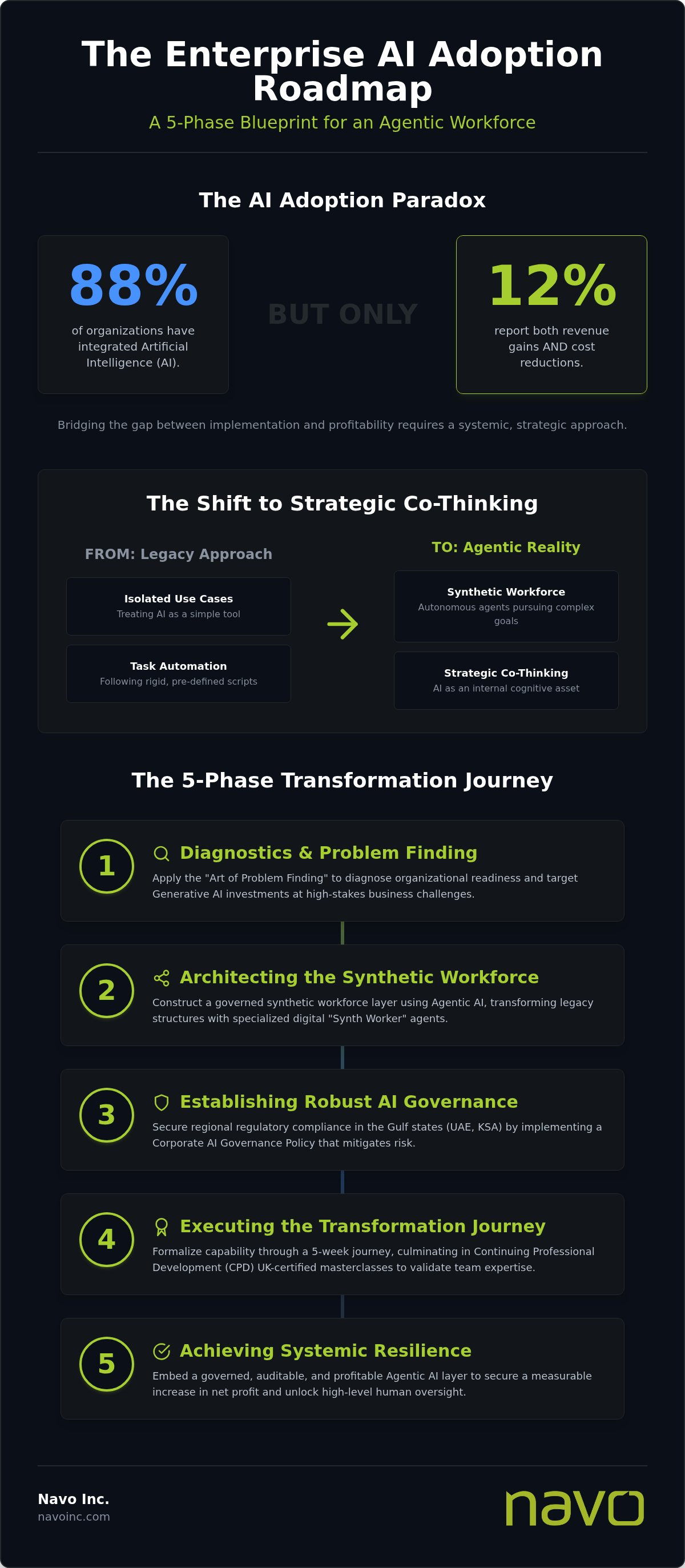
Why do only 12% of Chief Executive Officers report both revenue gains and cost reductions from Artificial Intelligence (AI), even though 88% of organizations have already integrated it into their core functions? It's a sobering reality for many leaders in Dubai and across the Gulf region who find themselves caught between the promise of innovation and the friction of operational disruption. You've likely witnessed significant capital allocated to poorly constructed briefs or felt the weight of regulatory uncertainty as Singapore and the European Union set new global benchmarks. Developing a robust Artificial Intelligence (AI) adoption roadmap for enterprises is no longer a matter of technical deployment. It's a requirement for systemic resilience in an era where task-specific agents are becoming the standard architectural layer for the modern firm.
We understand that true progress requires more than just a pilot project. It demands a strategic framework that bridges the gap between traditional management theory and cutting-edge digital concepts. This article presents a disciplined, five-phase blueprint to help you transition from legacy structures to a high-efficiency synthetic workforce. You'll discover how to implement a governed layer of Agentic Artificial Intelligence (AI) that is both auditable and profitable. By following this methodical path, your organization can achieve Continuing Professional Development (CPD) certified capability while securing a clear, measurable increase in net profit through a sophisticated approach to structural excellence.
Key Takeaways
- Establish a definitive path from experimentation to production-level deployment by utilizing a structured AI adoption roadmap for enterprises to integrate Artificial Intelligence (AI) into your core strategic architecture.
- Apply the proprietary "Art of Problem Finding" methodology to diagnose organizational readiness and ensure that Generative Artificial Intelligence (GenAI) investments are targeted at high-stakes business challenges.
- Construct a governed synthetic workforce layer using Agentic Artificial Intelligence (AI) to transform legacy structures into high-efficiency environments supported by specialized digital agents.
- Secure regional regulatory compliance in the Gulf states, including the United Arab Emirates (UAE) and Saudi Arabia, by implementing a Corporate Artificial Intelligence (AI) Governance Policy that mitigates operational risk.
- Formalize organizational capability through a 5-week transformation journey, culminating in Continuing Professional Development (CPD) UK-certified masterclasses that validate your team's expertise in the agentic era.
The 2026 Enterprise Artificial Intelligence (AI) Adoption Roadmap: Transitioning from Pilot Projects to Agentic Reality
The transition from the speculative experimentation of 2024 to the rigorous agentic execution of 2026 marks a definitive turning point for global commerce. While early adopters previously focused on isolated use cases, the current mandate for leadership in Dubai and the wider Gulf region is the integration of a cohesive Artificial Intelligence (AI) adoption roadmap for enterprises. This isn't a mere software update; it's a fundamental restructuring of how value is generated. Traditional digital transformation roadmaps often fail because they treat Generative Artificial Intelligence (GenAI) as a faster version of legacy tools. In reality, Generative Artificial Intelligence (GenAI) functions as a cognitive layer that requires a multidimensional strategy encompassing governance, talent development, and synthetic infrastructure.
Understanding where your organization sits on the Technology Adoption Life Cycle is critical for moving beyond basic Machine Learning (ML) toward what we define as Machine-in-the-Loop Thinking. This paradigm shift ensures that executive decision-making is augmented by real-time, high-fidelity data processing. It allows the Board and Chief Executive Officers (CEOs) to navigate market volatility with a level of professional composure that was previously unattainable. At Navo Inc., we see this as the difference between reactive technology usage and proactive strategic leadership.
The Shift Toward Agentic Artificial Intelligence (AI) and Synthetic Workers
The emergence of the Synthetic Workforce represents a new operational reality. Unlike simple automation, which follows rigid scripts to perform repetitive tasks, Agentic Artificial Intelligence (AI) agents possess defined roles, memory, and the autonomy to pursue complex objectives. These agents don't just follow instructions; they orchestrate production and analyze market intelligence independently. By deploying a layer of "Synth Workers," enterprises can scale their operational capacity without the traditional overhead of human-only resource expansion. This creates a robust system where human expertise is reserved for high-level oversight and nuanced ethical judgment, ensuring the organization remains agile in a hyper-competitive landscape.
Strategic Co-Thinking: The New Executive Paradigm
We position Generative Artificial Intelligence (GenAI) as a strategic co-thinking partner rather than a simple tool replacement. This shift moves the conversation from task-based usage to outcome-guaranteed strategic consulting. Our proprietary frameworks, such as the "Six Lanes of Working," redefine the executive relationship with technology. Instead of viewing Artificial Intelligence (AI) as an external service, leaders learn to treat it as an internal cognitive asset. This approach ensures that every technological investment is directly tied to a measurable increase in net profit. It provides a clear, auditable path to organizational excellence that satisfies both shareholders and regional regulatory bodies.
Phase I: The Art of Problem Finding and Organizational Readiness Diagnostics
We use rigorous Return on Investment (ROI) calculators to transform experimental labs into profit-guaranteed pilots. This analytical approach is essential for bridging the "Adoption Gap," ensuring that every initiative is backed by a clear financial justification. Our "Six Lanes of Working" framework then categorizes every enterprise workflow, ensuring that integration is systemic rather than sporadic. It's particularly vital in the complex regulatory environments of Dubai and the wider Gulf region, where alignment with local mandates is a prerequisite for operational stability. By establishing these diagnostic benchmarks early, leaders can maintain professional composure while navigating the rapid evolution of the agentic era.
Establishing a Diagnostic Foundation
Budget leakage often stems from "Poor Briefs," where vague objectives lead to misaligned outcomes. We utilize our proprietary Strategic Analysis and Risk Assessment (SARA) platform for brief validation, ensuring every project has an auditable objective. We also map data infrastructure for compatibility with Large Language Models (LLMs). Aligning research with standards like the National Artificial Intelligence (AI) Research and Development (R&D) Strategic Plan ensures your ecosystem supports the high-efficiency synthetic workforces of the near future.
Leadership Coaching and Capability Building
True transformation doesn't live in the Information Technology (IT) department; it begins with the Board and Chief Executive Officers (CEOs), who must understand systems as co-thinking partners. We integrate Continuing Professional Development (CPD) United Kingdom (UK) certified training to establish baseline literacy. Central to this is the "Natural Prompting Framework," equipping executives to communicate with Agentic Artificial Intelligence (AI). A governed Artificial Intelligence (AI) adoption roadmap for enterprises requires a strategically aligned workforce. Consider scheduling a diagnostic briefing to ensure your organization is architected for change.
Phase II: Architecting the Synthetic Workforce and Agentic AI Infrastructure
Architecting a robust AI adoption roadmap for enterprises requires a fundamental shift from viewing software as a tool to viewing it as a colleague. This phase focuses on the structural integrity of the synthetic workforce. We prioritize a tool-agnostic strategy because the specific Large Language Model (LLM) selected is less critical than the framework governing its behavior. By the end of 2026, 40% of enterprise applications are projected to have task-specific agents embedded, according to recent industry forecasts. This shift demands that agents be designed with defined roles, persistent memory, and rigorous performance metrics to ensure they function as reliable cognitive assets rather than isolated scripts.
Our "NOVA" approach to production orchestration facilitates the seamless integration of synthetic media and agentic workflows. It utilizes "Machine-in-the-Loop" protocols to maintain human oversight while scaling output to levels previously considered impossible. This orchestration ensures that autonomous systems don't operate in a vacuum but remain aligned with the strategic objectives of the C-suite. In Dubai and Singapore, where efficiency is a competitive benchmark, this level of architectural precision is the only way to move from pilot projects to scaled, profitable reality. It provides the steady hand needed to navigate complex organizational shifts without losing sight of the bottom line.
Developing Specialized Synthetic Workers
Synthetic workers, or "Synth Workers," are architected to handle specific high-value functions like market intelligence and client reporting. We define clear approval gates and escalation paths to ensure autonomous agents remain within governed boundaries. For example, integrating AI Video production allows for the rapid creation of scalable corporate communications that maintain brand consistency across global regions. These agents act as force multipliers; they process vast datasets into actionable insights while the human workforce focuses on high-stakes negotiation and ethical governance. This role-specific design is essential for maintaining professional composure during rapid technological scaling.
Integration with Legacy Business Processes
Phase III: Establishing Robust AI Governance and Regional Regulatory Compliance
Governance is the architecture of trust. A definitive AI adoption roadmap for enterprises remains incomplete without a framework that addresses the accelerating fragmentation of global regulations. As of August 2026, the European Union (EU) Artificial Intelligence (AI) Act's transparency obligations have become a baseline for international operations. However, for leaders in Dubai and Riyadh, the focus must remain on regional mandates. Singapore's Infocomm Media Development Authority (IMDA) established a global precedent in January 2026 by releasing the first model governance framework specifically for agentic Artificial Intelligence (AI). This regulatory shift signals that the era of "black box" deployment is over. We guide executive leadership in developing a Corporate Artificial Intelligence (AI) Governance Policy that ensures every autonomous agent operates within auditable, risk-mitigated parameters.
Ensuring data safeguards and human-ownership mechanisms is critical as we scale synthetic workforces. This process requires a deep awareness of cultural sensitivities and regional norms across the Middle East and Asia. In the United Arab Emirates (UAE) and Saudi Arabia, compliance isn't just about technical security; it's about aligning technological output with the ethical and legal cadence of the state. Our approach moves beyond generic bias testing to provide a sophisticated, steady hand in navigating these complex shifts, maintaining professional composure while others face regulatory friction.
The Governance Framework for Autonomous Agents
We establish permitted-use boundaries and accountability rules that define the operational limits of every synthetic worker. To prepare the Board for the agentic era, we provide comprehensive audit and assurance services that verify system integrity. A key component of this is the "Dual-Acceptance Lock" within our project briefs. This mechanism ensures a single source of truth by requiring both human and agentic validation before a project proceeds. This discipline prevents the budget leakage associated with misaligned objectives and keeps the organization on a path toward structural excellence.
Compliance in the Gulf and Asian Markets
Navigating regional data residency laws is a prerequisite for any Generative Artificial Intelligence (Generative AI) deployment in the Gulf states. We collaborate with regional consumer bodies and policymakers to ensure that your Artificial Intelligence (AI) usage is transparent and compliant with local sovereignty requirements. As a primary advisor in Dubai, Navo Inc. bridges the gap between international standards and regional legal realities. Integrating these local requirements into your AI adoption roadmap for enterprises ensures that your technological frontier remains both bold and legally resilient.
Phase IV: Executing the Transformation Journey through CPD UK-Certified Masterclasses
The execution of a robust AI adoption roadmap for enterprises culminates in the practical empowerment of the workforce. It's insufficient to architect infrastructure without calibrating the human element to lead it. We utilize a 5-week transformation journey that moves from pre-prep diagnostics to an intensive activation arc. This structured approach ensures that the transition isn't a theoretical exercise but a tangible shift in operational capability. By the end of 2026, over 80% of enterprises are expected to have integrated Generative Artificial Intelligence (GenAI) APIs or models, yet only those with a disciplined execution strategy will capture the projected value. Our methodology focuses on building "Synthetic Skills," ensuring your team is equipped to manage, audit, and co-think with Agentic Artificial Intelligence (AI) in a hyper-competitive talent market.
Why is Continuing Professional Development (CPD) UK accreditation the global benchmark for this journey? In a landscape saturated with generic training, this certification provides the intellectual rigor required by executive leadership in Dubai, Riyadh, and Singapore. It validates that the training meets high-register professional standards, offering a steady hand to organizations navigating complex shifts. We measure the success of the roadmap through an outcome-guaranteed strategy: a verifiable increase in net profit. This ensures that the transformation journey is directly tied to the systemic health and financial resilience of the firm, rather than being a disconnected technological expense.
The Masterclass Curriculum for Enterprises
Our facilitated learning modules focus on the nuances of human-to-machine communication and the exercise of responsible judgment. Unlike generic leadership training, we utilize evidence-based assessments and moderated portfolio reviews to ensure that every participant achieves true mastery. Organizations can scale this institutional excellence through CPD certified AI courses that are tailored to the specific regulatory and cultural requirements of the Gulf region. This curriculum transforms the workforce into a sophisticated partner for the synthetic layer, bridging the gap between historical business theory and modern agentic reality.
Sustainability and Continuous Evolution
Long-term resilience requires a framework that survives the rapid shifts in the Generative Artificial Intelligence (GenAI) landscape. We implement the "Clarify-Enable-Protect-Evolve" model to ensure that your Artificial Intelligence (AI) assets remain current and compliant. This involves renewing credentials and updating modules as new capabilities emerge, keeping your leadership at the technological frontier. Finalizing the AI adoption roadmap for enterprises involves a strategic move toward synthetic workforce development, where the integration of human and agentic talent becomes a seamless, self-evolving engine for growth. This methodical approach secures your position as a bold pioneer in the agentic era.
Architecting Your Agentic Future
The transition from legacy operations to a high-efficiency synthetic workforce is no longer a futuristic ambition; it's a present-day requirement for structural excellence. By prioritizing the "Art of Problem Finding" over basic tool deployment, your organization can move beyond the adoption gap that currently stalls 75% of enterprise experiments. A governed AI adoption roadmap for enterprises ensures that your integration of agentic systems remains both legally resilient and culturally sensitive across Dubai and the wider Middle East. This methodical approach secures your position as a bold pioneer while maintaining the professional composure expected of a global leader.
True leadership in the agentic era requires a steady, expert hand and a disciplined framework. Our consulting engagements, led by Amazon Bestselling Author Vasudevan Kidambi, focus on outcome-guaranteed strategies that target a measurable increase in your net profit. Through our Continuing Professional Development (CPD) UK-certified masterclasses, we provide your leadership team with the technical literacy needed to navigate these complex shifts. You're not just adopting technology; you're architecting a cognitive asset that will define your organization's resilience for years to come.
We look forward to partnering with you on this transformation journey.
Frequently Asked Questions
What is an AI adoption roadmap for enterprises in 2026?
In 2026, an AI adoption roadmap for enterprises is a five-phase architectural blueprint designed to integrate a governed synthetic workforce layer into legacy organizational structures. It moves beyond isolated pilot projects toward a unified system of Agentic Artificial Intelligence (AI) that serves as a strategic co-thinking partner. This roadmap ensures that technological deployment is directly aligned with systemic resilience and measurable financial outcomes within complex global markets like those in the Gulf states and Singapore.
How does the 'Art of Problem Finding' differ from traditional AI consulting?
The "Art of Problem Finding" is a proprietary diagnostic methodology that identifies high-stakes organizational challenges before selecting a technological solution. Traditional consulting often starts with a specific tool and searches for a use case, which leads to significant budget leakage. Our approach ensures that Generative Artificial Intelligence (GenAI) investments are targeted at areas with the highest potential for structural excellence and net profit increase, preventing the common trap of misaligned objectives.
Is a synthetic workforce suitable for highly regulated industries like BFSI?
A synthetic workforce is highly suitable for the Banking, Financial Services, and Insurance (BFSI) sectors, provided it's supported by a robust Corporate Artificial Intelligence (AI) Governance Policy. In February 2026, the United States Treasury Department issued a framework mapping the National Institute of Standards and Technology (NIST) Artificial Intelligence (AI) Risk Management Framework principles to 230 operational control objectives. This level of granularity allows regulated firms to deploy autonomous agents while maintaining strict auditability and compliance.
What are the specific AI regulations in the UAE and Gulf region that enterprises must follow?
Enterprises in the Gulf region must navigate emerging mandates in the United Arab Emirates (UAE) and Saudi Arabia that emphasize data residency and ethical alignment with regional norms. While specific federal laws are evolving, compliance requires adhering to sovereign data protection standards and transparency requirements for systems interacting with users. Our regional expertise in Dubai ensures that your deployment respects these cultural and legal sensitivities while maintaining alignment with global benchmarks like the Singapore Model Artificial Intelligence (AI) Governance Framework.
How can an enterprise measure the direct ROI of GenAI adoption?
Measuring the direct Return on Investment (ROI) of Generative Artificial Intelligence (GenAI) requires shifting from vague productivity metrics to concrete financial indicators like net profit increase and cost reduction. We utilize rigorous Return on Investment (ROI) calculators that track the performance of synthetic workers against established human-only benchmarks. This data-driven approach allows the Board and C-suite to audit the financial impact of the AI adoption roadmap for enterprises with professional composure and analytical clarity.
What is the difference between a pilot program and an Agentic AI deployment?
A pilot program is a controlled, isolated experiment designed to test a specific use case, whereas an Agentic Artificial Intelligence (AI) deployment is a production-level integration of autonomous digital workers. Pilots often fail to scale because they lack the necessary governance and infrastructure layers. Agentic deployments feature agents with defined roles, persistent memory, and the authority to execute complex workflows independently within a governed synthetic workforce layer, leading to more sustainable organizational shifts.
Why is CPD UK certification important for corporate AI training?
Continuing Professional Development (CPD) UK certification serves as the global benchmark for intellectual rigor in corporate training. It validates that the curriculum meets high-register professional standards and provides a structured pathway for upskilling the workforce. For organizations in Singapore or Malaysia, this accreditation ensures that internal Generative Artificial Intelligence (GenAI) literacy is not just a casual skill but a certified organizational capability that supports systemic health and long-term resilience in the agentic era.
How does Navo Inc. guarantee a net-profit increase through AI strategy?
We guarantee a net-profit increase by utilizing our proprietary SARA platform for brief validation and the "Art of Problem Finding" to eliminate budget leakage. Our outcome-guaranteed strategy is delivered through a disciplined 5-week transformation journey led by Amazon Bestselling Author Vasudevan Kidambi. By aligning every technological deployment with high-stakes business challenges, we ensure that your synthetic workforce serves as a profit-generating engine rather than a speculative cost center, providing a clear path to structural excellence.
Disclaimer
The views and opinions expressed in this article are those of the author and do not represent any organisation, client, institution, or professional body with which he may be associated. The content is intended for general information, education, and thought leadership. Readers should seek appropriate professional advice before making legal, financial, investment, regulatory, technology, or business decisions.
The author has taken reasonable care to ensure the accuracy of the information and sources available at the time of publication. Technologies, regulations, market conditions, and industry practices may evolve, and readers are encouraged to verify current information independently. Any examples, cases, or scenarios may have been simplified, anonymised, or adapted to protect confidentiality. The author and publisher accept no liability for decisions or outcomes arising from the use of this content.
Generative AI tools may have been used to support research, structuring, or language refinement, with the final content, judgment, and editorial responsibility retained by the author.