

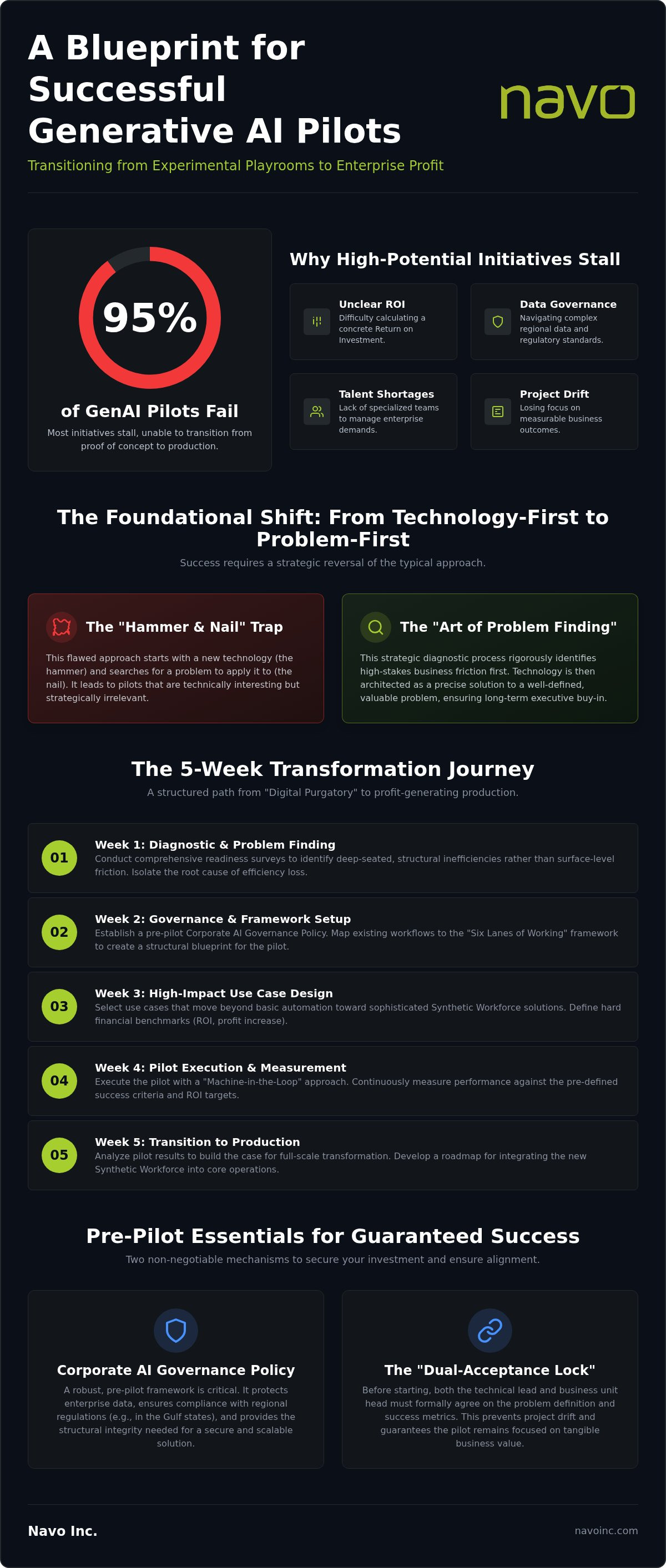
95% of Generative Artificial Intelligence (GenAI) pilots currently fail to transition into production, leaving organizations with little more than expensive experimental playrooms. For leaders in Dubai and across the Gulf, the challenge of creating a pilot project for GenAI often centers on the difficulty of calculating a concrete Return on Investment (ROI) while navigating complex regional data governance standards. It's a common frustration to see high-potential initiatives stall because they lack the structural depth to handle real-world enterprise demands.
You likely recognize that while the potential of this technology is undeniable, the path from a proof of concept to a scalable asset is often blocked by specialized talent shortages and evolving regulatory hurdles. This blueprint provides the rigorous strategic framework required to move beyond these initial hurdles and build a pilot that delivers measurable enterprise profit. We will examine how to transition from traditional human-only workflows to a high-performance Synthetic Workforce, ensuring your technological evolution is both resilient and systemically sound.
Key Takeaways
- Adopt the "Art of Problem Finding" as your primary diagnostic tool to ensure every initiative addresses deep-rooted systemic needs rather than superficial operational friction.
- Master the structural requirements for creating a pilot project for GenAI (Generative Artificial Intelligence) by utilizing the "Six Lanes of Working" framework to bridge the gap between high-level strategy and automated execution.
- Learn to differentiate between basic automation and a high-value Synthetic Workforce, moving beyond simple chatbots toward sophisticated Agentic Artificial Intelligence (AI) solutions.
- Protect your enterprise with a pre-pilot Corporate Artificial Intelligence (AI) Governance Policy and a diagnostic framework designed to secure data and guarantee a clear Return on Investment (ROI).
- Discover the 5-week transformation journey necessary to escape the "Digital Purgatory" of failed experiments and move your technological assets into full, profit-generating production.
Beyond the Proof of Concept (PoC): Why Problem Finding Precedes Pilot Success
The corporate landscape in Dubai and Riyadh is currently saturated with "experimental" initiatives that fail to provide a clear path to production. Most organizations fall into the "Hammer and Nail" trap, where they start with a specific tool and search for a place to apply it. This backwards approach is why 95% of pilots never scale. A Proof of Concept (PoC) merely demonstrates that Generative Artificial Intelligence (GenAI) can perform a task. In contrast, a strategic pilot proves that the technology can drive a specific, measurable business outcome within your unique organizational architecture.
Creating a pilot project for GenAI requires moving beyond the "cool factor" and into the "Art of Problem Finding." This isn't a simple brainstorming session; it's a rigorous diagnostic process designed to ensure high-stakes relevance. If your pilot doesn't address a problem with significant strategic consequence, it won't secure the long-term executive buy-in or budget required for full-scale transformation—a challenge often navigated by multi-generational entities like the Vieyra Family Office when aligning technology with sovereign-scale objectives. We don't build technology for the sake of innovation; we build it to resolve systemic friction that hinders growth.
The Diagnostic Phase: Identifying High-Stakes Business Friction
Success begins with an honest assessment of your organizational maturity. We utilize comprehensive readiness surveys to map how prepared your teams are for a hybrid workflow. It's vital to distinguish between "noisy" problems, which are surface-level annoyances, and "structural" problems, which represent deep-seated efficiency leaks in your core operations. Problem Finding is the act of isolating the root cause of efficiency loss before applying technology. By focusing on structural issues, you ensure that creating a pilot project for GenAI becomes a high-value investment rather than a peripheral Information Technology (IT) expense.
Setting Measurable Success Metrics for 2026
By 2026, the standard for success has shifted from vague qualitative feedback to hard financial benchmarks. Your pilot must be anchored in metrics like Return on Investment (ROI) and net-profit increase. To prevent project drift, we implement a "Dual-Acceptance Lock" for every project brief. This mechanism requires both the technical lead and the business unit head to formally agree on the problem definition and the specific success criteria before a single line of code is run. This alignment ensures that the pilot remains focused on delivering tangible value. Learn how Navo Inc. guarantees outcomes for GenAI consulting to bridge the gap between experimental playrooms and enterprise-grade production.
The Six Lanes of Working: Structuring Your Generative Artificial Intelligence (GenAI) Pilot for Scale
A successful pilot requires a structural blueprint that moves beyond isolated use cases and addresses the fundamental architecture of organizational output. The Six Lanes of Working framework provides this necessary rigour; it categorizes business processes into distinct streams ranging from high-level strategy and planning to technical execution and creative synthesis. When creating a pilot project for GenAI, leaders must map existing workflows against these lanes to identify where a "Machine-in-the-Loop" approach can most effectively augment human intelligence. This diagnostic mapping ensures that the pilot isn't merely a layer of software but a systemic redesign of how the organization thinks and operates.
This structural approach requires a shift in perspective; we move away from viewing technology as a passive tool and toward treating it as a co-thinking partner. Pilot design must therefore include specific tracks for leadership coaching and workforce capability to ensure the organization can manage this new hybrid reality. Establishing rigorous Governance, Data Safeguards, and Measuring ROI is a prerequisite for moving any initiative into these lanes. If you are ready to move from experimentation to enterprise-grade execution, you may wish to consult with our strategic advisors to define your roadmap.
Human-to-Machine Communication: The New Corporate Dialect
While basic Prompt Engineering is a tactical necessity, the true strategic asset for a modern enterprise is Natural Prompting. This involves training the workforce to articulate complex business logic and strategic intent in a way that aligns with the reasoning capabilities of Generative Artificial Intelligence (GenAI). During the pilot phase, implementing CPD UK-certified (Continuing Professional Development United Kingdom) training programs is essential to validate these skills and ensure a uniform standard of excellence. This educational foundation transforms employees from passive users into sophisticated architects of AI-driven outcomes.
Operational Redesign: Preparing for the Synthetic Workforce
The pilot phase often reveals that standard organizational charts are insufficient for the age of Agentic Artificial Intelligence (AI). Creating a pilot project for GenAI serves as the first step in developing a "Whole New Workforce Layer" composed of Synthetic Workers, or AI agents, that handle high-volume, logic-based tasks. Roles must be restructured to integrate these agents into existing teams, allowing human professionals to focus on high-stakes strategy and emotional intelligence. For a comprehensive look at this transition, The Executive Guide to Synthetic Workforce Development provides deeper insights into the future of agentic labor.
Selecting High-Impact Use Cases: From Basic Automation to Synthetic Workers
When creating a pilot project for GenAI, the selection of use cases determines whether the initiative remains a peripheral experiment or becomes a central engine of growth. Most organizations fail because they prioritize "low-hanging fruit" with minimal strategic consequence. In 2026, the benchmark for a successful pilot has shifted from simple cost-cutting to active revenue generation. We evaluate potential initiatives by mapping Strategic Consequence against Ease of Implementation, ensuring that the chosen path offers more than just a marginal efficiency gain. A high-impact pilot must address a fundamental business friction that, once resolved, fundamentally alters the organization's profit trajectory.
There is a critical distinction between Basic Generative Artificial Intelligence (GenAI), such as simple chatbots, and Agentic Artificial Intelligence (AI), which we define as Synthetic Workers. While basic tools respond to prompts, Synthetic Workers possess memory, access to enterprise tools, and the ability to execute multi-step workflows autonomously. Our SARA (Strategic Analysis and Response Agent) model for brief intake and the NOVA model for production serve as benchmarks for this transition. These agents don't just generate text; they manage the architectural integrity of a project from inception to delivery.
The Synthetic Worker Advantage
| Feature | Traditional Automation | Agentic AI (Synthetic Workers) |
|---|---|---|
| Logic Structure | Linear and rule-based | Reasoning and inference-based |
| Contextual Memory | None; stateless execution | Persistent; maintains project history |
| Tool Integration | Fixed Application Programming Interface (API) connections | Dynamic selection of enterprise tools |
| Refinement | Static output | Iterative and self-correcting |
Regional Industry Use Cases: Dubai, Singapore, and Riyadh
Creating a pilot project for GenAI in the Gulf requires a deep understanding of regional market dynamics, particularly within the Banking, Financial Services, and Insurance (BFSI) and Real Estate sectors. Pilots in Dubai and Riyadh must account for cultural sensitivities and the nuances of the Arabic language to ensure authentic engagement. Compliance with the United Arab Emirates (UAE) Personal Data Protection Law is non-negotiable. Your pilot architecture must prioritize data residency and localized governance to navigate the regulatory landscape of the Middle East while maintaining the speed of innovation required in Singapore and other global hubs.
Executing the Pilot: Governance, Data Safeguards, and Measuring Return on Investment (ROI)
Execution is the phase where strategic intent is stress-tested against organizational reality, particularly when integrating Generative Artificial Intelligence (GenAI) into core functions. Establishing a comprehensive Corporate Artificial Intelligence (AI) Governance Policy is a prerequisite for any pilot, ensuring that the integration of new technology doesn't compromise systemic health. Creating a pilot project for GenAI without this foundational layer is a high-stakes gamble that's often linked to Information Technology (IT) vulnerabilities or intellectual property loss. We employ the 'Clarify-Enable-Protect-Evolve' framework to manage these risks; it defines permitted-use boundaries and reinforces human-ownership mechanisms from the outset. This ensures that the organization remains the master of its data, even as it leverages increasingly autonomous systems to drive high-stakes transformation.
Dual-acceptance workflows are essential for maintaining an auditable source-of-truth. By mandating that both business and technical leads formally validate project briefs, you create a rigorous accountability trail that prevents project drift. This is particularly vital in the Gulf region, where regulatory bodies in the United Arab Emirates (UAE) and Saudi Arabia are setting high standards for transparency and data governance. Hard data dictates the scale of your success. Without these safeguards, a pilot is merely an unmanaged Information Technology (IT) liability rather than a strategic asset designed for resilient growth.
The ROI Calculator: Converting Efficiency into Net-Profit
Measuring the success of a pilot requires a move away from qualitative feedback toward hard financial diagnostics. Our Return on Investment (ROI) calculator tracks performance in real-time, contrasting the cost-per-output of 'Machine-in-the-Loop' workflows against traditional 'Human-Only' models. This data provides the clarity needed to map the 'Activation Arc,' moving an initiative from a controlled pilot environment into full-scale enterprise adoption. Real-time visibility ensures the pilot remains focused on net-profit increase.
Governance and Auditability in the Agentic Era
As we move toward Agentic Artificial Intelligence (AI), governance must account for the decisions made by autonomous agents. Creating a pilot project for GenAI involves building accountability rules to ensure these agents operate within strict operational constraints. 'Responsible Judgment' must be woven into the feedback loops to prevent logic errors from impacting the bottom line. Consult with Vasudevan Kidambi on Board-level AI Governance to align your executive leadership with regional standards.
Transitioning to Production: Partnering for Outcome-Guaranteed Generative Artificial Intelligence (GenAI) Transformation
The final hurdle in the evolution of an enterprise is moving from a successful test environment into full-scale production. Many organizations find themselves trapped in "Digital Purgatory," where high-potential initiatives stall indefinitely. This failure is rarely a consequence of the technology itself; instead, it's usually a failure of leadership to integrate the pilot into the core operational fabric. Creating a pilot project for GenAI is only the first step. To realize true value, you must bridge the gap with a disciplined, 5-week transformation journey designed to move your initiatives from a controlled experiment into a profit-generating asset.
At Navo Inc., we approach this transition with a focus on Guaranteed Net-Profit Increase. We don't merely offer technical implementation; we provide a high-stakes consulting partnership that secures Board-level buy-in for a full Synthetic Workforce rollout. By aligning the pilot's success with your organization's broader financial goals, we ensure that the transition to production is both seamless and systemically sound. This methodical progression transforms your technological investments into a resilient, long-term competitive advantage in markets like Dubai and Riyadh.
Selecting the Right Strategic Partner
The choice of a consultant often determines the longevity of your transformation. You must decide between product-centric firms, which focus on selling specific software stacks, and tool-agnostic advisors, who prioritize your unique strategic needs. A tool-agnostic approach ensures that your architecture remains flexible as the technology evolves. Furthermore, the inclusion of CPD UK-accredited (Continuing Professional Development United Kingdom) masterclasses is vital for sustaining long-term growth and ensuring your internal teams can manage a hybrid workforce. For a deeper analysis of these choices, see The Executive Guide to Selecting a Generative AI Consultant.
Initiating Your High-Stakes Pilot Today
The path from pilot to profit begins with a clear diagnostic of your current capabilities. Our "Art of Problem Finding" workshop serves as the foundational step, allowing your leadership team to isolate the root causes of efficiency loss before applying any technological solutions. This rigorous process ensures that creating a pilot project for GenAI is anchored in real-world necessity rather than speculative innovation. Once the problem is defined, the framework for scale becomes clear, leading your organization toward a future where human and synthetic intelligence operate in perfect synchronization.
Scaling Your Enterprise Intelligence for 2026
The transition from experimental isolation to enterprise-scale production requires more than technical proficiency; it demands a fundamental shift in organizational architecture. By adopting our proprietary Art of Problem Finding Framework, you ensure that every initiative addresses deep-rooted systemic friction rather than superficial symptoms. Creating a pilot project for GenAI is the first step in building a resilient, hybrid workforce where human professionals and synthetic agents operate within the structured Six Lanes of Working.
We provide the steady hand needed for this high-stakes transformation, offering CPD UK-Certified Masterclasses to validate your team's capabilities and ensure long-term sustainability. It's a journey that moves your organization beyond the uncertainty of "Digital Purgatory" and into a future of measurable growth. Our commitment to excellence is backed by a Guaranteed Net-Profit or Efficiency Increase, ensuring your capital is deployed with precision. You have the blueprint; now you must decide whether to remain an observer of this evolution or to lead it as a disciplined architect of change.
The future of enterprise intelligence isn't found in the tools you buy, but in the strategic rigour you apply to their integration. We look forward to partnering with you on this journey toward structural excellence.
Frequently Asked Questions
What is the difference between a Proof of Concept (PoC) and a Generative Artificial Intelligence (GenAI) pilot?
A Proof of Concept (PoC) is a technical exercise designed to validate that a specific technology can perform a task. In contrast, a pilot is a strategic stress-test of that technology within your actual organizational architecture. Creating a pilot project for GenAI involves mapping the tool to a high-stakes business outcome to prove it can deliver measurable enterprise profit before you commit to a full-scale rollout.
How much does a typical Generative Artificial Intelligence (GenAI) pilot project cost in 2026?
The investment required for a pilot in Dubai or Riyadh depends entirely on the complexity of your "Six Lanes of Working" and the depth of the Synthetic Workforce layer you intend to build. While basic automation tests require fewer resources, enterprise-grade pilots involving sophisticated agentic workflows require a more robust allocation of UAE Dirham (AED). We recommend evaluating the investment against the guaranteed net-profit increase rather than viewing it as a sunk IT expense.
How do we ensure our Generative Artificial Intelligence (GenAI) pilot complies with Dubai and UAE data laws?
Adherence to the United Arab Emirates Federal Decree Law No. 45 of 2021 regarding the Protection of Personal Data is a non-negotiable requirement. Your pilot must incorporate a pre-emptive Corporate Artificial Intelligence (AI) Governance Policy that defines strict data residency boundaries and permitted-use protocols. This ensures that all regional regulatory nuances are managed before the first line of code is run, protecting your organizational integrity and intellectual property.
What is a Synthetic Worker and why should it be part of our pilot project?
A Synthetic Worker is an autonomous Artificial Intelligence (AI) agent equipped with persistent memory, tool access, and defined reasoning capabilities. Unlike traditional chatbots that merely respond to prompts, these agents function as a hybrid workforce layer capable of executing complex, multi-step workflows. Including them in your pilot allows you to test a scalable co-thinking architecture that moves beyond simple automation toward a truly agentic enterprise model.
How do we measure the Return on Investment (ROI) of a Generative Artificial Intelligence (GenAI) pilot?
Return on Investment (ROI) is measured by contrasting the cost-per-output of "Machine-in-the-Loop" workflows against your traditional "Human-Only" benchmarks. Creating a pilot project for GenAI requires a "Dual-Acceptance Lock" to ensure that success is measured against hard financial metrics like net-profit increase and reclaimed billable hours. This diagnostic approach provides the board-level clarity needed to move from a controlled pilot environment into full-scale production transformation.
What is the 'Art of Problem Finding' and why is it mandatory for AI success?
The "Art of Problem Finding" is our proprietary diagnostic framework used to isolate the root cause of efficiency loss before any technology is applied. It prevents the common "Hammer and Nail" trap where organizations start with a tool and search for a problem. By identifying the highest-stakes business friction first, you ensure that your technological evolution is anchored in structural necessity rather than superficial innovation.
Can we run a Generative Artificial Intelligence (GenAI) pilot if our data is not perfectly clean?
Yes, you can initiate a pilot with imperfect data by establishing rigorous validation loops and data safeguards within the pilot architecture. Modern Agentic Artificial Intelligence (AI) models are increasingly capable of reasoning through noise, provided the "Six Lanes of Working" framework includes a specific track for data refinement. The pilot serves as a diagnostic tool to identify which data sets require cleaning to support a full-scale production rollout.
How long should a Generative Artificial Intelligence (GenAI) pilot project take to complete?
A well-structured enterprise pilot typically requires between eight and twelve weeks to reach a definitive "go/no-go" decision point. This timeframe allows for an initial "Art of Problem Finding" workshop, the development of specific agentic workflows, and a full cycle of performance testing. Maintaining this deliberate pace prevents project drift and ensures a seamless transition into a 5-week transformation journey for full-scale production and workforce integration.
Disclaimer
The views and opinions expressed in this article are those of the author and do not represent any organisation, client, institution, or professional body with which he may be associated. The content is intended for general information, education, and thought leadership. Readers should seek appropriate professional advice before making legal, financial, investment, regulatory, technology, or business decisions.
The author has taken reasonable care to ensure the accuracy of the information and sources available at the time of publication. Technologies, regulations, market conditions, and industry practices may evolve, and readers are encouraged to verify current information independently. Any examples, cases, or scenarios may have been simplified, anonymised, or adapted to protect confidentiality. The author and publisher accept no liability for decisions or outcomes arising from the use of this content.
Generative AI tools may have been used to support research, structuring, or language refinement, with the final content, judgment, and editorial responsibility retained by the author.