

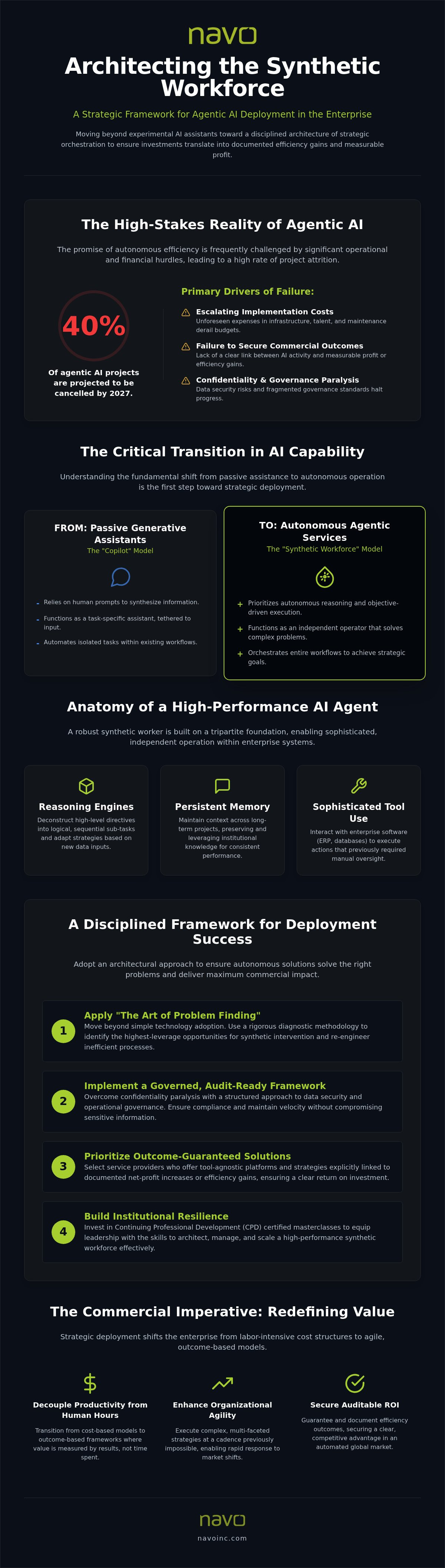
Over 40% of agentic AI projects are projected to be cancelled by the end of 2027, largely due to escalating implementation costs and a failure to secure clear commercial outcomes. For leadership teams across the UAE, the promise of autonomous efficiency is often eclipsed by the risks of confidentiality paralysis and the structural complexity of managing a synthetic workforce alongside human capital. You likely recognize that while the potential for agentic AI services is immense, the path to a scalable, audit-ready deployment remains obscured by technical hype and fragmented governance standards.
This reference guide provides a rigorous framework to navigate this complexity, moving beyond experimental assistance toward a disciplined architecture of strategic orchestration. You will gain a clear methodology for selecting the right agentic AI services to ensure your investments translate into documented efficiency gains and measurable profit. We will explore the critical transition from isolated task automation to a fully governed synthetic workforce, providing the analytical tools necessary for resilient enterprise evolution in the Gulf's rapidly advancing digital economy.
Key Takeaways
- Distinguish between passive generative assistants and goal-oriented agentic AI services to move beyond simple task automation toward autonomous workflow orchestration.
- Apply the "Art of Problem Finding" methodology to identify the highest-leverage opportunities for synthetic workers to drive measurable commercial outcomes.
- Overcome confidentiality paralysis by implementing a governed, audit-ready framework that ensures data security while maintaining operational velocity.
- Prioritize service providers who offer tool-agnostic solutions and outcome-guaranteed strategies linked to documented net-profit increases or efficiency gains.
- Build institutional resilience through Continuing Professional Development (CPD) UK-certified masterclasses that prepare leadership to architect and manage a high-performance synthetic workforce.
Understanding Agentic AI Services: Beyond Generative Assistants
The professional landscape in 2026 reflects a decisive departure from the era of generative experimentation. While earlier iterations of artificial intelligence focused on the passive synthesis of information, modern agentic AI services prioritize autonomous reasoning and objective-driven execution. This shift signifies the transition from a "Copilot" model, which remains tethered to human input, to a "Synthetic Workforce" model, where digital entities function as independent operators. For executives in the UAE and the broader Gulf region, this represents a critical opportunity to resolve the friction between high-speed growth and the limitations of traditional human-centric workflows. Despite high interest, only 23% of organizations report having scaled an agentic AI system into production as of July 2026, highlighting the gap between strategic intent and operational reality.
An AI agent is defined by its ability to perceive its environment, reason about its objectives, and take actions that maximize its chances of success. It doesn't merely answer questions; it solves problems. This proactivity is what distinguishes agentic systems from the generative assistants of previous years. When an organization deploys these services, it's commissioning a digital architect capable of navigating complex organizational shifts with professional composure and analytical precision. This is essential given that over 40% of agentic AI projects are projected to be canceled by the end of 2027 due to high costs and unclear business value.
The Anatomy of an AI Agent
The sophistication of an autonomous agent is built upon a foundation of advanced reasoning engines and persistent memory architectures. Reasoning engines permit the agent to break down a high-level executive directive into a sequence of logical sub-tasks, adjusting its strategy as it encounters new data. Persistent memory is equally vital, as it allows the agent to maintain context across long-term projects, ensuring that institutional knowledge is preserved and utilized. Through sophisticated tool use, these agents interact with enterprise resource planning systems and secure databases, performing actions that previously required manual oversight. This tripartite structure creates a robust foundation for systemic health and operational resilience.
Commercial Implications of Autonomy
Autonomy introduces a new paradigm for measuring technological return on investment. We're witnessing a shift from labor-intensive cost structures to outcome-based models where productivity is decoupled from human hours. This transition enhances organizational agility, enabling firms to execute complex strategies at a cadence that was previously impossible. Leaders must recognize that integrating these systems requires a sophisticated strategic response rather than a simple technical update. Exploring The Evolution of the AI Co-Thinking Partner provides further insight into how these proactive entities are reshaping the executive suite. By leveraging agentic AI services, enterprises can guarantee efficiency outcomes and secure a competitive advantage in an increasingly automated global market.
The Strategic Framework for Agentic AI Deployment
Successful deployment of agentic AI services requires a fundamental shift from technology adoption to architectural design. Most enterprises fail because they apply autonomous solutions to poorly defined problems. At Navo Inc., we utilize a proprietary methodology known as "The Art of Problem Finding" to identify high-leverage opportunities where synthetic intervention generates maximum commercial impact. This ensures that the transition from human-led tasks to machine-led orchestration doesn't just automate existing inefficiencies but fundamentally re-engineers them for superior performance. This diagnostic rigor is vital, especially considering that over 40% of agentic AI projects are projected to be canceled by the end of 2027 due to unclear business value.
The Six Lanes of Working serves as our primary model for this integration. It categorizes organizational activities by their suitability for automation, ranging from high-frequency administrative tasks to complex strategic co-thinking. Before a single line of code is written, leaders must evaluate their "Synthetic Readiness." This involves assessing data maturity, process consistency, and the cultural appetite for machine-in-the-loop decision-making. Without this systemic analysis, projects often succumb to the "pilot purgatory" that plagues 39% of organizations currently in the experimentation phase. Our approach moves beyond the tool-centric focus typical of global vendors, prioritizing the organizational reality of the Middle East market.
Diagnostic Tools for C-Suite Leaders
Effective governance begins with empirical assessment. Leaders should utilize ROI (Return on Investment) calculators to project the tangible value of a synthetic workforce, moving away from vague productivity promises. A comprehensive Readiness Survey is essential to identify gaps in data architecture that could lead to confidentiality paralysis. We recommend referencing the Agentic AI in Government Framework as a benchmark for high-stakes deployment. This structured approach allows for strategic AI roadmap development that aligns directly with board-level mandates and regional regulations across the UAE and KSA.
Architecting the Synthetic Workforce
A resilient synthetic workforce isn't a monolith but a collection of specialized agents. Navo Inc. deploys entities like SARA for intake and triage, while NOVA handles the orchestration of complex, multi-agent workflows. These agents operate within structured approval gates to ensure audit-ready outcomes. Maintaining human ownership mechanisms is non-negotiable. As agents become more autonomous, runtime governance becomes the primary tool for enforcing policy in real-time. This ensures that every action taken by agentic AI services remains transparent, auditable, and aligned with the organization's systemic health.
Evaluating Agentic AI Service Providers: Selection Criteria
Selecting a partner for agentic AI services requires a discerning eye for strategic alignment rather than mere technical capacity. By 2026, the distinction between tool resellers and visionary architects has become the primary determinant of project success. Executives must prioritize tool-agnosticism to avoid platform-lock, ensuring that their synthetic workforce remains resilient as underlying models evolve. Strategic flexibility allows an enterprise to pivot between different reasoning engines without rebuilding its entire operational layer. This is particularly crucial given that the orchestration framework alone can alter agent performance by as much as 30 percentage points on identical tasks.
High-level partnerships should favor providers who offer outcome guarantees. Tying professional fees to documented profit increases or efficiency gains ensures that the consultant’s incentives align with the enterprise’s commercial health. Quality is further validated through accredited training. A Continuing Professional Development (CPD) UK-certified masterclass serves as a global benchmark, ensuring that the expertise provided is intellectually rigorous and pedagogically sound. Expertise in the Gulf and Asian regulatory landscapes is equally non-negotiable. A partner must navigate the specific data residency requirements of the UAE and the world’s first model AI governance framework for agents released by Singapore’s Infocomm Media Development Authority in January 2026.
Infrastructure vs. Strategy Consulting
Enterprises often face a choice between the massive scale of hyperscalers and the diagnostic depth of boutique strategy firms. While hyperscalers provide the necessary compute and foundational models, they frequently lack the nuanced understanding of organizational change. Specialized generative AI consulting services bridge this gap by focusing on the human-to-machine communication mastery required for effective orchestration. Evaluating a provider’s "Evidence Discipline" is essential; look for a track record of moving agents beyond experimental phases into production environments where they deliver measurable value.
The Importance of Proprietary Frameworks
Off-the-shelf agents frequently fail in complex enterprise environments because they lack the necessary qualifiers and technical descriptors to handle nuanced business logic. A robust "Clarify-Enable-Protect-Evolve" architecture ensures that every agentic deployment is grounded in organizational reality. This proprietary approach prevents the systemic fragility associated with generic, one-size-fits-all solutions. For a deeper analysis of these selection metrics, consult our guide on Selecting a Strategic AI Partner. Only through a disciplined, framework-driven selection process can a firm architect a truly high-performance synthetic workforce.
Governance and Risk Management in the Agentic Era
The deployment of agentic AI services within the enterprise often triggers a state of confidentiality paralysis, where the perceived risks of data exposure outweigh the strategic drive for innovation. This hesitation is empirically justified; while 82% of organizations report utilizing AI agents as of July 2026, only 44% have established the security policies necessary for their governance. Establishing a position of leadership requires moving beyond reactive fear toward a structured, audit-ready governance framework. This involves implementing risk-based decision paths where the autonomy of a synthetic worker is strictly proportional to the sensitivity of the data it processes and the commercial gravity of the task it performs.
Aligning with the National Institute of Standards and Technology (NIST) Privacy Framework provides a foundational layer of protection, but regional specificity is paramount for firms operating in the Middle East. For entities within the UAE, compliance with local data residency laws and the evolving digital omnibus packages is essential for maintaining systemic health. A robust Corporate AI Governance Policy acts as a protective shield for enterprise intellectual property, ensuring that the reasoning capabilities of the synthetic workforce do not inadvertently leak proprietary logic to public models. This policy-driven approach transforms agentic AI services from a potential liability into a governed asset that enhances organizational resilience.
Data Safeguards and Anonymization
Effective risk management necessitates the application of rigorous anonymization standards, such as those provided by the Information Commissioner’s Office (ICO) guidance. By integrating these standards into agentic workflows, firms can establish permitted-use boundaries that define exactly what data a synthetic worker can access and under what conditions. This is a critical transition for human resources and legal teams in the Gulf states, who must now oversee the intersection of traditional labor laws and autonomous digital entities. Precise data masking ensures that agents can perform complex reasoning without ever coming into contact with unencrypted sensitive identifiers.
Ethical AI and Human Accountability
The "Machine-in-the-Loop" philosophy remains central to a disciplined architectural approach. It ensures that while agents operate with high levels of autonomy, human oversight is preserved through structured approval gates. Every decision made by an agent must be traceable through sophisticated auditability mechanisms, providing a clear record for regulatory review or internal post-mortems. This transparency is vital for maintaining stakeholder trust in autonomous systems. For a comprehensive look at building these systems, refer to our Synthetic Workforce Development Guide.
Request a customized Corporate AI Governance Policy audit
Implementing Agentic AI with Navo Inc.: Outcome-Driven Transformation
Navo Inc. facilitates the transition from theoretical exploration to operational excellence. We transform business models through strategic co-thinking; this process moves beyond technical implementation toward a fundamental re-alignment of organizational goals. By leveraging agentic AI services, we help enterprises in the United Arab Emirates and the broader Gulf region architect a resilient synthetic workforce that functions as a high-performance extension of the human team. This engagement is characterized by a commitment to systemic health and the elimination of the "pilot purgatory" that currently stalls 39% of organizations experimenting with autonomous systems.
Educational empowerment is central to our methodology. The Continuing Professional Development United Kingdom (CPD-UK) accredited Masterclass offers a rigorous 5-week journey to agentic mastery. This program equips executive leadership with the analytical tools necessary to manage autonomous agents with professional composure. Participants move through a structured curriculum that covers everything from human-to-machine communication mastery to the deployment of audit-ready workflows. This ensures that the organization’s leadership is not just a passive observer of technological change but a disciplined architect of its own digital future.
Practical commercial grounding is demonstrated through our deployment of SARA, a synthetic worker designed for intake and brief validation. In a recent enterprise engagement, SARA was utilized to reclaim significant marketing waste by rigorously validating agency briefs against predefined commercial benchmarks. By identifying misalignments before budget allocation, the organization secured a measurable increase in net-profit efficiency. This case study illustrates how agentic AI services can be targeted toward specific high-leverage friction points to deliver immediate, documented value.
The Navo Advantage
Our consulting practice is built upon a foundation of framework-led strategies that offer tangible net-profit increase guarantees. Clients gain direct access to the expertise of Vasudevan Kidambi, whose proprietary methods have been battle-tested across Singapore, India, and the Middle East. We prioritize intellectual honesty and commercial grounding, refusing to rely on hyperbolic marketing language. This steady, expert hand is essential for navigating the complex organizational shifts required for a successful synthetic workforce deployment.
Secure Your Enterprise Future
The journey toward a high-performance synthetic workforce begins with a diagnostic phase. Utilizing the Art of Problem Finding, we identify the specific organizational realities that present the greatest opportunity for agentic intervention. We invite leadership teams to request a personalized readiness survey to assess their data maturity and cultural alignment. This structured pathway ensures that your enterprise is not just adopting a software upgrade but is evolving into a more resilient, efficient, and profitable entity.
Architecting a Resilient Synthetic Future
The transition toward agentic AI services marks a definitive shift from passive assistance to autonomous enterprise orchestration. Achieving systemic health in this new era demands more than technical adoption; it requires a sophisticated strategic response that prioritizes auditability and commercial grounding. By integrating proprietary frameworks, organizations ensure every synthetic intervention delivers a documented net-profit increase instead of contributing to experimental waste. It's a journey toward structural excellence that balances high-stakes innovation with rigorous governance.
Navo Inc. provides the steady, expert hand required to navigate these complex organizational shifts. Our engagement model combines author-led advisory by Vasudevan Kidambi with outcome-guaranteed strategy consulting and CPD UK-certified Masterclasses. This ensures your leadership team possesses the intellectual rigor and technical precision required to govern a high-performance digital workforce within the UAE's unique regulatory landscape.
The path toward a proactive, governed synthetic workforce begins with a single diagnostic step toward securing your enterprise's future.
Frequently Asked Questions
What is the primary difference between an AI assistant and an AI agent?
An AI assistant typically operates on a request-response basis, requiring explicit human instruction for every task. In contrast, an AI agent is a goal-oriented system capable of autonomous reasoning and tool use. Agents don't just process information; they execute complex, multi-step workflows to achieve a defined business objective without constant manual intervention.
How do agentic AI services guarantee a return on investment?
Agentic AI services facilitate a transition from labor-intensive cost structures to outcome-based productivity models. By automating entire operational layers rather than isolated tasks, enterprises can decouple growth from headcount. Navo Inc. ensures this return through rigorous diagnostic frameworks that target high-leverage friction points, often providing net-profit increase guarantees for enterprise-scale deployments.
Is agentic AI safe for use in highly regulated sectors like BFSI in the UAE?
Agentic systems are safe for the Banking, Financial Services, and Insurance (BFSI) sector when deployed within a governed, audit-ready framework. In the United Arab Emirates, this requires strict alignment with local data residency laws and the implementation of risk-based decision paths. By utilizing runtime governance, firms can monitor agent actions in real-time, ensuring compliance with both regional regulations and global security standards.
What are the most common use cases for synthetic workers in 2026?
By 2026, 40% of enterprise applications are expected to feature task-specific agents. High-value use cases include marketing brief validation, complex supply chain orchestration, and automated regulatory compliance monitoring. Synthetic workers are frequently utilized for intake and triage, while others handle the orchestration of multi-agent workflows to resolve systemic inefficiencies across the Gulf's digital economy.
How long does it typically take to deploy a custom AI agent?
The deployment timeline varies significantly based on architectural complexity. A single-task agent might reach production in four to eight weeks, whereas a sophisticated, multi-agent enterprise system typically requires three to six months for full integration. This duration includes essential phases such as diagnostic problem finding, data anonymization, and the establishment of robust human-in-the-loop approval gates.
What role does human oversight play in autonomous agentic systems?
Human oversight is the primary safeguard in autonomous systems, functioning through a "Machine-in-the-Loop" philosophy. Rather than replacing human judgment, agents augment it by handling the computational heavy lifting while pausing for executive approval at critical decision gates. This ensures that the synthetic workforce remains a controlled extension of the human team, maintaining accountability and strategic alignment.
How can my organization overcome confidentiality paralysis when adopting AI?
Organizations can move beyond confidentiality paralysis by implementing a comprehensive Corporate AI Governance Policy. This involves applying rigorous data anonymization standards and establishing permitted-use boundaries for all agentic AI services. By creating a secure, audit-ready environment, firms can protect their intellectual property while still capturing the efficiency gains offered by autonomous digital entities.
What certifications should I look for in an agentic AI consulting firm?
Executives should prioritize firms that offer Continuing Professional Development (CPD) UK-certified masterclasses and evidence of framework-led consulting. Look for partners with a proven track record in the Gulf states and expertise in production-standard frameworks like LangGraph. A commitment to intellectually rigorous, author-led advisory is often a more reliable indicator of quality than generic technology certifications.
Generative AI tools may have been used to support research, structuring, or language refinement, with the final content, judgment, and editorial responsibility retained by the author.*
Disclaimer
The views and opinions expressed in this article are those of the author and do not represent any organisation, client, institution, or professional body with which he may be associated. The content is intended for general information, education, and thought leadership. Readers should seek appropriate professional advice before making legal, financial, investment, regulatory, technology, or business decisions.
The author has taken reasonable care to ensure the accuracy of the information and sources available at the time of publication. Technologies, regulations, market conditions, and industry practices may evolve, and readers are encouraged to verify current information independently. Any examples, cases, or scenarios may have been simplified, anonymised, or adapted to protect confidentiality. The author and publisher accept no liability for decisions or outcomes arising from the use of this content.
Generative AI tools may have been used to support research, structuring, or language refinement, with the final content, judgment, and editorial responsibility retained by the author.