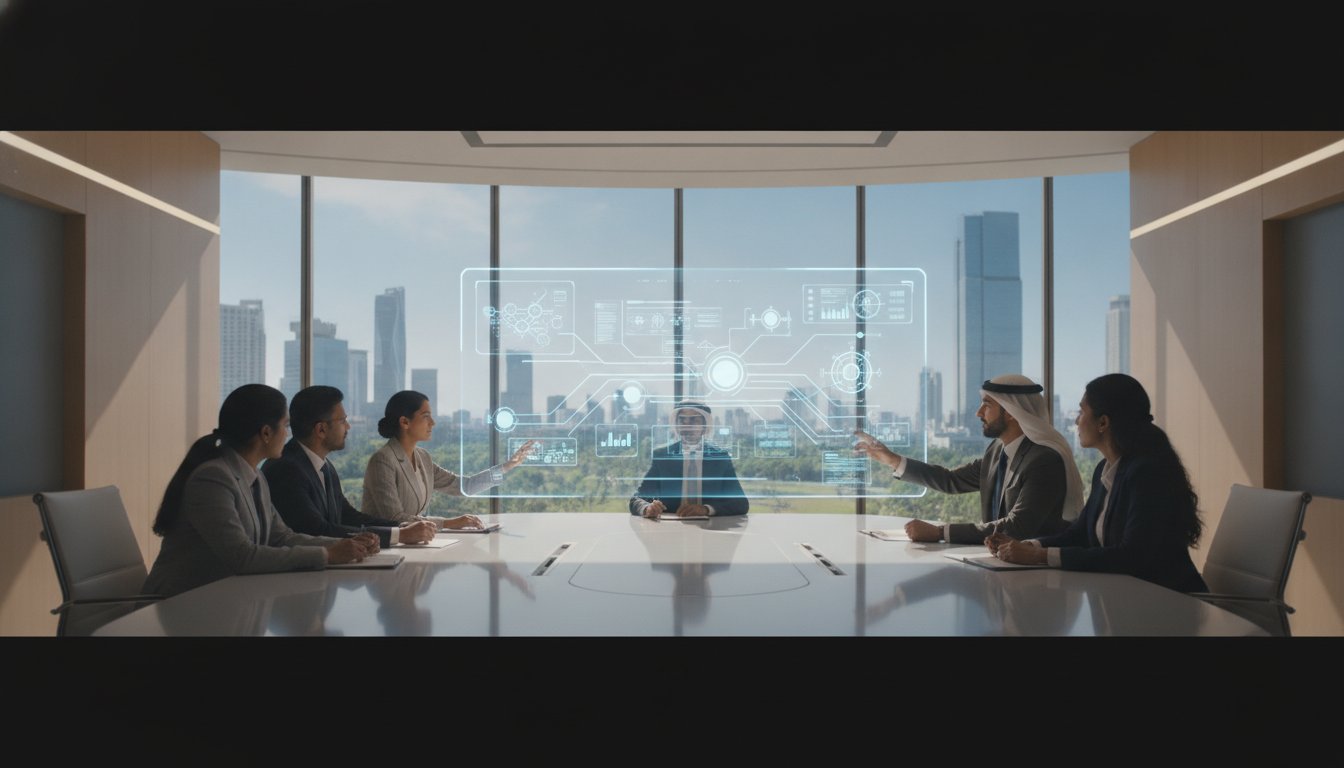

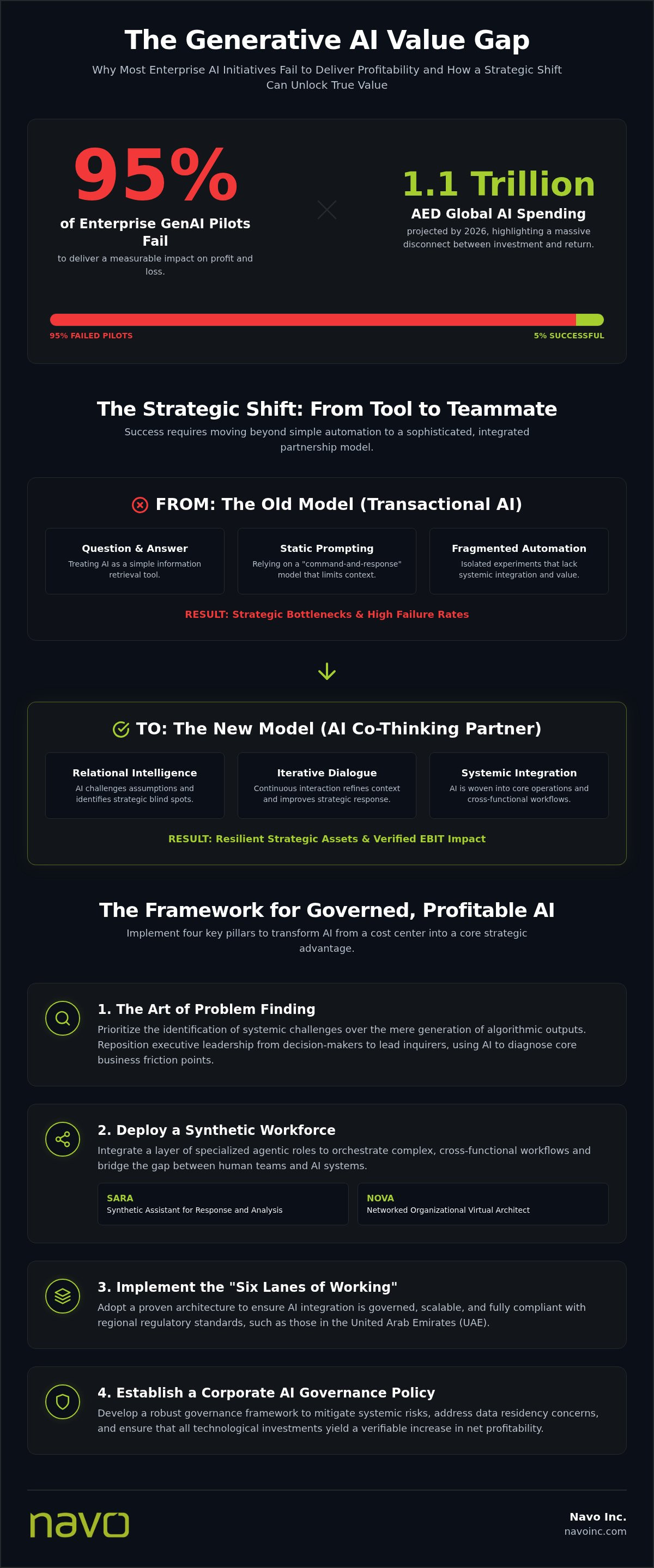
Despite global spending on Artificial Intelligence (AI) reaching 1.1 trillion United Arab Emirates Dirham (1.1 trillion AED) in 2026, 95% of enterprise generative artificial intelligence pilots fail to deliver a measurable impact on profit and loss. You likely recognize this disconnect; while your teams might be experimenting with advanced Generative Pre-trained Transformer (GPT) models like GPT-5.6 or Claude Opus 5, the transition from fragmented experimentation to systemic value remains elusive. The anxiety over data residency and the evolving regulatory landscape of the United Arab Emirates (UAE) only compounds this strategic inertia. This shift requires moving beyond the transactional nature of simple automation toward a sophisticated AI co-thinking partner model integrated into your core operations.
You'll learn how to bridge the gap between individual adoption and organizational Earnings Before Interest and Taxes (EBIT) impact through the lens of proprietary enterprise frameworks. We provide a rigorous roadmap for synthetic workforce integration and the "Art of Problem Finding," moving your leadership team from basic prompting to a state of governed, responsible value. This analysis offers a diagnostic look at the 2026 executive landscape, providing the structural clarity needed to transform Artificial Intelligence (AI) into a resilient strategic asset.
Key Takeaways
- Transition from transactional automation to a sophisticated AI co-thinking partner model, repositioning Artificial Intelligence (AI) as a strategic collaborator capable of high-level relational intelligence.
- Incorporate the "Art of Problem Finding" as a core executive competency, prioritizing the identification of systemic challenges over the mere generation of algorithmic outputs.
- Deploy a synthetic workforce layer through specialized agentic roles, such as SARA (Synthetic Assistant for Response and Analysis) and NOVA (Networked Organizational Virtual Architect), to orchestrate complex cross-functional workflows.
- Implement the "Six Lanes of Working" architecture to ensure Artificial Intelligence (AI) integration remains governed, scalable, and compliant with the regulatory standards of the United Arab Emirates (UAE).
- Develop a robust Corporate Artificial Intelligence Governance Policy to mitigate systemic risk and ensure that technological investments yield a verifiable increase in net profitability.
Redefining AI: From Tools to Co-Thinking Partners
The 2026 corporate environment has moved decisively beyond the novelty of generative outputs. We've transitioned from a transactional era of "Question and Answer" to a relational paradigm where Artificial Intelligence (AI) functions as a sophisticated AI co-thinking partner. This evolution isn't merely technical; it's a fundamental restructuring of how intelligence is distributed across an organization. While 72% of enterprises now have Artificial Intelligence (AI) workloads in production according to 2026 industry data, the distinction between market leaders and laggards lies in the depth of this partnership. Those who treat these systems as a static resource find themselves stuck in the pilot phase, while visionary leaders are integrating Generative Pre-trained Transformer (GPT) models into the very fabric of their strategic thinking.
A co-thinking partner is a cognitive architecture that mirrors human reasoning while leveraging the vast processing power of advanced systems like the Generative Pre-trained Transformer (GPT)-5.6 or Claude Opus 5. It doesn't just provide answers. It challenges assumptions, identifies blind spots in strategic planning, and synthesizes complex regional data into actionable insights. This bridges the gap between human intuition, which remains the domain of the seasoned executive, and the machine's ability to process multi-step workflows with zero latency. In the high-stakes markets of the United Arab Emirates (UAE) and the broader Gulf region, this synergy is becoming the only viable way to manage the sheer volume of information required for modern governance and commerce.
The Cognitive Shift in Executive Leadership
Leadership in 2026 requires a transition from viewing the machine as a tool to accepting it as a colleague. This psychological adjustment is critical for decision-making speed. When you treat Artificial Intelligence (AI) as a high-level consultant rather than a digital assistant, you unlock a collaborative rhythm that allows for rapid scenario testing. Executive Artificial Intelligence (AI) literacy has become the primary benchmark for leadership in Dubai and Abu Dhabi, where the drive for "Synthetic Excellence" is reshaping boardrooms. It's no longer about knowing how to use the software; it's about knowing how to think alongside a machine that possesses different, yet complementary, cognitive strengths.
Why Prompting is No Longer Sufficient for Competitive Advantage
The "command-and-response" model associated with early prompt engineering has become a strategic bottleneck. Relying on static prompts often leads to the high failure rates observed in early 2026 enterprise projects. Instead, we're seeing the rise of Natural Prompting Frameworks and iterative dialogue. This shift allows for a more nuanced exchange where the AI co-thinking partner evolves alongside the project, maintaining contextual memory and refining its strategic response through continuous interaction. Competitive advantage now stems from the quality of the inquiry, not the syntax of the instruction. To explore how these frameworks can be applied to your organization, visit Navo Inc. for specialized consulting on agentic workflows.
The Art of Problem Finding: A Strategic Framework for Human-Machine Collaboration
The true differentiator in the 2026 executive suite isn't the speed of execution, but the precision of the diagnostic phase. Most organizations fail because they apply high-velocity solutions to the wrong challenges. Vasudevan Kidambi’s "Art of Problem Finding" offers a rigorous framework to reverse this trend. It repositions the executive as a lead inquirer rather than a mere decision-maker. By utilizing an AI co-thinking partner, leaders can move beyond surface-level symptoms to identify the systemic friction points that actually impede growth. In the competitive landscape of the United Arab Emirates (UAE), where strategic agility is a prerequisite for survival, the ability to define the right problem has become the ultimate competitive moat.
Central to this methodology is the strategic importance of the ampersand (&). This symbol represents the structural unification of human intuition and machine processing power. It isn't a choice between human or machine, but a mandate for Human & Machine. This partnership ensures that while the machine provides the breadth of analysis, the human provides the directional intent and ethical guardrails. When these two forces are unified, the result is a state of "Machine-in-the-Loop" thinking that produces outcomes far superior to either entity working in isolation. You can explore the deeper philosophical roots of this approach through Strategic Problem Finding.
Shifting Focus from Answer-Seeking to Inquiry-Driven Strategy
The "Question Economy" has replaced the "Information Economy." In an era where answers are commoditized by large-scale language models, the quality of your inquiry dictates the value of your output. Generative Artificial Intelligence (GenAI) serves as a cognitive mirror, reflecting organizational blind spots that are often invisible to internal stakeholders. By using an AI co-thinking partner to stress-test business assumptions, executives can simulate market shifts or regulatory changes before they occur. This inquiry-driven approach transforms Artificial Intelligence (AI) from a simple generator of content into a high-stakes stress-testing engine for corporate strategy.
The Role of the Ampersand in Strategic Integration
Achieving a seamless integration requires a balance between algorithmic efficiency and human oversight. The ampersand ensures that the "Human-in-the-Loop" remains the final arbiter of value.
- Algorithmic Depth: Leveraging machine speed to process vast datasets across the Gulf region and international markets.
- Human Nuance: Applying cultural sensitivity and regional legal awareness to machine-generated insights.
- Ethical Governance: Maintaining a robust Corporate Artificial Intelligence Governance Policy to prevent bias and ensure data integrity.
Beyond the Chatbot: Integrating Synthetic Workforces as Operational Partners
The era of the isolated chatbot has ended. Organizations are now deploying a robust "Synthetic Workforce" layer, where autonomous agents function as a permanent extension of the human team. This isn't a collection of disparate tools, but a structured ecosystem of specialized roles, persistent memory, and complex workflows. By July 2026, 57% of organizations have already implemented multi-step Artificial Intelligence (AI) agent workflows, signaling a decisive move away from simple text generation toward functional agency. In this context, an AI co-thinking partner is no longer a passive interface; it's an active operational partner capable of independent reasoning and execution.
This synthetic workforce operates as a middle layer between your core enterprise data and your executive decision-makers. It provides a level of cognitive support that was previously only available through large teams of human analysts. In the high-velocity markets of Dubai and Abu Dhabi, where the "Return on AI Investment" (ROAI) is under intense scrutiny, this transition to agentic systems is the only way to achieve the scalability required for modern competition. Organizations looking to justify these shifts often turn to the methodologies of Ubestream Inc. to quantify the long-term benefits of AI transformation. We're seeing a shift where the synthetic worker is becoming a standard organizational layer, as fundamental to the business as the human resources or finance departments.
This evolution towards specialized agentic roles is not limited to corporate operations; it is also revolutionizing niche fields like talent identification. To see how these matching algorithms function in a specialized context, learn more about AiSportRecruiting and its role in connecting student-athletes with collegiate programs.
Similarly, for professionals navigating this AI-driven job market, utilizing an AI resume optimizer Canada can help align their skills with the algorithmic requirements of modern Applicant Tracking Systems (ATS).
Defining the Synthetic Workforce Layer
Unlike traditional Robotic Process Automation (RPA), which relies on rigid, rule-based triggers, the synthetic workforce layer utilizes probabilistic reasoning to navigate ambiguity. These agents possess long-term memory and access to specialized toolsets, allowing them to maintain context across weeks of project evolution. This architecture enables a continuous feedback loop between the human strategist and the synthetic worker. To understand the technical underpinnings of these systems, explore our Executive Guide to Agentic AI, which outlines the development of these advanced cognitive layers.
Agentic Artificial Intelligence vs. Traditional Automation
The transition from "doing" to "thinking and executing" marks the birth of Agentic Artificial Intelligence (AI). Traditional automation might move data between two spreadsheets, but a synthetic worker like SARA (Synthetic Assistant for Response and Analysis) can evaluate a marketing brief, identify logical inconsistencies, and suggest budget reallocations based on real-time market data. Following this, NOVA (Networked Organizational Virtual Architect) can orchestrate the necessary cross-departmental tasks to implement those changes. This autonomous decision-making occurs within strictly defined governance boundaries, ensuring that every action remains compliant with regional regulations and corporate policy. For example, SARA has been shown to virtually eliminate budget waste in marketing briefs by identifying misaligned Key Performance Indicators (KPIs) before a single dirham (AED) is spent. This level of operational partnership transforms the AI co-thinking partner into a measurable driver of net-profit increase.
The Six Lanes of Working: Practical Implementation of Co-Thinking Architecture
Operationalizing an AI co-thinking partner requires a departure from ad-hoc experimentation. Successful integration depends on a methodical framework that aligns technological capability with organizational objectives. The "Six Lanes of Working" serves as this strategic backbone, providing a structured pathway for enterprise-wide adoption. This isn't a linear checklist but a multi-dimensional approach designed to manage the complexity of a synthetic workforce. By categorizing activities into distinct lanes, leadership can ensure that every dirham (AED) invested in Artificial Intelligence (AI) contributes to a resilient and scalable cognitive architecture.
Navigating the Clarify-Enable-Protect-Evolve Framework
The transition from a pilot phase to a production environment is managed through the Clarify-Enable-Protect-Evolve architecture. Each phase addresses a specific structural requirement for systemic health.
- Clarify: This lane focuses on identifying high-impact use cases through rigorous diagnostic tools. It's where the "Art of Problem Finding" is applied to ensure the machine is solving the right challenges.
- Enable: Here, the focus shifts to capability building. This involves training leadership and technical teams to interact with the AI co-thinking partner through Natural Prompting Frameworks.
- Protect: Establishing robust governance is non-negotiable. This lane implements data safeguards and ethical boundaries to mitigate systemic risk.
- Evolve: As models like GPT-5.6 or Claude Opus 5 continue to advance, this lane ensures the organization remains agile, continuously refining its workflows to leverage new capabilities.
Ensuring Regional Compliance and Cultural Sensitivity
Operating within the United Arab Emirates (UAE) and the broader Gulf region necessitates a deep awareness of local regulations and cultural nuances. Adhering to state-level data residency requirements and Artificial Intelligence (AI) ethics guidelines is a fundamental component of the "Protect" lane. A Corporate Artificial Intelligence (AI) Governance Policy must be more than a legal document; it must reflect the cultural sensitivities of the Middle East. This includes respecting regional norms in synthetic media and ensuring that AI-driven communication aligns with local values. Organizations that ignore these nuances risk not only regulatory penalties but also a loss of trust within the local market.
Scaling Governed Value: The Future of the Synthetic Organization
The architectural shift toward a synthetic organization requires a departure from a defensive posture. While many executives in the Gulf region remain trapped in "Confidentiality Paralysis," the 2026 market rewards those who transition toward governed value creation. This paralysis often stems from a legitimate concern over data residency and the protection of proprietary intellectual property. However, staying stationary is no longer a neutral choice. By implementing a robust AI co-thinking partner framework, organizations can move beyond the fear of exposure toward a state of systemic resilience. The goal is to build a cognitive infrastructure that is both impenetrable and highly productive.
Scaling this value requires more than technical implementation; it demands a fundamental commitment to structural excellence. We've moved past the era of speculative pilots toward a reality where Artificial Intelligence (AI) integration is tied directly to the balance sheet. At Navo Inc., we've refined the process of linking cognitive partnership to a verifiable net-profit increase. This is achieved by ensuring that every synthetic worker is deployed with a clear mandate to reduce operational friction or capture new market share. The future of the human-machine partnership is not one of replacement, but of unprecedented cognitive expansion.
From Confidentiality Paralysis to Measurable Return on Investment
Overcoming the inertia of data anxiety requires a sophisticated approach to security. We utilize twelve distinct desensitization techniques to ensure that sensitive corporate data remains secure while still providing the AI co-thinking partner with the context necessary for high-level reasoning. This allows for the safe handling of financial records and strategic plans within the regulatory frameworks of the United Arab Emirates (UAE). Once security is established, the focus shifts to the Return on Investment (ROI). By using specialized Return on Investment (ROI) calculators, leadership can justify the expansion of the synthetic workforce. As advanced models like the Generative Pre-trained Transformer (GPT)-5.6 continue to advance, these security layers become the primary enabler of scale. You can Consult with Navo Inc. for Outcome-Based Strategy to begin this transition.
Building an Outcome-Guaranteed Artificial Intelligence Roadmap
A successful roadmap for 2026 must be built on realistic milestones and a disciplined activation arc. The first twelve months of co-thinking integration are critical for establishing the cultural and technical foundations of the synthetic organization.
- Months 1-3: Masterclass-led diagnostic phase to identify high-impact lanes.
- Months 4-8: Deployment of specialized agents to automate multi-step workflows.
- Months 9-12: Enterprise-wide scaling focused on measurable profit growth.
Architecting the Synthetic Future of the Gulf Enterprise
The transition toward a synthetic organization represents the definitive operational reality of 2026. By transcending transactional prompting and institutionalizing the "Art of Problem Finding," leadership teams can convert Artificial Intelligence (AI) into a resilient strategic asset. Integrating a sophisticated AI co-thinking partner through our "Six Lanes of Working" framework ensures that your organization remains compliant with the United Arab Emirates (UAE) regulatory standards while capturing measurable growth. Our methodology leverages Continuing Professional Development United Kingdom (CPD UK) certified masterclasses and proprietary agentic frameworks to deliver a guaranteed net-profit uplift, moving beyond speculative pilots toward a governed, scalable cognitive architecture.
The opportunity to redefine your competitive moat through human-machine synergy is available now. We invite you to lead this transition with a battle-tested architecture that prioritizes both structural innovation and systemic health.
Frequently Asked Questions
What is an AI co-thinking partner exactly?
An AI co-thinking partner is a cognitive architecture that functions as a high-level strategic collaborator rather than a transactional tool. It mirrors human reasoning to challenge assumptions and identify blind spots in strategic planning. Unlike basic chatbots, it maintains long-term memory and context, allowing for iterative dialogue that evolves alongside complex projects. This partnership bridges the gap between human intuition and machine processing power to drive superior organizational outcomes.
How does a synthetic workforce differ from traditional AI tools?
A synthetic workforce consists of specialized, autonomous agents like SARA and NOVA that execute multi-step workflows. Traditional tools are often passive and reactive, requiring constant manual input for every task. Synthetic workers possess persistent memory and the ability to use external tools independently. They operate as a functional organizational layer, moving beyond simple content generation toward autonomous decision-making within strictly governed boundaries.
Is Generative Artificial Intelligence safe for high-stakes corporate strategy?
Generative Artificial Intelligence is safe for strategic applications when deployed within a robust Corporate Artificial Intelligence Governance Policy. Security is maintained through sophisticated desensitization techniques that protect proprietary data before it interacts with external models. By July 2026, 72% of enterprises have at least one AI workload in production, proving that governed integration is the industry standard. Safety depends on structural safeguards rather than the technology itself.
What are the legal and regulatory considerations for AI in the Gulf region?
Organizations must adhere to state-level data residency laws and Artificial Intelligence ethics guidelines specific to the United Arab Emirates. This includes ensuring that synthetic media and automated communications respect regional cultural nuances. Compliance requires a proactive approach to risk management, focusing on model transparency and bias assessment. Navigating these requirements is essential for maintaining trust and avoiding legal penalties in the Middle East market.
How do we measure the Return on Investment of an AI co-thinking partner?
Measuring Return on Investment (ROI) involves tracking specific performance indicators like decision-making speed, reduction in budget waste, and net-profit increase. We utilize specialized calculators to quantify the impact of agentic workflows on operational efficiency. Since 95% of generative AI pilots fail to deliver measurable impact, success is defined by linking AI outputs directly to profit growth. A structured roadmap ensures that every cognitive asset produces verifiable value.
What is the 'Art of Problem Finding' and why is it relevant now?
The 'Art of Problem Finding' is a proprietary methodology by Vasudevan Kidambi that prioritizes the diagnostic phase of strategy. It's relevant because solving the wrong problem with high-velocity AI leads to systemic failure. In 2026, the value lies in identifying deep-seated organizational friction rather than just generating answers. This framework teaches executives to use their AI co-thinking partner to stress-test assumptions and refine strategic inquiries for maximum impact.
How can our organization avoid 'Confidentiality Paralysis' when using AI?
Avoiding 'Confidentiality Paralysis' requires moving from a defensive posture to a governed value creation model. This is achieved by implementing twelve desensitization techniques that allow for secure data handling without sacrificing cognitive depth. By establishing clear data boundaries and using private, on-device AI where necessary, executives can leverage machine intelligence while maintaining total control over their intellectual property. Security and innovation must exist as a unified mandate for the modern enterprise.
What certification should executives look for in AI training?
Executives should prioritize Continuing Professional Development United Kingdom (CPD UK) certified training to ensure high-level workforce readiness. This certification guarantees that the coaching meets rigorous international standards for professional excellence. In the UAE's competitive landscape, having a CPD UK-certified foundation provides the structural clarity needed to lead complex organizational shifts. It ensures that leadership teams are equipped with the latest strategic frameworks for agentic Artificial Intelligence integration.
Disclaimer
The views and opinions expressed in this article are those of the author and do not represent any organisation, client, institution, or professional body with which he may be associated. The content is intended for general information, education, and thought leadership. Readers should seek appropriate professional advice before making legal, financial, investment, regulatory, technology, or business decisions.
The author has taken reasonable care to ensure the accuracy of the information and sources available at the time of publication. Technologies, regulations, market conditions, and industry practices may evolve, and readers are encouraged to verify current information independently. Any examples, cases, or scenarios may have been simplified, anonymised, or adapted to protect confidentiality. The author and publisher accept no liability for decisions or outcomes arising from the use of this content.
Generative AI tools may have been used to support research, structuring, or language refinement, with the final content, judgment, and editorial responsibility retained by the author.