

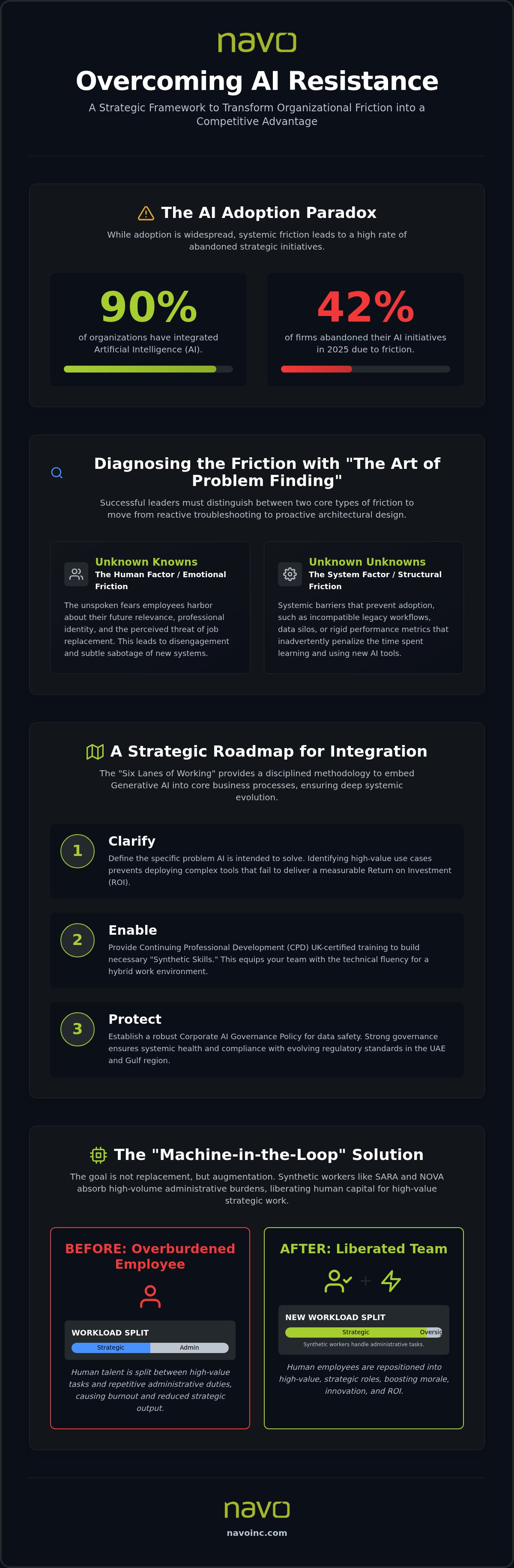
While 90% of organizations have integrated artificial intelligence (AI), a staggering 42% of firms abandoned their strategic initiatives in 2025 due to systemic friction. It's clear that your leadership team likely faces the burden of stalled digital transformation projects and a palpable decline in morale as employees navigate the fear of job replacement. This technical anxiety is rarely a failure of talent. Instead, it represents a critical diagnostic gap in your current operational architecture. Successful leaders recognize that overcoming resistance to AI in the workplace requires moving beyond simple software adoption toward a sophisticated "Machine-in-the-Loop" philosophy.
This guide provides a rigorous framework to transform organizational friction into a distinct competitive advantage. You'll learn to utilize the Art of Problem Finding to secure a measurable return on investment (ROI) while protecting your human capital. We will explore how deploying synthetic workers, such as SARA and NOVA, creates a high-performing hybrid workforce ready for the 2026 regulatory landscape in the United Arab Emirates and the wider Gulf region.
Key Takeaways
- Identify the structural roots of technical anxiety by applying the Art of Problem Finding to move beyond surface-level symptoms of organizational friction.
- Implement a structured integration strategy for overcoming resistance to AI in the workplace by utilizing the Six Lanes of Working to ensure technological tools serve defined operational goals.
- Leverage synthetic workers like SARA and NOVA to manage high-volume administrative tasks, effectively repositioning human employees into high-value, strategic roles.
- Establish a robust governance model that harmonizes global technological progress with the unique legal and cultural sensitivities of the United Arab Emirates and the wider Gulf region.
Diagnosing the Friction: Applying the Art of Problem Finding to AI Resistance
Traditional change management models frequently collapse when applied to Generative Artificial Intelligence (GenAI) because they treat cognitive automation as a standard software update. This approach ignores the nuanced variables of the Technology Acceptance Model, which suggests that perceived usefulness and ease of use are deeply tied to an individual's professional identity. When leadership focuses solely on technical deployment, they miss the underlying systemic friction that prevents true integration.
The Art of Problem Finding is a mechanism for identifying structural rather than emotional friction by uncovering the root causes of adoption failure. This framework forces a distinction between 'Unknown Knowns', which are the unspoken fears employees harbor about their future relevance, and 'Unknown Unknowns', the systemic barriers such as incompatible legacy workflows or rigid performance metrics that inadvertently penalize AI usage. By identifying these gaps, leaders can move from reactive troubleshooting to proactive architectural design.
Moving Beyond the Fear of Replacement
Distinguishing between a genuine fear of replacement and a simple lack of tool-fluency is the first step in overcoming resistance to AI in the workplace. When employees feel their agency is threatened, they disengage or subtly sabotage new systems. Adopting a 'Machine-in-the-Loop' philosophy repositions AI as a co-thinking partner rather than a competitor. As noted by Vasudevan Kidambi, business transformation succeeds when technology enhances human decision-making rather than attempting to automate it entirely. In the context of Dubai's evolving labor regulations, this strategy preserves institutional knowledge while driving technical evolution.
A Strategic Roadmap for Integration: The Six Lanes of Working
The transition from diagnostic insight to operational execution requires a disciplined methodology. The Six Lanes of Working framework provides a rigorous architecture for embedding Generative Artificial Intelligence (GenAI) into the core of your business processes. This model ensures that technological adoption isn't just a surface-level change but a deep systemic evolution.
- Step 1: Clarify. This phase involves defining the specific problem GenAI is intended to solve. Identifying high-value use cases prevents the common pitfall of deploying complex tools that fail to deliver a measurable return on investment.
- Step 2: Enable. This stage provides Continuing Professional Development (CPD) UK-certified training to build necessary Synthetic Skills. You provide your team with the technical fluency required to navigate a hybrid work environment.
- Step 3: Protect. This focus area establishes a robust Corporate AI Governance Policy to ensure data safety. Governance ensures systemic health and is critical for maintaining compliance with the evolving regulatory standards of the United Arab Emirates.
Positioning AI as a Co-Thinking Partner
Effective leadership involves rebranding AI from a potential competitor to an essential collaborator. Moving from "AI as a tool" to "AI as a co-thinker" requires the implementation of the Natural Prompting Framework, where employees engage in iterative, high-level reasoning with the machine. This shift is a cornerstone of overcoming resistance to AI in the workplace, as it reinforces human agency. For a deeper analysis of these operational shifts, review our Synthetic Workforce Development pillar. To tailor these frameworks to your specific organizational needs, you may reach out for a strategic consultation.
Consolidating Trust through Synthetic Workforce Governance
Trust is the final frontier in overcoming resistance to AI in the workplace. While diagnostic tools and roadmaps provide the necessary structure, long-term adoption depends on a clear understanding of the synthetic workforce's role. Synthetic workers like SARA and NOVA are designed to absorb high-volume administrative burdens, not to replace human headcount. This distinction isn't just about morale; it's a strategic necessity. By offloading repetitive cognitive tasks to these agents, your human capital is liberated to focus on strategic high-stakes decision-making.
In the United Arab Emirates and the wider Gulf Cooperation Council (GCC) region, technical adoption must align with specific legal and cultural sensitivities. A robust Classification Framework is necessary to distinguish between public and restricted data, ensuring that sensitive institutional information remains protected. This systemic clarity builds the confidence required for employees to experiment without fear of regulatory breaches. Rigorous governance serves not as a brake on innovation but as the essential enabler of speed by providing the legal safety necessary for rapid evolution.
Implementing an Agentic AI Governance Policy
Establishing an Agentic AI Governance Policy involves defining permitted-use boundaries and clear human-ownership mechanisms for all AI-generated outcomes. Auditability and transparency in these workflows reduce executive anxiety by providing a trail of accountability for every machine-assisted decision. When employees see that AI operates within a disciplined ethical and legal framework, their resistance dissolves into partnership. This shift is fundamental to overcoming resistance to AI in the workplace across the Middle East and North Africa (MENA) region. To ensure your firm remains resilient, you should book a strategic consultation to architect your AI governance and secure your organization’s future in the agentic era.
Architecting the Agentic Enterprise
Successfully overcoming resistance to AI in the workplace requires a transition from reactive crisis management to disciplined architectural design. By applying the Art of Problem Finding and the Six Lanes of Working, leadership teams can transform technical anxiety into a high-performing hybrid workforce. Structural health is the priority. This evolution ensures that synthetic workers like SARA and NOVA enhance rather than replace human ingenuity. Navo Inc. provides the steady hand needed for these high-stakes shifts, utilizing Continuing Professional Development (CPD) UK-certified coaching frameworks to secure organizational resilience. Our consulting model doesn't just promise results; it guarantees a net-profit increase for enterprise clients. This rigor positions your firm as a bold pioneer in the United Arab Emirates.
The path toward a sophisticated agentic future is paved with structural excellence and visionary leadership.
Frequently Asked Questions
How do I identify the root cause of AI resistance in my team?
Identifying the root cause requires a diagnostic approach that separates technical friction from psychological anxiety. Leaders must evaluate whether resistance stems from 'Unknown Knowns,' such as unvoiced fears of obsolescence, or 'Unknown Unknowns,' such as rigid legacy workflows. This structural assessment is a vital step in overcoming resistance to AI in the workplace by addressing specific barriers to tool-fluency.
What are the 'Six Lanes of Working' in AI adoption?
The Six Lanes of Working is a proprietary framework designed to integrate GenAI (Generative Artificial Intelligence) into existing business processes. It begins with the 'Clarify' phase to define the specific problem, followed by 'Enable' which provides Continuing Professional Development (CPD) UK-certified training. This roadmap ensures that technology adoption serves defined operational goals rather than being a superficial software update.
Is a Synthetic Workforce intended to replace human employees?
A Synthetic Workforce is designed to act as a co-thinking partner rather than a replacement for human headcount. AI agents like SARA and NOVA manage high-volume administrative tasks, which allows human employees to focus on strategic high-stakes decision-making. This 'Machine-in-the-Loop' philosophy preserves human agency while driving systemic efficiency and protecting the firm's institutional knowledge.
How does the 'Art of Problem Finding' differ from traditional problem-solving?
The Art of Problem Finding differs from traditional methods by focusing on the diagnostic phase rather than jumping straight to resolution. While traditional problem-solving treats symptoms like low adoption rates, this framework identifies the underlying structural friction. It seeks to uncover why a problem exists in the first place, ensuring that AI tools are deployed to solve the right organizational challenges.
Disclaimer
The views and opinions expressed in this article are those of the author and do not represent any organisation, client, institution, or professional body with which he may be associated. The content is intended for general information, education, and thought leadership. Readers should seek appropriate professional advice before making legal, financial, investment, regulatory, technology, or business decisions.
The author has taken reasonable care to ensure the accuracy of the information and sources available at the time of publication. Technologies, regulations, market conditions, and industry practices may evolve, and readers are encouraged to verify current information independently. Any examples, cases, or scenarios may have been simplified, anonymised, or adapted to protect confidentiality. The author and publisher accept no liability for decisions or outcomes arising from the use of this content.
Generative AI tools may have been used to support research, structuring, or language refinement, with the final content, judgment, and editorial responsibility retained by the author.