

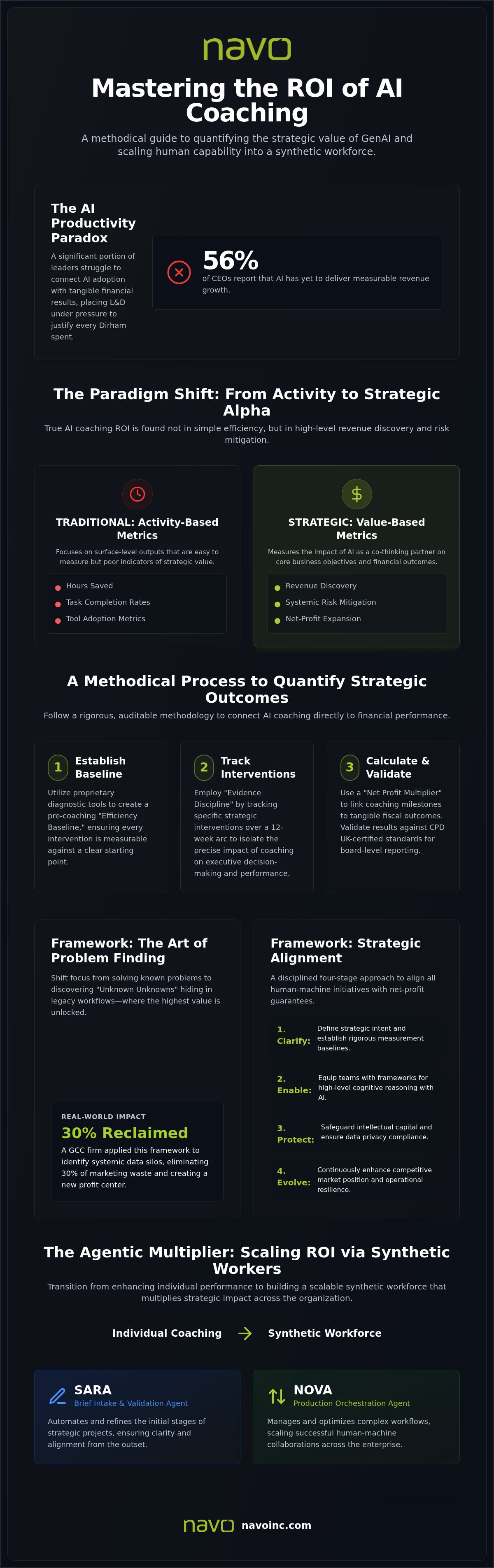
Research from January 2026 reveals a sobering reality: 56% of Chief Executive Officers (CEOs) report that Artificial Intelligence (AI) has yet to deliver measurable revenue growth. This productivity paradox has placed Learning and Development (L&D) leaders under intense pressure, as Finance departments demand rigorous justification for every UAE Dirham (AED) and a clear Return on Investment (ROI). You know the challenge isn't just adopting tools, but proving they move the needle on the balance sheet. Mastering how to measure the ROI of AI coaching is now a survival skill for the modern executive.
This guide provides a sophisticated, McKinsey, BCG, and Bain (MBB)-level methodology to quantify the strategic impact of Generative Artificial Intelligence (GenAI) coaching. We move beyond surface metrics to explore the "Art of Problem Finding" framework, aligning coaching with net-profit guarantees. You'll gain a defensible roadmap for scaling human capability into a synthetic workforce, ensuring your investment generates competitive Alpha.
Key Takeaways
- Pivot from activity-based metrics toward revenue discovery by distinguishing between mere task automation and the strategic co-thinking capabilities of Generative Artificial Intelligence (GenAI).
- Implement a rigorous methodology for how to measure the ROI of AI coaching (Return on Investment of Artificial Intelligence) by utilizing diagnostic tools to establish efficiency baselines and tracking interventions over a 12-week arc.
- Leverage the Agentic Multiplier to transition individual coaching successes into a scalable synthetic workforce, utilizing agents like SARA (Brief Intake and Validation) and NOVA (Production Orchestration).
- Align organizational strategy with net-profit guarantees by applying the "Clarify-Enable-Protect-Evolve" framework to all human-machine collaborative initiatives.
The Paradigm Shift: Defining the ROI of AI Coaching Beyond Productivity
Traditional Return on investment (ROI) models often collapse when applied to high-level executive development because they prioritize "Activity-Based Metrics," such as hours saved or completion rates. While these figures provide a comfortable baseline for Finance departments, they fail to capture the "Strategic Alpha" generated when Generative Artificial Intelligence (GenAI) functions as a sophisticated co-thinking partner. For a Dubai-based enterprise, the true value lies in "Strategic Value Metrics," where revenue discovery and systemic risk mitigation far outweigh simple efficiency gains.
Mastering how to measure the ROI of AI coaching requires a fundamental transition from viewing AI as a software tool to treating it as a cognitive catalyst. Navo Inc. utilizes the "Clarify-Enable-Protect-Evolve" framework to establish a rigorous measurement baseline. By first clarifying strategic intent and enabling high-level reasoning, organizations can protect their intellectual capital while evolving their competitive market position. This disciplined approach moves the financial needle from mere cost reduction to genuine net-profit expansion.
The Art of Problem Finding as a Value Driver
Standard coaching models focus on problem-solving, yet the highest returns emerge from problem discovery. The Art of Problem Finding identifies "Unknown Unknowns" that often hide within legacy operational workflows. Quantifying the value of discovery over solving is essential for executive-level justification. For instance, a prominent firm in the Gulf Cooperation Council (GCC) recently applied this framework to identify systemic data silos, ultimately reclaiming 30% of marketing waste. This transition from addressing known issues to uncovering entirely new profit centers creates a defensible, board-ready narrative for any AI investment.
A Methodical Process for Quantifying Strategic AI Coaching Outcomes
Establishing a baseline is the first prerequisite for understanding how to measure the ROI of AI coaching within a complex enterprise. Navo Inc. initiates this process by establishing a pre-coaching "Efficiency Baseline" through proprietary diagnostic tools, ensuring every strategic intervention remains auditable and transparent. We employ an "Evidence Discipline" approach, tracking specific strategic interventions over a 12-week arc to isolate the precise impact of coaching on executive decision-making. This methodology aligns with leading strategic frameworks for measuring AI ROI, where the analytical focus shifts from general tool adoption to verified, high-stakes performance deltas.
The final financial calculation utilizes a "Net Profit Multiplier," which links coaching milestones directly to tangible fiscal outcomes. By anchoring these results to Continuing Professional Development (CPD) UK-certified standards, organizations secure a defensible, high-register reporting structure suitable for board-level scrutiny. This rigorous validation process ensures that every UAE Dirham (AED) invested is accounted for through measurable revenue growth, operational resilience, or significant cost avoidance.
Isolating the Coaching Variable through Evidence Discipline
Achieving precision in how to measure the ROI of AI coaching requires the implementation of "Machine-in-the-Loop Thinking." This methodical protocol documents the cognitive delta in decision-making speed and quality through a three-step sequence. First, we define the specific Key Performance Indicator (KPI); second, we implement the Natural Prompting Framework; and third, we measure the resulting output quality against historical benchmarks. To maintain strict compliance with Dubai and Singapore privacy regulations, we utilize advanced desensitization toolkits. This ensures that internal ROI data collection remains robust without compromising corporate security or legal standards. If your leadership team requires a tailored diagnostic, it's time to initiate a strategic alignment session with our architects.
The Agentic Multiplier: Scaling Coaching ROI via Synthetic Workers
The ultimate evolution of executive development lies in the "Agentic Multiplier," where the focus shifts from individual performance to Synthetic Workforce ROI (Return on Investment). While previous sections focused on cognitive deltas, the true financial breakthrough occurs when a coached leader orchestrates a "Synthetic Layer" of Artificial Intelligence (AI) agents. By deploying specialized entities such as SARA (Brief Intake and Validation) and NOVA (Production Orchestration), organizations move beyond human limitations. This transition is pivotal for understanding how to measure the ROI of AI coaching, as it quantifies the output of an entire agentic system rather than just a single person.
When a leader is properly coached, they manage these synthetic workers to achieve a documented ≥50% reduction in time-to-acceptance for complex deliverables. This efficiency isn't just about speed; it's about systemic health. Integrating "Agentic AI Governance" into this model acts as a critical risk-mitigation factor, protecting the firm from algorithmic bias and ensuring compliance with Dubai’s evolving digital regulations. This layer of protection adds significant value to the ROI equation by preventing costly legal or reputational failures.
From Individual Coaching to Synthetic Workforce Orchestration
Coaching empowers leaders to act as architects, designing AI agents with precise roles and robust feedback loops. We measure the ROI of "Agentic Orchestration" by comparing its output against the high costs of human manual labor and traditional project management. The final calculation is definitive: rigorous coaching combined with a synthetic workforce equals a guaranteed net-profit increase. This systemic approach provides a comprehensive answer for how to measure the ROI of AI coaching, ensuring every UAE Dirham (AED) spent translates into a scalable, high-performance digital asset.
Architecting the Future of Cognitive Capital
The transition toward a high-performance cognitive economy requires a departure from surface-level productivity metrics. We've explored how a rigorous evidence discipline, rooted in the "Art of Problem Finding," transforms Artificial Intelligence (AI) from a tool into a strategic co-thinking partner. Mastering how to measure the ROI of AI coaching (Return on Investment) ensures that every UAE Dirham (AED) allocated to leadership development results in a documented net-profit increase. By leveraging CPD (Continuing Professional Development) UK-certified masterclasses and the proprietary SARA and NOVA frameworks, your organization can successfully scale human expertise into a resilient synthetic workforce. This methodology provides the board-level clarity needed to navigate complex organizational shifts with absolute composure.
The path to sustainable competitive advantage lies in the disciplined fusion of human leadership and agentic intelligence. We look forward to guiding your organization through this critical structural evolution.
Frequently Asked Questions
How do you differentiate between AI training ROI and AI coaching ROI?
Artificial Intelligence (AI) training Return on Investment (ROI) typically focuses on tactical efficiency and tool proficiency, whereas AI coaching ROI prioritizes the cognitive delta in executive decision-making. While training reduces task time, coaching empowers a leader who's orchestrating complex systems. It's measured through "Strategic Value Metrics," such as revenue discovered through enhanced problem finding rather than just hours saved on a spreadsheet.
Can the ROI of AI coaching be measured for "soft skills" like leadership?
Yes, leadership ROI is quantifiable through the "Evidence Discipline" approach, which tracks the evolution of strategic interventions over time. By documenting the delta in decision-making speed and output quality, organizations can assign a financial value to improved leadership. It's a methodology that provides a rigorous framework for how to measure the ROI of AI coaching even when the primary focus is cognitive orchestration.
What is the typical timeframe to see a positive Return on Investment from GenAI coaching?
Organizations typically observe initial strategic deltas within a 12-week coaching arc. Research from February 2026 indicates that while substantial transformation value outweighs upfront costs in an average of 28 months, tactical gains often appear much sooner. Navo's diagnostic tools help establish an early efficiency baseline, ensuring that every UAE Dirham (AED) invested is tracked toward a positive fiscal outcome from the outset.
How does the "Art of Problem Finding" framework impact the financial bottom line?
The "Art of Problem Finding" framework identifies systemic inefficiencies and "Unknown Unknowns" that traditional models overlook. By shifting focus from solving known issues to discovering new profit centers, firms can reclaim significant capital. A Gulf Cooperation Council (GCC) based firm recently used this methodology to reclaim 30% of marketing waste, demonstrating a direct and defensible impact on the corporate balance sheet.
Is it possible to guarantee a net-profit increase from AI coaching and consulting?
Navo Inc. offers a net-profit increase guarantee within specific consulting and coaching models. It's a commitment underpinned by a rigorous methodology that aligns Generative Artificial Intelligence (GenAI) initiatives with measurable business outcomes. By integrating synthetic workers like SARA and NOVA, we ensure that the strategic shift from human manual labor to agentic orchestration delivers a verifiable and scalable financial return.
Disclaimer
The views and opinions expressed in this article are those of the author and do not represent any organisation, client, institution, or professional body with which he may be associated. The content is intended for general information, education, and thought leadership. Readers should seek appropriate professional advice before making legal, financial, investment, regulatory, technology, or business decisions.
The author has taken reasonable care to ensure the accuracy of the information and sources available at the time of publication. Technologies, regulations, market conditions, and industry practices may evolve, and readers are encouraged to verify current information independently. Any examples, cases, or scenarios may have been simplified, anonymised, or adapted to protect confidentiality. The author and publisher accept no liability for decisions or outcomes arising from the use of this content.
Generative AI tools may have been used to support research, structuring, or language refinement, with the final content, judgment, and editorial responsibility retained by the author.