

What if the primary obstacle to your organizational growth isn't the technical limitation of the models, but the structural fragility of your implementation strategy? Most leadership teams across the Gulf states and Singapore find themselves trapped in what we call Pilot Purgatory, where small-scale tests of Generative Artificial Intelligence fail to translate into measurable bottom-line expansion. You've likely realized that isolated experiments don't survive the transition to core operations without a fundamental shift in how you view your human-machine capital. Scaling generative AI in enterprise environments in 2026 requires moving past the curiosity phase and into a reality where synthetic workers are treated as high-stakes strategic assets.
We've designed this guide to help you bridge the gap between experimental potential and guaranteed economic outcomes. You'll discover a structured roadmap for integrating a synthetic workforce into your core systems, utilizing our proprietary Art of Problem Finding framework to reclaim budgets often lost to poor briefing. We'll also provide a clear pathway for navigating the complex regulatory landscapes of the Middle East and Asia, ensuring your Agentic Artificial Intelligence systems remain compliant while delivering the efficiency and profit growth your stakeholders demand.
Key Takeaways
- Transcend the limits of "Pilot Purgatory" by adopting a systemic strategy for scaling generative AI in enterprise environments that integrates synthetic workers into your core organizational fabric.
- Utilize the "Six Lanes of Working" framework to architect a scalable environment for Agentic Artificial Intelligence (Agentic AI) that aligns with your specific business objectives.
- Adopt the "Art of Problem Finding" to identify high-impact use cases, preventing the common pitfall of scaling inefficient processes through automation.
- Secure your operations with a Corporate Artificial Intelligence Governance (Corporate AI Governance) policy tailored to the unique regulatory landscapes of Dubai, Riyadh, and Singapore.
- Transition to an outcome-guaranteed transformation model designed to deliver measurable increases in net profit and operational resilience.
The 2026 Paradigm Shift: From Experimental Pilots to Synthetic Workforce Scalability
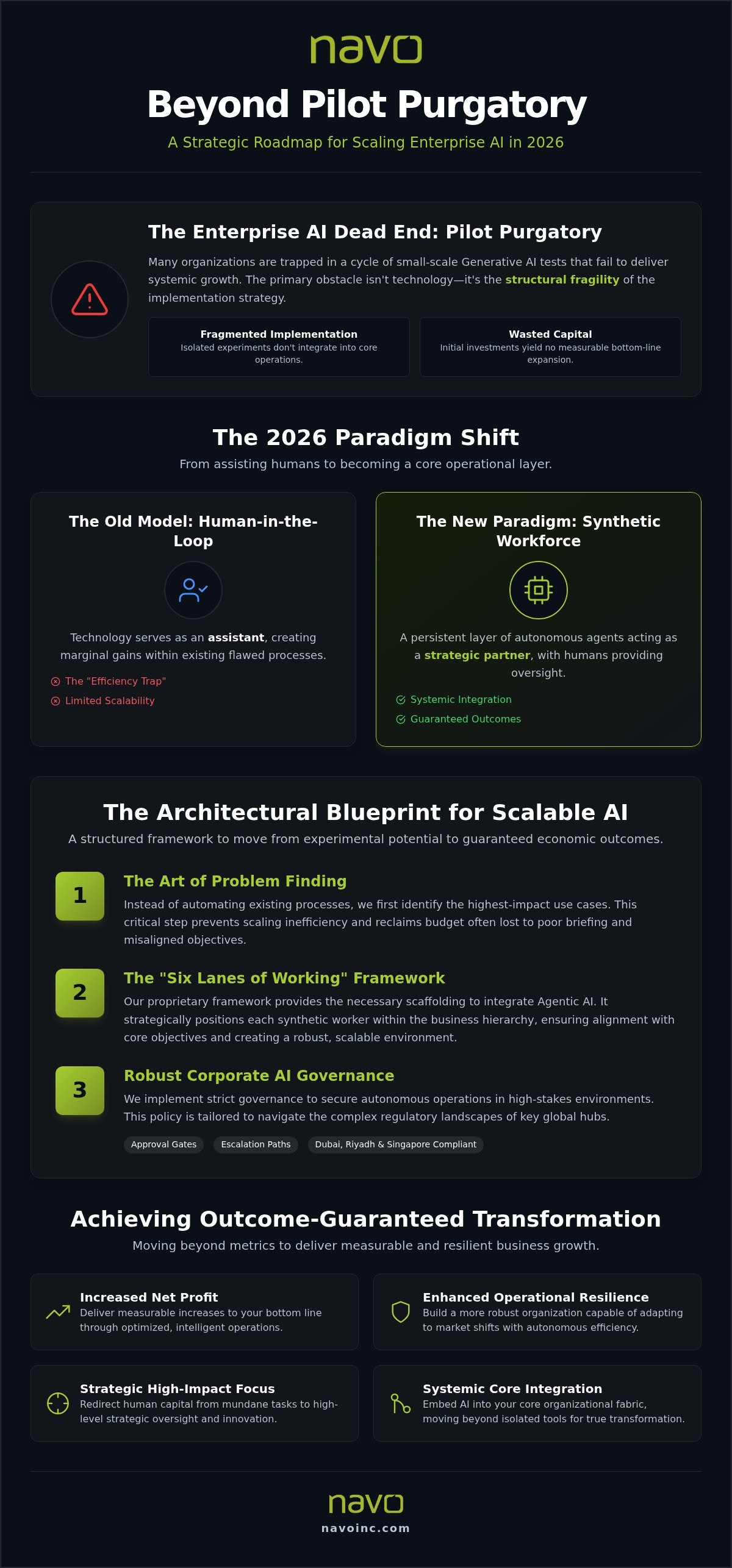
By 2026, the corporate world has reached a definitive crossroads. The era of the "novelty pilot" has concluded, leaving many organizations in a state of exhaustion known as Pilot Purgatory. This is the stage where small-scale tests and isolated use cases fail to deliver the systemic growth required to justify their initial investment. For mature enterprises in global hubs like Dubai and Singapore, the focus has shifted from mere experimentation to the rigorous process of scaling generative AI in enterprise operations. This transition isn't just a technical upgrade; it's a fundamental re-engineering of the organizational fabric.
True scalability involves moving beyond the "human-in-the-loop" model, where technology merely assists a person, toward a "machine-in-the-loop" reality. In this new paradigm, Generative Artificial Intelligence (Generative AI) serves as the primary engine for complex workflows, with human experts providing high-level strategic oversight and governance. We define this systemic integration as the creation of a Synthetic Workforce, a persistent layer of digital capability that operates with defined roles, memory, and feedback loops.
Why Traditional Scaling Models Fail the Modern Enterprise
Many leadership teams mistakenly treat Artificial Intelligence (AI) as a standard software rollout, similar to a new Enterprise Resource Planning (ERP) system. This approach is fundamentally flawed because it ignores the probabilistic nature of the technology. Traditional models often fall into the Efficiency Trap, where marginal gains in speed or content production don't actually lead to structural profit. If you automate a flawed process, you simply accelerate inefficiency. Scaling fails when there's a gap between the technical capability of the model and the organizational readiness of the workforce. Without a framework like our "Six Lanes of Working," enterprises struggle to align these powerful tools with their broader business strategy, leading to fragmented implementation and wasted capital.
The Emergence of the Synthetic Workforce Layer
The Synthetic Workforce represents the next evolution of the labor market. Unlike traditional software that requires rigid inputs, synthetic workers are autonomous agents capable of managing sophisticated tasks, maintaining context through organizational memory, and improving through continuous feedback. This layer sits between your legacy software systems and your human employees, acting as a bridge that translates high-level strategic intent into precise operational output. It's a shift from viewing technology as a tool to viewing it as a colleague. Within this framework, we define the Synthetic Workforce as a strategic co-thinking partner for leadership that reclaims budget lost to poor briefing and structural misalignment. This workforce doesn't just do more work; it does better work by applying the Art of Problem Finding to every task it encounters.
Structural Architecture: Integrating Agentic AI and Synthetic Workers into Core Operations
Successfully scaling generative AI in enterprise environments requires a transition from isolated toolsets to a robust structural architecture. Organizations can no longer rely on fragmented deployments. Instead, they must implement integrated Agentic Artificial Intelligence (Agentic AI) services that possess both agency and defined purpose. Our "Six Lanes of Working" framework provides the necessary scaffolding for this integration, ensuring that every synthetic worker is positioned strategically within the business hierarchy. This architectural approach allows for the implementation of strict Approval Gates and defined Escalation Paths. These safeguards are essential for managing autonomous agents in high-stakes environments, particularly within the rigorous regulatory frameworks of Dubai, Riyadh, and Singapore.
A significant portion of operational waste in modern firms stems from poor communication and ambiguous briefs. By integrating AI agents into the brief intake and validation process, enterprises can reclaim substantial portions of their budgets often lost to "re-work" and misalignment. These agents act as the first line of defense, utilizing sophisticated validation protocols to ensure every project has clear, actionable parameters before human resources are ever committed. This approach aligns with a broader enterprise AI transformation strategy that prioritizes outcome-based efficiency over mere activity, ensuring that the synthetic workforce remains a profit-generating asset rather than a technical burden.
Designing AI Agents with Defined Business Roles
Generic chatbots are insufficient for the sophisticated needs of the 2026 enterprise. The focus has shifted toward designing specialized agents that fulfill specific business roles, such as market intelligence analysts, project orchestrators, or supply chain auditors. These synthetic workers are equipped with organizational "Memory" to maintain long-term context and "Tools" to interact directly with existing enterprise software. Navo’s methodology ensures these agents operate strictly within permitted-use boundaries, maintaining the integrity of your Corporate Artificial Intelligence Governance (Corporate AI Governance) policy while driving measurable results.
Orchestrating the Synthetic-Human Hybrid Workforce
The ultimate objective is the seamless orchestration of a synthetic-human hybrid workforce. In this model, AI agents serve as "Co-Thinking Partners" rather than simple automation scripts. This shift allows human employees to transition from execution-heavy roles to higher-value activities like "Problem Finding" and strategic governance. This evolution ensures that your human capital is focused on the most complex organizational challenges while the synthetic layer handles the heavy lifting of data synthesis and routine orchestration. For a deeper look at how to operationalize this transition, consult our Synthetic Workforce Development Guide. If you're ready to evaluate your current architecture, you might consider scheduling a strategic consultation to explore your specific organizational needs.
The Art of Problem Finding: Identifying High-Impact Use Cases for Strategic Scalability
Scaling generative AI in enterprise environments necessitates a fundamental shift from "Problem Solving" to "Problem Finding." Most organizations rush to apply technology to visible symptoms without diagnosing the underlying structural weaknesses. This reactive approach leads to what we identify as Automated Inefficiency, where flawed processes are accelerated by high-speed computation, resulting in amplified operational waste rather than strategic growth. In high-stakes markets like Dubai and Singapore, where precision is a prerequisite for leadership, the ability to discern which problems are worth scaling is the ultimate competitive advantage.
To mitigate the risks of misdirected capital, leadership teams must utilize sophisticated diagnostic tools. These include proprietary Return on Investment (ROI) calculators and organizational readiness surveys designed to evaluate the friction points within current workflows. By adopting an outcome-based strategy, enterprises can move away from open-ended experimentation and toward a model where every deployment is tied to a specific financial or operational benchmark. This diagnostic rigor ensures that the synthetic workforce is deployed only where it can provide the highest leverage, reclaiming budgets that are typically lost to poor briefing and structural misalignment.
Moving Beyond Low-Hanging Fruit to Strategic Value
Low-hanging fruit, such as automated email drafting or basic content generation, offers negligible competitive advantage in a mature market. True scalability is found in "High-Stakes" problems that require complex reasoning and multi-step orchestration. For example, using Artificial Intelligence (AI) to synchronize multi-region supply chains or to perform real-time market intelligence synthesis provides far greater value than simple administrative automation. Our leadership coaching programs are essential in this transition, shifting the executive mindset away from tactical tool-usage toward visionary strategic transformation. We help leaders identify the unique intersection where technology meets organizational health.
Frameworks for Measuring Scaled AI Impact
Sustainable growth is managed through our Clarify-Enable-Protect-Evolve framework. This methodology provides a structured pathway for organizations to track profit increases and efficiency gains as they scale their operations. It's not enough to deploy; you must also protect the integrity of your systems and evolve them as market conditions shift. To sustain these advancements, we provide Continuing Professional Development (CPD) United Kingdom-certified training for leadership teams. This ensures that your human capital develops the necessary governance skills to manage an increasingly complex synthetic layer. By focusing on these rigorous benchmarks, the process of scaling generative AI in enterprise becomes a predictable engine for long-term resilience and economic expansion.
Governance and the Six Lanes: Ensuring Responsible Scaling in Global Markets
Scaling generative AI in enterprise environments requires more than technical foresight. It demands a rigorous governance architecture that preserves organizational integrity while enabling rapid evolution. As we enter the Agentic Era, the risks associated with autonomous systems necessitate a comprehensive Corporate Artificial Intelligence Governance (Corporate AI Governance) policy. This isn't a peripheral compliance exercise; it's a core strategic requirement. Without a structured framework, the transition from experimental pilots to a full-scale synthetic workforce can introduce systemic vulnerabilities that threaten both reputation and revenue. Our "Six Lanes of Working" framework addresses this by embedding governance directly into the operational workflow, ensuring that every AI agent operates within a defined lane of responsibility and oversight.
For entities operating in Dubai, Riyadh, or Singapore, the regulatory environment is characterized by a sophisticated blend of technological ambition and cultural preservation. Maintaining cultural sensitivity in Artificial Intelligence-generated (AI-generated) communications isn't merely a matter of etiquette. It's a legal and reputational mandate. Auditability must be baked into the system from the start, ensuring that every action taken by a synthetic worker can be traced back to a human-ownership mechanism. This ensures that scaling generative AI in enterprise leads to systemic health rather than legal liability, positioning your organization as a trustworthy leader in the regional market.
Navigating Regional Regulatory Landscapes
The Gulf Cooperation Council (GCC) region is witnessing an accelerated shift toward structured oversight. In the United Arab Emirates (UAE), the regulatory focus for 2026 emphasizes transparency, including requirements for machine-readable watermarking and the clear detection of artificially generated content. These standards, while mirroring international frameworks like the European Union (EU) AI Act, are tailored to the specific economic goals of the region. Similarly, in Asian markets like Malaysia and India, data safeguards and permitted-use boundaries are becoming increasingly stringent to protect consumer rights. Organizations must recognize that being regulatory 'Safe' is the minimum benchmark for enterprise trust; true leadership involves exceeding these standards through proactive internal policies.
The Ethics of the Synthetic Workforce
Transparency is the cornerstone of a functional synthetic-human hybrid workforce. When AI agents interact with clients or stakeholders, their identity and the scope of their autonomy must be explicitly clear. We implement the "Dual-Acceptance Lock" as a critical mechanism for auditable truth. This protocol requires human verification for high-stakes decisions, ensuring that while the machine executes the heavy lifting, the human remains the ultimate arbiter of value and ethics. This balance prevents the "black box" effect where decision-making becomes opaque and untraceable. For more on selecting the right partners to build these resilient systems, see our Executive Guide to GenAI Consulting.
Navo Inc. Strategy: Achieving Outcome-Guaranteed Enterprise AI Transformation
The transition from fragmented experimentation to structural excellence requires a partner who understands that technology is a means, not an end. Navo Inc. positions itself as a visionary strategist for organizations ready to move beyond the limitations of traditional management consulting. While many industry peers offer effort-based engagements, our model is built on the principle of outcome-guaranteed transformation. We don't just provide advice; we deliver a verifiable increase in net profit. By focusing on the systemic health of your organization, we ensure that scaling generative AI in enterprise environments becomes a predictable driver of economic value rather than an unpredictable cost center. This commitment to tangible results is what distinguishes our partnership from the standard "Big 4" or "MBB" firm offerings.
Future-proofing your talent is equally critical to sustaining these gains. We provide Continuing Professional Development (CPD) United Kingdom-certified masterclasses for leadership teams across Dubai, Singapore, and the wider Middle East. These sessions are designed to move executives from passive observation to the disciplined architecture of change. We don't just teach you how to use tools; we empower you to govern a synthetic workforce with the same rigor you apply to your human capital. This educational foundation ensures that your organization remains resilient as the technological frontier continues to shift.
The Navo Advantage: Framework-Led, Tool-Agnostic Transformation
A primary failure in many digital initiatives is the reliance on specific software vendors. Navo Inc. maintains a strictly tool-agnostic position, ensuring that your strategy is led by frameworks like the "Six Lanes of Working" rather than the limitations of a single platform. This independence is essential for long-term scalability and resilience. We integrate advanced Artificial Intelligence Video (AI Video) and Agentic Artificial Intelligence (Agentic AI) services to elevate your brand and operational efficiency without locking you into a rigid technical stack. This high-level strategic direction is spearheaded by Vasudevan Kidambi, whose expertise in navigating complex organizational shifts has defined our approach to modern business challenges.
Next Steps: From Strategy to Activation
The journey toward a fully operational synthetic workforce begins with a structured 5-week transformation program. This process starts with the deployment of diagnostic surveys to establish a baseline for your current capabilities and identify the highest-leverage opportunities for scaling generative AI in enterprise workflows. We use these insights to build a roadmap that aligns with your specific regional regulations and profit objectives. By moving from strategy to activation with clinical precision, we help you reclaim budgets lost to inefficient briefing and structural misalignment. The era of observation is over. It's time to architect your future.
Partner with Navo Inc. to scale your Generative Artificial Intelligence strategy today
Architecting the Next Era of Organizational Excellence
The transition to a synthetic workforce is no longer a speculative future but a current operational necessity for leaders across the Middle East and Asia. By moving beyond isolated tests and embracing the proprietary Art of Problem Finding framework, your organization can avoid the common pitfalls of automated inefficiency. Scaling generative AI in enterprise environments requires a disciplined integration of Agentic Artificial Intelligence (Agentic AI) supported by the Six Lanes of Working methodology. This approach ensures that every deployment is governed by rigorous regional standards while delivering a guaranteed net-profit increase. Through our Continuing Professional Development (CPD) United Kingdom-certified masterclasses, your leadership team will gain the strategic expertise needed to manage this sophisticated hybrid workforce with absolute confidence.
We invite you to move beyond observation and join us in building a more resilient, profit-driven future for your global operations.
Frequently Asked Questions
What does it mean to scale Generative Artificial Intelligence (GenAI) in an enterprise context?
Scaling generative AI in enterprise environments involves the systemic transition from isolated, experimental pilots to a deeply embedded operational layer. It's about moving past the "Pilot Purgatory" phase where small-scale tests fail to impact the bottom line. Instead, you integrate synthetic workers into your core organizational fabric, ensuring that Artificial Intelligence (AI) serves as a persistent engine for growth and resilience across all departments.
How do synthetic workers differ from traditional automation tools?
Synthetic workers differ from traditional automation through their capacity for reasoning, memory, and autonomous agency. While traditional tools follow rigid, rule-based scripts, synthetic workers act as "Co-Thinking Partners." They maintain context over long-term projects and can adapt to complex, multi-step workflows. This makes them far more flexible and strategically valuable than the static software of previous eras.
What are the primary risks of scaling Generative Artificial Intelligence without a governance framework?
Scaling Generative Artificial Intelligence (Generative AI) without a robust governance framework risks creating "Automated Inefficiency." Without clear Approval Gates and Escalation Paths, autonomous agents may produce errors at scale or violate regional regulatory standards. This lack of oversight can lead to significant financial waste and long-term reputational damage, particularly in high-stakes markets where auditability is a prerequisite for trust.
How can enterprises in the Gulf region ensure AI compliance with local regulations?
Enterprises in the United Arab Emirates (UAE) and the wider Gulf Cooperation Council (GCC) region must prioritize transparency and cultural alignment. Compliance involves adhering to emerging laws regarding machine-readable watermarking and the disclosure of artificially generated content. Implementing a tailored Corporate Artificial Intelligence Governance (Corporate AI Governance) policy ensures that your synthetic workforce respects local legal requirements while maintaining high standards.
What is the 'Art of Problem Finding' and why is it essential for AI ROI (Return on Investment)?
The "Art of Problem Finding" is a proprietary diagnostic framework used to identify high-leverage organizational challenges before any technology is deployed. It's essential for achieving a high Return on Investment (ROI) because it prevents you from automating flawed or low-value processes. By focusing on the right problems, you ensure that scaling generative AI in enterprise operations leads to measurable economic expansion.
Can Navo Inc. guarantee profit increases through Generative Artificial Intelligence consulting?
Yes, Navo Inc. offers an outcome-guaranteed consulting model that specifically targets a net-profit increase for our clients. We move beyond the effort-based billing of traditional firms to focus on clinical, measurable business results. This approach ensures that your investment in Generative Artificial Intelligence (Generative AI) is directly tied to the systemic health and financial growth of your organization.
How long does it typically take to see measurable results from a scaled GenAI implementation?
Measurable results typically emerge following our structured 5-week leadership transformation journey. While the initial strategic alignment happens quickly, enterprises often see significant throughput improvements of 25 to 40 percent within two quarters of full implementation. The exact timeline depends on the complexity of your existing infrastructure and the specific "Six Lanes of Working" you choose to activate first.
What role does CPD (Continuing Professional Development) UK certification play in AI training?
Continuing Professional Development (CPD) United Kingdom (UK) certification serves as an international benchmark for educational quality and professional rigor. In our masterclasses, this certification ensures that your leadership team is receiving high-register training that meets global standards. It's a critical component of future-proofing your human capital, giving them the verified skills needed to govern a synthetic workforce effectively.
Disclaimer
The views and opinions expressed in this article are those of the author and do not represent any organisation, client, institution, or professional body with which he may be associated. The content is intended for general information, education, and thought leadership. Readers should seek appropriate professional advice before making legal, financial, investment, regulatory, technology, or business decisions.
The author has taken reasonable care to ensure the accuracy of the information and sources available at the time of publication. Technologies, regulations, market conditions, and industry practices may evolve, and readers are encouraged to verify current information independently. Any examples, cases, or scenarios may have been simplified, anonymised, or adapted to protect confidentiality. The author and publisher accept no liability for decisions or outcomes arising from the use of this content.
Generative AI tools may have been used to support research, structuring, or language refinement, with the final content, judgment, and editorial responsibility retained by the author.