

Defining the Synthetic Worker: Beyond Social Media Automation
The enterprise landscape is saturated with social media tools promising efficiency. However, these platforms, largely operating as sophisticated schedulers or content generators, represent a fundamentally different class of technology from a synthetic worker for social media management. Understanding this distinction is the first critical step for executives planning their 2026 digital strategy. A traditional Software-as-a-Service (SaaS) tool is an instrument; a synthetic worker, built on an agentic framework, is a digital colleague.
- The Distinction: Tool vs. Agent. A software tool executes predefined, narrow commands. It requires a human operator to provide constant input, strategic direction, and context for every task. In contrast, a synthetic worker is an autonomous agent assigned a specific role. It possesses memory, learning capabilities, and the agency to pursue high-level objectives, not just execute isolated prompts.
- The Failure of Traditional Automation. Standard automation excels at repetitive tasks but fails spectacularly at capturing strategic intent and brand nuance. A script can schedule 100 posts, but it cannot discern a subtle shift in consumer sentiment in the Riyadh market or adjust its content strategy in response to a competitor's surprise campaign in Singapore. This is where automation hits its ceiling, leaving the most valuable work—strategic thinking—entirely on the shoulders of the human team.
- The Co-Thinking Partner Paradigm. A synthetic worker should not be viewed as a digital script but as a ‘co-thinking partner’. It ingests strategic goals, analyzes performance data, and proposes courses of action. It operates within a governed framework, allowing it to manage complex workflows while freeing human managers to focus on architecting strategy rather than micromanaging execution.
- The 2026 Shift: From Prompts to Autonomous Workflows. The current era of Generative Artificial Intelligence (GenAI) is largely defined by prompting—a human telling a machine what to do. The next evolution, which will define 2026, is the era of agentic workflows. Here, a human defines the objective (e.g., "Increase engagement with Gen Z in Dubai by 15% this quarter"), and a team of synthetic workers orchestrates the entire process, from market research to content creation and performance analysis, to achieve it.
The Anatomy of a Synthetic Social Media Manager
To move from a conceptual understanding to practical application, it is essential to dissect the core components of a synthetic social media manager. This is not about software features but about architecting a new workforce layer capable of shouldering genuine responsibility.
- Role Definition: The foundation of any synthetic worker is a clearly defined role charter. This involves establishing its objectives, key performance indicators (KPIs), operational boundaries, and escalation protocols. Is its role to manage community engagement, orchestrate content production, or analyze competitive intelligence? Clarity here prevents scope creep and ensures the agent’s actions are aligned with business outcomes.
- Memory and Context: Unlike a stateless tool that treats every request as its first, a synthetic worker maintains a persistent memory. It learns from past campaign performance, understands which content formats resonate with specific demographics, and retains context from previous interactions. This contextual awareness is what allows it to make increasingly sophisticated and brand-aligned decisions over time.
- Tool Integration: An effective synthetic worker does not operate in a vacuum. It must be integrated into the existing enterprise technology stack. This means granting it governed access to analytics platforms (e.g., Google Analytics, Brandwatch), Customer Relationship Management (CRM) systems, design software, and internal communication channels to both gather data and execute tasks seamlessly.
Why 'Problem Finding' Precedes Prompting
The true value of an agentic system is unlocked not by giving it better prompts, but by giving it better problems to solve. The most significant limitation of current GenAI adoption is the corporate world’s focus on execution-based commands ("write a post") rather than outcome-oriented challenges.
- Applying Navo's 'Art of Problem Finding': We advocate for applying a structured Strategic Problem Finding framework before deploying any synthetic worker. This methodology forces leadership to articulate the core business challenge with precision. The goal shifts from a superficial prompt to a deeply considered strategic objective.
- From Task to Strategy: Instead of instructing an AI to "write a social media post about our new product for the Riyadh market," a problem-finding approach reframes the objective to "solve the 20% decline in new user engagement we've observed in the Riyadh market over the last quarter." This higher-order problem gives the synthetic worker the strategic space to analyze data, identify root causes, and propose a multi-faceted campaign, moving it from a mere content generator to a strategic problem-solver.
- Defining the 'Lane of Working': The human strategist's role evolves into defining the agent's 'Lane of Working'. This means setting the strategic guardrails, business constraints, and desired outcomes. The human becomes the architect of the problem, while the synthetic worker becomes the architect of the solution, operating autonomously within its designated lane.
The Architecture of Agentic AI for Social Media Management
A robust synthetic workforce is not a single piece of software but an orchestrated system of specialized agents, feedback loops, and human oversight. This architecture ensures that autonomy is balanced with control, and scalability is paired with strategic alignment. For social media management, this structure is designed to handle the entire content lifecycle, from initial concept to final performance report, with precision and governance.
- The 'Six Lanes of Working' Framework: This proprietary framework structures the deployment of synthetic agents across distinct operational functions. For social media, these lanes could include strategic planning, trend analysis, content creation, community management, performance analytics, and compliance monitoring. Each agent specializes in its lane but collaborates with others to achieve the overarching campaign goal.
- Building Feedback Loops: A critical architectural component is the feedback loop. Synthetic workers must be designed to self-correct based on real-time data. If a particular content pillar is underperforming, the analytics agent should communicate this to the content creation agent, which then adjusts its output for the next cycle. This continuous optimization is what drives exponential performance gains.
- Approval Gates and Escalation Paths: Autonomy does not mean abdication of responsibility. The architecture must include predefined approval gates for high-stakes actions, such as budget allocation or crisis communications. These 'Human-in-the-Loop' checkpoints ensure that a human strategist retains ultimate authority, while 'Machine-in-the-Loop' processes handle routine quality checks, keeping the workflow efficient.
- Multi-Agent Orchestration: A sophisticated social media strategy requires collaboration. For instance, one agent might be tasked with monitoring emerging trends in the Gulf Cooperation Council (GCC) region, another with generating culturally resonant creative briefs, and a third with producing AI-driven video content. An orchestrator agent manages the workflow between them, ensuring a seamless handoff from insight to execution.
Stage 1: Strategic Intake and Brief Validation
One of the most significant sources of budget waste in corporate marketing is the "poor brief" problem. Vague, incomplete, or contradictory creative requests lead to endless revision cycles and misaligned outcomes. Industry analysis suggests that as much as 33% of a social media department's budget can be lost to this inefficiency. An agentic system addresses this at the source.
- Automated Brief Enhancement: A synthetic worker tasked with intake can be designed to validate all incoming social media requests against a predefined set of strategic criteria. It can automatically flag missing information, question ambiguous objectives, and even enrich the brief with relevant market data or past performance insights before it ever reaches a human or creative agent.
- Dual-Acceptance Workflow: To ensure a single, auditable source of truth, the system can enforce a dual-acceptance workflow. The human stakeholder who submitted the request and the synthetic worker (or its human supervisor) must both formally approve the validated brief. This creates an unbreakable chain of accountability and eliminates the "I thought you meant..." conversations that plague creative processes.
- Dynamic Request Scoring: Not all requests are created equal. The intake agent can dynamically score creative briefs based on their potential impact, strategic alignment, and required resources. This allows for intelligent resource allocation, ensuring that high-priority initiatives receive the attention they deserve while lower-priority tasks are handled efficiently.
Stage 2: Autonomous Content Production and Orchestration
Once a brief is validated, the production and orchestration phase begins. Here, a synthetic worker or a team of agents manages the entire content lifecycle, transforming a strategic directive into a finished, approved, and scheduled asset. This moves beyond simple text generation into a comprehensive production workflow.
- Lifecycle Management: The agent orchestrates the process from trend detection and keyword analysis to copywriting, visual asset generation (including AI-driven video production), and scheduling. It ensures that all content adheres to brand guidelines, tone of voice, and the specific nuances of the target platform and region.
- Maintaining a 'Machine-in-the-Loop' Approach: For high-stakes brand communications, a 'Machine-in-the-Loop' (MitL) system provides an essential layer of quality control. Before publication, another specialized AI agent can review content for compliance, brand safety, and factual accuracy. This automated check minimizes human error and reduces legal and reputational risk, which is especially critical in regulated industries or culturally sensitive markets.
- Localized Content Generation: A key advantage of an agentic system is its ability to scale localization. By connecting to regional data sources and being trained on local cultural nuances, a synthetic worker can adapt a global campaign theme into highly specific, relevant content for markets like Dubai, Kuala Lumpur, or Mumbai, far more efficiently than a centralized human team.
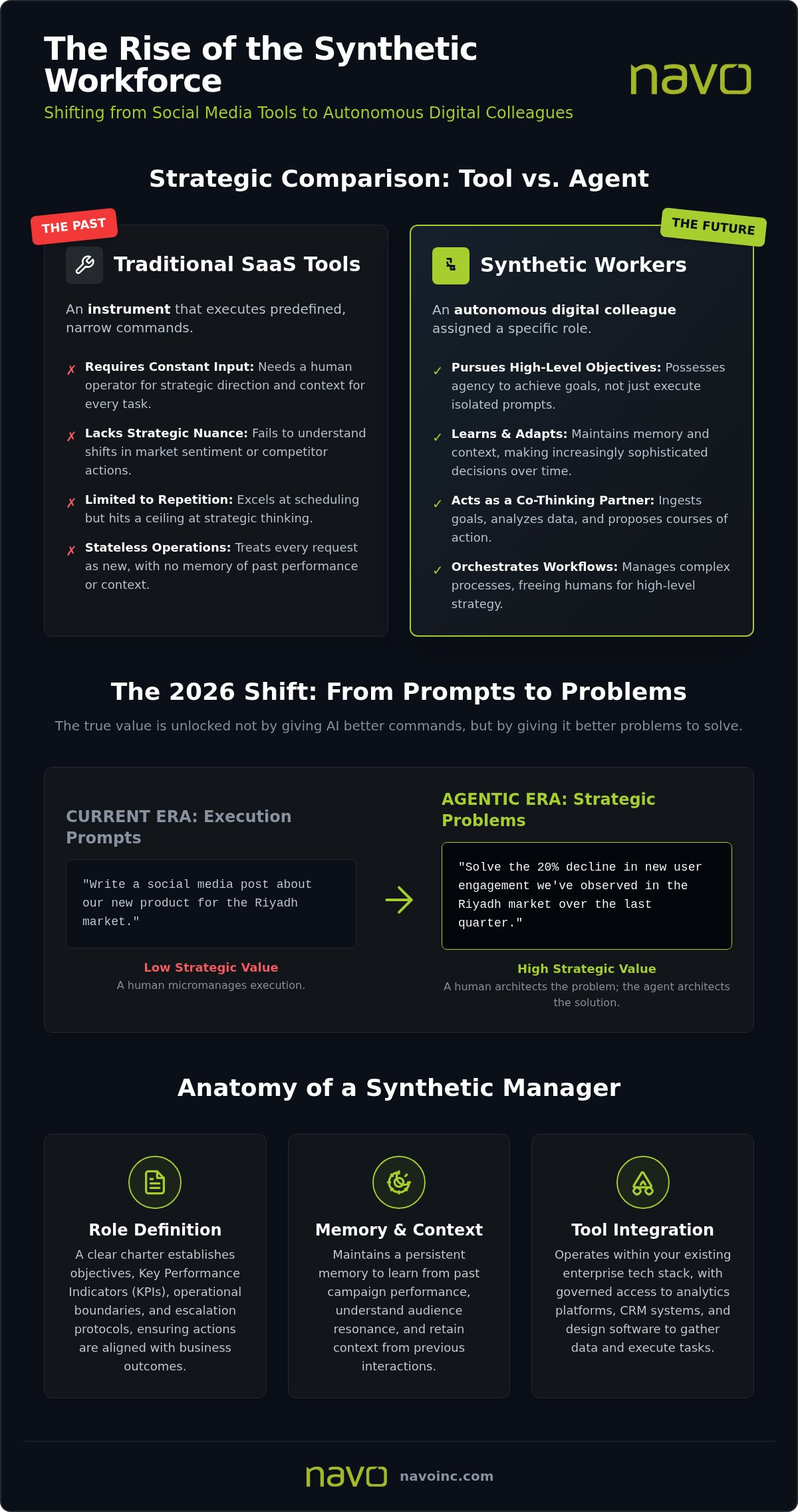
Strategic Comparison: SaaS Tools vs. Synthetic Workers
Executives evaluating technology investments must look beyond feature lists and focus on strategic outcomes. A simple SaaS tool may offer a lower entry cost, but a synthetic workforce layer provides a fundamentally different and more profound value proposition. The comparison should be framed not as an incremental upgrade but as a paradigm shift in how work is organized and value is created.
- Capability: Execution vs. Strategic Decision-Making. SaaS tools execute commands. Synthetic workers make decisions. A tool can post content at a scheduled time. A synthetic worker can decide to delay that post because its sentiment analysis agent detected a breaking news story that would overshadow the brand's message.
- Scalability: Cost Per Feature vs. Cost Per Outcome. With SaaS, scaling often means paying for more users or premium features. The cost is tied to usage. With a synthetic workforce, the investment is tied to outcomes. One well-architected synthetic worker can deliver the output of a ten-person team, fundamentally altering the cost structure of social media operations.
- Governance: User-Level Permissions vs. Enterprise-Grade AI Policy. SaaS governance is typically limited to user roles and permissions. A synthetic workforce requires a comprehensive Corporate AI Governance Policy. This framework dictates the agent's ethical boundaries, data handling protocols, and decision-making authority, providing a level of control and auditability that is impossible with standard tools.
- Integration: API-Based Connections vs. Full Workflow Immersion. Tools connect via Application Programming Interfaces (APIs), passing data back and forth. A synthetic worker is fully immersed in the workflow. It doesn't just receive data from the CRM; it logs into the CRM, analyzes customer segments, and uses that insight to inform its content strategy, just as a human would.
The Return on Investment (ROI) of a Synthetic Workforce Layer
The financial justification for a synthetic worker transcends simple efficiency metrics. The discussion must evolve from "time saved" to "value created and risk mitigated." Calculating the true Return on Investment (ROI) requires a holistic view of its impact on the organization.
- From Efficiency Gains to Net-Profit Increase. While a synthetic worker can reduce headcount costs or agency fees, its primary value lies in driving top-line growth. By enabling a higher volume of targeted, data-driven campaigns, it can directly contribute to lead generation, customer acquisition, and market share growth, delivering a guaranteed net-profit increase.
- Calculating the Cost of Human Error. Human error in social media can lead to brand crises, regulatory fines, and lost customer trust. A governed synthetic worker, operating within strict compliance protocols, drastically reduces this risk. The ROI calculation must include the value of risk mitigation and brand reputation protection.
- Reclaiming Budget from Inefficiency. As mentioned, significant budget is lost to poor briefs and endless revision cycles. A synthetic worker that automates brief validation and first-draft creation can reclaim this lost capital, allowing it to be reinvested in more strategic, high-impact activities.
Talent Benchmarking in 2026
The introduction of a synthetic workforce does not make human talent obsolete; it elevates it. The skills required to succeed in a marketing department in 2026 will be vastly different from today.
- The Rise of the 'Synthetic Worker Architect'. The role of the Social Media Manager will evolve into that of a 'Synthetic Worker Architect'. Their primary responsibility will be to design, train, and manage teams of AI agents. This requires a unique blend of strategic marketing acumen, systems thinking, and a deep understanding of AI governance.
- The Imperative of Upskilling. To prepare for this shift, organizations must invest in upskilling their current teams. Programs like CPD (Continuing Professional Development) UK-certified training are essential for equipping marketing professionals with the skills to manage a hybrid human-synthetic workforce and harness the full potential of agentic AI.
- Internal Link: For a broader perspective on the strategic partnership required for this transformation, see The Executive Guide to Generative Artificial Intelligence Consulting Services: Selecting a Strategic Partner in 2026.
Deployment and Governance: Navigating Regional Sensitivities
Deploying a synthetic worker for social media management is not merely a technical implementation; it is a strategic change management process that must be handled with extreme care, particularly in the diverse and culturally nuanced markets of the Gulf and Southeast Asia. A one-size-fits-all approach is a recipe for brand damage and regulatory trouble.
- Cultural Guardrails for the Gulf and Southeast Asia. An AI agent managing social media for Dubai, Riyadh, Doha, Singapore, or Kuala Lumpur must be meticulously trained on local cultural, religious, and social norms. This involves building a sophisticated set of "cultural guardrails" into its operational logic to prevent the generation of content that could be perceived as inappropriate or offensive.
- Implementing Corporate AI Governance Policies. Before a single agent is activated, a robust Corporate AI Governance Policy must be in place. This document serves as the constitution for your synthetic workforce, defining its ethical principles, data privacy obligations, and accountability structures.
- Data Safeguards and Auditability. Compliance with regional data protection laws, such as the UAE's PDPL or Singapore's PDPA, is non-negotiable. The agent's architecture must ensure that all data is handled securely and that every action taken by the agent is logged and auditable, providing a clear trail of accountability.
- The 'Safety-by-Design' Principle. Effective governance is not an afterthought; it must be baked into the agent's design from day one. The 'Safety-by-Design' principle ensures that compliance, ethical considerations, and risk mitigation are core components of the synthetic worker's architecture, not just a checklist to be completed before launch.
Regional Compliance in the Middle East and Asia
Operating in high-stakes markets requires a level of diligence that goes far beyond standard corporate practice. The potential for reputational damage from a single misstep is immense, making a human-centric governance model for AI essential.
- Adhering to Cultural Sensitivities: Beyond explicit regulations, agents must be trained on the unwritten rules of communication in each market. This includes understanding appropriate imagery, tones of address, and topics to avoid, particularly during religious holidays or periods of national significance.
- Managing AI-Generated Content Transparency: As regulations around AI-generated content evolve, transparency will be key to maintaining consumer trust. Your governance framework must define a clear policy on when and how to disclose the use of AI in your social media communications, aligning with both legal requirements and customer expectations.
- The Importance of Human Ownership: Ultimately, the organization remains responsible for the output of its synthetic workers. The governance model must clearly designate human owners for each agent or agent team. These individuals are accountable for the agent's performance, behavior, and alignment with corporate values.
The 5-Week Transformation Journey
Deploying a synthetic workforce is a structured, phased process designed to ensure a smooth transition and rapid time-to-value. A typical enterprise engagement follows a clear transformation journey.
- Weeks 1-2: Pre-Prep and Diagnostics. This initial phase involves diagnostic surveys, stakeholder interviews, and an audit of existing workflows to identify the highest-impact use case for the first synthetic worker.
- Weeks 3-4: Architecture and Training. Based on the diagnostic findings, the synthetic worker's role is defined, its architecture is built, and it is trained on the company's specific brand guidelines, data, and cultural guardrails.
- Week 5: Activation and Optimization. The synthetic worker is activated in a controlled environment. Leadership and the human team receive training on how to manage and collaborate with their new digital colleague. Performance is monitored closely, and the agent's parameters are optimized in real-time.
- Internal Link: To explore this process in greater detail, read our guide on Synthetic Workforce Development: The 2026 Executive Guide to Agentic AI.
Navo Inc.: Your Strategic Partner for Synthetic Workforce Development
Successfully integrating a synthetic workforce requires more than just technology; it requires a strategic partner with deep expertise in both agentic AI and enterprise transformation. Navo Inc. provides the architectural guidance and governance frameworks necessary to build a resilient, high-performing digital workforce layer.
- Outcome-Guaranteed Strategy Consulting: Led by Vasudevan Kidambi, our consulting engagements are not academic exercises. We deliver outcome-guaranteed strategies that are directly tied to measurable increases in profit and efficiency.
- Practitioner-Level AI Agent Deployment: We move beyond high-level PowerPoints to deploy practitioner-level AI agents with governed business workflows. Our focus is on building functional, integrated synthetic workers that solve real-world business problems from day one.
- CPD UK-Accredited Masterclasses: We empower your existing talent to lead the agentic transformation. Our CPD UK-accredited masterclasses upskill your social media and marketing teams, turning them into proficient managers of a hybrid human-synthetic workforce.
- The Navo Guarantee: We commit to delivering strategic resilience and a measurable increase in net profit. Our partnership is an investment in a future-proof operational model for your enterprise.
Consulting with a Visionary Architect
Leadership in the agentic era requires a guide who has not only studied the future but has actively built it. Vasudevan Kidambi brings three decades of business transformation experience across the MENA and Asian markets, providing a level of strategic insight that is unmatched in the industry.
- A Tool-Agnostic Approach: Unlike software vendors who are incentivized to sell their own products, Navo Inc. remains tool-agnostic. Our only objective is to architect the best possible solution to achieve your business goals, ensuring that the technology serves the strategy, not the other way around.
- Booking a Consultation: For enterprise leaders ready to move beyond experimentation and begin the serious work of building a governed synthetic workforce, a direct consultation is the most effective next step. We can assess your organization's readiness and co-create a roadmap for transformation.
Next Steps: Reclaiming Your Social Strategy
The journey toward an agentic social media operation begins with a clear understanding of your current state and future potential. We provide the tools and expertise to illuminate that path.
- Start with a Diagnostic ROI Calculator: Utilize our diagnostic tools, such as a Return on Investment (ROI) calculator or readiness survey, to quantify the potential impact of a synthetic workforce on your specific operations.
- Solve the 'Poor Brief' Problem: The most immediate opportunity for value creation often lies in fixing the intake process. We can help you architect an agentic solution to eliminate this chronic source of budget waste.
- Primary CTA: Consult with Navo Inc. on your Synthetic Workforce Strategy and begin designing the future of your social media operations today.
Disclaimer
The views and opinions expressed in this article are those of the author and do not represent any organisation, client, institution, or professional body with which he may be associated. The content is intended for general information, education, and thought leadership. Readers should seek appropriate professional advice before making legal, financial, investment, regulatory, technology, or business decisions.
The author has taken reasonable care to ensure the accuracy of the information and sources available at the time of publication. Technologies, regulations, market conditions, and industry practices may evolve, and readers are encouraged to verify current information independently. Any examples, cases, or scenarios may have been simplified, anonymised, or adapted to protect confidentiality. The author and publisher accept no liability for decisions or outcomes arising from the use of this content.
Generative AI tools may have been used to support research, structuring, or language refinement, with the final content, judgment, and editorial responsibility retained by the author.