

What if the primary obstacle to your Artificial Intelligence (AI) strategy isn't the technology's complexity, but the legacy of "hype fatigue" that has left your board skeptical of any non-linear Return on Investment (ROI)? Most leaders in the United Arab Emirates (UAE) are exhausted by vague promises of transformation while facing the rigid reality of regulatory compliance and shifting profit margins. You understand that securing executive buy-in for AI projects requires more than a technical demonstration; it demands a fundamental shift in how leadership perceives machine intelligence.
This framework provides the diagnostic techniques needed to transition your C-suite from hesitation to a signed budget by positioning AI as a strategic co-thinking partner. We'll explore the Art of Problem Finding, the deployment of synthetic workers like SARA to reclaim marketing spend, and the governance structures necessary to ensure human ownership remains central to every digital evolution.
Key Takeaways
- Utilize the "Art of Problem Finding" framework to uncover "Unknown Knowns," identifying hidden systemic inefficiencies that traditional diagnostic tools often overlook.
- Shift leadership perception by framing machine intelligence as a strategic co-thinking partner, a move essential for securing executive buy-in for AI projects in high-stakes environments.
- Integrate a "Synthetic Workforce" into your operational model, deploying agents like SARA or NOVA to execute non-linear tasks that directly impact the bottom line.
- Mitigate regulatory and security risks through a rigorous "Classification Framework," ensuring human-in-the-loop oversight and data desensitization remain foundational to your AI roadmap.
Transitioning from Hype to Strategic Consequence: The Art of Problem Finding
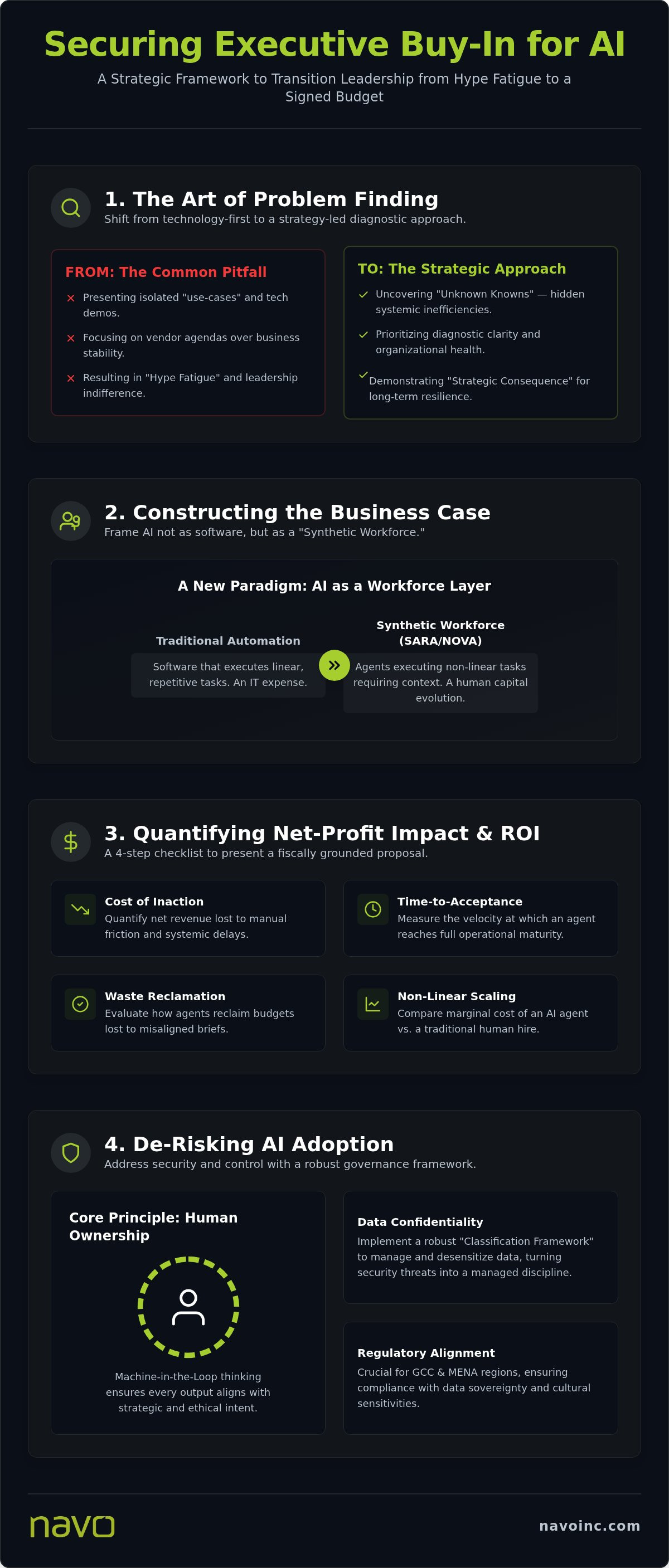
The primary barrier to securing executive buy-in for AI projects is rarely a lack of available technology; it's a fundamental lack of diagnostic clarity regarding business friction. While technical teams often present a litany of "use-cases," the Executive Leadership (C-Suite) remains indifferent to isolated applications. They invest in systemic health and "Strategic Consequence"-the measurable impact on the organization's long-term resilience and net-profit growth. To bridge this gap, we employ "The Art of Problem Finding." This proprietary diagnostic process focuses on uncovering "Unknown Knowns," those hidden structural inefficiencies and data silos that leadership may sense but cannot yet quantify. By shifting the focus from technological capability to a robust technology strategy, we move the conversation from speculative experimentation toward disciplined execution.
Moving Beyond Use-Case Lists to Diagnostic Clarity
Problem Finding is the non-negotiable prerequisite for any enterprise-level Artificial Intelligence (AI) transformation. Rather than simply solving a task, we use the "Six Lanes of Working" framework to redesign entire processes, ensuring that machine intelligence isn't just an add-on but a core component of the operational architecture. This tool-agnostic approach builds immediate credibility with the Board by prioritizing the organization's structural stability over specific vendor agendas. When you present a roadmap rooted in deep diagnostics, you aren't just asking for a budget; you're offering a systemic response to a verified organizational crisis. This methodical alignment is the most effective lever for securing executive buy-in for AI projects, as it ensures that technical capability remains subservient to business profit.
Constructing the Business Case for a Synthetic Workforce
Securing executive buy-in for AI projects relies on a fundamental shift from viewing machine intelligence as mere software to recognizing it as a "Synthetic Workforce." Unlike traditional automation, agents like SARA or NOVA function as a sophisticated workforce layer, executing non-linear tasks that require context and judgment. This distinction is vital; it moves the investment from an IT expense to a human capital evolution. By integrating these agents directly into your organization’s Operating Model, you ensure they adhere to existing hierarchies and professional standards.
This structural alignment addresses the primary executive objection regarding accountability. Utilizing a clear AI governance framework allows leadership to maintain oversight while the agentic layer handles high-volume processing. For a comprehensive roadmap on this transition, explore Navo Inc.'s guide on Synthetic Workforce Development. It's a strategy designed for resilience rather than temporary gain.
Quantifying Net-Profit Impact and ROI in the Agentic Era
Boards in Dubai and the wider Gulf region prioritize net-profit over vague "efficiency" gains. To prove value, we recommend a 4-step checklist for calculating Return on Investment (ROI):
- Cost of Inaction: Quantify the net revenue lost to manual friction and systemic delays.
- Time-to-Acceptance: Measure the velocity at which the agent reaches full operational maturity.
- Waste Reclamation: Evaluate how agents like SARA reclaim marketing budgets previously lost to misaligned briefs.
- Non-Linear Scaling: Compare the marginal cost of an additional agent against a traditional human hire.
This approach ensures your proposal for securing executive buy-in for AI projects is grounded in fiscal reality. If you're ready to define your agentic strategy, speak with our senior advisors to begin the diagnostic process.
De-risking AI Adoption through Governance and Human-Ownership
Securing executive buy-in for AI projects requires a narrative shift from "AI vs. Human" to "Machine-in-the-Loop Thinking." In this model, human ownership remains the definitive approval gate, ensuring that every algorithmic output aligns with the organization's ethical standards and strategic intent. We address data confidentiality through a robust "Classification Framework," which transforms perceived security threats into a managed, desensitized discipline. This is particularly vital across the Gulf Cooperation Council (GCC) and Middle East and North Africa (MENA) regions, where data sovereignty and cultural sensitivities are paramount. By establishing clear governance, leadership can move from defensive skepticism to a position of strategic commitment.
Implementing the Navo Framework for Secure Enterprise Transformation
Our roadmap for sustainable enterprise adoption follows the "Clarify-Enable-Protect-Evolve" framework. This structured methodology ensures that every deployment is grounded in diagnostic clarity and protected by rigorous oversight before it is allowed to evolve into a core operational pillar. Bridging the "synthetic skills" gap is equally critical for long-term systemic health. We integrate Continuing Professional Development (CPD) UK-certified training to upskill the human workforce, ensuring your team is prepared to manage the synthetic layer with technical proficiency.
This governed approach provides the structural evidence needed to move from a pilot phase to a fully sanctioned, profit-generating mandate. To finalize your strategy for securing executive buy-in for AI projects, a precise understanding of your current technological maturity is essential. We invite you to consult with Vasudevan Kidambi for a comprehensive diagnostic assessment of your organizational readiness. This high-level partnership ensures your transition remains both secure and visionary.
Architecting the Future of Agentic Leadership
Transitioning from speculative hype to strategic consequence requires a disciplined diagnostic approach. By utilizing the proprietary Art of Problem Finding framework, organizations can identify the systemic friction that traditional automation fails to address. Securing executive buy-in for AI projects is no longer about selling a tool; it's about proposing a governed, synthetic workforce that delivers outcome-guaranteed profit increases. This shift ensures machine intelligence serves the bottom line while maintaining rigorous standards of human-in-the-loop oversight. Combined with CPD (Continuing Professional Development) UK-certified leadership coaching, this framework ensures that your human capital remains the steady architect of every technological shift.
You now possess the roadmap to move beyond leadership skepticism and toward a signed strategic mandate. The era of agentic intelligence is here, and your organization is positioned to lead.
Frequently Asked Questions
What is the primary reason executive AI projects fail to get approved?
The primary reason for failure is a lack of diagnostic clarity regarding strategic consequence. Leadership often perceives Artificial Intelligence (AI) as a technical cost center rather than a profit driver. Securing executive buy-in for AI projects requires shifting the narrative from isolated use cases to systemic improvements that directly impact net profit and organizational resilience.
How do I calculate the Return on Investment (ROI) for an AI agent?
Calculating Return on Investment (ROI) for an AI agent involves measuring net-profit increases and waste reclamation. For example, synthetic workers like SARA reduce marketing spend lost to poor briefs. You must also account for the cost of inaction and the ability to scale operations non-linearly without increasing human headcount, providing a clear fiscal roadmap for the board.
What are the legal and data privacy considerations for AI in the GCC and Singapore?
Legal considerations focus on data sovereignty and ethical alignment within the Gulf Cooperation Council (GCC) and Singapore. Organizations must implement a rigorous Classification Framework to desensitize data and ensure compliance with local regulations. This governed approach mitigates the fear of regulatory non-compliance, making it a critical component for securing executive buy-in for AI projects in high-stakes markets.
How does the 'Art of Problem Finding' differ from traditional business analysis?
The Art of Problem Finding differs from traditional business analysis by prioritizing the discovery of "Unknown Knowns." While standard analysis optimizes existing processes, this framework uncovers hidden structural friction and systemic inefficiencies. It moves beyond solving known tasks to redesigning entire operational models using the Six Lanes of Working, ensuring AI serves as a strategic co-thinking partner.
Disclaimer
The views and opinions expressed in this article are those of the author and do not represent any organisation, client, institution, or professional body with which he may be associated. The content is intended for general information, education, and thought leadership. Readers should seek appropriate professional advice before making legal, financial, investment, regulatory, technology, or business decisions.
The author has taken reasonable care to ensure the accuracy of the information and sources available at the time of publication. Technologies, regulations, market conditions, and industry practices may evolve, and readers are encouraged to verify current information independently. Any examples, cases, or scenarios may have been simplified, anonymised, or adapted to protect confidentiality. The author and publisher accept no liability for decisions or outcomes arising from the use of this content.
Generative AI tools may have been used to support research, structuring, or language refinement, with the final content, judgment, and editorial responsibility retained by the author.