

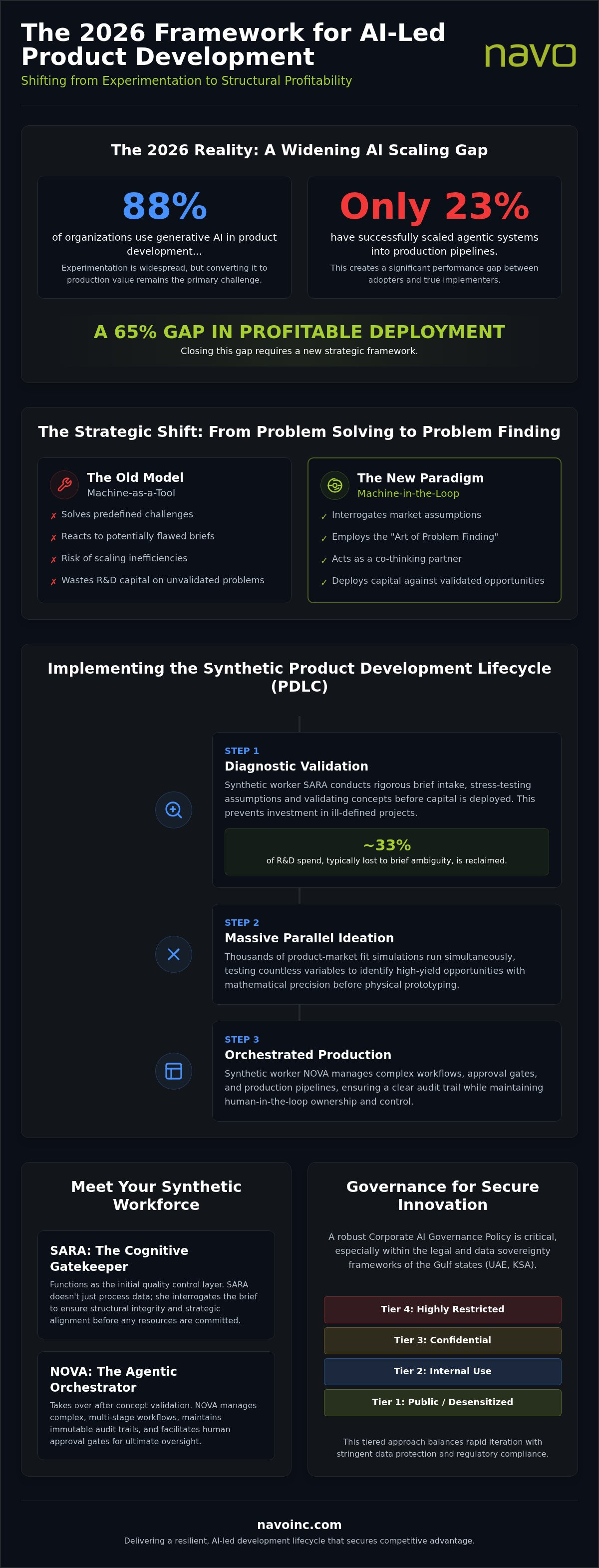
In 2026, the divergence between mere experimentation and structural profitability is stark; while 88% of organizations have adopted generative AI for product development, only 23% have successfully scaled agentic systems into their production pipelines. You likely recognize that the era of simple content generation is over, replaced by a pressing need to solve the systemic wastage of Research and Development (R&D) budgets on ill-defined briefs. This disconnect often results in significant capital loss that could otherwise be captured through disciplined orchestration.
This article provides a definitive 2026 framework to master this transition, shifting your strategy toward a governed synthetic workforce that guarantees measurable net-profit increases. We'll explore the integration of specialized synthetic workers like SARA and NOVA to accelerate innovation cycles while securing your intellectual property within the UAE’s rigorous regulatory environment. By adopting this structured approach, your organization can move from pilot projects to a resilient, AI-led development lifecycle that delivers a genuine competitive advantage.
Key Takeaways
- Transition from a "Machine-as-a-Tool" mindset to a "Machine-in-the-Loop" partnership that prioritizes the Art of Problem Finding before any R&D capital is deployed.
- Implement a synthetic Product Development Lifecycle (PDLC) that utilizes specialized agents to validate concepts early, ensuring generative AI for product development translates into measurable net-profit increases.
- Accelerate time-to-market by leveraging synthetic ideation to run massive parallel simulations of product-market fit, identifying high-yield opportunities with mathematical precision.
- Secure your innovation pipeline with a governance framework that categorizes data into four distinct risk tiers, balancing rapid iteration with the stringent legal sensitivities of the Gulf states.
The Strategic Shift: From Problem Solving to Problem Finding
The intellectual bottleneck in modern Research and Development (R&D) is rarely the capacity for solution generation; it is the precision of the initial inquiry. Most organizations exhaust their capital by deploying Generative artificial intelligence to solve predefined challenges that may not align with actual market friction. True leadership in this space requires a shift toward the Art of Problem Finding. This framework serves as a prerequisite for effective generative AI for product development, transforming the technology from a passive "Machine-as-a-Tool" into a "Machine-in-the-Loop" co-thinking partner.
By leveraging agentic reasoning, firms can identify "Unknown Unknowns" within complex market datasets that human analysts often overlook. These systems don't just answer questions; they interrogate the validity of the market assumptions themselves. This analytical depth is critical in the United Arab Emirates (UAE) market, where rapid diversification demands a level of systemic health that traditional linear thinking cannot provide.
The Architecture of a Strategic AI Brief
Success begins with a high-fidelity brief that stress-tests product assumptions before the first prototype is conceptualized. This process involves the ingestion of desensitized data inputs to ensure intellectual property protection while allowing the AI to simulate failure points. Establishing these rigorous protocols is a cornerstone of strategic AI consulting, as it ensures that every dirham spent on innovation is anchored in a validated problem. Without this diagnostic rigor, organizations risk scaling inefficiencies rather than breakthroughs.
This co-thinking partnership functions through a continuous feedback loop:
- Hypothesis Generation: AI identifies non-obvious correlations in consumer behavior.
- Constraint Mapping: The system highlights regulatory or logistical friction points early.
- Falsification: Agents actively attempt to "break" the product logic before investment occurs.
Implementing a Synthetic Product Development Lifecycle
Transitioning from manual workflows to a synthetic Product Development Life Cycle (PDLC) requires a fundamental re-engineering of the innovation stack. This evolution shifts the focus from individual tasks to a structured, autonomous layer of agentic intelligence. Integrating generative AI for product development at this level allows for a three-step progression: diagnostic validation, massive parallel ideation, and orchestrated production. This approach aligns with recent findings on Generative AI Technologies and Their Commercial Applications, which emphasize the shift toward integrated enterprise systems that move beyond superficial chat interfaces.
The diagnostic phase utilizes synthetic workers like SARA to conduct rigorous brief intake and validation. It's a critical step that prevents the common pitfall of Research and Development (R&D) spend being wasted on poorly defined parameters. SARA reclaims approximately 33% of marketing and product spend typically lost to brief ambiguity. Following this, synthetic ideation enables the execution of massive parallel simulations. These simulations test product-market fit across thousands of variables simultaneously, identifying high-yield opportunities before any physical prototypes are commissioned in the Dubai market.
Deploying SARA and NOVA in the R&D Workflow
SARA functions as the cognitive gatekeeper, ensuring every initiative aligns with the organization's existing knowledge base. She doesn't just process data; she interrogates the brief to ensure structural integrity. Once a concept is validated, NOVA takes over agentic orchestration. NOVA manages complex workflows and approval gates, maintaining a clear audit trail while preserving human-ownership mechanisms. This transition represents the next phase of synthetic workforce development, where AI agents act as specialized teammates rather than simple utilities. To understand how these agents can be tailored to your specific organizational needs, you might consider consulting with our strategy team to define your deployment roadmap.
Orchestrating Governance and ROI in the Agentic Era
Governance serves as the structural anchor for any organization moving beyond experimental pilots. In the United Arab Emirates (UAE) and Kingdom of Saudi Arabia (KSA), a robust Corporate AI Governance Policy must balance high-stakes innovation with regional legal sensitivities regarding data sovereignty. This isn't merely a compliance exercise; it's a strategic necessity for the safe deployment of generative AI for product development. By establishing clear parameters, leaders ensure that synthetic workers operate within a framework that prioritizes systemic health over unchecked speed.
A primary component of this governance is the Classification Framework, which categorizes product data into four distinct tiers:
- Public: Non-sensitive market intelligence and general trends.
- Internal-Low: Operational documentation with minimal risk profile.
- Confidential-Transformable: Proprietary logic that requires synthetic obfuscation before processing.
- Restricted: Core Intellectual Property (IP) and financial data that must remain within air-gapped environments.
The Executive Standard for AI Accountability
Leadership in the agentic era demands a sophisticated understanding of "Permitted-Use Boundaries" to prevent autonomous drift in synthetic workers. Executives must move beyond surface-level knowledge by engaging with CPD certified AI courses, which provide the Continuing Professional Development (CPD) standards required for rigorous oversight. This training enables the creation of an immutable audit trail for AI-generated product decisions, satisfying both internal risk committees and external regulatory bodies. Ultimately, the goal is to replace wasted Research and Development (R&D) spend with guaranteed efficiency gains that reflect directly on the balance sheet.
Architecting the Future of Synthetic Innovation
Mastering generative AI for product development requires a disciplined departure from superficial automation toward a structured co-thinking partnership. By prioritizing the Art of Problem Finding and deploying a synthetic workforce layer, organizations can reclaim significant Research and Development (R&D) capital previously lost to ambiguous briefs. This transition ensures that every innovation cycle is anchored in mathematical certainty and governed by a rigorous accountability framework. Navo Inc. provides the steady hand needed for this transformation through outcome-guaranteed consulting led by Vasudevan Kidambi, author of "Synth Worker" (2026). Our Continuing Professional Development (CPD) UK-certified masterclasses empower executive leadership to maintain structural excellence in an increasingly agentic market.
The path to structural profitability in the Gulf Cooperation Council (GCC) and Middle East and North Africa (MENA) regions is clear for those who choose precision over experimentation.
Frequently Asked Questions
How does the Art of Problem Finding improve product development ROI?
The Art of Problem Finding improves Return on Investment (ROI) by validating the structural integrity of a product brief before capital deployment. By interrogating market assumptions, it ensures that generative AI for product development is applied to genuine consumer friction points. This diagnostic rigor prevents the wastage of Research and Development (R&D) spend, which frequently accounts for significant losses due to ill-defined project parameters.
What is the difference between a GenAI tool and a Synthetic Worker like SARA?
A standard tool is a passive utility requiring constant human prompting, whereas a Synthetic Worker like SARA is an agentic teammate with context-aware reasoning. SARA conducts autonomous brief intake and validation, reclaiming approximately 33% of marketing and product spend lost to ambiguity. Unlike generic applications, these agents integrate directly into the Product Development Life Cycle (PDLC) to manage complex workflows and ensure knowledge-base alignment.
Is it safe to use confidential product data with Generative AI models?
Security is achieved through a rigorous Classification Framework that tiers data into public, internal, and restricted categories. Using desensitized data inputs and air-gapped environments allows organizations to leverage generative AI for product development without risking Intellectual Property (IP) leakage. Establishing a Corporate AI Governance Policy ensures that sensitive logic is obfuscated or transformed before interacting with large-scale language models.
How do GCC and Singapore regulations impact GenAI for product development?
Regulations in the Gulf Cooperation Council (GCC) and Singapore prioritize data sovereignty and algorithmic transparency. Compliance requires clear audit trails for AI-generated decisions and adherence to localized privacy laws. These legal frameworks necessitate a governed approach to innovation, where synthetic workers must operate within "Permitted-Use Boundaries" to satisfy regional regulatory bodies and maintain the organization's systemic health and public trust.
Disclaimer
The views and opinions expressed in this article are those of the author and do not represent any organisation, client, institution, or professional body with which he may be associated. The content is intended for general information, education, and thought leadership. Readers should seek appropriate professional advice before making legal, financial, investment, regulatory, technology, or business decisions.
The author has taken reasonable care to ensure the accuracy of the information and sources available at the time of publication. Technologies, regulations, market conditions, and industry practices may evolve, and readers are encouraged to verify current information independently. Any examples, cases, or scenarios may have been simplified, anonymised, or adapted to protect confidentiality. The author and publisher accept no liability for decisions or outcomes arising from the use of this content.
Generative AI tools may have been used to support research, structuring, or language refinement, with the final content, judgment, and editorial responsibility retained by the author.