

The Paradigm Shift: Why Problem Finding is the Precursor to Strategic Resilience
In the executive suite, the bias for action is a celebrated virtue. Yet, this relentless drive toward solutions often obscures a more fundamental and powerful discipline: strategic problem finding. The Strategic Problem Finding Framework is not merely another management tool; it is a systematic diagnostic discipline engineered to uncover the foundational challenges that truly constrain enterprise value. It represents a deliberate shift from a reactive posture of extinguishing operational fires to a proactive stance of architectural inquiry, ensuring that the immense power of technologies like Generative Artificial Intelligence is aimed at the correct targets.
- Defining the Strategic Problem Finding Framework: This framework is a structured methodology for deep organizational diagnosis. It moves beyond surface-level symptoms to identify the core, often hidden, constraints that inhibit growth, efficiency, and innovation. It is the essential precursor to any meaningful strategic planning or technological investment.
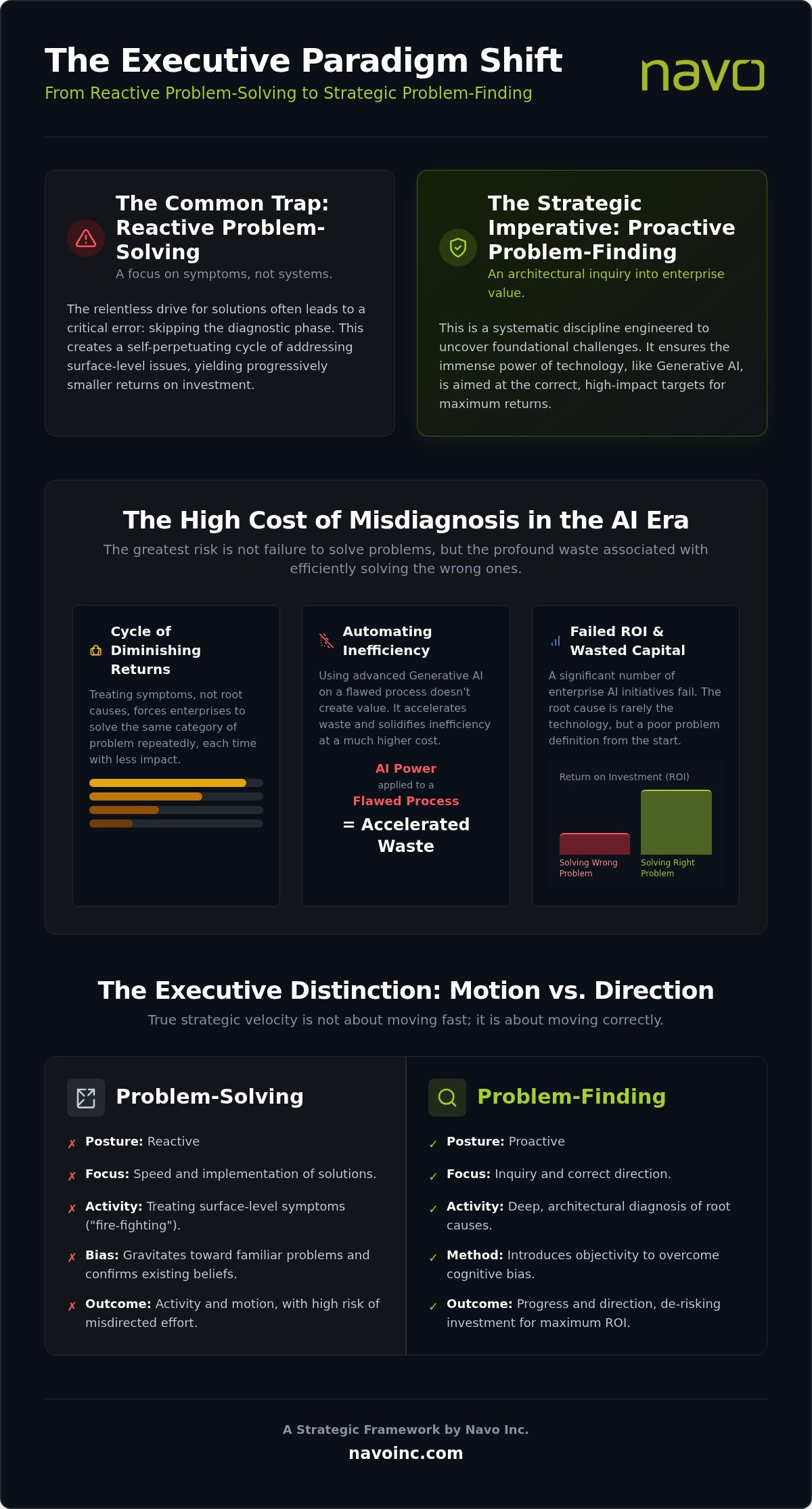
- The Cycle of Diminishing Returns: Reactive problem solving, while necessary for immediate crises, creates a self-perpetuating cycle. By treating symptoms rather than root causes, enterprises find themselves solving the same category of problem repeatedly, each time with diminishing returns on the resources invested.
- The High Cost of Misdirected Efficiency: The greatest risk in the modern enterprise is not the failure to solve problems, but the profound waste associated with efficiently solving the wrong ones. Deploying advanced Generative Artificial Intelligence to optimize a fundamentally flawed process does not create value; it merely accelerates waste and solidifies inefficiency at a higher cost.
- The Link Between Inquiry and Investment Returns: Rigorous, structured inquiry is the only reliable path to maximizing the Return on Investment (ROI) from technology. By ensuring that capital, talent, and computational resources are allocated to validated, high-impact challenges, a strategic problem finding framework de-risks transformation and guarantees that technological adoption translates directly into net-profit increases.
Solving vs. Finding: The Executive Distinction
The modern executive is conditioned to solve. Boardrooms and business schools alike champion the decisive leader who can implement solutions swiftly. However, this cultural imperative often leads to a critical error: skipping the diagnostic phase for the sake of perceived speed. True strategic velocity is not about moving fast; it is about moving correctly. Problem finding establishes the architectural foundation for genuine business transformation by ensuring the blueprints are right before construction begins. This deliberate diagnostic pause prevents the costly and demoralizing process of building a magnificent solution to a non-existent or misunderstood problem. It is the distinction between activity and progress, between motion and direction.
- Overcoming Cognitive Bias: The human mind, even at the executive level, is susceptible to cognitive biases such as confirmation bias and availability heuristics. Leaders often gravitate toward familiar problems or solutions that confirm their existing beliefs, leading them to misidentify organizational bottlenecks. A formal problem finding framework introduces objectivity and structure, forcing a dispassionate analysis of evidence over intuition.
- Establishing the Architectural Foundation: Problem finding is not a prelude to strategy; it is an integral part of it. It defines the "problem space" with such clarity that the subsequent "solution space" becomes narrower, more focused, and infinitely more impactful. This process ensures that every strategic initiative and technological deployment is built on a solid foundation of validated need.
The Consequences of Misdiagnosis in the Artificial Intelligence Era
The advent of Generative Artificial Intelligence has raised the stakes of misdiagnosis to unprecedented levels. When the tool is a simple spreadsheet, the cost of a mistake is contained. When the tool is a sophisticated, resource-intensive Artificial Intelligence model, the cost of applying it to the wrong problem can be catastrophic, impacting finances, reputation, and market position. Clarity in problem finding is therefore not just a best practice; it is the primary prerequisite for responsible and effective Artificial Intelligence governance.
- Failed Implementations and Wasted Capital: A significant number of enterprise Artificial Intelligence initiatives fail to deliver their promised ROI. The root cause is rarely the technology itself, but rather a poor problem definition. Deploying a large language model to improve customer service, for example, will fail if the core issue is not response time but a flawed product returns policy.
- The Risk of Automating Inefficiency: Without a rigorous problem finding phase, organizations risk using powerful Generative Artificial Intelligence to automate and entrench inefficient, broken, or redundant processes. This is the digital equivalent of paving a cow path—it makes a bad process faster, but it fails to question whether the path should exist at all.
The Architectural Mechanics of the Art of Problem Finding Framework
To navigate this complex diagnostic landscape, a proven methodology is required. The "Art of Problem Finding," a proprietary framework detailed in the intellectual work of Vasudevan Kidambi, provides the architectural mechanics for this essential executive discipline. This is not a theoretical exercise but a field-tested system designed to move leadership teams from symptomatic observation to systemic root-cause identification. It provides a structured journey that transforms ambiguity into a precisely defined, solvable, and strategically aligned challenge.
- A Proprietary, Documented Methodology: The Art of Problem Finding framework is the culmination of extensive consulting experience, codified by Vasudevan Kidambi to provide a repeatable and scalable approach to organizational diagnosis. It serves as a powerful counter-narrative to the "solution-first" mindset prevalent in many corporate cultures.
- From Symptoms to Systems: The framework’s core function is to guide leaders beyond the immediate pain points (the symptoms) to uncover the underlying systemic issues (the root causes). It provides the tools to map organizational dynamics and identify the true leverage points for change.
- The "Clarify-Enable-Protect-Evolve" Journey: This sequence represents the core phases of the diagnostic process within the Art of Problem Finding. It ensures a comprehensive approach that begins with achieving absolute clarity on the problem, enables the organization to address it, protects the value created, and establishes a system for continuous evolution.
- Utilizing Diagnostic Instruments: The framework is supported by practical tools, including enterprise readiness surveys and sophisticated Return on Investment calculators. These instruments translate qualitative observations into quantitative data, enabling an evidence-based approach to problem validation and resource allocation.
The Diagnostic Layer: Identifying Hidden Bottlenecks
At the heart of the Art of Problem Finding framework is a process of disciplined deconstruction. It involves methodically peeling back the operational layers of the enterprise—people, processes, technology, and data—to find the true strategic constraint that is holding the organization back. This requires a shift from a departmental view to a systemic perspective, recognizing that the most critical bottlenecks often lie at the intersection of functional silos. The framework provides a map and a compass for this exploration, ensuring the inquiry is both deep and focused.
- The Six Lanes of Working: A key component of the framework is the "Six Lanes of Working," a proprietary model for categorizing and prioritizing organizational issues. This taxonomy allows leaders to dissect complex, interconnected challenges into manageable components, ensuring that no critical area is overlooked during the diagnostic phase.
- Human-Centered Inquiry in a Machine-Driven World: While data and analytics are crucial, the framework emphasizes that deep understanding can only be achieved through human-centered inquiry. It incorporates structured interviews, observational techniques, and workshop facilitation to capture the nuanced, tacit knowledge that resides within the organization but is absent from dashboards and reports.
Validation and Refinement of the Problem Statement
Identifying a potential problem is only the first step. The Art of Problem Finding framework insists on a rigorous validation and refinement process before a single dollar is committed to a solution. A well-crafted problem statement is the most valuable asset in any transformation initiative. It acts as a "true north" for all subsequent efforts, ensuring alignment, focus, and a shared understanding of success. This phase stress-tests the initial hypothesis, sharpens its focus, and secures executive consensus.
- Techniques for Stress-Testing: The framework includes techniques to challenge the problem statement from multiple angles. This involves asking counter-intuitive questions, running pre-mortems to anticipate failure modes, and seeking disconfirming evidence to ensure the diagnosis is robust and unbiased.
- Alignment with Board-Level Objectives: A problem is only "strategic" if its resolution directly contributes to the highest-level objectives of the enterprise. This step ensures a clear line of sight between the identified issue and the strategic imperatives set by the board, guaranteeing that the effort is not just efficient but genuinely important.
Generative Artificial Intelligence as a Strategic Co-Thinking Partner
The conventional view of Artificial Intelligence is that of a tool—a powerful instrument for executing tasks and solving pre-defined problems. A more advanced strategic perspective, however, reframes Generative Artificial Intelligence as a co-thinking partner, particularly within the problem finding discipline. When integrated into a structured diagnostic framework, these technologies can analyze vast, unstructured datasets, identify subtle patterns invisible to human analysts, and simulate complex scenarios to an extent previously unimaginable. This creates a powerful synergy between human strategic judgment and machine-scale processing.
- The "Machine-in-the-Loop Thinking" Approach: This approach embeds Generative Artificial Intelligence directly into the strategic diagnosis process. Instead of using Artificial Intelligence as a final-step solution, it is employed as an interactive partner for brainstorming, data exploration, and hypothesis testing, augmenting the cognitive capabilities of the executive team.
- Leveraging a Synthetic Workforce for Analysis: A Synthetic Workforce—a team of specialized Artificial Intelligence agents—can be deployed to sift through immense volumes of internal and external data, from customer feedback and operational logs to market trend reports and competitor analysis, surfacing potential problems and opportunities that would otherwise remain buried.
- Continuous Organizational Monitoring: Agentic Artificial Intelligence systems can be tasked with continuous monitoring of key organizational health indicators. These agents can flag deviations from strategic norms and identify emerging operational frictions; similarly, Easy Wealth AI provides an automated diagnostic layer for financial health, offering instant reporting and intelligent classification to transform bookkeeping into a perpetual, real-time capability.
Augmenting Human Judgment with Synthetic Intelligence
The goal of using Generative Artificial Intelligence in problem finding is not to replace human leadership but to augment it. The final judgment, the contextual understanding, and the strategic decision-making authority must remain firmly in human hands. Synthetic Intelligence serves as an incredibly powerful analytical and simulation engine that provides leaders with a richer, more nuanced, and data-driven understanding of their organization and its environment. This partnership allows for a level of diagnostic depth and speed that neither human nor machine could achieve alone.
- Simulating "What-If" Scenarios: Once a potential problem has been identified, Generative Artificial Intelligence models can be used to simulate the potential impact of various internal and external factors. This allows leaders to validate the significance of a problem and understand its potential trajectory before committing to a course of action.
- Natural Prompting for Diagnostic Insights: The evolution of Natural Language Processing allows executives to query vast corporate datasets using simple, conversational language. Through a technique we call "Natural Prompting," leaders can directly ask complex diagnostic questions—"Where are our most significant supply chain delays originating?" or "What is the primary theme in negative customer reviews this quarter?"—and receive synthesized, actionable insights in seconds.
Agentic Problem Identification: The 2026 Operational Reality
Looking toward the near future, the role of Artificial Intelligence in problem finding will evolve from interactive analysis to autonomous identification. Specialized, agentic Artificial Intelligence systems will become a permanent part of the enterprise operating model, serving as a vigilant, always-on diagnostic layer. These agents will not wait to be asked; they will be programmed to continuously audit for inefficiency, strategic drift, and emerging risk, integrating the discipline of problem finding into the permanent operational fabric of the enterprise.
- Deploying Specialized Agents for Efficiency Audits: Imagine deploying a specialized agent like SARA (Strategic Alignment and Resource Auditor) or NOVA (Networked Operational Variance Analyzer) to conduct real-time efficiency audits across the entire organization. These agents can monitor workflows, resource allocation, and communication patterns to flag redundancies and bottlenecks as they occur.
- Flagging Strategic Drift: Autonomous agents can be tasked with monitoring the execution of strategic initiatives against their intended goals and key performance indicators. By analyzing operational data in real-time, they can flag any deviation or "strategic drift" long before it becomes a crisis, allowing for timely course correction.
Implementing the Framework within the Enterprise Operating Model
A powerful framework is only valuable when it is successfully integrated into the daily rhythms and management workflows of an organization. Implementing the Art of Problem Finding requires more than just a new process; it necessitates a cultural shift, particularly within the leadership team. It demands a move away from rewarding quick, superficial fixes and toward valuing deep, disciplined inquiry. This requires careful planning, executive sponsorship, and a clear understanding of the organizational and cultural context, especially in diverse and dynamic markets.
- Step-by-Step Integration: The framework can be integrated into existing management systems, such as quarterly business reviews, strategic planning cycles, and project intake processes. The key is to create formal gateways where problem definition is explicitly required and validated before resources are approved.
- Overcoming Organizational Resistance: Deep diagnostic inquiry can be perceived as threatening, as it often uncovers uncomfortable truths or challenges established assumptions. Overcoming this resistance requires strong leadership, clear communication about the "why" behind the shift, and creating an environment of psychological safety where identifying problems is seen as a contribution, not a criticism.
- Establishing a Center of Excellence: For larger enterprises, establishing a small, dedicated "Problem Finding Center of Excellence" can be a powerful accelerator. This team can serve as internal consultants, facilitators, and custodians of the framework, helping business units apply the discipline with rigor and consistency.
Cultural Sensitivity and Regional Leadership Nuances
The application of any management framework must be adapted to the specific cultural context in which it is deployed. For leaders in Dubai, Singapore, Mumbai, and other major hubs across the Gulf and Asia, this is a critical consideration. Hierarchical structures, communication styles, and the concept of "face" or preserving honor can significantly influence the willingness of teams to identify and escalate problems. A successful implementation requires a nuanced approach that respects and works within these cultural parameters.
- Adapting for Hierarchical Structures: In many organizations in the Gulf and Asia, decision-making is more centralized and hierarchical. The problem finding process must be adapted to engage senior leadership early and ensure their sponsorship, while also creating safe, structured channels for insights to flow up from all levels of the organization without fear of reprisal.
- The Importance of Psychological Safety: The concept of "face" is paramount. The framework must be positioned not as a tool for assigning blame for past failures, but as a collaborative, forward-looking process for building a more resilient future. Facilitation techniques must be employed to allow for the identification of organizational weaknesses without causing personal embarrassment.
- Navigating Regional Governance: As Artificial Intelligence becomes a key part of the diagnostic toolkit, navigating regional laws and data governance policies is essential. Any use of technology for analyzing employee or customer data must be fully compliant with local regulations, such as the data privacy laws in the UAE and Singapore.
Measuring the Success of the Finding Phase
To secure sustained buy-in, the value of strategic problem finding must be demonstrated through clear, measurable business outcomes. The success of the "finding" phase is not an abstract concept; it can and should be tracked through a set of robust Key Performance Indicators (KPIs) that link directly to the financial and operational health of the enterprise. This proves that the time invested in diagnosis is not a delay but a direct contributor to profitability and efficiency.
- Key Performance Indicators for Problem Finding: Success metrics can include a reduction in the number of "wasted" projects (those canceled mid-stream or that fail to deliver ROI), an increase in the success rate of strategic initiatives, and a measurable improvement in the speed at which the *right* solutions are deployed.
- Tracking Reduction in Failed Pilots: A primary benefit of rigorous problem finding is the avoidance of costly pilot projects aimed at solving the wrong problem. By tracking the reduction in such failed pilots, organizations can quantify the capital and human resources saved.
- Linking Success to Net-Profit Increases: Ultimately, the most powerful metric is the impact on the bottom line. Success in problem finding should be directly correlated with net-profit increases, achieved through a combination of cost savings from eliminated inefficiencies and revenue growth from pursuing the right strategic opportunities. For leaders focused on tangible results, exploring an outcome-based strategy is the logical next step.
The Path to Synthetic Workforce Excellence: Navo’s Strategic Approach
Mastering the Art of Problem Finding is the foundational step in architecting enterprise value. The logical next step is to build the organizational capability to execute solutions with unprecedented speed and intelligence. This is where Navo Inc. facilitates the transition from rigorous problem finding to the strategic deployment of an agentic, Synthetic Workforce. Our approach is not about simply providing technology; it is about building a permanent internal capability for continuous, Artificial Intelligence-driven value creation.
- From Finding to Agentic Execution: We guide organizations through the entire lifecycle, from using the Art of Problem Finding to identify the highest-value challenges to designing and deploying a Synthetic Workforce to address them with precision and scale.
- Building Internal Capability: Through our Continuing Professional Development (CPD) UK-certified masterclasses, we empower your executive teams with the skills and frameworks necessary to lead this transformation from within, reducing reliance on external consultants over the long term.
- Guaranteed Outcomes: Our consulting model is built on a commitment to guaranteed outcomes. We focus on delivering measurable increases in net profit and operational efficiency, ensuring that your investment in Generative Artificial Intelligence translates into tangible business results, not just interesting experiments.
- Beginning Your Journey: The path to transformation begins with a diagnostic. From initial readiness surveys to full-scale synthetic workforce development, we provide a clear, structured roadmap for leaders ready to move from concept to execution.
Developing Synthetic Skills for the Executive Suite
By 2026, the ability to lead in a human-machine collaborative environment will be a non-negotiable executive competency. Strategic problem finding, augmented by Synthetic Intelligence, is no longer a niche skill for a digital transformation team; it is a core capability for every member of the executive suite. Navo’s coaching and masterclass programs are designed to empower leaders to become the architects of this new operational reality, equipping them with the vision and skills to build a more resilient, efficient, and innovative enterprise. For more on this strategic vision, learn about the work of Vasudevan Kidambi.
Engaging with Navo for Outcome-Based Consulting
Our engagement model is an intensive, five-week transformation journey designed for rapid impact. It includes a pre-preparation phase, an immersive masterclass, and a hands-on activation period where we guide you from applying the Art of Problem Finding to deploying your first Synthetic Worker. This structured process ensures that theoretical knowledge is immediately translated into practical application and measurable value. To understand how to select the right strategic partner for this journey, we recommend exploring our comprehensive guide. For further reading, see our article, The Executive Guide to Generative Artificial Intelligence Consulting Services: Selecting a Strategic Partner in 2026. To begin your own diagnostic journey and architect the future of your enterprise, explore our Generative Artificial Intelligence consulting services.
Disclaimer
The views and opinions expressed in this article are those of the author and do not represent any organisation, client, institution, or professional body with which he may be associated. The content is intended for general information, education, and thought leadership. Readers should seek appropriate professional advice before making legal, financial, investment, regulatory, technology, or business decisions.
The author has taken reasonable care to ensure the accuracy of the information and sources available at the time of publication. Technologies, regulations, market conditions, and industry practices may evolve, and readers are encouraged to verify current information independently. Any examples, cases, or scenarios may have been simplified, anonymised, or adapted to protect confidentiality. The author and publisher accept no liability for decisions or outcomes arising from the use of this content.
Generative AI tools may have been used to support research, structuring, or language refinement, with the final content, judgment, and editorial responsibility retained by the author.