

Beyond Headcount: Redefining Synthetic Workforce Return on Investment for the 2026 Enterprise
For the Board of Directors and C-suite leaders steering enterprises through the complexities of the 2026 commercial landscape, the conversation around Artificial Intelligence (AI) has reached a critical inflection point. The question is no longer if one should invest in a synthetic workforce, but how to quantify its true financial and strategic impact. Traditional metrics, designed for an era of linear software automation, are proving dangerously inadequate for measuring the value of autonomous, agentic systems. This article presents a sophisticated framework for calculating the Return on Investment (ROI) of a synthetic workforce, moving beyond simple cost-avoidance to a more holistic model of value creation tailored for the high-growth markets of the Middle East and Asia.
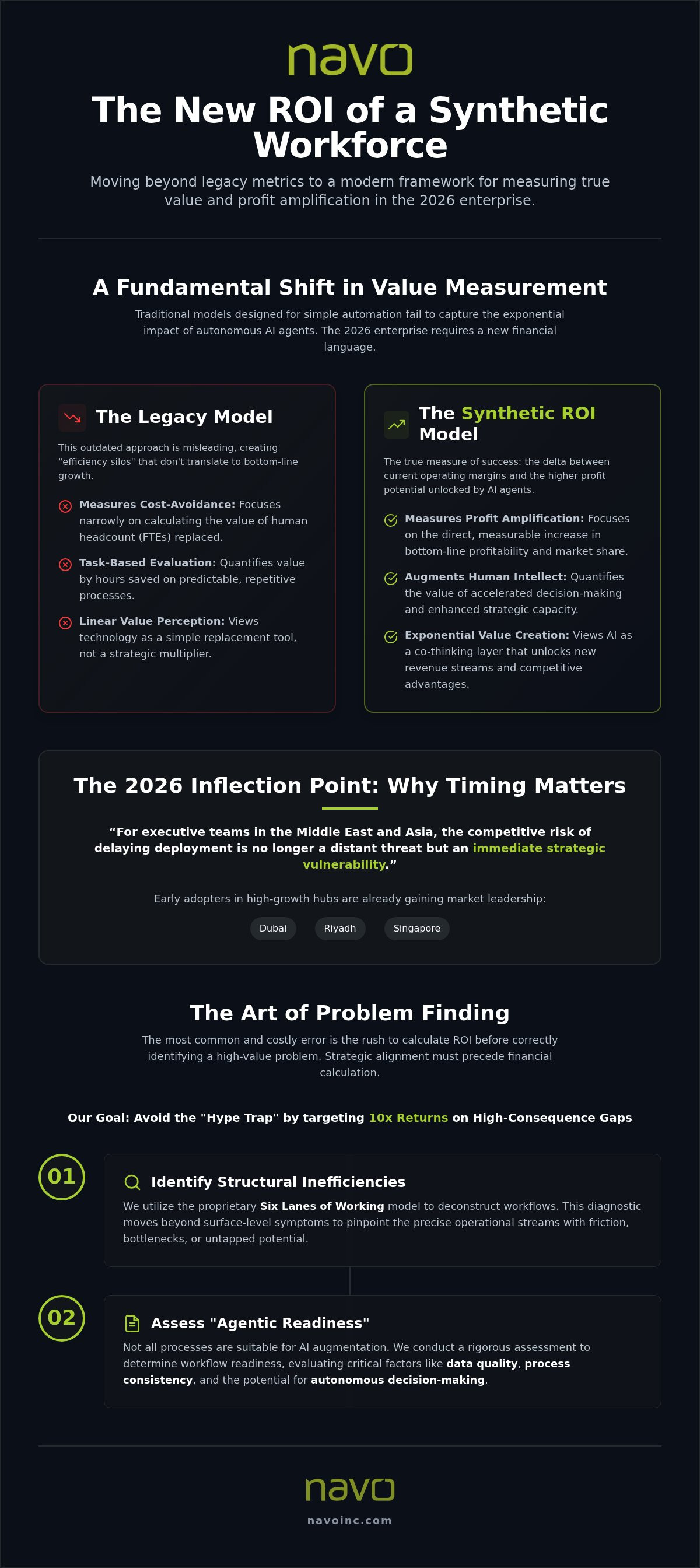
A synthetic workforce is not merely a software suite to be procured; it is a strategic co-thinking layer integrated into the very fabric of your organization. It comprises AI agents capable of reasoning, planning, and executing complex tasks with a degree of autonomy that fundamentally changes how work is done. Consequently, legacy models that measure value by calculating the Full-Time Equivalent (FTE) human headcount replaced are not just outdated—they are misleading. They fail to capture the exponential value generated by augmenting human intellect, accelerating decision-making, and creating new strategic capacity. In dynamic economic hubs like the United Arab Emirates and Singapore, where innovation and speed-to-market are paramount, clinging to a "cost avoidance" mindset means ceding competitive ground. The 2026 enterprise requires a financial modeling approach that can accurately articulate the shift from operational efficiency to guaranteed profit amplification.
The Limitations of Legacy ROI Models
Conventional ROI models for technology are built on a foundation of task-based automation. They excel at measuring how many hours are saved when a predictable, repetitive process is handed over to a machine. However, an autonomous AI agent does not just perform a task; it analyzes context, refines its own approach, and interacts with human colleagues to improve outcomes. Measuring its impact with task-completion metrics is like evaluating a grandmaster-level chess champion based solely on the number of pieces moved. This approach creates "efficiency silos"—pockets of isolated productivity that do not translate to a measurable increase in bottom-line profit. The true measure, which we define as Synthetic ROI, is the delta between current operating margins and the demonstrably higher profit potential unlocked by an agent-augmented organizational structure.
The 2026 Inflection Point: Why Timing Matters
The imperative to adopt this new ROI model is amplified by the rapid integration of Agentic AI across key sectors in the Gulf Cooperation Council (GCC) and Asia. In the financial services and retail industries of Dubai and Riyadh, early adopters are already leveraging synthetic workers to compress product development cycles and deliver hyper-personalized customer experiences. For executive teams in the Middle East, the competitive risk of delaying deployment is no longer a distant threat but an immediate strategic vulnerability. As market dynamics accelerate, the ability to accurately forecast and measure the value of agentic systems becomes a defining feature of market leadership. Understanding the foundational principles of this technological shift is the first step toward building a compelling business case. For a deeper structural context, leaders should reference the Executive Guide to Agentic AI, which outlines the architectural components of a modern synthetic workforce.
The Art of Problem Finding: Why Strategic Alignment Precedes Financial Calculation
The most common and costly error in enterprise AI deployment is the rush to calculate ROI before correctly identifying the problem. A brilliantly engineered solution applied to a low-value problem yields a negative strategic return, regardless of its efficiency. This is why we assert that the Art of Problem Finding is the essential precursor to any credible financial calculation. It is a disciplined, diagnostic process designed to uncover "high-consequence" business gaps—structural weaknesses or untapped opportunities where Generative Artificial Intelligence (GenAI), the technology powering modern AI agents, can drive exponential, 10x returns. Focusing on technological novelty or chasing competitor hype without this strategic alignment is a direct path to expensive pilot programs that fail to deliver meaningful business value.
The Navo approach institutionalizes this discipline through proprietary diagnostic tools and readiness surveys. Before a single line of code is deployed or an AI agent is configured, we ensure there is an absolute strategic fit between the business challenge and the proposed agentic solution. This methodology is designed to avoid the "Hype Trap" by anchoring every initiative in measurable outcomes, ensuring that investment is directed only toward problems whose resolution will create a direct and significant impact on profitability and market position.
Diagnostic Framework for Strategic AI
To move from abstract challenges to concrete, solvable problems, we employ a structured diagnostic framework. This process ensures that the synthetic workforce is deployed with surgical precision against the organization's most critical needs.
- Step 1: Identifying Structural Inefficiencies: We utilize the Six Lanes of Working—a proprietary model that deconstructs organizational workflow into distinct operational streams. This allows us to pinpoint the precise lane where friction, bottlenecks, or untapped potential exists, moving beyond surface-level symptoms to diagnose root-cause inefficiencies.
- Step 2: Assessing "Agentic Readiness": Not all business processes are suitable for augmentation by AI agents. We conduct a rigorous assessment of specific workflows to determine their "Agentic Readiness," evaluating factors like data quality, process consistency, and the potential for autonomous decision-making.
- Step 3: Mapping Problems to Synthetic Worker Roles: Once a high-consequence, agent-ready problem is identified, we map it to the appropriate class of synthetic worker. For example, a problem rooted in poorly defined project briefs would be assigned to SARA, a specialized agent for research and brief validation, while a challenge in complex workflow management would be addressed by NOVA, an agent designed for production orchestration.
Human-to-Machine Communication as a Value Lever
A frequently overlooked component of synthetic workforce ROI is the quality of human-to-machine communication. Research indicates that ambiguous or poorly constructed project briefs can cost organizations up to 30% of their project budgets in wasted effort, rework, and misaligned outcomes. This is a massive financial drain that legacy ROI models completely ignore. The SARA platform, for instance, is built on the principle that "Clarity" is a quantifiable asset. By enforcing a structured, dual-acceptance validation process for project briefs before they enter the workflow, it transforms a major source of cost into a powerful lever for value. The ROI of clarity is measured in reduced rework, compressed timelines, and higher-quality outputs. This value is further amplified through CPD UK-certified training programs that equip human teams with the skills to interact effectively with their synthetic counterparts, dramatically reducing the "Learning Curve" cost associated with new technology adoption.
Quantifying the Four Pillars of Agentic Efficiency and Profitability
Once strategic alignment is achieved, a robust financial model for synthetic workforce ROI can be built upon four distinct pillars. These pillars move beyond simplistic metrics to capture the multifaceted impact of Agentic AI on both efficiency and, more importantly, profitability.
- Labor Hour Reallocation: This is the most mature of the pillars, but it requires a critical reframing. The goal is not to measure "hours saved" as a cost-cutting exercise. Instead, we measure the economic impact of reallocating highly skilled human talent from low-value, repetitive tasks to high-value strategic activities like client engagement, innovation, and complex problem-solving. The key metric becomes "value added per hour," reflecting the elevated contribution of the human workforce.
- Error Rate and Rework Reduction: Human error is an inherent and expensive part of any complex process. By integrating a "Machine-in-the-Loop" for quality control and validation, a synthetic workforce introduces a level of precision that drastically reduces error rates. The financial impact is felt directly through lower rework costs, reduced material waste, and decreased compliance risk.
- Cycle Time Compression: Unlike a human workforce, synthetic workers operate 24/7 without fatigue. This capability allows organizations to dramatically compress project cycle times, from product development to market entry. In hyper-competitive commercial hubs like Dubai and Mumbai, accelerating the brief-to-execution timeline by weeks or even months provides a decisive competitive advantage that translates directly into increased market share and revenue.
- Strategic Capacity Expansion: Perhaps the most powerful pillar, this measures the ability to scale operations without the corresponding linear growth in headcount and overhead. In high-cost regions, a synthetic workforce allows an enterprise to pursue new revenue streams, enter new markets, or handle significant increases in demand without the massive capital expenditure and recruitment challenges associated with traditional expansion.
Direct vs. Indirect Financial Gains
The financial benefits derived from these four pillars can be categorized as either direct or indirect. Direct gains are those that a Chief Financial Officer can easily recognize and track on a balance sheet, such as reduced operational expenditure from lower rework costs or decreased overtime pay. Indirect gains, while harder to quantify, are often more strategically significant. These include improved decision-making speed, as leaders are equipped with better data and analysis, and enhanced employee morale, as skilled professionals are freed from mundane tasks to focus on more engaging and rewarding work. A powerful case study highlight involves a financial services firm that used a synthetic agent to reduce its brief-to-execution cycle for new marketing campaigns from six weeks to nine days, a direct gain in speed that led to the indirect gain of capturing market opportunities ahead of competitors.
The Navo Net-Profit Guarantee
Building a business case on projected gains involves inherent risk. To address this primary concern for the Board of Directors, Navo has structured its consulting engagements around an outcome-based model that includes a net-profit increase guarantee. The logic is straightforward: if our diagnostic frameworks and deployment methodologies are as effective as we claim, we should be willing to tie our success to the client's financial outcomes. This guarantee fundamentally changes the risk profile of the investment. It transforms the engagement from a standard consulting expenditure into a self-funding strategic initiative, providing the Board with the assurance that the project is designed from the ground up to deliver a positive, measurable return. For leaders evaluating potential partners, understanding this distinction is critical, as detailed in our guide on selecting a strategic AI partner.
Architecting a Board-Ready Business Case: From Pilot to Profit
Presenting a compelling business case for a synthetic workforce requires more than just numbers; it requires a strategic narrative that resonates with C-suite priorities and addresses regional sensitivities. For executive teams in the Middle East and Asia, this means structuring the financial projections within a framework of robust governance, data sovereignty, and ethical AI deployment. A failure to proactively address these concerns can derail even the most financially promising initiative. A prudent entry point for many organizations is the "5-Week Transformation Journey," a structured pilot program designed to deliver tangible proof of value on a contained, high-impact problem. This approach minimizes initial risk while generating the real-world data needed to calculate a credible, enterprise-wide ROI.
Regional Compliance and Governance Costs
A sophisticated ROI model must account for the specific costs associated with regional compliance. Deploying AI in the UAE and Saudi Arabia, for example, requires adherence to evolving regulations around data residency, privacy, and algorithmic transparency. These are not secondary concerns; they are foundational costs that must be factored into the business case. However, robust governance also delivers a positive return. The ROI of "Auditability"—achieved through transparent agent workflows and mechanisms like the SARA platform’s dual-acceptance lock—is measured in reduced legal exposure, lower insurance premiums, and enhanced trust with both regulators and customers. Proactive investment in governance is a powerful mitigator of long-term liability costs.
The Pilot-to-Scale Roadmap
A successful business case presents a clear roadmap from a limited pilot to a full-scale deployment. The pilot program should be structured to deliver "Proof of Value" within a 90-day window, demonstrating a clear return on a specific, measurable key performance indicator. Once this initial ROI is validated, the business case can model the scaled-up impact of deploying the synthetic workforce across the other Six Lanes of Working. A forward-looking Synthetic ROI calculation must therefore be expressed as: [(Direct Gains + Indirect Gains) - (Deployment Costs + Integration Friction)] - Governance Buffer = Net Agentic Impact. This formula provides a comprehensive and defensible financial narrative for the Board, accounting for both the upside potential and the realistic costs of implementation and compliance.
Partnering with Navo: Deploying Governance-First Synthetic Workers
Ultimately, the long-term ROI of a synthetic workforce is determined by the strategic rigor of its implementation. Navo’s tool-agnostic, framework-led approach ensures that technology serves strategy, not the other way around. By prioritizing the Art of Problem Finding and embedding governance from day one, we deliver a superior and more sustainable Return on Investment. This strategic foundation is complemented by our CPD UK-certified Masterclasses, which equip internal teams with the skills needed to manage and collaborate with their synthetic colleagues, future-proofing the organization's talent base and maximizing the value of the AI investment.
This methodology is the product of the deep expertise of our leadership team, including author and strategist Vasudevan Kidambi, whose work is at the forefront of AI-driven business transformation. To begin calculating the specific ROI potential for your enterprise, the next step is to engage with the Navo ROI Diagnostic Tool.
The Navo Advantage: Intellectual Rigor and Global Experience
Our approach is built on three decades of experience guiding complex business transformations across the MENA region and Asia. We combine this deep regional understanding with intellectually rigorous frameworks, such as our "Machine-in-the-Loop" thinking model, which provides a unique and powerful methodology for integrating human oversight with machine autonomy. This synthesis of global best practices and local market intelligence is the core of the Navo advantage. To learn more about our outcome-guaranteed consulting services and proprietary platforms, we invite you to visit the Navo Inc. homepage.
Securing Your Synthetic Workforce Strategy
The journey toward an agentic enterprise begins with a clear, Board-level AI Governance Policy. This foundational document sets the strategic direction, defines ethical boundaries, and establishes the accountability structures necessary for a successful and secure deployment. Your engagement with Navo can begin with a diagnostic readiness survey designed to assess your current state and identify the highest-value opportunities for agentic intervention. We encourage you to take the definitive next step.
Disclaimer
The views and opinions expressed in this article are those of the author and do not represent any organisation, client, institution, or professional body with which he may be associated. The content is intended for general information, education, and thought leadership. Readers should seek appropriate professional advice before making legal, financial, investment, regulatory, technology, or business decisions.
The author has taken reasonable care to ensure the accuracy of the information and sources available at the time of publication. Technologies, regulations, market conditions, and industry practices may evolve, and readers are encouraged to verify current information independently. Any examples, cases, or scenarios may have been simplified, anonymised, or adapted to protect confidentiality. The author and publisher accept no liability for decisions or outcomes arising from the use of this content.
Generative AI tools may have been used to support research, structuring, or language refinement, with the final content, judgment, and editorial responsibility retained by the author.