

While many organizations rush to implement basic chatbots, the most successful leaders in Dubai and Singapore are doing the opposite by slowing down to architect a deeper layer of intelligence. You've likely seen the high failure rates of pilots that lack strategic grounding or felt the hesitation caused by data confidentiality concerns. It's a common hurdle where the initial excitement of experimentation meets the hard reality of enterprise security and operational scale. Execution is everything.
This article provides the framework to navigate the transition from experimental Generative Artificial Intelligence (GenAI) to a high-performance synthetic workforce with an outcome-guaranteed roadmap for AI agent deployment for business. We'll explore how to build a reliable, governed layer of intelligence that aligns with Continuing Professional Development (CPD) United Kingdom (UK) certified standards for Artificial Intelligence (AI) leadership. By moving from passive tools to autonomous partners, you'll secure a significant competitive advantage in the 2026 economic environment.
Key Takeaways
- Transition from passive Generative Artificial Intelligence (GenAI) to an autonomous synthetic workforce by applying the Art of Problem Finding to identify high-impact operational use cases.
- Develop a robust architecture for AI agent deployment for business that integrates advanced memory, reasoning, and role-specific tool-use into your organizational structure.
- Implement a disciplined roadmap for process redesign that ensures data safeguarding through alignment with the National Institute of Standards and Technology (NIST) Privacy Framework and regional residency laws.
- Establish a sustainable Corporate AI Governance Policy that addresses the specific ethical standards and transparency requirements of the Gulf states, India, and Singapore.
Beyond Prototyping: The Strategic Shift to AI Agent Deployment for Business
The transition from experimental Generative Artificial Intelligence (GenAI) to a high-performance synthetic workforce is not a technical upgrade; it's a structural evolution. While the previous era of GenAI focused on passive, request-response interactions, the current horizon demands autonomous agents capable of independent reasoning and execution. AI agent deployment for business marks the moment an organization stops playing with prompts and starts architecting a resilient, agentic layer that operates with minimal supervision. This shift moves the technology from a side-desk curiosity to a core operational partner.
Success in this transition requires a mastery of the Art of Problem Finding. Most enterprises fail by applying sophisticated technology to the wrong bottlenecks. Instead of asking what the Artificial Intelligence (AI) can do, leadership must identify the high-stakes organizational friction points where agentic co-thinking partnerships can drive the most significant impact. This movement from open-ended experimentation to outcome-guaranteed deployment is what separates market leaders in Singapore and Dubai from those stuck in perpetual pilot mode. Executives now demand strategies that prioritize specific business results over the vague promise of innovation labs.
Diagnosing Deployment Readiness
Before a single agent is integrated, a rigorous diagnostic phase is essential. We utilize the Clarify-Enable-Protect-Evolve architecture to assess if the foundational data and governance structures are robust enough for autonomous operations. This involves mapping organizational tasks across the Six Lanes of Working to pinpoint exactly where agents provide the maximum leverage. By categorizing workflows into these distinct lanes, executives can move past the confidentiality paralysis that often halts progress. This ensures that sensitive enterprise data remains secure while efficiency gains are realized. This methodical approach transforms AI from a speculative cost center into a reliable driver of net-profit increases across the Middle East and beyond.
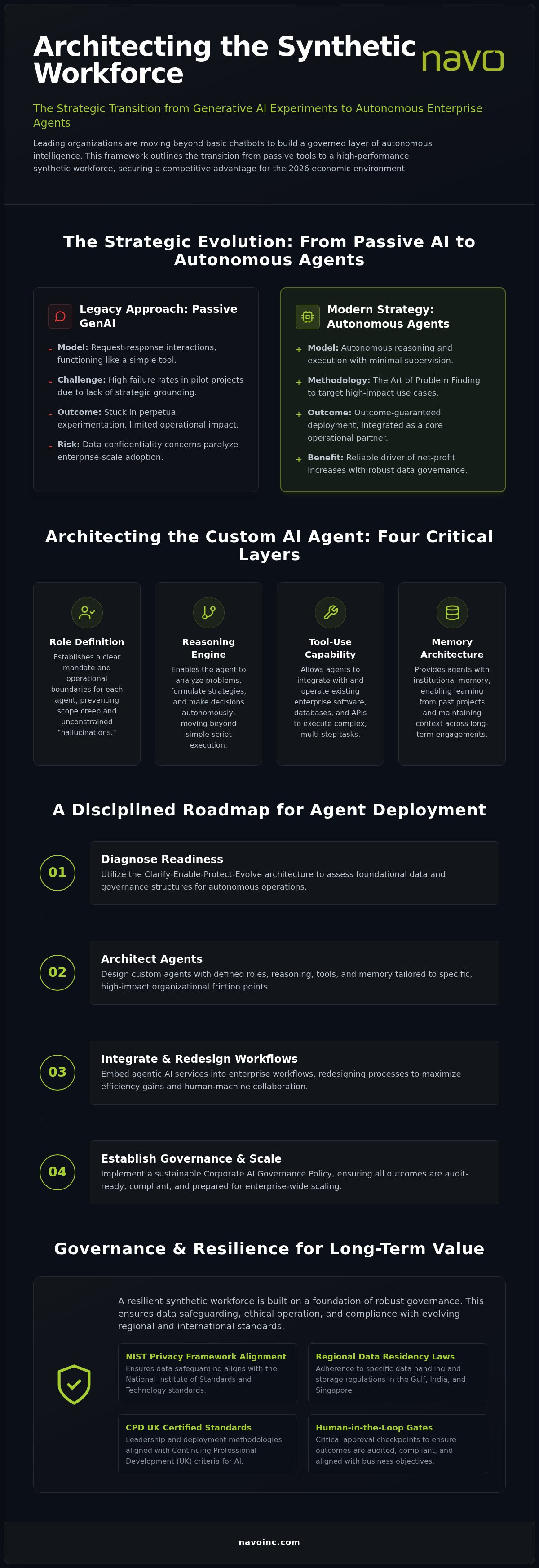
Architecting the Synthetic Workforce: Key Components of Custom AI Agent Development
By 2026, the concept of a Synthetic Workforce Layer will be an established operational reality for leading enterprises. This isn't merely a collection of software scripts or simple Generative Artificial Intelligence (GenAI) wrappers; it's a sophisticated architectural tier where autonomous entities function with the nuance of human specialists. Effective AI (Artificial Intelligence) agent deployment for business requires a departure from generic, off-the-shelf solutions in favor of custom-built agents tailored to specific organizational DNA. Don't settle for static scripts when you can architect a system composed of four critical layers: Role Definition, Reasoning, Tool-use, and Memory.
A resilient deployment strategy must remain tool-agnostic. While underlying models like Large Language Models (LLMs) evolve rapidly, a robust architectural framework ensures that your synthetic workforce remains stable even as specific technologies become obsolete. Our approach utilizes proprietary frameworks to manage this complexity. For instance, SARA facilitates sophisticated client briefing and data intake, while NOVA manages the intricate orchestration required for multi-agent collaboration. This ensures that the intelligence is embedded in the process, not just the model.
Role Definition and Memory Architecture
The true value of custom agent development lies in its ability to retain institutional memory. Unlike stateless interactions, these agents are designed with memory architectures that allow them to learn from past projects and maintain continuity across long-term cycles. Role definition ensures each agent has a clear mandate, preventing the hallucinations common in unconstrained systems. By designing feedback loops and human-in-the-loop approval gates, we ensure that every outcome is audit-ready and compliant with regional standards in the Gulf and Singapore. If your organization is ready to move from fragmented tools to a structured synthetic layer, you can consult with our transformation experts to begin the architectural design phase.
The Implementation Roadmap: Integrating Agentic AI Services into Enterprise Workflows
The realization of a high-functioning synthetic workforce demands a methodical implementation roadmap that transcends traditional software rollout protocols. This strategic journey prioritizes long-term resilience over immediate, superficial gains, ensuring that AI agent deployment for business becomes a permanent pillar of organizational health. Success requires a shift from tactical implementation to a more sophisticated model of strategic orchestration, where every digital entity is aligned with the broader corporate mission.
- Step 1: Process Redesign — This phase involves a comprehensive re-architecting of operational flows. We meticulously map agentic workflows alongside existing human core strategies to ensure systemic harmony and identify optimal cognitive hand-offs.
- Step 2: Data Safeguarding — Security is non-negotiable. We mandate strict alignment with the National Institute of Standards and Technology (NIST) Privacy Framework and the specific data residency regulations of the Gulf Cooperation Council (GCC), India, and Singapore.
- Step 3: Multi-Agent Orchestration — To prevent the performance degradation common in monolithic systems, we deploy specialized agents that divide complex enterprise responsibilities into manageable, high-precision tasks.
- Step 4: Continuous Evaluation — Resilience is maintained through empirical success metrics. We measure performance against rigorous success criteria, specifically focusing on knowledge-base hit rates and autonomous task completion accuracy.
Managing the Human-Agent Interface
Maintaining human ownership of high-stakes decisions is paramount even as autonomy increases. We advocate for a Machine-in-the-Loop paradigm, where agents provide the cognitive heavy lifting while human leaders retain final executive authority. This ensures that the Artificial Intelligence (AI) serves as a sophisticated extension of human intent rather than a detached black box. For a deeper exploration of these governance structures, you should review our executive reference on Mastering Agentic AI Services.
Schedule a strategic roadmap consultation.
Governance and Resilience: Sustaining Long-Term Value in the Agentic Era
Sustaining the structural gains of AI agent deployment for business requires more than technical maintenance; it demands a robust Corporate Artificial Intelligence (AI) Governance Policy that defines the limits of autonomy. This framework serves as the definitive boundary for permitted-use and accountability, ensuring that synthetic workers don't drift from their intended mandate. Within the specific regulatory landscapes of the Gulf, India, and Singapore, these policies must account for nuanced cultural norms and strict data residency requirements. A steady, expert hand is required to navigate these complexities, turning potential legal risks into a competitive advantage of trust and transparency.
Future-proofing the human talent that manages these agents is the final component of long-term resilience. We prioritize Continuing Professional Development (CPD) United Kingdom (UK)-certified training to ensure that leadership remains intellectually equipped to oversee sophisticated orchestration. This educational grounding prevents the organizational decay that often follows rapid technological adoption. By aligning your workforce with international standards, you create a corporate culture capable of evolving alongside the synthetic layer, rather than being overwhelmed by it.
Calculating Synthetic Workforce Return on Investment (ROI)
Moving from experimental pilot metrics to tangible bottom-line impact is the ultimate indicator of success in the agentic era. You shouldn't settle for surface-level engagement data when you can measure actual net-profit increases through autonomous operational efficiency. The Navo Masterclass serves as the essential pathway for leaders to achieve these rigorous benchmarks. Our outcome-guaranteed roadmap ensures that you move beyond confidentiality paralysis and into a governed, high-performance reality where Generative Artificial Intelligence (GenAI) delivers consistent value. This disciplined approach secures your position as a battle-tested pioneer in the modern digital frontier.
Securing Your Position in the Agentic Economy
The transition from experimental Generative Artificial Intelligence (GenAI) to a high-performance synthetic workforce is no longer a distant projection but an immediate executive mandate for any Artificial Intelligence (AI) leader. By mastering the Art of Problem Finding and architecting custom agents that retain institutional memory, organizations don't just solve tasks; they build resilience. Successful AI agent deployment for business requires a disciplined integration of multi-agent orchestration and rigorous governance that respects regional data residency laws across the Gulf and Singapore.
This transformation is guided by the expertise of Vasudevan Kidambi, the authoritative author of 'Synth Worker', ensuring that every deployment aligns with Continuing Professional Development (CPD) United Kingdom (UK)-certified coaching standards. We help you move beyond the paralysis of confidentiality to deliver a guaranteed net-profit increase for enterprise clients through structural excellence. It's clear that the future belongs to those who view these technologies as a strategic asset rather than a technical accessory.
Secure Your Strategic AI Transformation with Navo's GenAI Consulting
Your journey toward a resilient, autonomous workforce begins with a single, strategic decision to lead rather than observe.
Frequently Asked Questions
What is the difference between AI agent development and AI agent deployment?
Artificial Intelligence (AI) agent development focuses on the construction of the agent's cognitive architecture, including its memory, reasoning, and tool-use capabilities. In contrast, AI agent deployment for business involves the systemic integration of these entities into live enterprise environments. It's the transition from a technical prototype to an operational partner that adheres to corporate governance and executes real-world workflows with measurable outcomes.
How do we ensure custom AI agents comply with regional data laws in Dubai and Riyadh?
Compliance is achieved by architecting agents that strictly adhere to the United Arab Emirates (UAE) Data Protection Law and the Saudi Arabian Personal Data Protection Law (PDPL). We prioritize localized data residency and secure hosting within regional cloud infrastructures. This ensures that sensitive enterprise information remains within sovereign borders while still benefiting from the advanced reasoning capabilities of global Generative Artificial Intelligence (GenAI) models.
What are the common failure points in enterprise AI agent deployment for business?
The primary failure point is often a lack of strategic grounding, where organizations skip the Art of Problem Finding and automate the wrong bottlenecks. Other critical issues include confidentiality paralysis regarding sensitive data and the absence of a structured multi-agent orchestration layer. Without a clear implementation roadmap, pilots often remain isolated experiments rather than scalable drivers of net-profit increases.
How does the 'Machine-in-the-Loop' framework maintain human accountability?
The Machine-in-the-Loop framework ensures that human leaders remain the final authority in any decision-making chain. While agents perform the cognitive heavy lifting and data synthesis, high-stakes outcomes require a human approval gate. This architecture preserves accountability and ensures that the synthetic workforce operates as a sophisticated extension of executive intent rather than an autonomous black box that lacks institutional oversight.
What is the expected Return on Investment (ROI) for a synthetic workforce deployment?
Return on Investment (ROI) is calculated by moving beyond superficial engagement metrics to focus on bottom-line impact and net-profit increases. By replacing fragmented, manual processes with a reliable synthetic workforce layer, enterprises can achieve significant gains in operational efficiency. We provide outcome-guaranteed roadmaps that align these technological shifts with the financial performance standards expected by modern boards and shareholders in the Gulf and Singapore.
Generative AI tools may have been used to support research, structuring, or language refinement, with the final content, judgment, and editorial responsibility retained by the author.*
Disclaimer
The views and opinions expressed in this article are those of the author and do not represent any organisation, client, institution, or professional body with which he may be associated. The content is intended for general information, education, and thought leadership. Readers should seek appropriate professional advice before making legal, financial, investment, regulatory, technology, or business decisions.
The author has taken reasonable care to ensure the accuracy of the information and sources available at the time of publication. Technologies, regulations, market conditions, and industry practices may evolve, and readers are encouraged to verify current information independently. Any examples, cases, or scenarios may have been simplified, anonymised, or adapted to protect confidentiality. The author and publisher accept no liability for decisions or outcomes arising from the use of this content.
Generative AI tools may have been used to support research, structuring, or language refinement, with the final content, judgment, and editorial responsibility retained by the author.