

The traditional distinction between human capital and software infrastructure is dissolving into a unified architecture where the Synth Worker (AI Agent) serves as the primary driver of organizational resilience. You've likely encountered the paralysis that accompanies initial Generative AI pilots, where concerns regarding data confidentiality and the spectral risk of hallucinations stall meaningful deployment within the UAE's regulated markets. This hesitation is understandable in a landscape that demands absolute systemic health and professional composure.
This article provides the strategic clarity required to move beyond experimental curiosity toward a structured integration of synthetic workers that delivers measurable profit and operational excellence. We examine the governance frameworks necessary for high-stakes environments and outline a definitive roadmap for architecting a synthetic workforce layer that functions with the precision your enterprise demands. By shifting from a tool-based perspective to an architectural one, you'll discover how to transform AI from a speculative asset into a disciplined engine for net-profit growth and structural stability.
Key Takeaways
- Define the architectural transition from traditional RPA to autonomous agentic systems. Understand why the Synth Worker (AI Agent) functions as a strategic workforce layer rather than a simple software tool.
- Identify the core components of enterprise-grade agents, including role definition and memory retention. Learn why the 'Art of Problem Finding' is the essential diagnostic prerequisite for successful deployment.
- Establish a robust governance framework that ensures accountability and auditability within the UAE's regulatory landscape. Align your synthetic operations with the NIST Privacy Framework and local Gulf standards.
- Transition from experimental pilots to measurable operational excellence using structured readiness surveys. Discover the methodology for calculating net-profit increases and securing long-term systemic health.
What is a Synth Worker? Redefining the Synthetic Workforce Layer
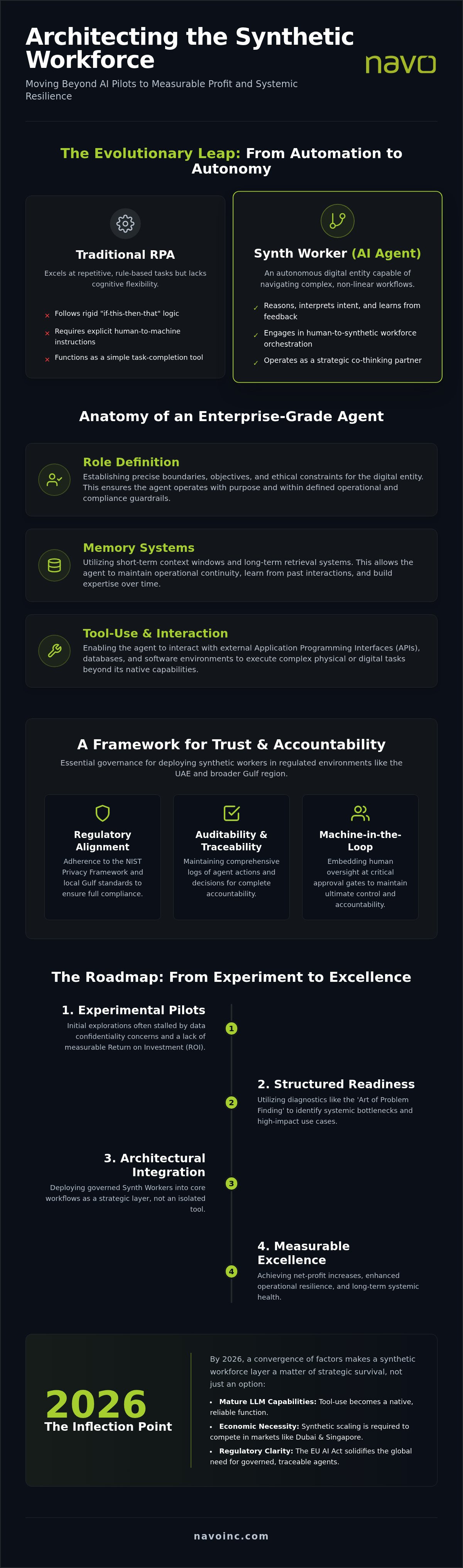
The conceptual framework of the Synth Worker (AI Agent) represents a fundamental departure from traditional software utilities. It is not merely a tool for task completion but an autonomous digital entity capable of executing defined roles, retaining long-term and short-term memory, and navigating complex, non-linear workflows. While legacy systems required rigid human-to-machine instructions, modern enterprise resilience depends on human-to-synthetic workforce orchestration. This shift transforms Generative AI from a simple utility into a strategic co-thinking partner that operates within the "Six Lanes of Working" to enhance systemic health.
Distinguishing between traditional Robotic Process Automation (RPA) and Agentic AI is critical for executive leadership. RPA excels at repetitive, rule-based tasks but lacks the cognitive flexibility of an intelligent agent. A Synth Worker (AI Agent) possesses the reasoning capacity to interpret intent, select appropriate tools, and adjust its trajectory based on environmental feedback. It moves beyond the "if-this-then-that" logic of the past to provide a sophisticated strategic response to organizational challenges.
From Automation to Agency: Why 2026 is the Year of the Synth Worker
By July 2026, the evolution of Large Language Models has reached a critical threshold where tool-use capabilities are native rather than experimental. In high-stakes markets like Dubai and Singapore, the economic necessity of synthetic scaling has become a matter of survival. Organizations are no longer seeking marginal efficiency gains. They are architecting a synthetic layer to manage the cognitive heavy lifting of modern business. The arrival of the EU AI Act in August 2026 has further solidified the need for governed, traceable agents that can operate autonomously while maintaining absolute compliance.
The Role of Synthetic Workers in Modern Business Strategy
Specialized agents like SARA, a Synthetic Client-Briefing Specialist, are already redefining intake and validation processes by ensuring high-fidelity data capture before human intervention. These agents don't just process data; they validate it against complex enterprise standards. A Synth Worker is a persistent, role-based digital entity that evolves through feedback loops to maintain operational excellence. This persistence allows for a continuous stream of expert guidance, ensuring that the transition between identifying an organizational need and proposing a structured resolution is seamless and well-reasoned.
The Architectural Anatomy of an Enterprise-Grade AI Agent
The architectural integrity of a Synth Worker (AI Agent) requires a sophisticated synthesis of cognitive dexterity and operational constraint. Deploying an agent without a rigorous diagnostic phase often results in the lack of measurable outcomes seen in failed pilots. We posit that the Art of Problem Finding is the essential prerequisite for agentic deployment. This process ensures that the synthetic layer addresses systemic bottlenecks rather than superficial symptoms. Enterprises must prioritize a tool-agnostic architecture to prevent vendor lock-in, ensuring that the synthetic workforce remains resilient as underlying models evolve.
Three core components define the enterprise-grade agent:
- Role Definition: Establishing precise boundaries, objectives, and ethical constraints for the digital entity.
- Memory Systems: Utilizing short-term context windows and long-term retrieval systems to maintain operational continuity.
- Tool-Use: Enabling the agent to interact with external APIs, databases, and software environments to execute physical or digital tasks.
Strategic leaders are already extracting measurable value from AI agents by embedding Machine-in-the-Loop protocols. These protocols ensure human oversight at critical approval gates, maintaining accountability in regulated UAE markets. This approach moves beyond simple automation toward a governed, high-fidelity workforce layer.
Proprietary Frameworks: The Six Lanes of Working
Navo utilizes the Six Lanes of Working to position Generative AI alongside core strategy rather than as an isolated IT project. This framework, supported by the Clarify-Enable-Protect-Evolve adoption architecture, ensures that the integration of synthetic workers is both seamless and secure. This structured pathway leads from initial clarification of organizational needs to the continuous evolution of the workforce layer. It's a methodology designed for high-stakes environments where precision is non-negotiable.
Memory and Context: Making Synthetic Workers Business-Aware
To achieve business awareness, agents utilize Retrieval-Augmented Generation (RAG) and targeted fine-tuning to retain organizational knowledge. While individual agents handle specific tasks, agents like NOVA specialize in project orchestration and multi-agent coordination. This hierarchical structure allows for complex problem-solving that reflects the nuances of your specific enterprise. To explore how these architectures fit your current operational model, consider consulting with our strategic advisors.
Orchestrating the Synthetic Workforce: Governance and Regional Compliance
The primary barrier to the large-scale deployment of a Synth Worker (AI Agent) remains a profound concern regarding accountability and auditability. In high-stakes enterprise environments, the transition from experimental pilots to a structured workforce layer necessitates a rigorous Corporate AI Governance Policy. This policy must define permitted-use boundaries and risk-based decision paths to ensure that agentic actions remain transparent. Effective orchestration requires a shift from passive observation to active, disciplined oversight. You can explore these dynamics further in our executive reference on Mastering Agentic AI Services.
Aligning with regional standards is a prerequisite for operational legitimacy in the Middle East. Organizations must harmonize their synthetic operations with the NIST Privacy Framework while respecting the specific data sovereignty laws of the UAE, Saudi Arabia, and Qatar. This alignment ensures that the deployment of a Synth Worker (AI Agent) doesn't just meet technical requirements but also adheres to the rigorous regulatory landscape of the Gulf. Systemic health depends on this intersection of technological innovation and legal composure.
Human-Ownership Mechanisms in the Agentic Era
Maintaining human ownership is the cornerstone of responsible AI orchestration. We implement dual-acceptance locks and approval protocols for high-stakes decisions to prevent autonomous drift. Accountability rules must state that humans are the ultimate owners of outcomes. This architecture ensures that while agents handle cognitive heavy lifting, executive leadership retains final authority. It's a balance of speed and safety that prevents the confidentiality paralysis often seen in unregulated deployments.
Governance in the Gulf: Navigating Local Regulatory Landscapes
The Middle Eastern regulatory context demands a specialized approach that respects cultural norms and strict data residency requirements. Building local workforce capability is essential for long-term resilience. We prioritize CPD UK-certified masterclasses to ensure that internal teams possess the expertise to govern these systems effectively. This commitment to professional development bridges the gap between global technology and local market conditions, ensuring your synthetic workforce evolves in lockstep with regional expectations.
Establish your Corporate AI Governance Policy today
Implementing Synth Workers for Measurable Profit and Efficiency
Transitioning from speculative Generative AI pilots to a governed synthetic workforce layer requires a methodical departure from "Confidentiality Paralysis." This shift is achieved through structured masterclasses designed to transform organizational hesitation into operational excellence. By moving beyond the experimental phase, enterprises can integrate a Synth Worker (AI Agent) as a strategic asset that drives net-profit growth. This evolution is detailed in our guide on Synthetic Workforce Development, which outlines the pathways for executive-level orchestration.
Calculating the Return on Investment (ROI) of a Synth Worker (AI Agent) involves more than simple time-saving metrics; it requires diagnostic readiness surveys to identify systemic inefficiencies. The BetterBriefs Global Report indicates that approximately one-third of marketing budgets are effectively lost due to inadequate briefing and poor internal alignment. Specialized agents like SARA mitigate this waste by reducing time-to-acceptance and ensuring that every project brief meets a high-fidelity standard before human resources are committed. This reclamation of wasted budget directly enhances the bottom line while maintaining professional composure in high-stakes environments.
The 5-Week Transformation Journey: From Pilot to Profit
Achieving structural excellence in the synthetic layer follows a disciplined, five-step trajectory:
- Step 1: Diagnostic Readiness Assessment. Evaluating the current technological and cultural maturity of the organization.
- Step 2: Strategic Problem Finding. Identifying the specific bottlenecks where agentic intervention yields the highest ROI.
- Step 3: Agent Architecture Design. Constructing the role, memory, and tool-use parameters for the synthetic worker.
- Step 4: Governance Layer Implementation. Establishing the accountability protocols and regional compliance frameworks discussed earlier.
- Step 5: Full-Scale Synthetic Deployment. Integrating the agent into the live workflow with continuous feedback loops for evolution.
Future-Proofing Talent with Synthetic Skills
The arrival of the synthetic workforce necessitates a new category of leadership capability. Developing these internal competencies is the focus of our specialized GenAI coaching, which prepares executives to lead in an augmented environment. Synthetic Skills represent the hybrid leadership capability required to orchestrate both human capital and artificial intelligence toward a unified strategic objective. This ensures that your organization remains an active leader in the UAE market, combining battle-tested consulting wisdom with bold technological pioneering.
Architecting Structural Excellence for the Agentic Era
The integration of a Synth Worker (AI Agent) is no longer a speculative venture but a prerequisite for enterprise resilience in the UAE's evolving market. By architecting a disciplined synthetic layer, organizations move beyond the limitations of legacy automation toward a model of continuous, co-thinking partnership. This journey requires a steady, expert hand to navigate the complexities of regional governance and the "Art of Problem Finding."
Navo Inc. provides the strategic composure necessary for this high-stakes transition. Led by Amazon-bestselling author Vasudevan Kidambi, our firm offers CPD UK-accredited GenAI leadership coaching and proprietary frameworks that ensure your digital workforce remains an asset rather than a liability. We don't just propose frameworks; we deliver guaranteed net-profit increases for enterprise clients by aligning technological innovation with structural stability.
Your organization's evolution into an augmented enterprise begins with a single strategic decision. We look forward to partnering with you on this disciplined path toward operational excellence and systemic health.
Frequently Asked Questions
What is the difference between an AI chatbot and a Synth Worker?
A Synth Worker (AI Agent) is an autonomous digital entity defined by its ability to execute complex roles, maintain persistent memory, and utilize external tools. Unlike a traditional AI chatbot, which is limited to reactive conversational responses within a single session, a synthetic worker proactively follows multi-step workflows. It functions as a persistent strategic layer that evolves through feedback loops rather than a temporary communication utility for simple queries.
How do Synthetic Workers handle sensitive enterprise data in the GCC region?
Synthetic workers operate within a governed framework that prioritizes data sovereignty and local regulatory alignment across the UAE, Saudi Arabia, and Qatar. By adhering to the NIST Privacy Framework and specific regional compliance standards, these systems ensure that sensitive information remains within permitted boundaries. Our deployment architecture includes rigorous auditability protocols to maintain systemic health and professional composure in high-stakes environments where confidentiality is paramount.
Can a Synth Worker operate without human supervision?
No, a Synth Worker (AI Agent) is designed to function within a Machine-in-the-Loop architecture that mandates human oversight at critical approval gates. This disciplined approach ensures that high-stakes decisions remain subject to human-ownership mechanisms. Dual-acceptance locks and clear accountability rules prevent autonomous drift while allowing the agent to handle cognitive heavy lifting. This balance maintains executive control while significantly accelerating operational throughput.
What is the expected ROI when deploying a Synthetic Workforce?
ROI is primarily realized through guaranteed net-profit increases and the systematic reclamation of wasted operational budgets. By reducing time-to-acceptance and improving briefing fidelity, specialized agents like SARA address the significant budget waste identified in the BetterBriefs Global Report. The transition from speculative pilots to a structured synthetic layer delivers measurable gains in both efficiency and professional accuracy, providing a clear pathway to long-term organizational resilience.
How does Navo’s 'Art of Problem Finding' improve AI agent performance?
The Art of Problem Finding serves as a diagnostic prerequisite that ensures agents are deployed against systemic bottlenecks rather than superficial symptoms. This methodology focuses on identifying the root cause of organizational friction before architecting the agentic response. By clarifying the true nature of a challenge first, we ensure the synthetic workforce operates with a precision that targets high-impact outcomes and improves overall systemic health throughout the enterprise.
Generative AI tools may have been used to support research, structuring, or language refinement, with the final content, judgment, and editorial responsibility retained by the author.*
Disclaimer
The views and opinions expressed in this article are those of the author and do not represent any organisation, client, institution, or professional body with which he may be associated. The content is intended for general information, education, and thought leadership. Readers should seek appropriate professional advice before making legal, financial, investment, regulatory, technology, or business decisions.
The author has taken reasonable care to ensure the accuracy of the information and sources available at the time of publication. Technologies, regulations, market conditions, and industry practices may evolve, and readers are encouraged to verify current information independently. Any examples, cases, or scenarios may have been simplified, anonymised, or adapted to protect confidentiality. The author and publisher accept no liability for decisions or outcomes arising from the use of this content.
Generative AI tools may have been used to support research, structuring, or language refinement, with the final content, judgment, and editorial responsibility retained by the author.