

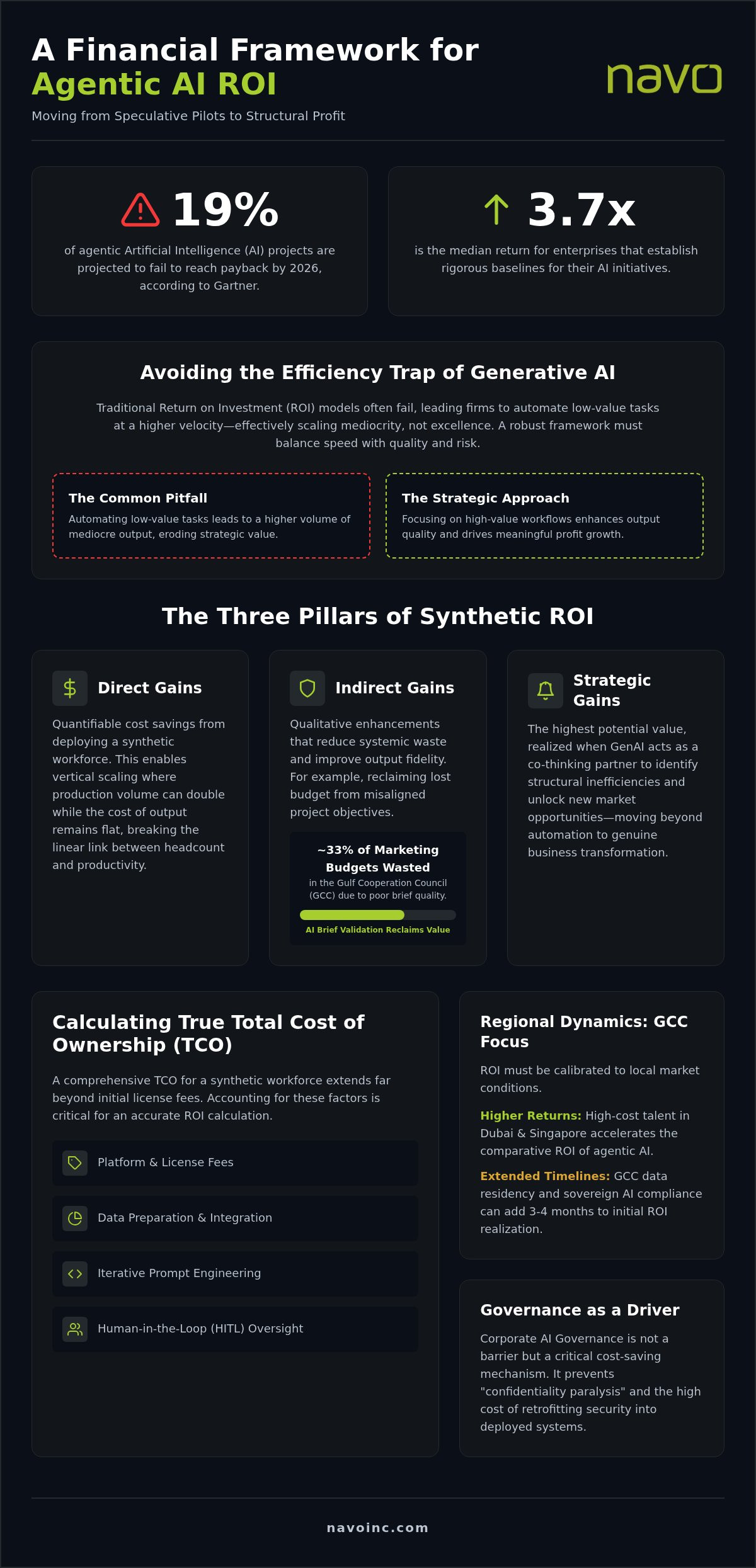
According to Gartner, 19% of agentic Artificial Intelligence (AI) projects in 2026 fail to reach payback, a stark contrast to the 3.7x median return realized by enterprises that establish rigorous baselines. For leadership teams in Dubai and the wider Gulf Cooperation Council (GCC) region, the challenge is no longer about testing the technology but about moving from speculative pilots to structural profit. To bridge this gap, a sophisticated AI automation ROI calculator, designed to measure Return on Investment (ROI), must account for more than just saved minutes. It requires a framework that integrates the cost of synthetic workforces against traditional headcount while managing the complexities of consumption-based pricing models now common in the enterprise sector.
You likely recognize that traditional financial models struggle to capture the nuanced value of "soft" gains like accelerated decision-making or the reduction in budget waste achieved through precise project orchestration. This article provides the rigorous financial framework necessary to quantify the impact of agentic systems, offering the board-ready justification required for large-scale deployment. We'll examine the transition from pilot to profit, the role of Financial Operations (FinOps) in margin expansion, and how proprietary tools like SARA and NOVA ensure every automated workflow contributes directly to the bottom line.
Key Takeaways
- Redefine the Return on Investment (ROI) of Artificial Intelligence (AI) to encompass a multi-dimensional value framework that prioritizes strategic quality and risk mitigation.
- Construct a sophisticated AI automation ROI calculator to establish rigorous baselines and categorize workflows within the Six Lanes of Working orchestration model.
- Eliminate systemic budget leakage and enhance output fidelity through the deployment of brief validation systems like the proprietary SARA framework.
- Advance from speculative technology pilots toward a disciplined implementation strategy that guarantees measurable net-profit increases for enterprises across the Gulf region.
Beyond the Efficiency Trap: Why Traditional ROI Models Fail Generative AI
The standard definition of Return on Investment (ROI) often falls short when applied to Generative Artificial Intelligence (GenAI). While traditional software focuses on linear efficiency, GenAI requires a multi-dimensional metric that balances output quality and risk mitigation against raw speed. Many enterprises fall into the "Efficiency Trap," where they mistakenly prioritize automating low-value tasks. This leads to a scenario where the organization produces lower-value outputs at a higher velocity, effectively scaling mediocrity rather than excellence. A robust AI automation ROI calculator must account for these qualitative shifts to prevent strategic drift.
Establishing a Corporate AI Governance Policy is frequently viewed as a bureaucratic hurdle. However, in the context of agentic AI, it serves as a critical cost-saving mechanism. Without clear guardrails, projects often stall during the implementation phase due to security concerns, a phenomenon we describe as "confidentiality paralysis." By codifying governance early, firms avoid the redundant expenses of retrofitting safety protocols into already deployed systems. Unlike the theoretical frameworks often presented by "Big 4" consultancies, Navo’s approach focuses on outcome-guaranteed strategies that transform governance from a cost center into a performance driver.
The Total Cost of Ownership (TCO) for Synthetic Workforces
Calculating the true expense of a synthetic workforce requires looking beyond license fees. The Total Cost of Ownership (TCO) includes data preparation, iterative prompt engineering, and the establishment of Human-in-the-Loop (HITL) approval gates. These gates are essential for maintaining oversight but add a layer of operational friction that must be quantified. Failing to account for the time spent by subject matter experts in these HITL stages can skew the results of even the most detailed AI automation ROI calculator.
Regional Labor Dynamics: Dubai to Singapore
ROI expectations must be calibrated against regional labor markets. In hubs like Dubai and Singapore, where the cost of high-tier management talent is significant, the deployment of agentic AI offers a higher comparative return than in markets with lower labor arbitrage. In the Gulf Cooperation Council (GCC), the specific requirements for localized data residency and sovereign AI compliance add an initial layer of complexity that typically extends the initial ROI timeline by three to four months.
The Three Pillars of Synthetic ROI: Direct, Indirect, and Strategic Gains
A sophisticated AI automation ROI calculator must transcend the simplistic "time saved multiplied by hourly rate" formula. While initial pilots often focus on the low-hanging fruit of task automation, mature enterprises in the Gulf region are seeing substantial ROI with Generative AI by categorizing returns into three distinct pillars. Direct gains represent the most visible layer; these are the hard cost savings realized through the deployment of synthetic workers that handle high-volume, repetitive processes without requiring a linear increase in human headcount. This synthetic layer allows for vertical scaling where the cost of output stays flat even as production volumes double.
Indirect gains focus on the qualitative enhancement of organizational output. In the marketing sector, for instance, a significant portion of capital is lost to misaligned objectives. Our internal data indicates that approximately 33% of marketing budgets in the GCC (Gulf Cooperation Council) are wasted due to poor brief quality. By utilizing proprietary systems like SARA for brief validation, firms can reclaim this lost budget, ensuring that every dollar spent on execution is underpinned by a mathematically sound strategy. This transition from passive automation to active orchestration is a hallmark of high-performing agentic systems.
Strategic gains offer the highest potential value but remain the most difficult to quantify. These gains emerge when GenAI (Generative Artificial Intelligence) acts as a co-thinking partner in the "Art of Problem Finding." This framework allows leadership teams to identify structural inefficiencies that were previously invisible. To explore how these systems integrate into your existing hierarchy, you might consider how strategic coaching can align technology with your specific profit goals.
Quantifying the Quality of Thought
Measuring the impact of AI-driven analytics on C-suite decision-making requires a shift in perspective. It's not just about speed; it's about the reduction of risk and the increase in predictive accuracy. Enterprises that invest in "Synthetic Skills" through CPD (Continuing Professional Development) UK-certified workforce upskilling create a more resilient talent pool. This ensures that the human element of the organization is equipped to manage the sophisticated outputs generated by agentic AI, turning technological capability into a competitive advantage.
Brief Validation and Budget Reclamation
Proprietary tools like SARA are designed to target the specific points where projects fail before they even begin. By validating the logic of a project brief at the outset, organizations can effectively "reclaim" budget that would otherwise be spent on corrective work or failed initiatives. This is a critical component of Synthetic Workforce Development, where the focus shifts from merely doing things faster to doing the right things with unerring precision. Using a comprehensive AI automation ROI calculator allows you to visualize these reclaimed funds as direct additions to your net margin.
Constructing Your AI Automation ROI Calculator: A Step-by-Step Logic
Moving from conceptual value to financial certainty requires a structured mathematical approach. To build a functional AI automation ROI calculator, leadership teams must first define the baseline by auditing current human-centric workflow costs and documented error rates. In high-cost labor markets like Dubai and Singapore, this audit often reveals significant "invisible" costs associated with iterative manual approvals and coordination friction. Once this baseline is established, processes should be categorized using the "Six Lanes of Working" framework, which identifies which organizational functions are most suitable for agentic orchestration versus those requiring deep human intuition.
The third phase involves applying the "Synthetic Multiplier" to determine the output capacity of AI agents like NOVA compared to traditional employees. Unlike human workers, synthetic systems scale vertically without a corresponding increase in fixed overhead, allowing for a continuous operational cycle. Finally, any rigorous calculation must factor in the "Governance Discount." This involves subtracting the necessary costs of compliance, security monitoring, and adherence to regional regulations such as the Saudi Central Bank (SAMA) frameworks or the UAE’s Artificial Intelligence (AI) ethics guidelines. This discount ensures that your AI automation ROI calculator remains grounded in fiscal reality rather than technological optimism.
The Formula for Net Profit Increase
Navo’s proprietary Return on Investment (ROI) logic integrates Continuing Professional Development (CPD) UK-certified training benchmarks into long-term productivity models. By quantifying how upskilled staff interact with agentic systems, we can project measurable net-profit increases. This formula moves beyond simple cost-cutting to measure how "Synthetic Skills" accelerate the time-to-market for new enterprise initiatives.
Case Study: From Pilot to Profit
A leading organization in the Banking, Financial Services, and Insurance (BFSI) sector in Riyadh recently transitioned from a fragmented AI pilot to a structured agentic deployment. By establishing a clear baseline and applying our "Art of Problem Finding" framework, they achieved a significant reduction in operational latency while maintaining strict regulatory compliance. For a more detailed breakdown of these metrics, you can explore our methodology for Measuring AI Impact on Profit, which explores the direct correlation between workforce training and financial output.
From Pilot to Profit: Navo’s Outcome-Guaranteed Implementation Strategy
Enterprises often mistake software procurement for strategic evolution. While a powerful Large Language Model (LLM) provides the capability, it doesn't provide the direction. Without a framework-led approach, technology investments become fragmented cost centers. Navo Management Consultants advocates for a tool-agnostic strategy where the AI automation ROI calculator serves as the primary diagnostic tool before a single line of code is deployed. This ensures that every agentic system is mapped to a specific financial outcome, moving the organization beyond the limitations of isolated experiments.
Our methodology centers on the "Art of Problem Finding." This proprietary framework allows leaders to isolate the structural bottlenecks where Generative Artificial Intelligence (GenAI) can deliver the most significant impact. By identifying these high-value use cases and validating them through a sophisticated AI automation ROI calculator, we transition from speculative technology pilots to a model of guaranteed net-profit increases. This isn't about incremental efficiency; it's about structural excellence that scales without the traditional constraints of human-centric growth.
The 5-Week Transformation Journey
The transition from a traditional workforce to a high-performing synthetic workforce is achieved through our CPD (Continuing Professional Development) UK-accredited Masterclass. This 5-week journey is structured into three critical phases: Preparation, Intensive, and Activation. During these stages, we facilitate the shift from "confidentiality paralysis" to a state of governed value. We ensure that your Corporate AI Governance Policy isn't just a document but an active enabler of secure, agentic orchestration across your regional operations.
Partnering with Navo Inc.
Leaders ready to deploy a sophisticated synthetic workforce require more than just technical support; they need high-stakes strategic coaching. For comprehensive advisory on integrating agentic systems into your enterprise architecture, connect with Navo Management Consultants. For C-suite coaching and visionary leadership development, you can engage directly with Vasudevan Kidambi to navigate the complexities of the 2026 technological frontier and secure your organization’s future in the global digital economy.
Scaling Structural Excellence in the Agentic Era
Integrating agentic systems into the enterprise architecture is a transformative shift that demands more than just technical proficiency. It requires a disciplined commitment to structural stability and the precision of the "Art of Problem Finding" framework. By moving beyond the efficiency trap and focusing on measurable net-profit increases, organizations in Dubai and the wider Gulf region can establish a position of technological leadership that remains unfazed by complexity.
Utilizing a sophisticated AI automation ROI calculator allows leadership teams to quantify the impact of synthetic workforces with the same rigor applied to traditional capital expenditures. Through the deployment of proprietary frameworks like SARA for brief validation and NOVA for orchestration, coupled with CPD (Continuing Professional Development) UK-certified masterclasses, the path from pilot to profit becomes a predictable journey toward margin expansion. It's a shift that ensures your digital evolution is both sustainable and fiscally sound.
The transition to a resilient, AI-native organization is a high-stakes endeavor that rewards the prepared. We're ready to partner with you to navigate these complex shifts and build a future defined by systemic health and radical progress.
Strategic Insights: Frequently Asked Questions
What are the primary metrics for an AI automation ROI calculator in 2026?
Primary metrics include direct cost reduction, the "Synthetic Multiplier" for output capacity, and the "Governance Discount" for compliance overhead. A robust AI automation ROI calculator must also account for the reduction in budget waste achieved through precise brief validation. These metrics allow CFOs (Chief Financial Officers) to move beyond simple time-saving estimates toward a comprehensive view of margin expansion.
How do you calculate the financial value of a synthetic worker compared to a human employee?
Calculating the value of a synthetic worker involves comparing the Total Cost of Ownership (TCO) against the fully loaded cost of a human employee. This includes salaries, benefits, and training costs versus license fees, compute usage, and the cost of human-in-the-loop (HITL) approval gates. Synthetic workers offer non-linear scaling, meaning they increase output without a corresponding rise in fixed organizational overhead.
Can Navo Inc. guarantee a specific net-profit increase through GenAI consulting?
Navo Inc. provides outcome-guaranteed consulting that directly targets measurable net-profit increases. By utilizing proprietary systems like SARA (Synthetic Analysis and Risk Assessment) for brief validation, we aim to reduce the 33% marketing budget waste commonly seen in the GCC (Gulf Cooperation Council) region. This commitment ensures that your investment in Generative Artificial Intelligence (GenAI) translates into tangible financial returns rather than speculative pilots.
What is the role of CPD UK certification in measuring AI training ROI?
CPD (Continuing Professional Development) UK certification establishes a rigorous benchmark for workforce readiness and productivity. By certifying our masterclasses, we ensure that employees acquire high-tier "Synthetic Skills" that are verifiable and measurable. This certification allows leadership teams to track the return on training investments by linking skill acquisition directly to the performance of agentic AI (Artificial Intelligence) systems.
How does the "Art of Problem Finding" framework impact the ROI of AI projects?
The "Art of Problem Finding" framework maximizes Return on Investment (ROI) by ensuring that resources are only allocated to high-impact challenges. Most AI projects fail because they automate the wrong processes, leading to faster but lower-value outputs. This framework identifies structural inefficiencies first, ensuring that your AI automation ROI calculator is measuring the impact of solving the right problems from the outset.
Disclaimer
The views and opinions expressed in this article are those of the author and do not represent any organisation, client, institution, or professional body with which he may be associated. The content is intended for general information, education, and thought leadership. Readers should seek appropriate professional advice before making legal, financial, investment, regulatory, technology, or business decisions.
The author has taken reasonable care to ensure the accuracy of the information and sources available at the time of publication. Technologies, regulations, market conditions, and industry practices may evolve, and readers are encouraged to verify current information independently. Any examples, cases, or scenarios may have been simplified, anonymised, or adapted to protect confidentiality. The author and publisher accept no liability for decisions or outcomes arising from the use of this content.
Generative AI tools may have been used to support research, structuring, or language refinement, with the final content, judgment, and editorial responsibility retained by the author.