

What if your most effective talent acquisition strategist wasn't a person you hired, but a digital architect you orchestrated? In major business hubs from Dubai to Singapore, Human Resources (HR) leaders are grappling with a paradox: they have more automation tools than ever, yet recruitment spend remains inefficient due to poorly validated briefs. You're likely aware that as of 2026, 69% of companies use Artificial Intelligence (AI) in talent acquisition, but very few have moved beyond simple, rule-based tasks. Transitioning to a synthetic workforce for HR and recruitment represents the next evolution of organizational health, moving beyond basic bots toward agentic partners that actually think with you.
It's time to stop treating technology as a mere efficiency tool and start managing it as a strategic asset. In this guide, you'll discover how to transition from basic automation to a sophisticated framework where synthetic workers handle the cognitive heavy lifting. We'll preview a structured pathway to help you scale talent acquisition without the linear cost of increasing headcount, ensuring your team remains the steady, expert hand in a rapidly shifting labor market across the Gulf and Southeast Asia.
Key Takeaways
- Identify the structural transition from traditional linear automation to the Agentic Era, where Artificial Intelligence (AI) serves as a sophisticated co-thinking partner in organizational design.
- Utilize the "Six Lanes of Working" diagnostic framework to map Human Resources (HR) workflows and pinpoint specific areas where synthetic intervention generates the highest strategic yield.
- Discover how a synthetic workforce for HR and recruitment utilizes specialized agents like SARA to validate job briefs and eliminate the resource waste common in high-volume talent acquisition.
- Implement a rigorous governance and classification framework to ensure all Artificial Intelligence (AI) deployments remain fully compliant with the labor laws and data regulations of Dubai and the wider Gulf region.
- Shift the focus of the Human Resources (HR) function toward high-level strategy by adopting a "Machine-in-the-Loop" operational model that balances technological efficiency with expert human judgment.
The Evolution of HR Talent Orchestration: Beyond Automation to a Synthetic Workforce
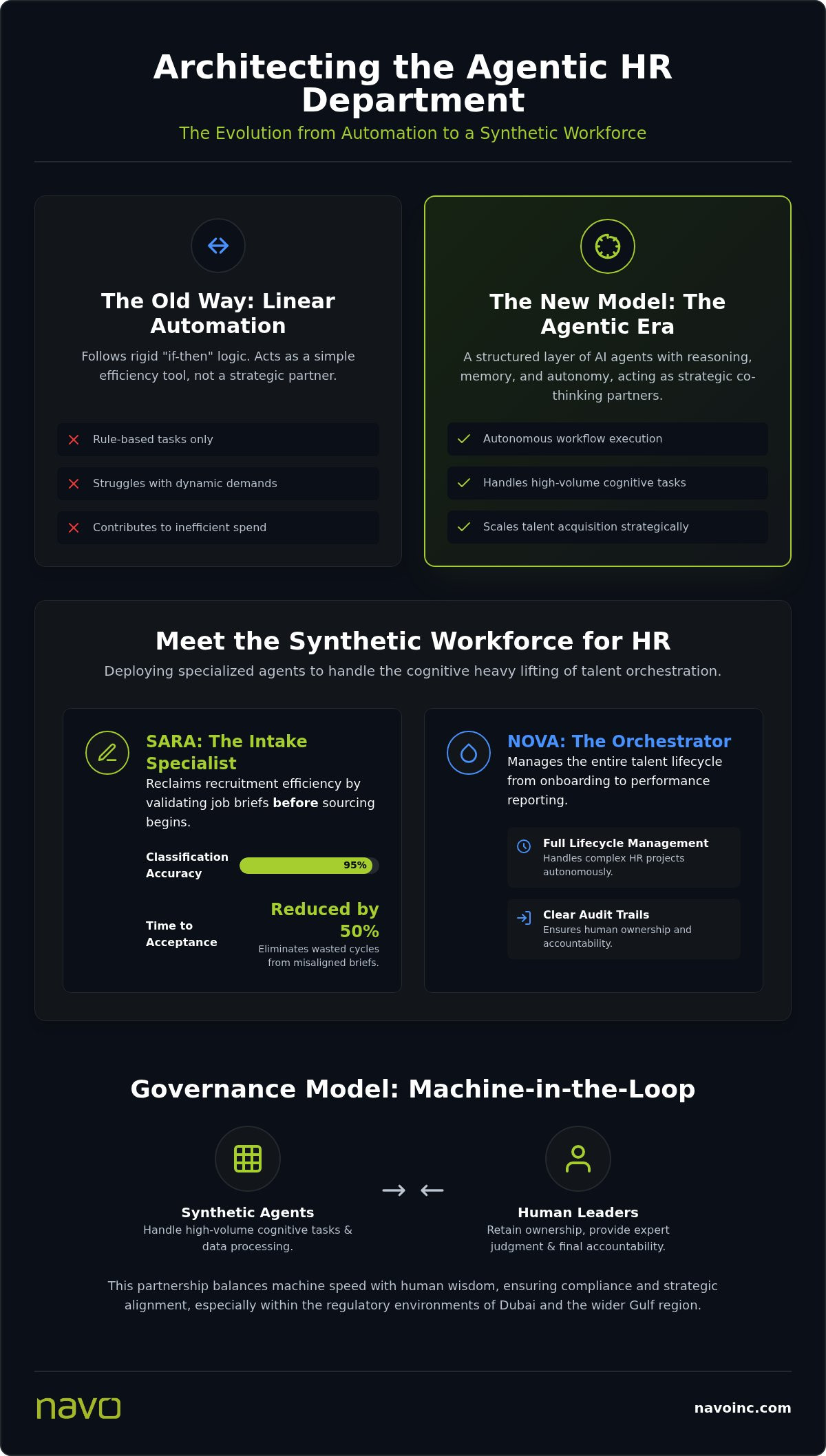
The transition from manual recruitment to digital automation was merely the first step. Today, we're witnessing a more profound shift toward the Agentic Era of management. While traditional "Linear Automation" follows rigid if-then logic, a synthetic workforce for HR and recruitment functions as a structured layer of AI agents capable of reasoning, memory, and autonomous workflow execution. This evolution moves beyond basic algorithmic management to create a system where Generative AI (GenAI) acts as a strategic co-thinking partner for leadership.
To maintain organizational integrity, we employ a "Machine-in-the-Loop" philosophy. This ensures that while synthetic agents handle high-volume cognitive tasks, human leaders retain ownership and final accountability. It's a sophisticated partnership that balances machine speed with human judgment, especially critical in the complex regulatory environments of the Gulf states and Southeast Asia.
The Shift from Tools to Synthetic Talent
Standard HR Information Systems (HRIS) often struggle with the dynamic talent demands of 2026. These platforms are repositories of data, not active participants in strategy. Synthetic talent bridges this gap by applying "Synthetic Skills" to high-stakes decisions, enabling a level of precision that human teams alone cannot reach at scale. A synthetic workforce is an architectural layer of specialized intelligence integrated into your operations, not a software purchase.
Problem Finding in Recruitment Strategy
Success begins with identifying the right challenges before attempting to solve them. By applying The Art of Problem Finding, HR leaders in markets like Dubai and Singapore can uncover hidden bottlenecks in their talent acquisition pipeline. Utilizing diagnostic tools such as readiness surveys allows enterprises to move from reactive hiring to proactive workforce orchestration. This structured approach ensures that technology isn't just added to a broken process but is used to redesign the process for systemic health.
Architecting the Agentic Human Resources (HR) Department: Deploying SARA and NOVA for Strategic Impact
Establishing a synthetic workforce for Human Resources (HR) and recruitment requires a methodical blueprint rather than a scattered adoption of tools. We begin with a diagnostic mapping of organizational workflows using the "Six Lanes of Working" framework. This allows leadership to identify exactly where cognitive bottlenecks exist and where agentic intelligence provides the highest return on investment. Once the landscape is mapped, we deploy specialized Artificial Intelligence (AI) agents into specific roles to handle the heavy lifting of talent orchestration.
SARA: Reclaiming Recruitment Efficiency
Recruitment failure often stems from the very beginning: the job brief. SARA acts as the primary intake specialist, validating requirements against market realities to ensure 95% classification accuracy. By refining the search criteria before a single candidate is sourced, organizations can reduce time to acceptance by 50%. This precision eliminates the resource waste typical of misaligned hiring cycles. For a deeper look at the technical architecture behind these agents, consult our Synthetic Workforce Development guide.
NOVA: Orchestrating the Talent Lifecycle
While SARA handles the intake, NOVA focuses on production orchestration across the entire talent lifecycle. This agent manages complex Human Resources (HR) projects from initial onboarding to automated performance reporting. Integrating agentic AI in recruitment workflows ensures that every action is logged, creating clear audit trails. This level of transparency is vital for maintaining human ownership and accountability within the system, especially when managing high-volume hiring across multiple jurisdictions.
The final stage involves establishing feedback loops and approval gates. These gates serve as a "Machine-in-the-Loop" safeguard, ensuring that outputs from Artificial Intelligence (AI) align with regional labor regulations and internal culture. It's about building a system that's both autonomous and audited. If you're ready to map your own organizational readiness, consider consulting with our strategic advisors to build a custom roadmap for your enterprise.
Governance and Return on Investment (ROI): Quantifying the Value of Synthetic Workers in the Human Resources (HR) Enterprise
Establishing a synthetic workforce for Human Resources (HR) and recruitment is not just a technological upgrade; it's a rigorous governance commitment. In jurisdictions like Dubai and Riyadh, where labor regulations are evolving to address algorithmic transparency, organizational leaders must ensure their digital agents operate within strict ethical boundaries. By utilizing a sophisticated "Classification Framework," organizations can shield sensitive employee data while maintaining the operational speed of agentic workflows. This approach ensures that innovation never outpaces legal compliance or organizational integrity.
Regional Governance and Ethical Safeguards
Navigating data safeguards and accountability rules in the Middle East and India requires a steady, expert hand. We implement the "Clarify-Enable-Protect-Evolve" framework to ensure every synthetic worker has a defined mandate and a human supervisor. This structure protects the enterprise from the risks of "black box" decision-making. It's about building systemic health where Artificial Intelligence (AI) serves the organization's long-term resilience rather than creating new liabilities.
The Path to Profit-Guaranteed Human Resources (HR) Transformation
The true maturity of an agentic department is found in its Return on Investment (ROI). We help leadership shift their metrics from a simple "cost-per-hire" to a "net-profit contribution" per synthetic worker. Navo Inc. Generative AI (GenAI) Consulting provides a structured, five-week transformation journey that moves from initial diagnostic pre-preparation to full activation. This process is designed to deliver measurable efficiency outcomes that directly impact the bottom line.
To lead this shift effectively, the human workforce must also evolve. We encourage leadership teams to explore the Continuing Professional Development (CPD) Certified AI Course to build the necessary capability for synthetic workforce orchestration. This United Kingdom-certified training ensures that your team remains the visionary architects of change, rather than passive observers of technological shifts. By combining high-level strategic coaching with proprietary agents, you create a recruitment framework that is both deeply trustworthy and intellectually stimulating.
The Architecture of Organizational Resilience
The transition from digital automation to a sophisticated agentic layer is no longer a theoretical exercise; it's a requirement for systemic health. By orchestrating specialized agents like SARA and NOVA, your department moves beyond administrative friction toward a model of high-level strategic partnership. This evolution ensures that your operations remain compliant with the labor laws of Dubai and the wider Gulf region while shifting metrics from simple cost-per-hire to substantial net-profit contribution. It's a fundamental redesign of how talent is sourced and managed.
Integrating a synthetic workforce for HR and recruitment allows your team to reclaim cognitive capacity and focus on the nuanced elements of leadership. Our approach is grounded in the frameworks established in the book 'Synth Worker – A Whole New Workforce Layer' and is backed by a net-profit increase guarantee for enterprise consulting. Through Continuing Professional Development (CPD) United Kingdom-certified coaching, we empower your leadership to become the disciplined architects of this technological frontier.
The path to a resilient, future-proof organization begins with a single strategic decision to evolve your talent orchestration model today. We look forward to partnering with you on this journey toward excellence.
Frequently Asked Questions
What exactly is a synthetic workforce in the context of Human Resources (HR)?
A synthetic workforce for Human Resources (HR) and recruitment represents a deliberate architectural layer of agentic intelligence. Unlike traditional software, these agents are designed with specific cognitive roles and memory to act as a co-thinking partner for leadership. This framework allows organizations to scale their talent acquisition capabilities in markets like Singapore and Mumbai without the linear overhead of traditional headcount expansion.
How do SARA and NOVA agents differ from standard Human Resources (HR) chatbots?
Standard Human Resources (HR) chatbots are essentially reactive interfaces designed for basic query resolution. SARA and NOVA are agentic workers that possess the reasoning capacity to execute complex workflows autonomously. While a chatbot might answer a policy question, these agents actively validate recruitment briefs and orchestrate the entire talent lifecycle, maintaining a high standard of professional density and auditability.
Can a synthetic workforce comply with labor laws in Dubai and the United Arab Emirates (UAE)?
Compliance is a foundational element of our framework, specifically designed to meet the legal requirements of Dubai and the United Arab Emirates (UAE). By maintaining a "Machine-in-the-Loop" structure, the system ensures that all Artificial Intelligence (AI) activities remain under human oversight. This approach respects regional data sensitivities and ensures that all hiring decisions align with the rigorous labor regulations of the Gulf states.
What is the expected Return on Investment (ROI) when integrating Artificial Intelligence (AI) agents into recruitment?
The Return on Investment (ROI) of integrating Artificial Intelligence (AI) agents is realized through a fundamental shift from administrative efficiency to strategic profit contribution. Beyond merely reducing time to hire, these agents eliminate the significant financial drain caused by misaligned job briefs and poor candidate matching. This results in a more resilient organizational structure where recruitment spend is optimized for maximum net-profit impact.
Disclaimer
The views and opinions expressed in this article are those of the author and do not represent any organisation, client, institution, or professional body with which he may be associated. The content is intended for general information, education, and thought leadership. Readers should seek appropriate professional advice before making legal, financial, investment, regulatory, technology, or business decisions.
The author has taken reasonable care to ensure the accuracy of the information and sources available at the time of publication. Technologies, regulations, market conditions, and industry practices may evolve, and readers are encouraged to verify current information independently. Any examples, cases, or scenarios may have been simplified, anonymised, or adapted to protect confidentiality. The author and publisher accept no liability for decisions or outcomes arising from the use of this content.
Generative AI tools may have been used to support research, structuring, or language refinement, with the final content, judgment, and editorial responsibility retained by the author.