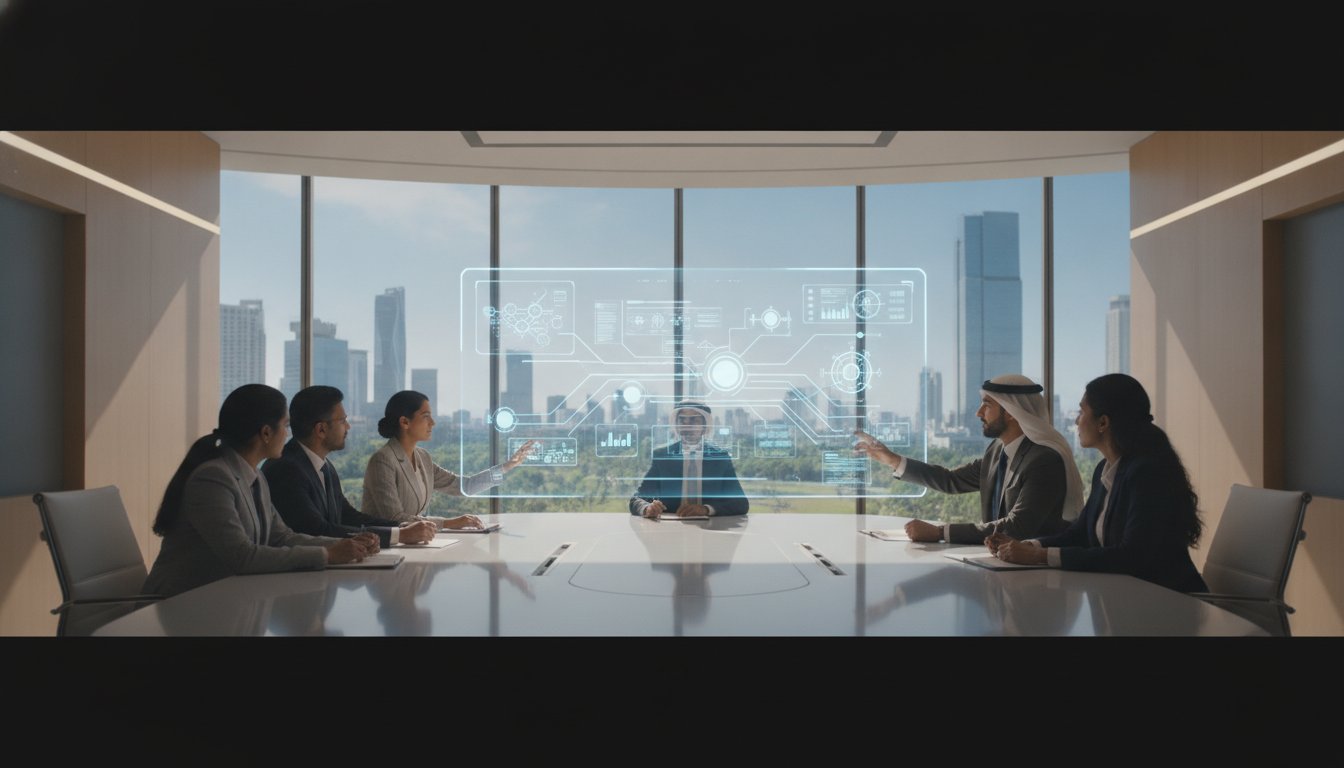

The greatest risk to your organization in 2026 isn't the presence of Artificial Intelligence (AI), but the paralysis of a workforce that views it as a predator rather than a peer. In high-stakes markets from Dubai to Singapore, the silence following automation rumors often does more damage than the technology itself. You've likely noticed a dip in morale or a hesitation in your top performers, driven by the uncertainty of where they fit in an increasingly automated future.
We understand that bridging the gap between legacy operations and a modern synthetic workforce requires more than just new software; it demands a psychological and structural evolution. This guide offers actionable fear of AI job displacement solutions that move beyond protectionist policies. You'll discover how to transition your team from the role of the "doer" to the "orchestrator" through strategic reskilling and the Art of Problem Finding. We'll outline a clear framework for human-AI synergy that stabilizes your workforce, reduces turnover, and transforms looming displacement anxiety into a shared engine for growth and systemic resilience.
Key Takeaways
- Identify why Generative Artificial Intelligence (GenAI) displacement anxiety must be managed as a systemic organizational risk to protect institutional stability during the 2026 transition.
- Implement high-value fear of AI job displacement solutions by auditing legacy workflows and transitioning human roles from routine execution to the proprietary Art of Problem Finding framework.
- Architect a functional synthetic workforce where specialized Artificial Intelligence (AI) agents manage administrative burdens, allowing your human capital to focus exclusively on strategic output.
- Establish a robust Corporate AI Governance policy that defines clear permitted-use boundaries and mandates human-ownership for every automated output to ensure ethical accountability.
- Develop a comprehensive roadmap for transforming the internal perception of AI from a disruptive threat into a sophisticated tool for sustainable productivity and human-AI synergy.
Analyzing the Psychological and Economic Realities of Generative AI (GenAI) Displacement
The integration of Generative Artificial Intelligence (GenAI) into the global economy has reached a critical inflection point in 2026. While many legacy analysts focus on the raw numbers of potential job losses, the more immediate threat to organizational health is the systemic anxiety permeating the workforce. This fear of AI job displacement solutions necessitates a move away from defensive posturing toward a proactive, strategic redesign of human roles. In the Gulf region, where national visions in Dubai and Riyadh prioritize rapid technological adoption, the pressure to maintain a high-performance culture while integrating Artificial Intelligence (AI) is particularly intense. We see that entry-level white-collar positions are no longer protected by their complexity, as GenAI now handles sophisticated data synthesis and administrative execution with precision.
The Cost of Inaction: Confidentiality Paralysis and Morale Decay
Leaders often succumb to "confidentiality paralysis," a state where strategic silence regarding AI implementation creates a vacuum filled by employee speculation. When executive teams fail to articulate a clear roadmap for human-AI collaboration, they inadvertently signal that human talent is an expendable commodity. This erosion of trust manifests as declining productivity and increased turnover among top-tier talent who seek stability elsewhere. Intellectual honesty is the only antidote; leaders must acknowledge the capabilities of GenAI while simultaneously defining the enduring value of human strategic oversight.
Shifting the Narrative: From Automation to Augmentation
Transitioning from a replacement mindset to an augmentation reality requires a structural framework like the "Six Lanes of Working." This diagnostic tool categorizes tasks based on their suitability for automation, allowing organizations to redeploy human intelligence toward higher-value activities. Through high-stakes coaching at Navo Inc., executives learn to navigate this transition by focusing on resilience and systemic health. By treating AI as a synthetic partner rather than a mechanical substitute, firms can stabilize their workforce and foster an environment where innovation thrives through human-machine synergy.
Executing a Strategic Reskilling Program: Transitioning from Execution to Problem Finding
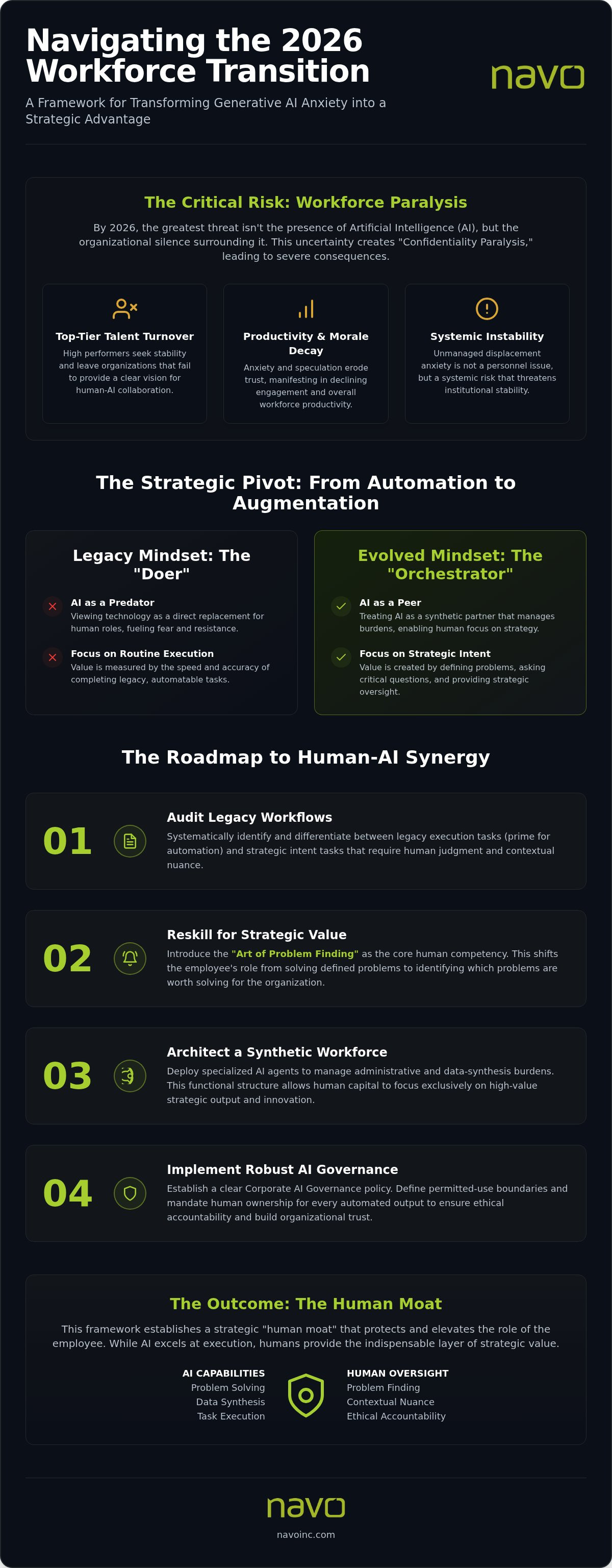
Moving beyond the initial anxiety described in the previous section requires a disciplined approach to workforce evolution. To implement effective fear of AI job displacement solutions, organizations must first conduct a comprehensive audit of existing workflows. This process differentiates between legacy execution tasks, which are ripe for automation, and strategic intent tasks that require human judgment. By isolating these components, leaders can clear the path for the 2026 workforce's most critical competency: the Art of Problem Finding. This transition is not merely a change in job description; it is a fundamental shift in how value is created within the enterprise.
- Workflow Auditing: Systematically identify legacy execution tasks vs. strategic intent tasks to determine automation potential.
- Cognitive Pivot: Introduce the Art of Problem Finding as the core competency for employees navigating an Artificial Intelligence (AI) integrated environment.
- Evidence-Based Benchmarking: Deploy Continuing Professional Development (CPD) UK-certified masterclasses to provide globally recognized skill standards.
- Collaborative Oversight: Implement a Machine-in-the-Loop thinking model where humans approve, refine, and take ownership of AI-generated outputs.
The Art of Problem Finding: The Human Moat
While AI demonstrates remarkable efficiency in solving defined problems, it lacks the contextual nuance required to identify which problems are actually worth solving. This distinction forms a strategic human moat that protects and elevates the role of the employee. Drawing on Vasudevan Kidambi’s proprietary frameworks on strategic transformation, we position the human as the architect of inquiry. In this model, the employee's value shifts from the speed of their output to the sophistication of their questions and their ability to align technological capabilities with high-level business objectives. If you are ready to begin this transition, you can consult with our team to design a bespoke reskilling roadmap.
Measuring Reskilling Return on Investment (ROI)
Quantifying the success of a transition program is essential for maintaining stakeholder buy-in. Organizations should utilize diagnostic tools and readiness surveys to establish a baseline for employee adaptability and track their progress over time. Monitoring the Return on Investment (ROI) of these initiatives involves observing the shift from administrative execution to high-value strategic oversight. For leaders seeking a structured and certified pathway, our CPD Certified AI Course provides the necessary skill benchmarks to ensure your team meets international standards of excellence while neutralizing displacement anxiety.
Architecting a Synthetic Workforce to Augment Human Strategic Output
The realization of a synthetic workforce represents a shift from viewing Artificial Intelligence (AI) as a series of disconnected tools to treating it as a functional layer of autonomous agents. These agents execute defined roles with audit-ready outcomes, effectively acting as an extension of the existing team. By integrating these entities, organizations provide the most practical fear of AI job displacement solutions: a future where humans are no longer the bottleneck for routine execution. This architecture allows the workforce to move from manual labor to high-level orchestration, ensuring that human capital is deployed where it is most impactful.
Specific synthetic workers like SARA, a Synthetic Client-Briefing Specialist, demonstrate this transition by removing the administrative burden from creative and marketing teams. SARA synthesizes complex client requirements into actionable briefs, ensuring clarity before a single human hour is spent on production. Similarly, NOVA manages project orchestration, tracking dependencies and timelines with a level of precision that exceeds manual oversight. This allows human managers to focus on high-stakes decision-making and relationship management, while the "Sense-Ask-Refine-Approve" workflow maintains strict human-in-the-loop control over every agentic output.
Role Definition for AI Agents
Effective integration requires moving away from simple prompts toward comprehensive "agent briefs." These documents treat the AI as a professional colleague, defining its memory parameters, tool access, and mandatory approval gates. By establishing clear boundaries and expectations, leaders ensure that agentic AI operates within the cultural and legal frameworks of the Gulf region. This structured approach transforms the AI from a black-box utility into a transparent, accountable member of the strategic team.
Reducing Human Burnout Through Agentic Support
The deployment of agentic services and AI video production addresses the pervasive issue of professional burnout. By automating the repetitive elements of communication and content creation, firms can reclaim "the lost third" of budgets often wasted on misaligned briefs or poor internal coordination. This systemic health improvement is a cornerstone of Synthetic Workforce Development, as it refocuses the human experience on creativity and complex problem-solving rather than administrative survival.
Implementing Robust Corporate AI Governance to Foster Organizational Trust
The final pillar of a resilient transition involves the codification of trust through a comprehensive Corporate AI Governance Policy. Effective governance serves as a definitive fear of AI job displacement solutions by establishing clear boundaries where human intelligence remains the ultimate authority. By defining permitted-use parameters, organizations ensure that Generative Artificial Intelligence (GenAI) operates as a regulated extension of the workforce rather than an unmonitored substitute. Central to this framework is a Human-Ownership mechanism, which mandates that every synthetic output has a designated human professional responsible for its ethical alignment and technical accuracy. This structure transforms governance from a perceived barrier into a value-driver that enables safe, high-speed innovation.
Strategic alignment with the National Institute of Standards and Technology (NIST) Privacy Framework and local Dubai AI governance mandates for 2026 is non-negotiable for firms operating in the Gulf. These regulations provide a rigorous template for data integrity and algorithmic accountability, ensuring that your synthetic workforce architecture meets international standards. By embedding these rules into the organizational fabric, leaders provide the psychological safety necessary for employees to embrace Artificial Intelligence (AI) as a permanent, secure partner in their professional evolution. It's about creating a stable environment where technological progress doesn't come at the expense of systemic health.
The Leadership Playbook for AI Transparency
Maintaining workforce alignment requires a commitment to radical transparency through quarterly AI Readiness town halls. These sessions serve as a forum to communicate the current state of the transition and reinforce the Clarify-Enable-Protect-Evolve adoption architecture. This methodology ensures that the workforce understands the specific intent behind technological shifts, enabling them to protect their strategic value while evolving alongside the machine. It's a disciplined approach to organizational health that prevents the decay of morale during periods of rapid change.
Building an Audit-Ready Operational Model
In highly regulated sectors like Banking, Financial Services, and Insurance (BFSI), an audit-ready operational model is essential for systemic resilience. Every interaction between a human orchestrator and a synthetic worker must produce a transparent audit trail that satisfies both internal compliance and external regulatory bodies. This level of rigor ensures that the integration of AI doesn't compromise the firm’s legal standing or its commitment to cultural norms within the Middle East and Singapore. Establishing these safeguards is the final step in neutralizing the fear of AI job displacement solutions by proving that the human remains the essential, accountable core of the enterprise.
Partner with Navo Inc. for outcome-guaranteed GenAI consulting
Steering the 2026 Workforce Toward Strategic Resilience
The journey from a legacy workforce to a high-value synthetic-human collaboration is no longer a theoretical exercise; it's a survival mandate. By auditing workflows and pivoting toward the Art of Problem Finding, your organization secures its most valuable asset: human judgment. Specialized agents like SARA and NOVA manage the administrative burden, while robust governance ensures every output remains under human ownership and ethical oversight.
These fear of AI job displacement solutions don't just protect your team. They empower them to become the orchestrators of a more productive future. Navo Inc. provides a steady hand through this transition, offering CPD (Continuing Professional Development) UK-Accredited Excellence and an Outcome-Guaranteed Strategy rooted in bestselling thought leadership. It's time to move beyond the anxiety of automation and embrace a disciplined architecture of growth.
Your leadership today defines the systemic health and competitive edge of your organization tomorrow. Embrace the evolution with confidence.
Frequently Asked Questions
What is the most effective way to address employee fear of AI job displacement?
Addressing employee anxiety requires a shift from defensive silence to radical transparency. The most effective fear of AI job displacement solutions involve presenting a clear roadmap where human roles evolve from manual execution to strategic oversight. By demonstrating that technology is a partner rather than a replacement, leaders stabilize morale and protect institutional knowledge. It's about showing the workforce that their value lies in orchestration, not just repetitive output.
How does the "Art of Problem Finding" differ from traditional problem solving?
Traditional problem solving focuses on finding efficient answers to predefined queries. In contrast, the Art of Problem Finding identifies the underlying systemic issues that need addressing. This cognitive shift ensures that human professionals remain the architects of strategy, utilizing Artificial Intelligence (AI) to execute the solutions they've uniquely identified. It creates a "human moat" that machines cannot replicate because they lack contextual intuition.
What are the benefits of a "Synthetic Workforce" for a mid-sized enterprise in Dubai or India?
A synthetic workforce allows mid-sized enterprises in Dubai and India to scale operations without the prohibitive costs of traditional expansion. By deploying specialized agents like SARA or NOVA, firms can automate high-volume administrative tasks and client briefing processes. This enables existing talent to focus on relationship management and complex decision-making, which are critical in the culturally nuanced Middle Eastern and Indian markets.
Can GenAI actually increase net profit, and how is this measured?
Generative Artificial Intelligence (GenAI) increases net profit by reclaiming the "lost third" of budgets typically wasted on communication friction and repetitive execution. Measurement involves tracking the shift in human hours from low-value tasks to high-stakes strategic output. Success is quantified by improved margins and the reduction of operational bottlenecks through human-AI synergy, ensuring that capital is deployed toward growth rather than administrative survival.
What should be included in a 2026 Corporate AI Governance Policy?
A 2026 Corporate AI Governance Policy must establish definitive "permitted-use" boundaries and a "Human-Ownership" mechanism. It should ensure every output is vetted by a responsible professional, maintaining alignment with the National Institute of Standards and Technology (NIST) Privacy Framework. Policies must also comply with local Dubai AI governance mandates to ensure legal and ethical resilience across all operational layers.
Is CPD UK-certified training necessary for AI adoption?
Continuing Professional Development (CPD) UK-certified training is essential for establishing evidence-based skill benchmarks within an organization. It provides an international standard of excellence that reassures stakeholders and employees alike during a period of radical change. Certified masterclasses ensure that the transition to a synthetic workforce is grounded in verified methodologies rather than speculative experimentation, providing a structured pathway for professional evolution.
Disclaimer
The views and opinions expressed in this article are those of the author and do not represent any organisation, client, institution, or professional body with which he may be associated. The content is intended for general information, education, and thought leadership. Readers should seek appropriate professional advice before making legal, financial, investment, regulatory, technology, or business decisions.
The author has taken reasonable care to ensure the accuracy of the information and sources available at the time of publication. Technologies, regulations, market conditions, and industry practices may evolve, and readers are encouraged to verify current information independently. Any examples, cases, or scenarios may have been simplified, anonymised, or adapted to protect confidentiality. The author and publisher accept no liability for decisions or outcomes arising from the use of this content.
Generative AI tools may have been used to support research, structuring, or language refinement, with the final content, judgment, and editorial responsibility retained by the author.