

By 2026, the distinction between a digital tool and a functional colleague has effectively vanished, leaving leadership teams to manage a workforce that is increasingly synthetic. You're likely grappling with the tension between aggressive innovation and the stringent requirements of the Federal Authority for Artificial Intelligence and Data (FAAID). Establishing a comprehensive AI governance policy framework for enterprises in UAE is no longer a secondary compliance task; it's a foundational requirement for operational resilience in a market where the Central Bank of the United Arab Emirates (CBUAE) now holds boards directly accountable for algorithmic outcomes.
We understand the paralysis that stems from regulatory uncertainty and the fear of data sovereignty breaches. This article delivers a rigorous, implementation-ready framework designed to align your Generative Artificial Intelligence (GenAI) initiatives with both the UAE Charter for the Development and Use of Artificial Intelligence and international National Institute of Standards and Technology (NIST) benchmarks. We'll provide a strategic checklist that transforms abstract ethical principles into a board-ready governance structure, ensuring your transition into the era of Agentic AI remains secure, compliant, and architecturally sound.
Key Takeaways
- Align organizational standards with the 12 foundational principles of the UAE AI Charter and the mandates of the Federal Authority for Artificial Intelligence and Data (FAAID).
- Implement a robust AI governance policy framework for enterprises in UAE that establishes permitted-use boundaries and mitigates board-level liability through human-to-algorithm accountability.
- Establish governance protocols for the orchestration of a synthetic workforce, ensuring autonomous agents like SARA and NOVA operate under strict Human-in-the-Loop (HITL) oversight.
- Leverage a strategic roadmap to bridge the gap between regulatory compliance and the profitable deployment of Agentic Artificial Intelligence (AI) and synthetic workers.
- Build internal leadership capability through CPD UK-certified (Continuing Professional Development) masterclasses focused on governing and scaling synthetic workforces.
The UAE Artificial Intelligence Regulatory Landscape: Aligning with National Charters
The regulatory environment in the UAE has matured into a sophisticated ecosystem where compliance is no longer a simple checkbox exercise. By 2026, the Federal Authority for Artificial Intelligence and Data (FAAID) has centralized oversight, requiring a robust AI governance policy framework for enterprises in UAE. This evolution stems from the 12 foundational principles of the UAE AI Charter, which prioritize human-centricity, transparency, and the mitigation of algorithmic bias. Leadership teams must recognize that these principles are the baseline for any scalable deployment of synthetic workforces.
The 'UAE’s International Stance on Artificial Intelligence Policy' clarifies the nation's position on cross-border data flows, ensuring enterprise data remains secure while allowing for global collaboration. This policy is bolstered by the research and talent development initiatives at the Mohamed bin Zayed University of Artificial Intelligence (MBZUAI), which serves as a cornerstone for the National Strategy for Artificial Intelligence 2031. Organizations that fail to align with these international standards risk significant operational friction when expanding beyond the Gulf region.
The Artificial Intelligence and Advanced Technology Council (AIATC) now provides the technical scaffolding for local standards, bridging the gap between high-level policy and industrial application. In 2026, the shift from static compliance to dynamic governance is mandatory. It's no longer sufficient to have a dormant policy document. You need a living framework that responds to real-time model drift and evolving data sovereignty requirements.
Key Regulatory Pillars in Dubai and Abu Dhabi
Dubai’s focus remains anchored in AI-driven Web3 initiatives and decentralized finance, while Abu Dhabi prioritizes industrial AI applications and energy sector optimization. Both emirates align under the National Program for Artificial Intelligence (NPAI), yet enterprises must tailor their governance to these local nuances to maintain operational licenses. A policy that works for a Dubai-based fintech might not satisfy the industrial safety requirements of an Abu Dhabi manufacturing hub.
Expanding Abbreviations and Contextual Definitions
Board-level clarity is non-negotiable. Definitions of Generative Artificial Intelligence (GenAI), which creates new content, and Large Language Models (LLM), the foundational architectures like GPT-4 or Falcon, must be explicitly detailed within your policy. Expanding these technical terms ensures that non-technical stakeholders understand the risk profiles associated with each technology. It's about creating a shared language of risk and opportunity at the executive level.
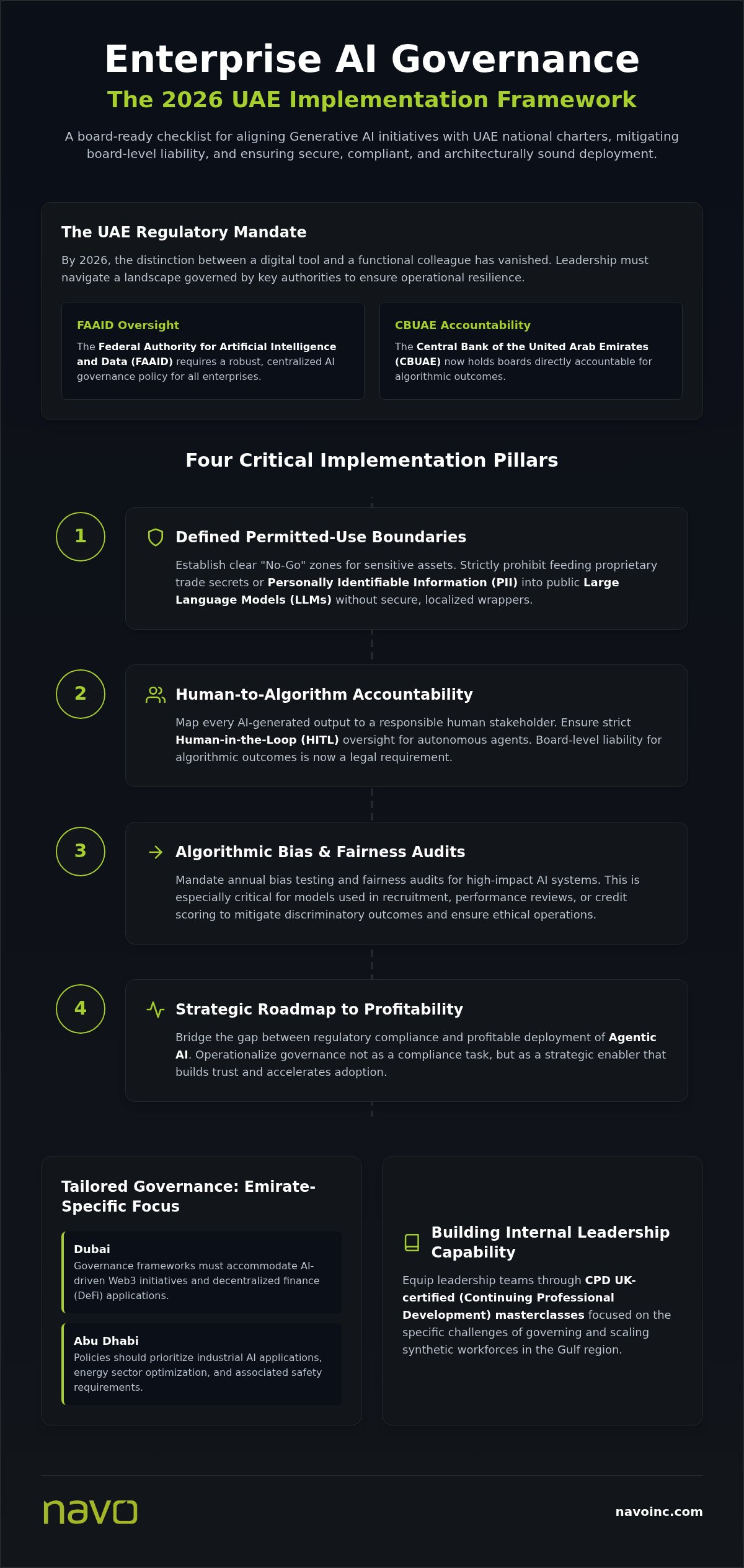
Enterprise AI Governance Checklist: The 2026 Implementation Framework
Translating high-level principles into an operational AI governance policy framework for enterprises in UAE requires a transition from theoretical ethics to granular control. The 2026 regulatory environment, steered by the Federal Authority for Artificial Intelligence and Data (FAAID), demands that organizations move beyond vague guidelines. A resilient framework is built on four critical implementation pillars designed to mitigate risk while accelerating the adoption of synthetic workers.
- Defined Permitted-Use Boundaries: You must establish clear 'No-Go' zones for sensitive enterprise assets. This includes a strict prohibition on feeding proprietary trade secrets or PII (Personally Identifiable Information) into public Large Language Models (LLM) without localized, secure wrappers.
- Accountability and Human Ownership: Every AI-generated output or decision must be mapped to a responsible human stakeholder. Following the February 2026 guidance from the Central Bank of the United Arab Emirates (CBUAE), board members now carry direct legal accountability for the outcomes of automated systems.
- Algorithmic Bias and Fairness Audits: High-impact AI systems, specifically those used in recruitment or credit scoring, require annual bias testing. This ensures that models don't develop discriminatory patterns or suffer from model drift over time.
- Data Sovereignty and Local Storage: Adherence to the UAE Personal Data Protection Law (Federal Decree-Law No. 45 of 2021) is mandatory. Governance must ensure that data processed by AI agents remains within UAE jurisdiction, utilizing local cloud infrastructure where required.
Aligning these pillars with the UAE National Strategy for Artificial Intelligence 2031 ensures your organization remains a contributor to the nation's digital economy rather than a liability. Developing a resilient governance architecture is the first step toward secure innovation.
Transparency and Auditability Protocols
Enterprises must maintain audit-ready logs for all AI decision-making processes. This documentation is essential for satisfying the 'Right to Explanation,' a mandate ensuring that any stakeholder affected by an automated outcome can request a clear, human-readable justification for that decision. Transparency isn't just about technical visibility; it's about maintaining trust through every layer of the synthetic workforce.
Risk-Based Decision Paths
Governance shouldn't be a bottleneck. By categorizing AI use cases into risk levels, Low, Medium, High, or Prohibited, you can establish 'Approval Gates' that match the stakes of the deployment. High-impact deployments require a 'Human-in-the-Loop' (HITL) model, where a qualified professional reviews and validates AI outputs before they reach the final consumer or operational stage.
Governing the Synthetic Workforce: Protocols for Agentic Artificial Intelligence
The emergence of Agentic Artificial Intelligence (AI) has introduced a sophisticated organizational layer: the synthetic workforce. Unlike traditional, passive software, these autonomous agents execute complex roles and make decisions, necessitating a specialized AI governance policy framework for enterprises in UAE. In this evolving ecosystem, synthetic workers like SARA or NOVA act as functional extensions of your human capital. This paradigm shift requires moving beyond basic oversight toward rigorous Human-in-the-Loop (HITL) protocols, where every agentic execution is validated against enterprise risk tolerances.
Accountability is the cornerstone of agentic governance. When an autonomous agent commits a strategic error, the legal and operational liability remains with the human owner, a principle reinforced by the 2026 Federal Authority for Artificial Intelligence and Data (FAAID) mandates. Auditing these workers involves establishing robust Key Performance Indicators (KPIs) that evaluate accuracy, ethical adherence, and alignment with corporate values. Performance metrics must be reviewed with the same rigor as human appraisals to ensure systemic integrity.
Proprietary Frameworks: Clarify-Enable-Protect-Evolve
Leaders often face confidentiality paralysis when deploying agents. Navo Inc.'s proprietary architecture, the "Clarify-Enable-Protect-Evolve" model, provides a structured pathway to move from hesitation to governed value. By integrating Machine-in-the-Loop (MITL) thinking into the standard operating model, enterprises ensure that their governance protocols are not static. Instead, they evolve alongside the agent's capabilities, maintaining structural excellence during rapid technological shifts.
Security Protocols for Agentic Orchestration
Securing agentic workflows demands protection against prompt injection and unauthorized agentic actions. It's essential to deploy project orchestration agents that act as systemic guardians. These controllers monitor the health of the agentic network, ensuring that every automated task remains within strictly defined permitted-use boundaries. This multi-layered security approach prevents rogue executions and maintains the resilience of the digital infrastructure.
Design your agentic governance roadmap.
Establishing these permitted-use boundaries now positions your organization as a steady, expert hand in a rapidly evolving digital economy. We look forward to partnering with you to architect a future of secure, high-impact innovation.
Frequently Asked Questions
What are the 12 Principles of the UAE AI Charter for enterprises?
The 12 principles of the UAE Charter for the Development and Use of Artificial Intelligence (AI) provide an ethical framework focused on human-centricity, transparency, and safety. These principles require that systems are developed to enhance human well-being while actively mitigating risks such as algorithmic bias. Enterprises must align their internal standards with these tenets to ensure both social responsibility and alignment with the Federal Authority for Artificial Intelligence and Data (FAAID) mandates.
Is a corporate AI governance policy mandatory for businesses in Dubai?
Establishing a formal AI governance policy framework for enterprises in UAE is increasingly mandatory, particularly within high-stakes sectors. The Central Bank of the United Arab Emirates (CBUAE) issued a Guidance Note in February 2026 making AI governance a board-level obligation for all licensed financial institutions. For other organizations, the centralized oversight provided by the FAAID makes a documented policy essential for maintaining structural excellence and operational licenses.
How does the UAE's Artificial Intelligence policy differ from the EU AI Act?
The UAE's policy landscape favors a sophisticated balance between rapid innovation and ethical safeguards, whereas the European Union (EU) AI Act utilizes a more rigid, risk-based classification system. The UAE National Strategy for Artificial Intelligence 2031 emphasizes enabling the digital economy through strategic partnerships and research. This approach encourages the deployment of a synthetic workforce while maintaining human-centricity, rather than focusing primarily on prescriptive prohibitions.
What is the role of 'Human-in-the-Loop' in UAE AI governance?
'Human-in-the-Loop' (HITL) serves as a critical accountability mechanism where a human professional validates the outputs of an Artificial Intelligence (AI) system before final execution. The CBUAE guidance for 2026 encourages different levels of oversight, including Human-on-the-Loop (HOTL) and Human-out-of-the-Loop (HOOL) for lower-risk processes. For high-impact decisions such as credit scoring, HITL ensures that a responsible human stakeholder remains the final arbiter of the algorithmic outcome.
How can enterprises ensure data privacy when using synthetic workers in the Gulf?
Enterprises must adhere to the UAE Personal Data Protection Law (Federal Decree-Law No. 45 of 2021) by ensuring that synthetic workers process data within the local jurisdiction. This involves utilizing secure, localized cloud infrastructure and preventing sensitive assets from being uploaded to public Large Language Models (LLM). Implementing permitted-use boundaries within your governance architecture ensures that every interaction an agent has with enterprise data remains compliant with national residency requirements.
Generative AI tools may have been used to support research, structuring, or language refinement, with the final content, judgment, and editorial responsibility retained by the author.*
Disclaimer
The views and opinions expressed in this article are those of the author and do not represent any organisation, client, institution, or professional body with which he may be associated. The content is intended for general information, education, and thought leadership. Readers should seek appropriate professional advice before making legal, financial, investment, regulatory, technology, or business decisions.
The author has taken reasonable care to ensure the accuracy of the information and sources available at the time of publication. Technologies, regulations, market conditions, and industry practices may evolve, and readers are encouraged to verify current information independently. Any examples, cases, or scenarios may have been simplified, anonymised, or adapted to protect confidentiality. The author and publisher accept no liability for decisions or outcomes arising from the use of this content.
Generative AI tools may have been used to support research, structuring, or language refinement, with the final content, judgment, and editorial responsibility retained by the author.