

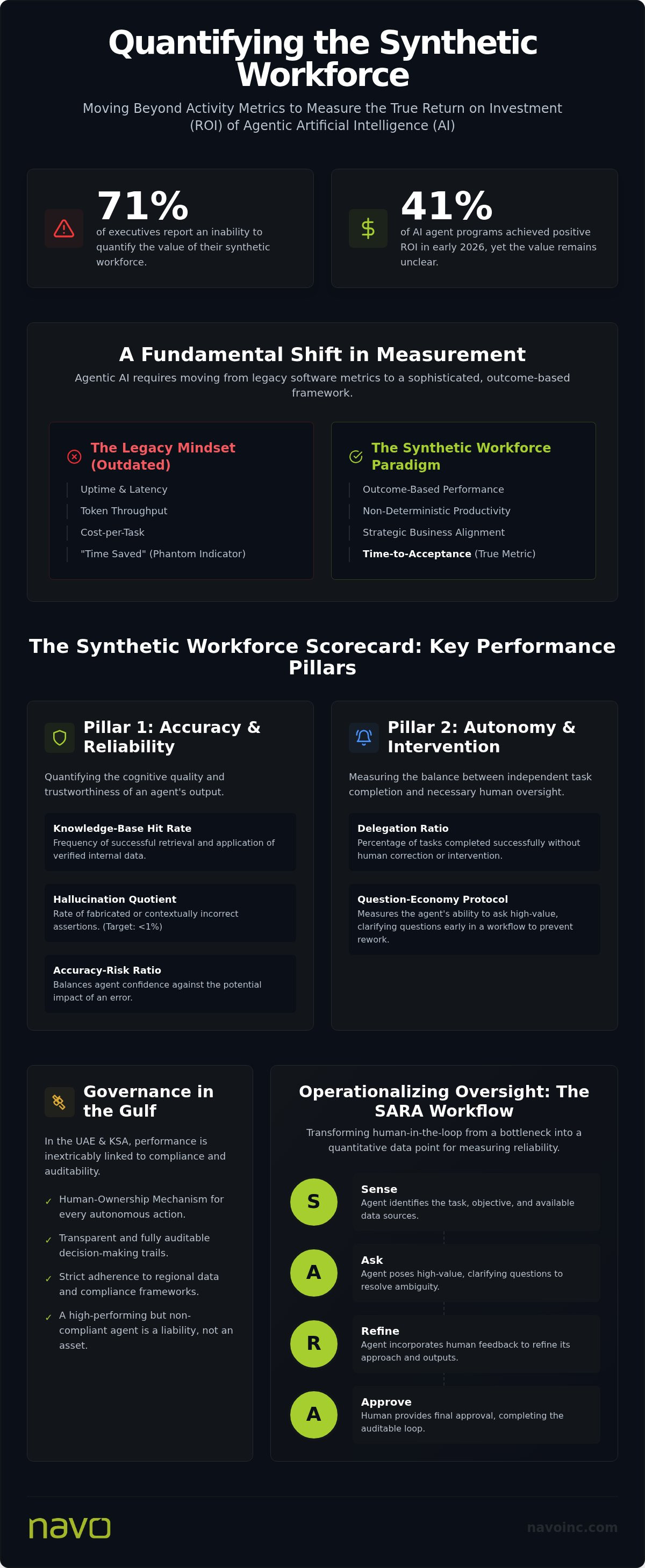
While 41% of AI agent programs achieved positive Return on Investment (ROI) in early 2026, a staggering 71% of executives still report a profound inability to quantify the actual value of their synthetic workforce. This disconnect creates a strategic vacuum where high-stakes investments in autonomous systems lack the rigorous financial justification required by modern boards. You likely recognize that measuring productivity of AI agents involves more than tracking hours saved or cost-per-task reductions; it requires a fundamental shift toward outcome-based performance.
This article provides a sophisticated framework for quantifying the performance and ROI of agentic Artificial Intelligence (AI) within the modern enterprise. By moving beyond superficial activity metrics toward a "Question-Economy" and "Outcome-Lock" paradigm, you can align synthetic worker performance with net-profit increases while maintaining strict governance in regulated markets like the United Arab Emirates (UAE) and the Kingdom of Saudi Arabia (KSA). We will explore a clear set of Key Performance Indicators (KPIs) and a structured approach to balancing agent autonomy with human oversight.
Key Takeaways
- Shift your perspective from legacy software performance to a synthetic workforce paradigm that treats autonomous agents as professional contributors rather than simple tools.
- Master a multi-dimensional framework for measuring productivity of AI agents that prioritizes intellectual honesty and strategic business outcomes over superficial activity metrics.
- Integrate the Sense, Ask, Refine, Approve (SARA) workflow to transform human-in-the-loop oversight into a precise, quantitative data point for measuring reliability.
- Align synthetic worker output with regional economic goals by applying "The Art of Problem Finding" to target high-value challenges that drive net-profit increases.
- Establish a robust governance structure that balances agent autonomy with the strict regulatory requirements of the United Arab Emirates and Saudi Arabian markets.
Beyond Token Throughput: Why Traditional KPIs Fail Agentic AI
The transition from viewing Artificial Intelligence (AI) as a static utility to a dynamic synthetic worker represents a seismic shift in management theory. In the legacy software era, performance was a matter of uptime, latency, and throughput. However, measuring productivity of AI agents requires a departure from these deterministic metrics. We're no longer managing code; we're overseeing rational agents designed to execute complex, multi-step objectives. In 2026, technical reliability is merely table stakes. The real challenge lies in quantifying "Non-Deterministic Productivity," where an agent's value is derived from its ability to navigate ambiguity and deliver strategic outcomes.
Relying on traditional Key Performance Indicators (KPIs) creates an incomplete and often misleading picture of agentic value. If an enterprise measures an agent solely on how many emails it drafts or how quickly it processes data, it misses the systemic impact on organizational health. A sophisticated framework must account for the cognitive quality of the output. Without this, GenAI (Generative Artificial Intelligence) investments remain speculative, lacking the rigorous financial justification required for high-stakes digital transformation.
The Fallacy of 'Time Saved' in Executive Decision-Making
Executives often fall into the trap of celebrating "time saved" as a primary success metric. This is a phantom indicator. Time saved is only valuable if it translates to reallocated strategic focus or direct cost reduction. We often observe the "Efficiency Paradox," where faster, lower-quality AI outputs actually increase the burden on human review. If an agent completes a task in seconds but requires extensive senior-level correction, the net economic gain evaporates. True productivity is found in the reduction of "Time-to-Acceptance," not just "Time-to-Completion."
Regional Context: Governance and Accountability in the Gulf
In Dubai and Riyadh, the regulatory environment demands a level of auditability that often exceeds Western standards. For enterprises in the Banking, Financial Services, and Insurance (BFSI) sector, measuring productivity of AI agents is inextricably linked to governance. Every autonomous action must have a "Human-Ownership" mechanism to satisfy local compliance frameworks. In this region, an agent's value is tied to its compliance and the clarity of its decision-making trail. A high-performing agent that lacks a transparent, auditable process is a liability, not an asset.
The Synthetic Workforce Scorecard: Four Pillars of AI Agent Performance
The transition from qualitative excitement to quantitative rigor requires a robust Synthetic Workforce Scorecard. This multi-dimensional framework moves beyond technical benchmarks to focus on business process outcomes. Intellectual honesty is the cornerstone of this reporting; providing the C-suite with a clear, unvarnished view of agent performance is essential for long-term strategic health. At Navo Inc., our philosophy centers on outcome-guaranteed results, which necessitates the use of proprietary diagnostic tools to establish a verifiable performance baseline. By integrating these metrics into broader productivity measurement frameworks, organizations can finally treat AI as a measurable labor asset.
Accuracy, Reliability, and the Hallucination Quotient
For specialized agents like SARA, the Knowledge-Base Hit Rate measures the frequency with which the agent successfully retrieves and applies verified internal data. We contrast this with the Hallucination Quotient, a metric that tracks the rate of fabricated or contextually incorrect assertions. The Accuracy-Risk Ratio represents the mathematical equilibrium between an agent's confidence threshold and the catastrophic potential of a single erroneous output. This ratio allows leaders to calibrate agents based on the specific risk tolerance of the department, whether in procurement or financial auditing.
Autonomy vs. Intervention: The Delegation Ratio
The Delegation Ratio is a critical indicator in measuring productivity of AI agents, quantifying the percentage of tasks completed without human correction. High autonomy is desirable, but it's balanced by the Question-Economy Protocol. This protocol measures the agent's ability to ask high-value, clarifying questions early in a workflow, which reduces the cost of downstream errors and minimizes the "Intervention Tax" on human managers. If your current systems don't have this level of visibility, you may benefit from a strategic evaluation of your agentic workflows.
Operationalizing Auditability: Measuring the Machine-in-the-Loop
Operationalizing auditability requires a transition from post-hoc technical validation to real-time telemetry embedded within the business process. The SARA (Sense, Ask, Refine, Approve) workflow facilitates this by establishing a rigorous data trail for every autonomous action. By treating the "Approve" stage as a quantitative "Approval Gate," organizations can track the machine's reliability with mathematical precision. This approach transforms the workflow into a continuous stream of performance data, ensuring that "Audit-Ready Outcomes" align with the Environmental, Social, and Governance (ESG) mandates of the Dubai financial sector. Dynamic Scoring further enhances this by evaluating the qualitative depth of project orchestrations, providing a structural check on the agent's strategic reasoning. This methodology isn't just a safety protocol; it's a foundational requirement for measuring productivity of AI agents over time.
Human-in-the-Loop (HITL) Metrics and Feedback Loops
The primary metric for agentic efficiency is "Time-to-Acceptance," which measures the duration from an agent's initial output to the final human sign-off. Unlike simple speed metrics, this accounts for the friction of correction and the cognitive load on the human reviewer. This focus is essential for measuring productivity of AI agents in high-stakes environments where accuracy is paramount. Quantifying human feedback allows for the systematic improvement of synthetic worker memory and tool-use, creating a virtuous cycle of performance. Our approach reflects IBM's framework for measuring AI productivity, emphasizing the critical role of the collaborative interface between human intelligence and machine execution.
Cost-to-Outcome Ratio: The True Measure of ROI
Calculating the Return on Investment (ROI) for a synthetic worker involves comparing the total cost of the agentic deployment against the economic value of the outcomes produced. Traditional hiring models focus on cost-per-hour, but synthetic workforces demand a focus on the cost-per-successful-outcome. The "Scalability Factor" becomes evident as agentic orchestration, through frameworks like NOVA, matures. As orchestration layers stabilize, the marginal cost of executing additional complex tasks drops significantly. This creates a productivity trajectory where output grows exponentially while operational costs remain relatively flat, providing a level of structural resilience that traditional staffing models can't replicate.
Strategic Alignment: Transforming Measurement into Net-Profit
The final objective of any synthetic workforce strategy is the conversion of operational telemetry into net-profit increases. Measuring productivity of AI agents shouldn't be viewed as an isolated technical exercise; it's a strategic imperative that connects synthetic labor directly to high-level business transformation goals. By utilizing "The Art of Problem Finding," executives ensure that their agents aren't merely solving trivial tasks but are instead addressing the systemic bottlenecks that impede organizational growth. This shift reframes Generative Artificial Intelligence (GenAI) as a sophisticated co-thinking partner rather than a simple execution engine. For leaders in Dubai and the wider Gulf region, moving past "confidentiality paralysis" is essential. Establishing governed, measurable value chains allows for the secure integration of autonomous systems into the most sensitive layers of the enterprise.
The Role of CPD-UK Accredited Coaching in Performance
A synthetic worker's output is fundamentally a reflection of the human's ability to prompt, govern, and refine its logic. If the human interface lacks the necessary architectural rigor, the agent's productivity will inevitably plateau. This reality underscores the importance of CPD certified AI courses for workforce readiness. These programs equip leadership teams with the disciplined framework required to oversee complex agentic workflows. When the human-in-the-loop possesses the right skills, the delegation ratio improves, and the cost-to-outcome ratio shifts in the organization's favor. Workforce education is the primary lever for maximizing the return on any agentic investment.
Conclusion: Building a Culture of Evidence Discipline
Success in the synthetic era requires a culture of evidence discipline. Measuring productivity of AI agents demands a rigorous, noun-heavy approach to performance data that prioritizes structural excellence over marketing hype. As we navigate the complexities of the 2026 enterprise landscape, the ability to quantify the economic impact of autonomous agents will distinguish market leaders from those who remain stuck in the proof-of-concept phase. Executives must embrace a methodical, resource-driven path toward integration. For organizations seeking to bridge the gap between technological potential and realized profit, the transition begins with outcome-guaranteed strategic coaching designed for the modern Gulf enterprise.
Architecting the Future of Synthetic Performance
The architectural transition from experimental pilots to a structured synthetic workforce layer represents the definitive corporate challenge of 2026. Successfully measuring productivity of AI agents requires a departure from legacy software metrics in favor of a rigorous, outcome-based framework that treats autonomous systems as measurable labor assets. By operationalizing auditability through the SARA (Sense, Ask, Refine, Approve) workflow and applying the proprietary Art of Problem Finding framework, leaders can finally align agentic output with measurable net-profit increases across the Gulf's high-stakes sectors.
Navo Inc. provides the steady, expert hand needed to navigate these complex organizational shifts. Our approach combines CPD UK-certified Masterclasses with outcome-guaranteed strategy consulting to ensure your leadership is prepared for the agentic era. We don't just implement technology; we architect resilience and systemic health within your digital transformation journey. The path to a high-performing synthetic workforce is built on evidence discipline and a relentless focus on structural excellence.
Your organization's evolution into a leader of the synthetic economy starts with a single, disciplined step toward strategic clarity and operational mastery.
Frequently Asked Questions
What is the most important KPI for measuring AI agent productivity in 2026?
The most critical Key Performance Indicator (KPI) is Time-to-Acceptance, which quantifies the duration between an agent's initial output and final human sign-off. This metric is superior to simple speed or volume because it accounts for the cognitive friction of correction and the quality of the synthetic work. In the context of measuring productivity of AI agents, a lower Time-to-Acceptance directly correlates with higher organizational trust and smoother integration into high-stakes workflows.
How do I calculate the Return on Investment (ROI) of a synthetic worker?
Return on Investment (ROI) is calculated by dividing the net economic value of outcomes produced by the total cost of agent deployment plus human oversight hours. Unlike traditional hires, the cost-per-successful-outcome for a synthetic worker typically drops as the orchestration layer matures. Organizations should quantify the UAE Dirham (AED) value of the strategic focus reallocated to human staff to determine the true fiscal impact on the bottom line.
Can AI agents be held accountable for business outcomes in regulated markets like the UAE?
Accountability is maintained through rigorous Human-Ownership mechanisms where every autonomous action is mapped to a designated human supervisor. In regulated sectors across Dubai and Riyadh, agents must operate within auditable decision trails to satisfy regional data laws and Environmental, Social, and Governance (ESG) mandates. By embedding an "Approval Gate" into the workflow, enterprises ensure that synthetic workers remain compliant while delivering high-velocity results.
What is the 'Delegation Ratio' and why does it matter for the C-suite?
The Delegation Ratio measures the percentage of complex tasks an agent completes without requiring human intervention or correction. This metric is vital for executive leadership because it serves as a primary barometer for measuring productivity of AI agents at scale. A high Delegation Ratio indicates that the synthetic workforce is providing genuine leverage rather than increasing the management burden on senior personnel.
How does Navo Inc. guarantee net-profit increases through agentic AI?
Navo Inc. delivers measurable profit increases by applying the proprietary Art of Problem Finding framework to target high-value organizational bottlenecks. By utilizing synthetic workers like SARA within a Sense, Ask, Refine, Approve workflow, we target classification accuracy levels of 95% or higher. This disciplined, outcome-guaranteed strategy ensures that AI deployment is a focused financial investment rather than a speculative technical experiment.
Disclaimer
The views and opinions expressed in this article are those of the author and do not represent any organisation, client, institution, or professional body with which he may be associated. The content is intended for general information, education, and thought leadership. Readers should seek appropriate professional advice before making legal, financial, investment, regulatory, technology, or business decisions.
The author has taken reasonable care to ensure the accuracy of the information and sources available at the time of publication. Technologies, regulations, market conditions, and industry practices may evolve, and readers are encouraged to verify current information independently. Any examples, cases, or scenarios may have been simplified, anonymised, or adapted to protect confidentiality. The author and publisher accept no liability for decisions or outcomes arising from the use of this content.
Generative AI tools may have been used to support research, structuring, or language refinement, with the final content, judgment, and editorial responsibility retained by the author.