

While competitors remain preoccupied with generative prompts, is your leadership team architecting a synthetic workforce capable of autonomous enterprise growth? The distinction between superficial digital adoption and deep structural transformation has never been more critical for the modern executive. Most leaders acknowledge the paralysis caused by data security concerns and the frustration of capital deployment toward surface-level workshops that fail to yield measurable ROI. Identifying a reputable CPD certified AI for leaders course in Singapore is no longer about checking a box for professional development; it's about securing a strategic framework for systemic resilience.
Strategy must precede implementation. This guide provides a rigorous analysis of the executive education landscape, specifically focusing on programs that deliver a clear roadmap for integrating agentic AI into legacy workflows. You'll gain a sophisticated perspective on the governance of synthetic workers and the mitigation of high-stakes technological risk. We move beyond the hype to examine how disciplined leadership transforms AI from a disruptive uncertainty into a steady pillar of organizational strength.
Key Takeaways
- Identify the transition from superficial generative literacy to the Art of Problem Finding as the essential prerequisite for autonomous enterprise growth.
- Distinguish between theoretical academic programs and outcome-guaranteed, consultancy-led masterclasses to ensure professional development yields a measurable impact on organizational resilience.
- Establish rigorous selection criteria for a CPD certified AI for leaders course in Singapore to align with international professional benchmarks and regional digital initiatives.
- Discover a structured five-week transformation journey for integrating a synthetic workforce into executive workflows through agentic orchestration and disciplined governance.
The Strategic Imperative for CPD Certified AI Training in Singapore's 2026 Economy
The transition toward an autonomous economy necessitates a fundamental shift in leadership paradigms. As Singapore accelerates its Smart Nation 2.0 objectives, the demand for verified expertise has moved beyond general digital literacy into the realm of systemic orchestration. Continuing Professional Development (CPD) serves as the global benchmark for this professional rigor, ensuring that executive education isn't merely a passive intake of information but a structured advancement of strategic capability. In an environment where technological obsolescence is a constant threat, the pursuit of a CPD certified AI for leaders course in Singapore becomes a prerequisite for maintaining institutional resilience.
Regional financial and tech hubs are currently witnessing an aggressive pivot from simple Generative AI awareness to full-scale Agentic Leadership. This evolution requires a level of professional density capable of managing high-stakes crisis scenarios and complex organizational shifts. Leaders must now architect environments where synthetic workers and human talent coexist within a governed framework. This isn't a task for the uninitiated; it requires a disciplined understanding of how AI agents integrate into existing workflows without compromising data integrity or corporate security. The focus has moved from what the tools can do to how the leader can mastermind their deployment.
Why CPD UK Certification Matters for Singaporean Executives
The value of CPD UK accreditation lies in its ability to standardize competency across disparate global offices, from Dubai and Singapore to London. It provides a common language for excellence that resonates with international regulatory bodies. By focusing on ethical AI governance, these programs ensure compliance with both Asian and Gulf standards, shielding the enterprise from the reputational risks of unmanaged AI deployment. This rigorous, evidence-based assessment validates the return on investment, transforming leadership training from an opaque expenditure into a transparent asset for enterprise transformation. It's about establishing a steady, expert hand in an era of radical progress.
Evaluating Executive AI Curriculum: Beyond Basic Large Language Model (LLM) Literacy
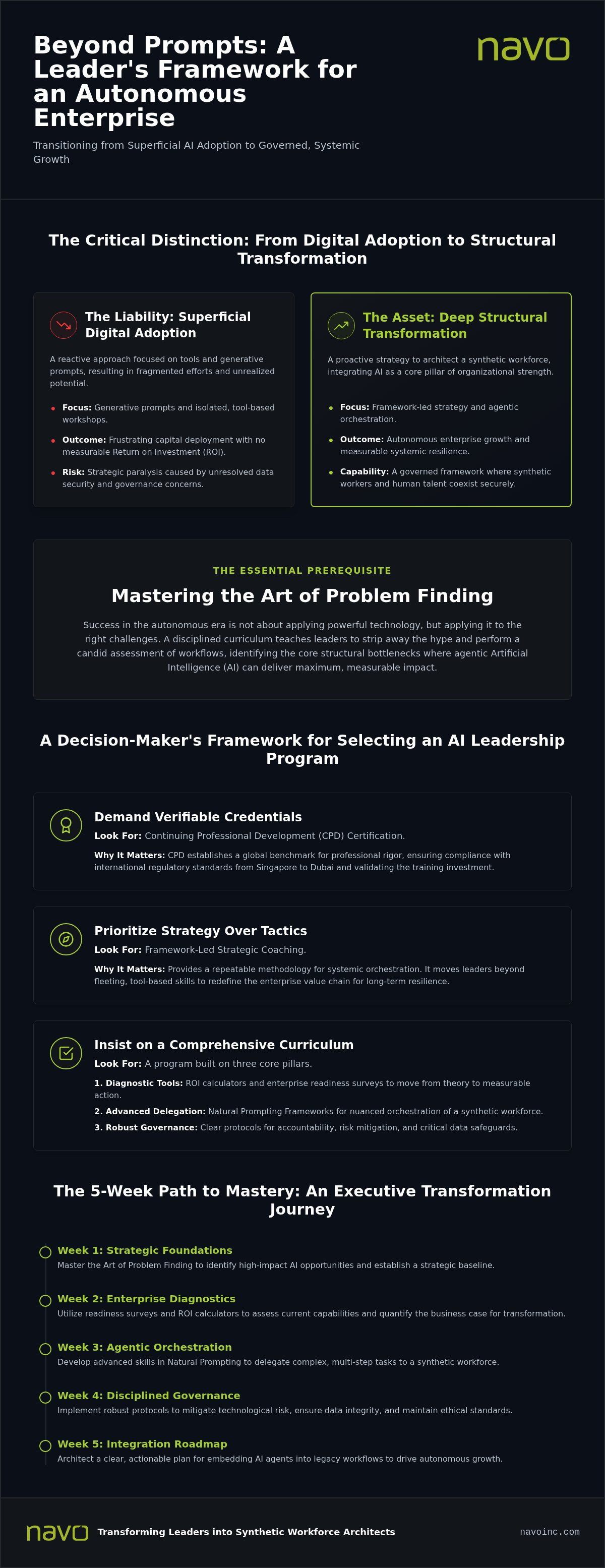
Superficial digital literacy has become a liability in the high-stakes environment of 2026. While many workshops focus on the mechanics of specific tools, a robust CPD certified AI for leaders course in Singapore must prioritize framework-led strategic coaching. The distinction is critical. Tool-based training offers fleeting utility; framework-led instruction provides a repeatable methodology for systemic orchestration. Leaders don't need to know how to code; they need to know how to restructure their enterprise to capitalize on agentic capabilities. This shift requires moving beyond basic LLM interactions toward a sophisticated understanding of how AI redefines the value chain.
The prerequisite for successful AI integration is the Art of Problem Finding. Most organizations fail because they apply powerful technology to the wrong challenges. A disciplined curriculum teaches executives to strip away the hype and identify the core structural bottlenecks that AI is uniquely qualified to resolve. This process demands intellectual honesty. It forces a candid assessment of which workflows are truly value-additive and which are merely legacy artifacts. By mastering the Six Lanes of Working, leaders can position GenAI as a strategic co-thinking partner rather than a simple automation script. This methodology ensures that every AI initiative aligns with long-term resilience and net-profit objectives.
The Core Components of a High-Stakes AI Masterclass
Effective executive training utilizes diagnostic tools, such as ROI calculators and enterprise readiness surveys, to move from theory to measurable transformation. Communication must also evolve. Moving beyond basic prompting, leaders should adopt Natural Prompting Frameworks that mirror high-level human delegation. This sophisticated interaction allows for more nuanced orchestration of synthetic workers. Finally, governance protocols must be established to ensure accountability and data safeguards. Refining your strategic approach requires a consultative diagnostic to move beyond surface-level adoption and toward governed enterprise growth.
A Decision-Maker's Framework for Selecting an AI Leadership Program
The selection of an executive education provider requires a diagnostic approach that prioritizes operational viability over theoretical prestige. While many academic institutions provide valuable historical context, they often lack the practitioner-led agility required for rapid enterprise transformation. Decision-makers must evaluate programs based on three non-negotiable criteria: recognized accreditation, the depth of the instructor’s practitioner experience, and the availability of proprietary frameworks. A CPD certified AI for leaders course in Singapore should be viewed as a strategic investment in organizational resilience rather than a mere training expense.
The primary executive objection centers on the transition from pilot projects to sustainable profit. Bridging this gap requires more than just technical knowledge; it necessitates a fundamental shift in the operating model. Success depends on selecting a strategic AI partner capable of delivering a structured pathway from experimentation to industrial-scale deployment. This transition demands intellectual honesty regarding current structural limitations and a commitment to architectural excellence.
Academic vs. Practitioner-Led Training in Singapore
Peer-to-peer executive education thrives on the insights of battle-tested consultants who have managed complex organizational shifts. Programs led by experts like Vasudevan Kidambi leverage decades of senior leadership experience to provide a perspective that is both seasoned and contemporary. This practitioner-led approach introduces critical concepts like Machine-in-the-Loop thinking, where human judgment remains central to the AI-augmented workflow. It ensures that the deployment of synthetic workers is governed by strategic intent rather than technological novelty. Unlike programs that lack an activation phase, this model prioritizes the immediate application of frameworks to real-world business challenges.
Navo’s CPD UK-Certified Masterclass: Transforming Leaders into Synthetic Workforce Architects
Navo’s approach to executive development is defined by a rigorous five-week transformation cycle. This journey begins with a diagnostic preparation phase to align strategic objectives, followed by an intensive masterclass, and concludes with a critical activation period. Unlike traditional seminars that conclude with a certificate, this CPD certified AI for leaders course in Singapore ensures that theoretical knowledge is immediately converted into operational capability. It's a structured pathway designed for those who demand measurable enterprise transformation over passive participation. This methodology prioritizes the creation of a resilient operating model capable of sustained growth.
Central to this evolution is the deployment of a synthetic workforce. Leaders learn to orchestrate specialized AI agents like SARA, designed for sophisticated briefing and data synthesis, and NOVA, an agentic architect for complex workflow orchestration. Integrating these synth workers into leadership workflows represents a fundamental shift from tool management to architectural oversight. This mastering of agentic AI services allows executives to reclaim strategic bandwidth by delegating high-density cognitive tasks to a governed digital layer. The focus remains on systemic health and the enhancement of human decision-making through machine augmentation.
From Confidentiality Paralysis to Governed GenAI Value
Many organizations remain stalled by confidentiality paralysis, fearing the security implications of large-scale AI adoption. Navo’s framework addresses this by establishing robust Corporate AI Governance and risk-based decision paths. This ensures that every deployment remains within a secure, ethical, and compliant perimeter. The transition from traditional management to synthetic workforce development is a high-stakes shift that requires a steady, expert hand. By prioritizing net-profit increases through an outcome-guaranteed model, the masterclass provides the financial and operational clarity necessary for bold leadership. It's a commitment to structural excellence in an increasingly complex digital frontier.
Architecting the Autonomous Enterprise
The evolution of the regional economy demands a departure from speculative experimentation toward disciplined, agentic orchestration. We've established that true enterprise transformation requires more than surface-level familiarity with digital tools; it necessitates a fundamental restructuring of the leadership operating model. By prioritizing the Art of Problem Finding and the deployment of a governed synthetic workforce, executives can bridge the gap between technological potential and measurable net-profit growth.
Securing a seat in a CPD certified AI for leaders course in Singapore ensures that your strategic roadmap is validated by international benchmarks of professional rigor. These masterclasses, led by bestselling author Vasudevan Kidambi, provide the authoritative guidance needed to navigate high-stakes crisis management and systemic shifts. This outcome-guaranteed strategy consulting approach transforms the uncertainty of AI adoption into a steady, expert hand for organizational resilience.
The transition from traditional management to synthetic workforce development is the defining challenge of the 2026 landscape. Position your organization at the forefront of this shift with a framework built for structural excellence and long-term systemic health.
Frequently Asked Questions
What is a CPD certified AI for leaders course?
A CPD certified AI for leaders course in Singapore represents a standardized benchmark for executive education that aligns with global professional development requirements. These programs are rigorously audited to ensure the curriculum provides more than just technical awareness; they focus instead on the strategic orchestration of digital assets. It's a formal validation of a leader's ability to navigate complex organizational shifts within a governed and resilient framework. Standards remain high.
How does the 'Art of Problem Finding' differ from standard AI prompting courses?
Standard courses focus on the mechanics of conversational prompts, whereas the Art of Problem Finding is a diagnostic methodology designed to identify structural inefficiencies. It acts as a strategic filter, ensuring that capital isn't wasted on automating redundant or low-value processes. This framework-led approach prioritizes systemic health and intellectual honesty, allowing leaders to pinpoint exactly where agentic AI will yield the highest competitive advantage. Strategy must precede automation.
Are Navo's masterclasses available for in-house corporate training in Singapore?
Navo provides bespoke in-house masterclasses for organizations requiring a tailored approach to synthetic workforce development. These sessions are designed to align with specific corporate governance policies and regional regulatory standards. By delivering the masterclass within the enterprise environment, leadership teams can focus on live high-stakes challenges and the immediate integration of agents like SARA and NOVA into their proprietary workflows. Customization is essential.
How long is the CPD UK certification valid for AI leadership programs?
CPD UK certification validates the specific professional development hours completed during the masterclass. While the credits remain on your professional record, the rapid evolution of the technological landscape suggests that leaders should refresh their credentials every 12 to 24 months. This consistency ensures that executive expertise remains contemporary and aligned with the latest advancements in agentic orchestration and governance. Evolution is constant.
What is the expected Return on Investment (ROI) for an executive attending an AI masterclass?
The return on investment is calculated through an outcome-guaranteed model that focuses on measurable net-profit increases and the reclaiming of strategic bandwidth. Executives typically see value through the reduction of operational bottlenecks and the successful deployment of autonomous agents to handle high-density cognitive tasks. This transition shifts the focus from cost-reduction to value-creation, positioning the masterclass as a fundamental driver of enterprise resilience. ROI becomes a tangible asset.
Disclaimer
The views and opinions expressed in this article are those of the author and do not represent any organisation, client, institution, or professional body with which he may be associated. The content is intended for general information, education, and thought leadership. Readers should seek appropriate professional advice before making legal, financial, investment, regulatory, technology, or business decisions.
The author has taken reasonable care to ensure the accuracy of the information and sources available at the time of publication. Technologies, regulations, market conditions, and industry practices may evolve, and readers are encouraged to verify current information independently. Any examples, cases, or scenarios may have been simplified, anonymised, or adapted to protect confidentiality. The author and publisher accept no liability for decisions or outcomes arising from the use of this content.
Generative AI tools may have been used to support research, structuring, or language refinement, with the final content, judgment, and editorial responsibility retained by the author.