
By 2026, 50% of organizations will require "AI-free" skills assessments to ensure critical thinking hasn't atrophied in an era of total automation. It's a sobering reality for leaders who realize that traditional job descriptions are becoming historical artifacts rather than operational blueprints. You're likely facing the friction of measuring productivity in augmented teams while managing the regulatory complexities of the UAE AI Governance guidelines and shifting labor laws in India. Implementing a cohesive AI workforce transition strategy is no longer a peripheral project; it's a fundamental architectural requirement for systemic health.
We've developed this executive checklist to help you master the structural shift from legacy staffing to a multi-layered workforce of humans, agents, and synthetic workers. You'll gain a clear, three-layer architecture that guarantees efficiency gains while remaining compliant with regional cultural sensitivities. This article details a rigorous framework for steering these high-stakes transitions with the professional composure of a disciplined architect of change.
Key Takeaways
- Understand why incremental adoption and basic prompt training fail to deliver enterprise-level results in the face of 2026’s structural workforce disruptions.
- Discover how to implement a resilient three-layer architecture that balances high-stakes human judgment with task-specific autonomous agents and synthetic workers.
- Access a phased executive roadmap to deploy a robust AI workforce transition strategy that aligns with the latest United Arab Emirates Artificial Intelligence (AI) Governance guidelines.
- Learn the "Clarify-Enable-Protect-Evolve" framework to maintain board-level accountability and human-in-the-loop oversight during complex agentic integration.
- Identify how a tool-agnostic, outcome-guaranteed approach to consulting can secure measurable efficiency gains and long-term organizational resilience.
The 2026 Workforce Crisis: Why Incremental AI Adoption Fails
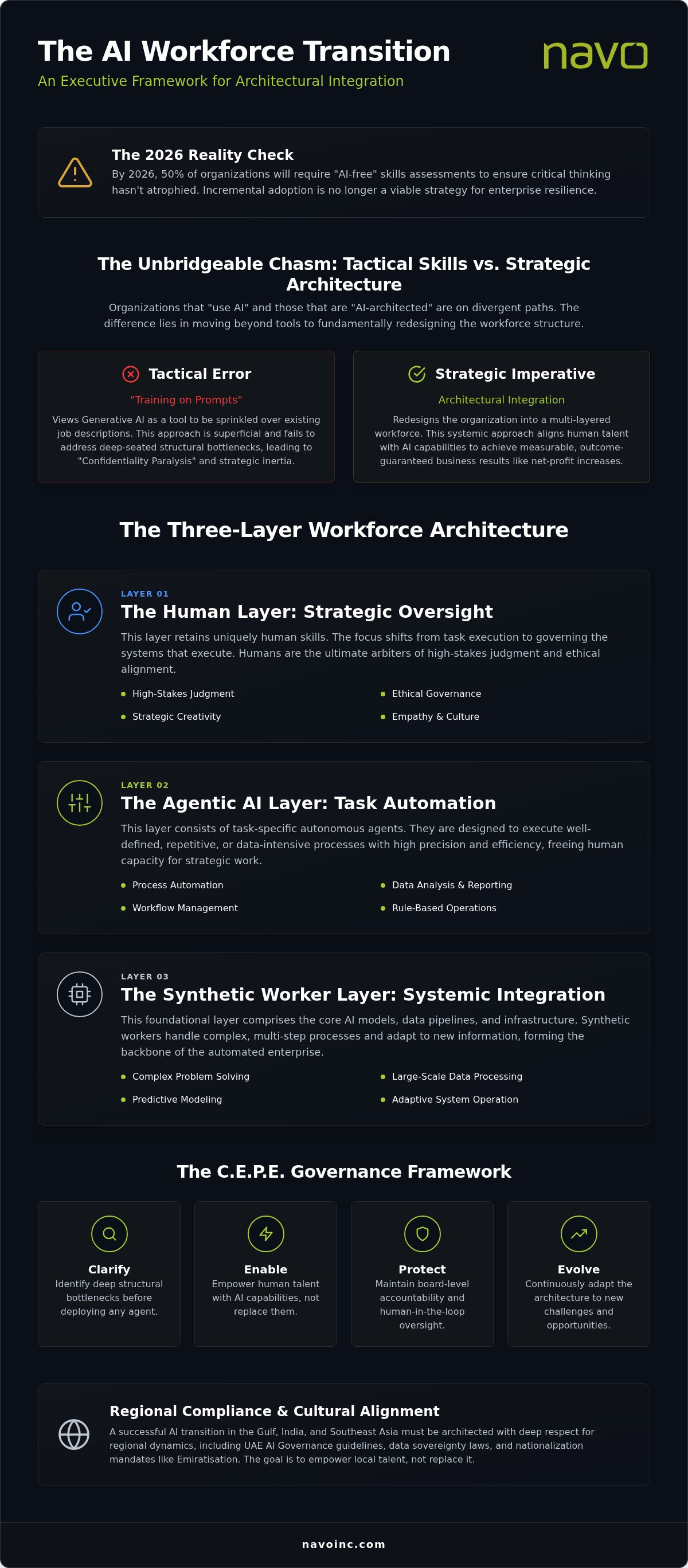
Incrementalism is the silent killer of enterprise resilience. By mid-2026, the gap between organizations that "use AI" and those that are "AI-architected" has become an unbridgeable chasm. Many Human Resources (HR) leaders mistakenly view Generative Artificial Intelligence (GenAI) as a set of tools to be sprinkled over existing job descriptions. This approach ignores the systemic reality: we are witnessing a structural shift that demands a comprehensive AI workforce transition strategy. Organizations that rely solely on "training on prompts" are merely teaching staff to use a faster typewriter while the entire industry landscape is being reinvented. Prompting is a tactical skill; architectural integration is a strategic imperative.
"Confidentiality Paralysis" is particularly acute in the Gulf and Asian markets, where data sovereignty and regulatory caution often lead to strategic inertia. Leaders in Dubai, Riyadh, and Mumbai frequently stall transformation due to valid concerns over information security and the potential for technological unemployment. However, the cost of this hesitation is immense. While organizations wait for perfect regulatory clarity, they risk falling into a cycle where their human talent becomes misaligned with the new economic reality. The shift must move from vague efficiency-seeking to outcome-guaranteed business models. In these models, the integration of synthetic workers is measured by tangible metrics such as net-profit increases or specific efficiency gains, moving beyond the superficial allure of "time saved."
The Art of Problem Finding in Workforce Design
Successful integration starts with the Art of Problem Finding rather than immediate problem solving. Before deploying a single autonomous agent, leaders must identify the deep-seated structural bottlenecks that hinder organizational performance. Our "Ampersand" philosophy emphasizes the union of human intuition with machine precision. It requires a transition from execution-heavy roles to strategy-focused oversight. Employees are no longer valued for their ability to process data, but for their capacity to govern the systems that do. This redesign ensures that the human element remains the ultimate arbiter of high-stakes judgment and ethical alignment. To maintain a strong sense of mission during this structural shift, you can check out Kaika AI to see how workforce alignment platforms connect individual employee purpose with your organizational goals.
Regional Market Dynamics: GCC and India
In the Middle East, the transition to an Artificial Intelligence (AI) augmented workforce must coexist with nationalization mandates such as Emiratization in the United Arab Emirates. A sophisticated strategy does not replace local talent; it empowers it. Dubai has emerged as a global hub for AI governance, providing a rigorous framework for testing these new labor architectures. Maintaining human dignity is paramount in the "Agentic Era." We must ensure that technology serves the cultural and social fabric of the region, respecting local laws and sensitivities while pushing the boundaries of innovation across India, Singapore, and the broader Gulf Cooperation Council (GCC) states. This balanced approach creates a resilient, culturally aligned workforce that is prepared for the complexities of 2026.
The Three-Layer Workforce Architecture: Humans, Agents, and Synthetic Workers
The transition from a traditional staffing model to a future-ready enterprise requires more than just software procurement. It demands a fundamental redesign of the organizational fabric. A robust AI workforce transition strategy recognizes that the modern workforce is not a monolith but a sophisticated, three-layer architecture. This structure ensures that technological progress doesn't dilute human value but rather amplifies it through precise role allocation and systemic oversight. By defining these layers, leaders can move beyond the "tool" mentality and embrace a truly integrated workforce.
The first layer is the Human Layer. Here, the focus remains on creativity, empathy, and high-stakes judgment. These are the essential skills that cannot be replicated by algorithms. While global trends like U.S. AI Workforce Initiatives highlight the need for broad digital literacy, our regional focus in Dubai and Riyadh emphasizes the preservation of human leadership in critical decision-making. The second layer is the Agentic Artificial Intelligence (AI) Layer. This consists of task-specific autonomous agents designed for process optimization. These agents operate within defined parameters to execute repetitive, high-volume tasks with machine precision, freeing humans for higher-order cognitive work.
The third and most transformative layer is the Synthetic Worker Layer. Unlike simple tools, synthetic workers are auditable AI entities endowed with memory, specific roles, and continuous feedback loops. They function as digital colleagues rather than mere utilities. This layer necessitates "Machine-in-the-Loop Thinking," where cross-functional collaboration is governed by rigorous protocols. This ensures that every automated output is validated by human expertise before it impacts the organizational bottom line. This architecture provides the structural stability required to navigate the complexities of 2026.
Synthetic Workforce Development: A New Operational Reality
The emergence of this architecture has birthed the role of the "Synthetic-Worker Architect" within modern Human Resources (HR) departments. This specialist is responsible for the lifecycle of digital entities like SARA, which handles brief intake, and NOVA, which manages complex orchestration. Integrating these agents is a core component of our Synthetic Workforce Development Pillar, providing a roadmap for moving from legacy workflows to agentic efficiency. It's a shift that requires both technical precision and strategic vision.
The Six Lanes of Working Framework
To operationalize this strategy, we utilize the "Six Lanes of Working" framework. This diagnostic tool allows leaders to allocate tasks across six distinct lanes of human and machine capability. In the professional services sector, this facilitates a shift from "doing" to "validating." Every automated decision path must be auditable and accountable, maintaining the structural stability required by United Arab Emirates (UAE) regulatory standards. If your organization is ready to move beyond incrementalism, consider how a structured diagnostic assessment can clarify your path forward.
Checklist: The Executive AI Workforce Transition Roadmap
Execution without a structured sequence is merely expensive experimentation. For the modern executive, a resilient AI workforce transition strategy is built on a methodical, five-phase roadmap that ensures technological integration doesn't outpace organizational readiness. This sequence prioritizes structural stability over rapid, uncoordinated tool adoption, providing a steady hand for the high-stakes shifts occurring across the Gulf and Asian markets.
- Phase 1: Diagnostic Readiness. We begin with a "Problem Finding" audit, utilizing Return on Investment (ROI) calculators and readiness surveys to identify high-friction processes where automation yields the highest impact.
- Phase 2: Governance Architecture. Leaders must establish a Corporate AI Governance Policy that aligns with the National Institute of Standards and Technology (NIST) Privacy Framework and regional guidelines such as the United Arab Emirates (UAE) Artificial Intelligence (AI) Governance rules.
- Phase 3: Skill Synthesis. We deploy Continuing Professional Development (CPD) UK-certified coaching to prepare leadership for the "Agentic Era," focusing on the governance of synthetic entities rather than just technical usage.
- Phase 4: Pilot Integration. This involves launching agentic AI in low-risk, high-impact lanes, allowing for the observation of "Machine-in-the-Loop" dynamics in a controlled environment.
- Phase 5: Scaling and Evolution. The final phase transitions the organization from isolated pilots to profit-guaranteed models where efficiency gains are baked into the operational DNA.
Diagnostic and Governance Checkpoints
The diagnostic phase isn't merely about technical capability; it's about organizational transparency. Developing desensitization toolkits helps staff understand the transition, reducing the friction often associated with AI Workforce Policy and Research findings regarding talent displacement. Governance must also incorporate Information Commissioner's Office (ICO) anonymization guidance to ensure data integrity. By establishing these checkpoints, firms in Dubai and Riyadh can maintain compliance while aggressively pursuing innovation.
Capability Building and Masterclass Integration
Our 5-week activation arc moves leadership from initial pre-prep to intensive, hands-on masterclasses. This process defines "Synthetic Skills"-the ability to architect and oversee digital workers-as the new talent benchmark for 2026. It's no longer enough to manage people; you must manage the systems that manage the work. For a deeper dive into the operational mechanics of this layer, see our guide on Deploying Synthetic Workers. This training ensures that your team doesn't just survive the transition but leads it with professional composure and analytical depth.
Managing Risk: Governance and Compliance in the Agentic Era
Governance in the "Agentic Era" is not a secondary consideration; it's the structural foundation of a resilient enterprise. A sophisticated AI workforce transition strategy utilizes the "Clarify-Enable-Protect-Evolve" adoption architecture to ensure that every technological advancement is matched by a corresponding safeguard. This framework begins by clarifying the specific boundaries of machine autonomy and human authority, followed by enabling the workforce with the necessary technical literacy. Protection involves implementing rigorous data desensitization techniques to scrub sensitive organizational information before it enters any Large Language Model (LLM) environment. Finally, the evolution phase ensures that these protocols adapt as the technology matures.
Maintaining board-level accountability requires more than just high-level oversight. It demands specific human-in-the-loop approval protocols where high-stakes decisions are never left solely to autonomous agents. Organizations must establish risk-based decision paths that clearly delineate when an agent can act independently and when human judgment is mandatory. This is especially critical in professional services where the cost of an unverified output can lead to significant financial or reputational damage. By embedding these protocols into the operational fabric, leaders can confidently navigate the complexities of synthetic integration.
Regional Compliance: United Arab Emirates, Kingdom of Saudi Arabia, and Singapore
Adherence to local data residency laws and Artificial Intelligence (AI) ethics charters is non-negotiable for firms operating in the Gulf and Southeast Asia. In the Kingdom of Saudi Arabia, this means aligning transformation efforts with the Saudi Vision 2030 framework, which prioritizes technological leadership alongside social responsibility. Transparency in AI-driven recruitment and performance management is essential to maintain trust, particularly when navigating nationalization quotas. Dubai's rigorous governance standards provide a benchmark for ensuring that every synthetic worker operates within the legal and cultural parameters of the region.
The Role of the Independent Artificial Intelligence Director
As the complexity of the workforce increases, boards are increasingly turning to Environmental, Social, and Governance (ESG) accredited Artificial Intelligence governance advisors. These independent directors provide the necessary audit and assurance for synthetic worker performance, ensuring that automated systems don't introduce bias or operational fragility. This level of oversight is a hallmark of the strategic guidance provided by experts like Vasudevan Kidambi, who specializes in bridging the gap between traditional corporate governance and the demands of the digital frontier.
Outcome-Guaranteed Transformation: The Navo Partnership Model
Success in the "Agentic Era" is measured by the resilience of the organizational architecture, not the quantity of AI tools deployed. Navo Inc. distinguishes itself by providing an AI workforce transition strategy that is contractually tied to net-profit increases or measurable efficiency outcomes. While many global consultancies offer "efficiency-seeking" pilots that often stall at the proof-of-concept stage, our partnership model ensures that every structural shift delivers a verified impact on the bottom line. This focus on systemic health over software sales allows us to remain tool-agnostic, prioritizing the frameworks that best serve your unique operational reality.
Consider the transition of a prominent regional distribution firm operating across the Gulf. Faced with the obsolescence of traditional inventory management roles, they engaged Navo Inc. to architect a synthetic workforce model. By moving their human staff from execution-heavy tasks to the "Validation Lane" of our framework, they achieved a significant reduction in operational friction without the typical productivity dips associated with large-scale change. This transition wasn't merely a software upgrade; it was a fundamental redesign of their labor layers, ensuring they remained competitive within the evolving United Arab Emirates (UAE) market conditions.
Why Navo Inc. Surpasses Global Consulting Benchmarks
Our approach combines three decades of Middle Eastern management experience with cutting-edge Generative Artificial Intelligence (GenAI) research. We bridge the gap between traditional management theory and the radical progress of the digital frontier, exceeding the standards of "Big 4" and "MBB" firms through superior regional nuance. Our Continuing Professional Development (CPD) UK-certified coaching provides your leadership team with the high-level articulation required to govern synthetic workers effectively. We don't just prepare you for 2026; we ensure your organization leads the market through a profit-guaranteed transition model.
Initiating Your Transition Strategy
The first 90 days are critical for establishing a stable foundation. This period focuses on the "Problem Finding" diagnostic, identifying where synthetic workers can provide the most immediate relief to overstretched human teams. Engaging the board through high-stakes strategic coaching ensures that the transition is viewed as a systemic evolution rather than a series of isolated technical projects. This alignment is essential for navigating the regulatory complexities and cultural sensitivities inherent in the Gulf states and India. For Australian professional services firms looking to optimize their human layer during such transitions, you can visit Tarino to explore specialized offshore recruitment in the Philippines. By treating the workforce as a three-layer architecture, you secure long-term structural excellence.
Architecting the Future of Synthetic Labor
The 2026 workforce is no longer a collection of static roles; it's a dynamic ecosystem requiring rigorous architectural oversight. By embracing the three-layer model of humans, autonomous agents, and synthetic workers, you move from the vulnerability of legacy staffing to the stability of an integrated digital workforce. This transition demands more than technical proficiency. It requires a commitment to the Art of Problem Finding and a governance framework that respects regional regulations from Dubai to Singapore. Implementing a resilient AI workforce transition strategy ensures your organization moves beyond the fragility of incremental adoption.
Navo Inc. provides the steady hand needed for these high-stakes shifts. Our approach is grounded in three decades of regional expertise and validated by Continuing Professional Development (CPD) UK-certified coaching. Led by Red Dot and Golden Book Award-winning strategists, we provide a partnership model that prioritizes structural excellence and offers a guaranteed net-profit uplift. The opportunity to lead this transformation is now.
Your organization's evolution depends on the decisions made today. We're ready to help you steer through this complexity with precision and analytical depth.
Frequently Asked Questions
What is an AI workforce transition strategy?
An AI workforce transition strategy is a systemic architectural redesign of an organization's labor model. It moves beyond tactical tool adoption to integrate humans, autonomous agents, and synthetic workers into a cohesive, multi-layered structure. This strategy ensures that technological progress aligns with long-term resilience and structural excellence rather than just providing short-term efficiency gains. It requires a fundamental shift from execution-heavy roles to strategy-focused oversight.
How do synthetic workers differ from traditional AI tools?
Synthetic workers are auditable Artificial Intelligence (AI) entities endowed with memory, specific roles, and continuous feedback loops. Unlike traditional tools that act as passive utilities for human use, synthetic workers function as digital colleagues within a multi-layered workforce architecture. They possess the capacity for orchestration and autonomous task execution while remaining subject to rigorous human oversight and board-level accountability throughout the entire operational lifecycle.
Is an AI workforce transition compliant with labor laws in the UAE and Saudi Arabia?
Yes, provided the transition adheres to regional data residency laws and nationalization mandates like Emiratization. A robust AI workforce transition strategy incorporates the latest United Arab Emirates (UAE) Artificial Intelligence (AI) Governance guidelines and Saudi Vision 2030 frameworks. Compliance is maintained through transparent recruitment practices and the preservation of human dignity in all automated decision paths, ensuring technology serves the cultural fabric of the region.
What are the key 'Synthetic Skills' my team needs to develop by 2026?
The primary skills focus on the governance, orchestration, and validation of machine-driven outputs. By 2026, talent benchmarks will shift from manual task execution to the capacity for "Machine-in-the-Loop Thinking." This includes the ability to architect synthetic workflows and manage the ethical alignment of autonomous agents like SARA and NOVA. Teams must move from being doers to becoming disciplined architects of digital labor systems.
How does the 'Art of Problem Finding' improve AI implementation ROI?
Problem Finding identifies the deep-seated structural bottlenecks that hinder organizational performance before any technology is deployed. By focusing on the root cause of friction rather than just applying Generative Artificial Intelligence (GenAI) to surface-level symptoms, organizations secure a higher Return on Investment (ROI). This diagnostic approach prevents the waste associated with automating inefficient processes, ensuring every integration leads to a measurable and sustainable increase in net profit.
Can Navo Inc. guarantee financial outcomes for our workforce transition?
Navo Inc. provides a partnership model that contractually guarantees net-profit increases or specific efficiency gains through strategic coaching. Our tool-agnostic approach prioritizes the frameworks that deliver measurable results rather than software sales. This commitment to outcome-guaranteed transformation ensures your organization moves from the uncertainty of pilot programs to tangible financial resilience, backed by our Red Dot and Golden Book Award-winning leadership and expertise.
What is the role of a 'Human-in-the-Loop' in an agentic AI system?
The human acts as the ultimate arbiter of high-stakes judgment, empathy, and ethical alignment. In an agentic system, "Human-in-the-Loop" protocols ensure that autonomous agents don't operate without supervision. Every critical output is subject to human validation before it impacts the organizational bottom line. This maintains board-level accountability and prevents the operational fragility that can occur when automated systems lack human intuition and professional oversight.
How long does a typical enterprise-level AI workforce transition take?
A comprehensive transition typically follows a phased roadmap beginning with a 90-day foundation-building period. The initial five-week activation arc moves leadership from diagnostic readiness to intensive Continuing Professional Development (CPD) UK-certified training. Scaling the architecture across the entire enterprise usually evolves over several quarters to ensure cultural alignment, structural stability, and the full integration of synthetic layers into the existing human workforce environment.
Disclaimer
The views and opinions expressed in this article are those of the author and do not represent any organisation, client, institution, or professional body with which he may be associated. The content is intended for general information, education, and thought leadership. Readers should seek appropriate professional advice before making legal, financial, investment, regulatory, technology, or business decisions.
The author has taken reasonable care to ensure the accuracy of the information and sources available at the time of publication. Technologies, regulations, market conditions, and industry practices may evolve, and readers are encouraged to verify current information independently. Any examples, cases, or scenarios may have been simplified, anonymised, or adapted to protect confidentiality. The author and publisher accept no liability for decisions or outcomes arising from the use of this content.
Generative AI tools may have been used to support research, structuring, or language refinement, with the final content, judgment, and editorial responsibility retained by the author.