

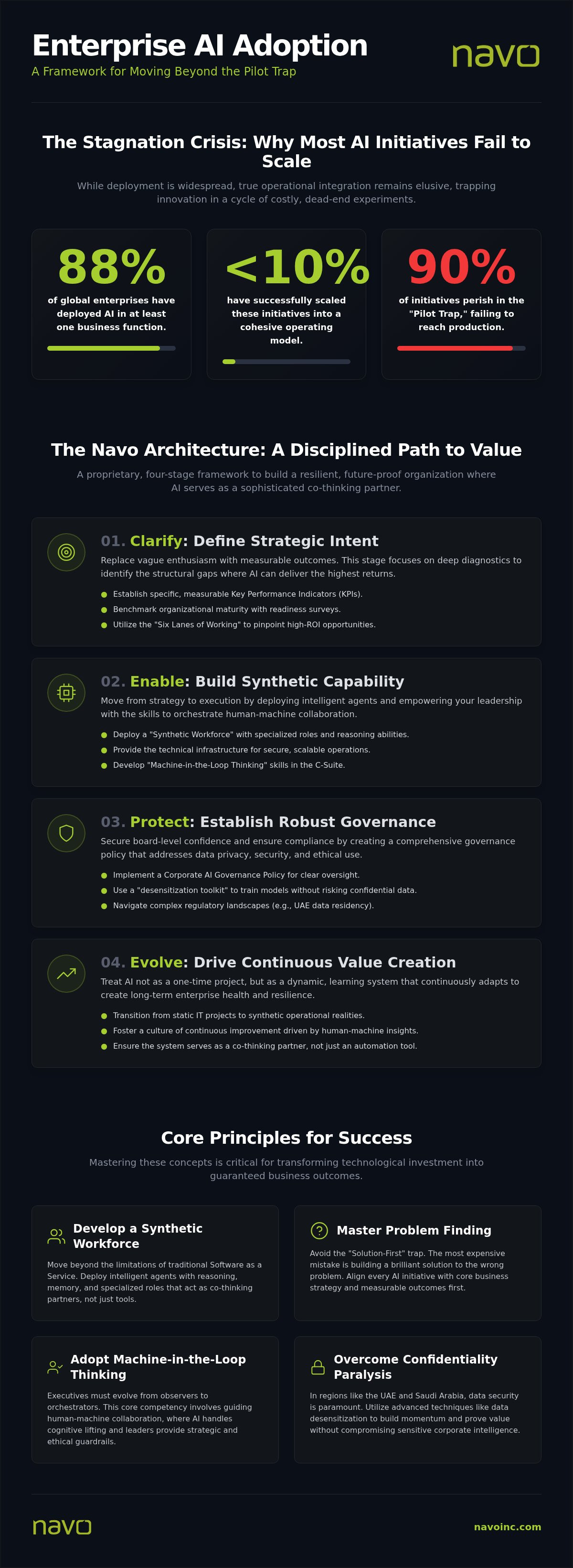
While 88% of global enterprises have deployed Artificial Intelligence in at least one business function, fewer than 10% have successfully scaled these initiatives into a cohesive operating model. This stagnation usually isn't a failure of the technology itself; it's a failure of the enterprise AI adoption framework used to govern it. In the competitive landscape of Dubai and the wider Gulf, the gap between a successful pilot and a profitable, scaled deployment has never been more pronounced.
You've likely felt the weight of "confidentiality paralysis" or the frustration of Generative Artificial Intelligence projects that consume resources without shifting the bottom line. We understand that for global leaders, the goal isn't just to experiment; it's to build a resilient, future-proof organization. This article provides a proprietary, outcome-guaranteed playbook to help you integrate a high-performing synthetic workforce into your core operations. We'll examine the strategic architecture required to move from fragmented tools to a governed system where Artificial Intelligence serves as a sophisticated co-thinking partner, driving efficiency and guaranteed profit outcomes across your entire enterprise.
Key Takeaways
- Move beyond the "Pilot Trap" by transitioning from isolated experiments to a systemic architecture that guarantees measurable business value and operational scalability.
- Implement the proprietary enterprise AI adoption framework built on the Clarify-Enable-Protect-Evolve architecture to ensure both structural stability and radical progress.
- Develop a "Synthetic Workforce" by deploying intelligent agents that possess reasoning capabilities, memory, and specialized roles, moving beyond the limitations of traditional software.
- Master the "Art of Problem Finding" to ensure your technological investments align with core business strategy and avoid the high costs of solving the wrong organizational challenges.
- Establish a comprehensive Corporate Artificial Intelligence Governance Policy to secure board-level confidence and navigate the complex regulatory landscapes of the United Arab Emirates and global markets.
Beyond the Hype: Why Traditional Enterprise Artificial Intelligence Adoption Frameworks Fail in 2026
Traditional management consulting often treats Artificial Intelligence as a plug-and-play utility. This reductionist view is why the vast majority of custom Generative Artificial Intelligence initiatives never leave the experimental phase. An effective enterprise AI adoption framework is not a procurement checklist; it's a systemic architecture designed for continuous value creation. By July 2026, the "Pilot Trap" has become the primary graveyard for corporate innovation, where 90% of initiatives fail to reach production due to a lack of structural alignment and a failure to move beyond isolated use cases.
Most firms fall into the "Solution-First" trap. They start with a specific Large Language Model and search for a problem to solve. This approach ignores the Technology adoption life cycle, which dictates that sustainable scaling requires deep cultural and operational integration. We must move beyond viewing Artificial Intelligence as a mere tool for automation. Instead, it must be treated as a co-thinking partner, a non-deterministic entity that reasons alongside your human experts to solve complex, high-stakes challenges that traditional software cannot touch.
The Crisis of Confidentiality Paralysis
In the United Arab Emirates and Saudi Arabia, fear of data leaks often halts progress before it begins. Regional leaders face strict data residency requirements and a justifiable skepticism of generic Software as a Service platforms that don't meet local security benchmarks. When sensitive corporate intelligence is at stake, a simple privacy policy isn't enough. Our framework introduces a "desensitization toolkit" during the early adoption phases. This allows organizations to train and test models using synthetic or anonymized data, ensuring compliance with regional regulations while building the necessary momentum for full-scale deployment without compromising systemic health.
The Missing Layer: Synthetic Skills in the C-Suite
There's a profound disconnect between technical Artificial Intelligence knowledge and strategic leadership capability. Executives don't need to write code, but they must master "Machine-in-the-Loop Thinking." This is the core competency of orchestrating human-machine collaboration where the Artificial Intelligence handles the heavy cognitive lifting and the leader provides the ethical and strategic guardrails. Bridging this gap is critical for organizational resilience. Navo's Continuing Professional Development United Kingdom-certified coaching provides the disciplined architecture leaders need to evolve from passive observers into bold technological pioneers capable of navigating this new frontier.
The Navo Inc. Architecture: Clarify, Enable, Protect, and Evolve
The Navo Inc. Architecture serves as a disciplined response to the fragmented, tool-centric strategies that often lead to organizational stagnation. This enterprise AI adoption framework is built on four pillars: Clarify, Enable, Protect, and Evolve. Each stage represents a critical milestone in the transition from experimental curiosity to systemic excellence. By establishing a logical cadence between strategic intent and technological execution, we ensure that every initiative contributes to the long-term health and resilience of the enterprise.
Stage 1 & 2: From Clarity to Capability
The journey begins with Stage 1: Clarify. We replace vague executive enthusiasm with specific, measurable Key Performance Indicators. This phase utilizes sophisticated diagnostic tools and readiness surveys to benchmark organizational maturity. A central component here is the "Six Lanes of Working" framework, which identifies precisely where Artificial Intelligence can deliver the highest returns on investment. We don't just ask what the technology can do; we identify the structural gaps it is uniquely qualified to fill.
Stage 2: Enable focuses on building the necessary infrastructure and "synthetic skills" within your workforce. True enablement is not merely about software deployment. It involves a shift in human-to-machine communication, where employees learn to treat Agentic Artificial Intelligence as a sophisticated partner. This capability is cultivated through structured coaching and masterclasses, ensuring your team is equipped to manage the cognitive complexities of a hybrid workforce.
Stage 3 & 4: Governance and Continuous Evolution
Stage 3: Protect addresses the critical need for governance and regional compliance. In the United Arab Emirates and broader Gulf region, data sovereignty and auditability are non-negotiable. Navo Inc. implements "Safety-by-Design" protocols that align with the National Institute of Standards and Technology Privacy Framework and local regulations. While international guidelines like BSA's AI Adoption Agenda (provided by BSA | The Software Alliance) offer a broad policy perspective, the Navo Inc. framework prioritizes the specific legal requirements of the Middle East. This includes establishing human-in-the-loop approval gates for non-deterministic systems, ensuring that accountability remains firmly with human leadership.
Finally, Stage 4: Evolve facilitates the transition from individual efficiency to full-scale business model innovation. Navo Inc. creates a continuous feedback loop where synthetic workers improve based on real-time organizational performance data. This ensures the system is not static but evolves alongside your strategic ambitions. This disciplined enterprise AI adoption framework transforms Artificial Intelligence from a risky experiment into a predictable driver of profit and resilience.
Integrating the Synthetic Workforce Layer: Moving Beyond Software as a Service
The most significant shift in a modern enterprise AI adoption framework is the transition from viewing Artificial Intelligence as a software utility to recognizing it as a distinct workforce layer. While traditional Software as a Service models provide tools for human use, a "Synthetic Worker" is an autonomous agent equipped with memory, specialized tools, and clearly defined organizational roles. These agents don't just wait for instructions; they possess the reasoning capabilities to execute complex workflows, making them a primary scalability engine for global enterprises operating across diverse markets like the United Arab Emirates and Singapore.
We must distinguish between traditional automation and Agentic Artificial Intelligence. Traditional systems are deterministic, following rigid "if-this-then-that" logic. In contrast, Agentic Artificial Intelligence is non-deterministic, meaning it uses reasoning to navigate ambiguity. This allows for a dual-acceptance workflow where humans and machines collaborate on high-stakes tasks. The machine handles the cognitive heavy lifting and data synthesis, while the human leader provides the final strategic validation. This partnership ensures that the speed of the synthetic workforce is always balanced by the seasoned judgment of your senior management.
Proprietary Agents: SARA and NOVA in Action
To move beyond theoretical frameworks, we deploy proprietary agents designed for specific operational bottlenecks. SARA, our Brief Intake and Validation agent, serves as a critical gatekeeper in marketing and creative workflows. By validating project briefs against strategic objectives before a single Dirham (د.إ) is spent, SARA eliminates the budget waste common in fragmented global campaigns. NOVA, our Production Orchestration agent, manages the complexities of project lifecycles, ensuring that timelines and resource allocations remain optimized. These agents are built with rigorous auditability and human-ownership mechanisms, ensuring that every action taken by the synthetic workforce is transparent and aligned with corporate policy.
The Question-Economy Protocol
As the synthetic workforce matures, the core organizational skill shifts from "Prompt Engineering" to "Question Design." Tactical prompting is a temporary fix; sophisticated Question Design is a strategic asset. This protocol is rooted in the Art of Problem Finding, where the quality of the output is determined by the intellectual rigor of the initial inquiry. When leadership masters the ability to frame high-level strategic questions, the synthetic workforce can provide deeper, more actionable insights. For a more comprehensive look at how these roles evolve, explore our Executive Guide to Generative Artificial Intelligence Consulting Services. This shift ensures that your enterprise AI adoption framework isn't just about faster execution, but about smarter, more resilient decision-making at every level of the organization.
The Art of Problem Finding: Aligning Artificial Intelligence with Measurable Outcomes
Most corporate initiatives fail because they apply high-powered technology to low-value problems. Within a disciplined enterprise AI adoption framework, the primary differentiator isn't technical prowess but the "Art of Problem Finding." While traditional consultants focus on automating existing processes, we prioritize identifying the structural bottlenecks that, if resolved, shift the entire financial trajectory of the organization. Solving the wrong problem with Artificial Intelligence is the most expensive mistake an enterprise can make, leading to "pilot fatigue" and significant wasted capital. In the high-stakes markets of Dubai and Riyadh, where precision is a prerequisite for leadership, this diagnostic rigor is non-negotiable.
The "Ampersand Strategy" serves as our diagnostic engine. It bridges the gap between fragmented departmental needs and a unified corporate vision, ensuring that every deployment is an act of strategic integration rather than an isolated patch. This methodology has been proven across the Middle East and India, where shifting the focus from "how to use technology" to "what specific problem requires a synthetic solution" leads directly to a robust outcome-based AI strategy. By integrating unity with strategic intent, we transform Artificial Intelligence from a cost center into a profit-generating asset.
Diagnostic Tools for ROI Benchmarking
To move beyond the experimental phase, leadership requires empirical evidence. We utilize sophisticated Return on Investment calculators that benchmark organizational maturity against projected gains. Our ultimate North Star metric is "Net-Profit Increase." While many firms track "time saved" or "engagement rates," these are often vanity metrics that don't reflect systemic health. A high-stakes use case must demonstrate a direct impact on the bottom line. By distinguishing between "Novelty" use cases, which provide temporary excitement, and "High-Stakes" use cases, which provide structural resilience, we ensure that every Dirham (د.إ) invested delivers a measurable return.
Request a diagnostic ROI benchmark for your enterprise
Applying the Six Lanes of Working
The enterprise AI adoption framework is operationalized through the "Six Lanes of Working": Strategy, Operations, Customer Experience, Product Innovation, Risk, and Talent. Each lane represents a critical pillar of organizational stability. We prioritize investments by analyzing which lane offers the most immediate path to exponential growth. For instance, while one firm may find its greatest leverage in optimizing supply chain operations, another may require a radical shift in customer experience through reasoning agents. This structured prioritization prevents the dilution of resources and ensures that the transition to a synthetic workforce is both methodical and profitable.
Executing the Transition: From Information Technology Projects to Synthetic Operational Realities
The final phase of a disciplined enterprise AI adoption framework involves transitioning from isolated Information Technology projects to a permanent synthetic operational reality. This shift requires a methodical five-week transformation journey designed to dismantle organizational inertia. We move through a structured sequence: Pre-prep for alignment, an Intensive Masterclass for skill acquisition, and the Activation Arc for deployment. This deliberate pace ensures that the integration of a synthetic workforce is not a disruptive shock but a controlled evolution toward systemic excellence.
For risk-averse enterprises in the United Arab Emirates and broader Asia, the implementation of a robust Corporate Artificial Intelligence Governance Policy is the cornerstone of board-level confidence. Without clear guardrails, the fear of non-compliance or data residency violations can lead to "confidentiality paralysis." We provide a framework where governance is an enabler of innovation rather than a barrier. By establishing clear auditability and human-in-the-loop protocols, we allow leaders to pursue aggressive growth strategies with the assurance that every synthetic action is aligned with regional regulations and ethical standards.
Our approach differs from traditional "Big 4" experimental labs by offering outcome-guaranteed consulting. We understand that in high-stakes environments, speculative pilots are a liability. Whether your objective is a measurable increase in net profit or a significant reduction in operational friction, our engagement is tied to these specific results. This focus on "Evidence-Discipline" ensures that every Dirham (د.إ) invested in the enterprise AI adoption framework contributes directly to the long-term resilience and profitability of the organization.
Scaling with Continuing Professional Development United Kingdom-Certified Excellence
Future-proofing a leadership team requires more than just technical awareness; it demands a culture of "Intellectual Honesty." This is why our training modules are Continuing Professional Development United Kingdom-certified, providing an internationally recognized benchmark for excellence. Leaders must move beyond the surface-level hype to understand the underlying mechanics of human-machine collaboration. You can learn more about Vasudevan Kidambi's transformation frameworks for senior leaders, which focus on building the strategic maturity necessary to lead a hybrid workforce into the late 2020s.
Your Next Step: The Strategic Diagnostic
The 2026 benchmark for enterprise readiness is no longer about the quantity of tools you possess, but the quality of your governed architecture. Where does your organization stand on the spectrum of maturity? Moving from a state of experimental uncertainty to one of governed value requires an honest assessment of your current capabilities. We invite you to move beyond the "Pilot Trap" and begin the journey toward a high-performing synthetic workforce.
Request a personalized Enterprise Artificial Intelligence Readiness Diagnostic
Architecting the Future of Synthetic Operational Excellence
The transition from experimental curiosity to a disciplined synthetic operational reality is the defining challenge for global leadership in 2026. Success requires more than technical deployment; it demands a rigorous enterprise AI adoption framework that prioritizes the proprietary Art of Problem Finding to ensure every initiative delivers a measurable net-profit increase. By moving beyond isolated pilots and embracing a governed architecture of Clarify, Enable, Protect, and Evolve, your organization can build a resilient workforce where human experts and reasoning agents co-think for a distinct strategic advantage.
Our Continuing Professional Development United Kingdom-certified coaching pathway provides the intellectual foundation needed to navigate these organizational shifts with confidence. We replace the uncertainty of the "Pilot Trap" with an outcome-guaranteed methodology that has been battle-tested across the United Arab Emirates and broader Asian markets. You're now equipped with the playbook to move from confidentiality paralysis to a state of sustained, governed value.
)Secure your strategic advantage-contact our Dubai-based transformation team today
The future of your enterprise depends on the structural excellence you establish today. We look forward to partnering with you as a steady, expert hand on this journey toward radical progress and systemic health.
Frequently Asked Questions
What is an enterprise Artificial Intelligence adoption framework?
An enterprise AI adoption framework is a systemic architecture designed to move an organization beyond experimental pilots into a state of governed, scalable value. It provides the structural stability required to integrate Artificial Intelligence into core business strategy; this ensures that innovation leads to organizational resilience rather than fragmented complexity. By establishing a clear roadmap, leaders can avoid the pitfalls of isolated technology implementations and achieve systemic health.
How do we measure the Return on Investment of Generative Artificial Intelligence?
We measure the Return on Investment of Generative Artificial Intelligence by focusing on the Net-Profit Increase as the ultimate North Star metric. While many firms track vanity metrics such as "time saved" or "user engagement," we prioritize hard financial outcomes. By using sophisticated diagnostic calculators, we benchmark organizational maturity against the actual efficiency gains and revenue growth achieved through synthetic workforce integration in your specific market.
Why do most Enterprise Artificial Intelligence projects fail?
Most projects fail because of the "Pilot Trap," where 90% of initiatives never reach production. This usually stems from a "Solution-First" approach, where companies implement a tool without first identifying a high-stakes business problem. Without structural alignment and leadership capability, these experiments remain isolated. They eventually lose corporate momentum because they fail to deliver a measurable impact on the bottom line, often wasting millions of UAE Dirham (د.إ) in the process.
What is the difference between an Artificial Intelligence tool and a Synthetic Worker?
An Artificial Intelligence tool is a simple utility used by a human to complete a discrete task. In contrast, a Synthetic Worker is an autonomous agent with memory, specialized tools, and reasoning capabilities. These agents function as co-thinking partners within your workforce, handling non-deterministic tasks that require logic and strategic alignment. They represent a new layer of your organization rather than just another software subscription or basic automation script.
How does Navo ensure regional compliance in the Middle East and Gulf states?
We ensure compliance by implementing "Safety-by-Design" protocols that adhere to the specific data sovereignty laws of the United Arab Emirates and Saudi Arabia. Our framework integrates the National Institute of Standards and Technology Privacy Framework and utilizes desensitization toolkits to protect sensitive corporate intelligence. This approach ensures that your Artificial Intelligence initiatives meet the highest security benchmarks while maintaining full auditability for regional regulators in the Gulf.
What is the Art of Problem Finding in the context of Artificial Intelligence?
The Art of Problem Finding is the disciplined process of identifying the structural bottlenecks that offer the highest leverage for transformation. Instead of merely automating existing tasks, we focus on locating the "right" problems to solve. This ensures that your technological investments are aligned with measurable business outcomes and long-term growth. It is the essential first step in our framework that prevents expensive mistakes and the misallocation of resources on novelty use cases.
How long does it take to implement a full Enterprise Artificial Intelligence Adoption Framework?
Implementing a full enterprise AI adoption framework typically follows a five-week transformation journey. This cadence includes a Pre-prep phase for alignment, an Intensive Masterclass for skill acquisition, and an Activation Arc for deployment. This methodical approach ensures that the transition to a synthetic workforce is both stable and profitable. It moves your organization from a state of "confidentiality paralysis" to one of governed, high-performing operational reality.
Is Navo's coaching Continuing Professional Development United Kingdom accredited?
Yes, all of our masterclasses and coaching pathways are Continuing Professional Development United Kingdom-certified. This accreditation ensures that your leadership team receives training that meets international standards for quality and intellectual rigor. It provides the "synthetic skills" necessary to lead a modern, hybrid organization effectively. This certification offers a reliable benchmark for professional excellence in a rapidly evolving technological landscape, ensuring your team remains capable of navigating complex organizational shifts.
Generative AI tools may have been used to support research, structuring, or language refinement, with the final content, judgment, and editorial responsibility retained by the author.*
Disclaimer
The views and opinions expressed in this article are those of the author and do not represent any organisation, client, institution, or professional body with which he may be associated. The content is intended for general information, education, and thought leadership. Readers should seek appropriate professional advice before making legal, financial, investment, regulatory, technology, or business decisions.
The author has taken reasonable care to ensure the accuracy of the information and sources available at the time of publication. Technologies, regulations, market conditions, and industry practices may evolve, and readers are encouraged to verify current information independently. Any examples, cases, or scenarios may have been simplified, anonymised, or adapted to protect confidentiality. The author and publisher accept no liability for decisions or outcomes arising from the use of this content.
Generative AI tools may have been used to support research, structuring, or language refinement, with the final content, judgment, and editorial responsibility retained by the author.