

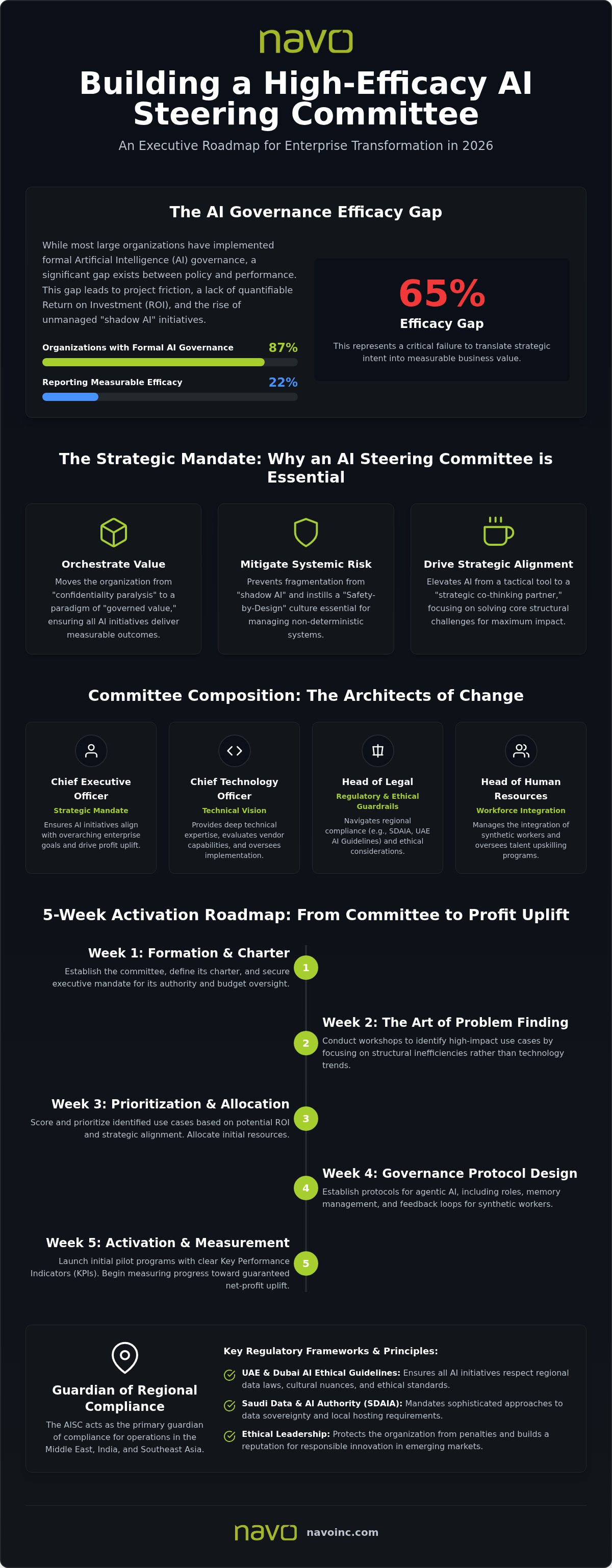
While 87% of large organizations have established formal AI governance, a mere 22% report that these systems operate with measurable efficacy in 2026. For many executives in the United Arab Emirates, the initial excitement of pilot programs has been replaced by the friction of overlapping projects and a persistent lack of quantifiable ROI. You likely recognize that without a centralized authority, the risks of "shadow AI" and regulatory misalignment within the GCC region only intensify. This guide offers a comprehensive executive roadmap for building an AI steering committee that functions as a disciplined architect of change rather than a bureaucratic hurdle. You'll gain a clear framework for prioritizing high-impact use cases through the Art of Problem Finding and a strategic charter for integrating synthetic workers into your core operations. We'll explore the path toward structural excellence, ensuring your organization achieves the guaranteed net-profit uplift required in today's competitive landscape.
Key Takeaways
- Understand why building an AI steering committee is the essential precursor to orchestrating a high-impact synthetic workforce that drives measurable enterprise transformation.
- Master the "Art of Problem Finding" to prioritize AI use cases based on their capacity to resolve structural inefficiencies rather than chasing superficial technological trends.
- Establish sophisticated governance protocols for agentic AI to manage the roles, memory, and feedback loops of autonomous synthetic workers.
- Ensure regional compliance and operational resilience by aligning your committee’s charter with the latest UAE and SDAIA AI governance frameworks.
- Follow a disciplined five-week activation roadmap supported by CPD-certified coaching to bridge the gap between strategic intent and guaranteed profit uplift.
The Strategic Mandate: Why an Artificial Intelligence (AI) Steering Committee (AISC) is Essential in 2026
The 2026 enterprise landscape is defined by a critical divergence between organizations that treat artificial intelligence as a peripheral tool and those that view it as a core architectural layer. A standard steering committee often lacks the specialized technical and ethical depth required to manage non-deterministic systems. Building an AI steering committee provides the necessary cross-functional governance to orchestrate these complex shifts. This body moves the organization beyond "confidentiality paralysis," a state where the fear of data leakage halts innovation, and toward a paradigm of "governed value." By establishing clear protocols, the committee transforms AI from a source of anxiety into a source of strategic resilience.
Traditional Information Technology (IT) committees were built for the era of deterministic software where inputs led to predictable outputs. Generative AI (GenAI) and agentic systems operate differently; they require a "Safety-by-Design" culture that prioritizes observability and risk mitigation at the point of inception. The AISC doesn't just manage risk; it identifies opportunities for systemic health. This proactive stance prevents the fragmentation of "shadow AI" and ensures that all projects align with the overarching enterprise mission, maintaining a steady hand amidst technological volatility.
Moving Beyond Governance to Strategic Co-Thinking
The transition from viewing AI as a productivity tool to a strategic co-thinking partner is a hallmark of mature 2026 leadership. This shift requires the AISC to align technological capabilities with high-level business objectives to ensure that every pilot program translates into a measurable outcome. The AISC serves as the central nervous system for enterprise-wide synthetic workforce integration. By leveraging the Art of Problem Finding, the committee moves away from the question of "how to use AI" and focuses instead on which structural challenges require an intelligent response. This ensures that resources are allocated to initiatives that offer the highest potential for profit uplift and operational efficiency.
Regulatory Awareness in the Middle East and India
Enterprises operating within the United Arab Emirates and the Kingdom of Saudi Arabia face a unique set of regulatory demands that require expert navigation. The Dubai AI Ethical Guidelines and the frameworks established by the Saudi Data and AI Authority (SDAIA) mandate a sophisticated approach to data sovereignty and local hosting. The AISC acts as the primary guardian of compliance, ensuring that all AI initiatives respect regional data laws and cultural nuances. This is particularly vital when integrating agentic systems that process sensitive corporate data. A well-structured committee monitors these evolving legal landscapes, protecting the organization from the significant penalties associated with non-compliance while fostering a reputation for ethical leadership in the Middle East.
Designing the Committee Charter: A Template for Executive Governance
Establishing a formal charter serves as the foundational architecture for any successful AI deployment. This document defines the scope of authority, budget oversight, and approval protocols, ensuring that AI initiatives transcend departmental silos to become enterprise-wide assets. When building an AI steering committee, the charter must explicitly grant the body the power to halt non-compliant projects and reallocate resources toward high-priority use cases. This level of structural clarity is essential for navigating the complexities of 2026, where the speed of technological evolution often outpaces traditional bureaucratic processes. Organizations can draw inspiration from established strategic frameworks, such as Duke University's AI Steering Committee Report, which emphasizes the necessity of aligning governance with long-term institutional goals.
The composition of the committee requires a deliberate balance of executive power and functional expertise. While the Chief Technology Officer (CTO) provides the technical vision, the inclusion of the Chief Executive Officer (CEO), Legal, and Human Resources (HR) ensures that AI orchestration remains rooted in business reality and ethical standards. This diverse group moves the organization away from rigid monthly reviews toward agile, evidence-based decision loops. Success metrics must evolve accordingly. Beyond simple efficiency gains, the committee should track net-profit increase and workforce readiness, ensuring the enterprise is prepared for the eventual integration of autonomous agents.
The Composition of a High-Performance AI Council
A high-performance council thrives under the leadership of a business-focused "AI Champion" rather than a purely technical lead. This distinction ensures that every technological investment serves a strategic commercial purpose. To maintain ethical integrity, the committee must include a "Human-in-the-Loop" (HITL) advocate responsible for overseeing the responsible deployment of agentic systems. Incorporating external advisors is equally vital. These specialists provide tool-agnostic perspectives that challenge internal biases and prevent vendor lock-in, which is a common risk in the rapidly consolidating AI market. Their presence ensures the committee remains focused on systemic health rather than specific software features.
Decision-Making Frameworks and Accountability
Operationalizing the committee's vision requires robust decision-making frameworks. Establishing "Permitted-Use Boundaries" and "Desensitization Toolkits" protects corporate data while allowing for rapid experimentation. In the United Arab Emirates, these frameworks must be particularly sensitive to regional data sovereignty laws and the cultural nuances of the Middle East. For high-stakes business decisions, a "Dual-Acceptance Workflow" ensures that AI-generated insights are validated by human expertise before execution. This layer of accountability reduces the risk of automated errors and builds trust across the organization. You can secure your organization's future with a bespoke AI Governance Policy that addresses these specific regional and technological requirements.
The Art of Problem Finding: Prioritizing High-Impact AI Use Cases
The primary failure of many 2026 AI initiatives stems from a preoccupation with technological capability over organizational necessity. While competitors often suggest reactive surveys of current AI usage, building an AI steering committee requires a more rigorous, diagnostic approach. The "Art of Problem Finding" framework shifts the executive focus from the mechanics of "how to use AI" to the strategic identification of "what problem needs solving." This methodology ensures that capital is not wasted on superficial novelties but is instead directed toward structural bottlenecks that impede enterprise growth.
The "Six Lanes of Working" provides a structured taxonomy for categorizing these opportunities across the organization. By applying this framework, the committee can differentiate between simple efficiency gains, such as automated reporting, and profound strategic transformations that redefine market positioning. This distinction is critical for maintaining the "Evidence Discipline," a protocol that mandates verifiable proof-of-value before any Generative Artificial Intelligence (GenAI) pilot is permitted to scale. This rigorous vetting process protects the organization’s resources and maintains the integrity of the technological roadmap.
From Hype-Driven to Outcome-Guaranteed Strategy
Evaluating use cases through Navo’s "Outcome-Guaranteed" model ensures that every initiative is anchored in a projected net-profit increase. Experimental labs often lack this commercial grounding, leading to "pilot purgatory" where projects fail to move beyond the testing phase. The Ampersand Strategy facilitates the seamless integration of artificial intelligence into existing business models by ensuring that technological adoption enhances rather than disrupts proven operational strengths. This approach prioritizes resilience and systemic health over the pursuit of unproven digital trends.
The Synthetic Workforce ROI Calculator
The committee must employ a sophisticated ROI calculator to justify capital expenditure (CAPEX) on AI infrastructure. This financial model factors in the cost of displacement, mandatory retraining programs, and the ongoing maintenance of synthetic workers. For enterprises in the United Arab Emirates, these calculations must be presented in UAE Dirham (AED) to align with local financial reporting standards and regional economic realities. A thorough understanding of these costs is essential for maintaining professional composure during high-stakes budget approvals. For deeper selection criteria on these initiatives, read our pillar article on Generative Artificial Intelligence Consulting Services.
Governing the Synthetic Workforce: New Protocols for AI Agents
The 2026 enterprise has moved beyond viewing AI as a static chat interface. It now operates as a dynamic, autonomous workforce. Building an AI steering committee is the only way to manage the transition from Large Language Models (LLMs) to agentic systems that execute tasks independently. These agents don't just predict text; they manage workflows and interact with enterprise software. Governing this synthetic workforce requires a shift in perspective. The committee must establish the roles, memory constraints, and tool access for every digital worker. This oversight ensures that autonomous systems remain aligned with the organization's strategic mission.
Auditability is the cornerstone of this new governance model. Every action taken by an autonomous agent must have a clear human-ownership mechanism to prevent "black box" accountability gaps. The committee implements a "Machine-in-the-Loop" thinking framework to orchestrate collaboration between human intuition and machine speed. This ensures that while agents handle high-velocity data processing, strategic oversight remains firmly in human hands. By formalizing these feedback loops, the organization maintains professional composure even as its digital workforce scales.
Managing AI Agents as Organizational Assets
Treating AI agents, such as SARA or NOVA, with the same rigor as human employees is essential for systemic health. The steering committee must institute performance reviews for these agents, monitoring their accuracy and alignment with corporate values. Approval protocols are established for autonomous actions that impact financial transactions or customer relationships in the United Arab Emirates. This level of scrutiny prevents unmanaged AI from creating security vulnerabilities. For a deeper look at implementation, explore our guide on Synthetic Workforce Development.
The Ethics of Agent-to-Agent Communication
As internal AI agents increasingly interact with external third-party services, the committee must govern these digital conversations. This involves ensuring compliance with the NIST Privacy Framework and strict regional data residency laws within the GCC. Data sovereignty is a legal requirement for any enterprise operating in the UAE. The committee's role is to verify that agentic memory remains within permitted boundaries. This protects the organization from unintended data leakage during agent-to-agent exchanges. Maintaining this boundary is vital for preserving the integrity of proprietary corporate intelligence.
Implementation Roadmap: From Committee Formation to Profit Uplift
The activation of a high-impact council follows a disciplined five-week trajectory. This "Activation Arc" begins with a two-week diagnostic pre-prep phase designed to map existing structural inefficiencies and identify the most fertile ground for intelligent automation. During weeks three and four, the committee undergoes intensive coaching to align strategic business objectives with the technical realities of agentic systems. The final week marks the formal activation, where the charter is operationalized and the first "Problem Finding" cycle commences. This structured approach ensures that building an AI steering committee results in immediate momentum rather than prolonged theoretical debate.
Continuous Professional Development (CPD) UK-certified masterclasses provide the essential literacy required for this journey. Literacy in Generative AI allows committee members to transition from defensive gatekeepers to proactive innovation accelerators. This shift is vital for maintaining professional composure when navigating the complex regulatory frameworks of the United Arab Emirates and the wider GCC. By fostering a deep understanding of non-deterministic systems, the committee becomes capable of making high-stakes decisions that guarantee a net-profit increase for the enterprise.
Coaching the AI Steering Committee
Coaching an executive team for the Agentic Era requires more than technical training; it necessitates the development of "synthetic skills." These skills enable leaders to manage a hybrid workforce where human intuition and machine speed are seamlessly integrated. Leveraging the three decades of transformation expertise provided by Vasudevan Kidambi, committee members learn to orchestrate this complex integration with a steady, expert hand. This coaching ensures that the leadership remains unfazed by technological volatility, focusing instead on the systemic health and resilience of the organization.
Ensuring Long-Term Resilience and Evolution
Sustainable AI adoption is built upon the "Clarify-Enable-Protect-Evolve" architecture. This framework ensures that every initiative is clearly defined, technologically enabled, protected by robust governance, and capable of evolving as new capabilities emerge. In instances where early pilots fail to meet expectations, the committee must lead "post-conflict" trust rebuilding efforts to maintain organizational momentum. This disciplined approach to failure prevents a retreat into "confidentiality paralysis" and keeps the enterprise focused on long-term profit uplift. Ultimately, the Art of Problem Finding remains the ultimate competitive advantage, allowing the committee to identify high-value opportunities that others overlook.
Architecting the Future of Enterprise Intelligence
The evolution of the 2026 enterprise demands more than passive adoption; it requires a disciplined orchestration of autonomous systems. By building an AI steering committee, you establish the structural stability necessary to transition from fragmented pilots to a cohesive synthetic workforce layer. This journey relies on the rigorous Art of Problem Finding to ensure every initiative is anchored in commercial reality rather than technological hype. As regional regulations in the UAE and Saudi Arabia continue to mature, your committee serves as the steady hand that balances innovation with uncompromising data sovereignty. It's a shift from merely managing tools to architecting systemic health.
Navo Inc. provides the expert guidance required to navigate these shifts with professional composure. Our CPD UK-certified AI leadership training and author-led consulting by Vasudevan Kidambi ensure your executive team is equipped with the synthetic skills needed for the agentic era. We're committed to delivering guaranteed net-profit increase outcomes through proprietary frameworks that prioritize long-term resilience. Your organization's transition from a passive observer to a bold technological pioneer is within reach.
The path toward structural excellence begins with a single, decisive strategic alignment.
Frequently Asked Questions
What is the primary role of an Artificial Intelligence (AI) Steering Committee?
The primary role is the strategic orchestration of intelligent systems to ensure alignment with overarching enterprise objectives. This body acts as the central nervous system for synthetic workforce integration, moving the organization beyond fragmented pilot programs. It focuses on identifying structural bottlenecks and governing the deployment of agentic systems to guarantee a measurable net-profit increase. By centralizing authority, the committee prevents "shadow AI" and ensures every initiative contributes to systemic health.
Who should ideally chair the Artificial Intelligence (AI) Steering Committee?
A business-focused executive, such as the Chief Executive Officer or a designated "AI Champion" with commercial oversight, should chair the committee. This leadership structure ensures that technological investments serve a strategic commercial purpose rather than becoming isolated IT projects. While technical leads provide essential expertise, the chair's focus remains on ROI, enterprise resilience, and the successful integration of AI into existing business models.
How does an AI Steering Committee differ from a standard IT governance board?
Standard IT governance boards typically manage deterministic software and hardware infrastructure with predictable outputs. In contrast, an AI Steering Committee handles non-deterministic systems, such as Generative AI and autonomous agents, which require specialized ethical and operational oversight. The committee addresses the profound workforce shifts and "Safety-by-Design" cultures that traditional boards aren't equipped to navigate. It prioritizes observability and risk mitigation at a much more granular level.
What are the common challenges when building an AI Steering Committee in the Middle East?
Building an AI steering committee in the Middle East involves navigating complex data sovereignty laws and strict local hosting mandates. Regional enterprises face unique pressures from evolving frameworks established by the UAE AI Office and the Saudi Data and AI Authority (SDAIA). Managing these regulatory requirements while ensuring digital sovereignty is a primary hurdle. Committees must ensure that all synthetic workers operate within the specific legal boundaries of the GCC region to avoid significant penalties.
How often should an Artificial Intelligence (AI) Steering Committee meet?
The committee should adopt an agile cadence rather than relying on rigid annual or quarterly cycles. Bi-weekly sessions are recommended during the initial five-week activation journey to maintain momentum and address immediate hurdles. Once the governance framework is established, monthly reviews supported by rapid, evidence-based decision loops are sufficient. This frequency allows the organization to remain responsive to the high velocity of technological shifts in the agentic era.
How can an AI Steering Committee ensure compliance with regional data laws like the UAE's Personal Data Protection Law?
Compliance is achieved by establishing "Permitted-Use Boundaries" and rigorous data residency protocols that align with the UAE's Personal Data Protection Law. The committee must verify that all agentic systems process sensitive information within permitted geographic and legal limits. Every AI-driven action requires a clear human-ownership mechanism for legal traceability. Regular audits of agentic memory and tool access ensure that the organization's synthetic workforce remains compliant with evolving regional standards.
What metrics should the AI Steering Committee use to measure success?
Success metrics must transcend simple efficiency gains to focus on net-profit increase and measurable workforce readiness. The committee should track the conversion rate of pilot programs into scaled, profit-generating operations across the enterprise. Metrics such as the reduction in "confidentiality paralysis" and the successful integration of autonomous agents into core workflows provide a clear indicator of strategic health. These data points allow for professional composure during high-stakes executive reporting.
How does the 'Art of Problem Finding' framework assist the AI Steering Committee?
The "Art of Problem Finding" serves as the primary filter for use-case prioritization within the committee. It shifts the executive focus from technological capability to identifying the specific structural challenges that impede enterprise growth. This methodology ensures that resources aren't wasted on superficial novelties but are directed toward initiatives with the highest potential for commercial uplift. It provides a disciplined pathway for transforming complex organizational realities into structured technological responses.
Disclaimer
The views and opinions expressed in this article are those of the author and do not represent any organisation, client, institution, or professional body with which he may be associated. The content is intended for general information, education, and thought leadership. Readers should seek appropriate professional advice before making legal, financial, investment, regulatory, technology, or business decisions.
The author has taken reasonable care to ensure the accuracy of the information and sources available at the time of publication. Technologies, regulations, market conditions, and industry practices may evolve, and readers are encouraged to verify current information independently. Any examples, cases, or scenarios may have been simplified, anonymised, or adapted to protect confidentiality. The author and publisher accept no liability for decisions or outcomes arising from the use of this content.
Generative AI tools may have been used to support research, structuring, or language refinement, with the final content, judgment, and editorial responsibility retained by the author.