

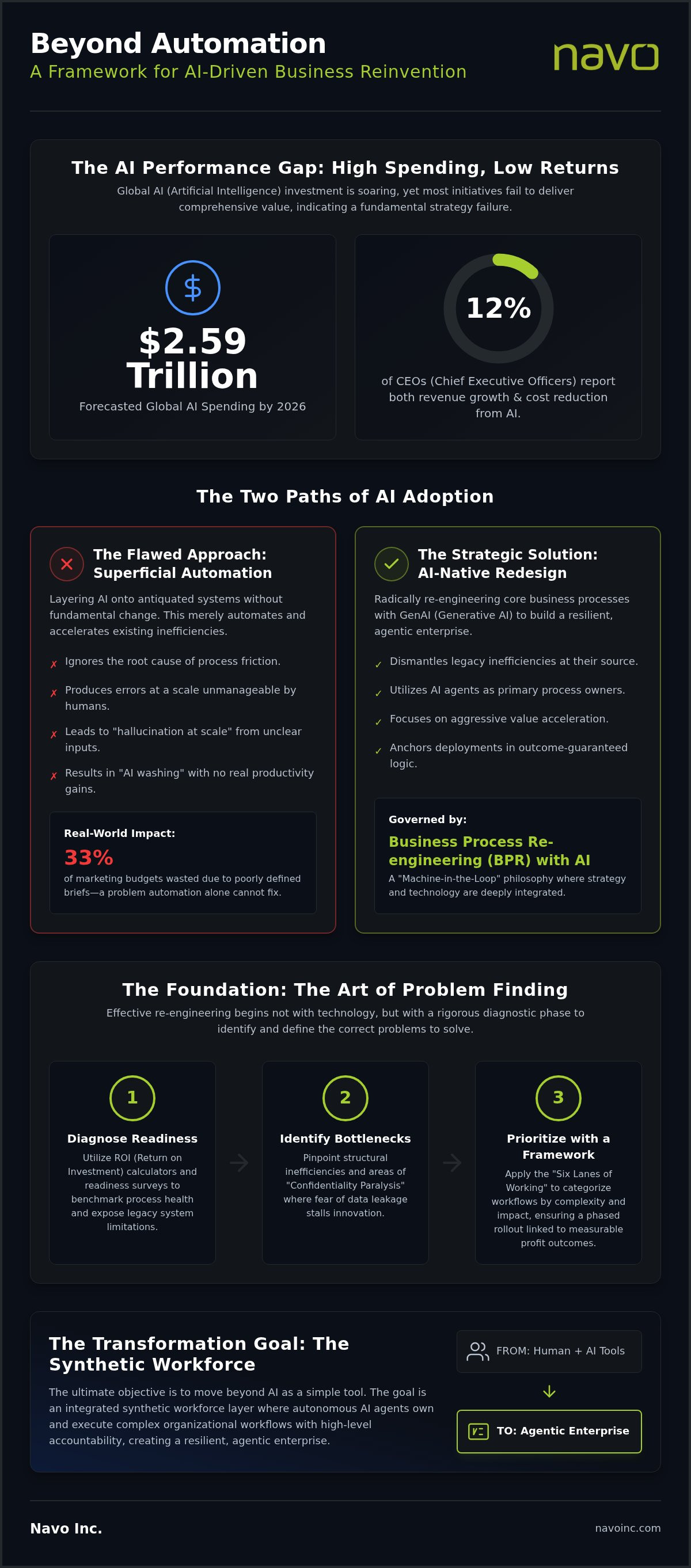
While global AI (Artificial Intelligence) spending is forecasted to reach 2.59 trillion USD in 2026, only 12 percent of CEOs (Chief Executive Officers) report that their initiatives have delivered both revenue growth and cost reductions. This disparity highlights a critical failure in current adoption strategies. Most organizations are merely layering automation onto antiquated systems rather than pursuing fundamental business process re-engineering with AI. You likely recognize the friction of confidentiality paralysis and the high-cost inefficiencies of legacy workflows that remain untouched by surface-level tools.
This article provides a strategic framework to move beyond task-level automation toward a radical, governed reinvention of your operations. We will outline a roadmap for BPR (Business Process Re-engineering) with AI that utilizes a proprietary GenAI (Generative Artificial Intelligence) framework to ensure measurable profit increases. You will learn how to integrate AI agents into a synthetic workforce layer, transforming your organization into a resilient, agentic enterprise designed for the synthetic era.
Key Takeaways
- Distinguish between superficial automation and a systemic AI-Native Redesign by applying business process re-engineering with AI (Artificial Intelligence) to dismantle legacy inefficiencies.
- Utilize "The Art of Problem Finding" as a diagnostic precursor to deployment, ensuring that strategic questions drive technological investment rather than the reverse.
- Transition toward a Synthetic Workforce of autonomous AI Agents capable of owning and executing complex organizational workflows with high-level accountability.
- Align transformation efforts with the specific regulatory standards of the GCC (Gulf Cooperation Council) and Singapore through a structured "Protect and Evolve" architecture.
- Adopt an outcome-guaranteed framework that moves beyond "AI washing" to deliver measurable profit increases and long-term operational resilience.
Beyond 'AI Washing': The Radical Shift from Automation to Process Reinvention
The era of corporate experimentation has concluded. In 2026, the distinction between market leaders and laggards is defined by their approach to Business Process Re-engineering. Many organizations remain trapped in "AI washing," a superficial practice where GenAI (Generative Artificial Intelligence) is layered onto fragmented, legacy workflows. This approach fails because it ignores the fundamental "J-Curve" of productivity; true gains only occur after a period of structural disruption. To achieve radical efficiency, executives must pivot toward business process re-engineering with AI, adopting a "Machine-in-the-Loop" philosophy where AI agents act as primary process owners rather than mere assistants.
The Cost of Automating Inefficiency
Speeding up a flawed process doesn't fix the underlying problem; it merely compounds organizational technical debt. When a broken workflow is automated, it produces errors at a scale that human oversight cannot easily manage. The BetterBriefs Global Report 2021 highlighted that 33 percent of marketing budgets are wasted due to poorly defined briefs. In the context of AI, this lack of clarity leads to "hallucination at scale." True transformation requires that we stop automating the past and start engineering for a synthetic future where clarity is the primary currency.
Value-First Process Architecture
The objective of business process re-engineering with AI has shifted from simple cost-cutting to aggressive value acceleration. Leading firms in Dubai and Singapore are no longer looking for incremental hours saved; they're looking for new revenue pathways. This requires a co-thinking partnership where leaders identify non-value-adding activities for total elimination. By stripping away the administrative friction that traditionally slows down decision-making, organizations can move at the speed of agentic intelligence, ensuring that every technological deployment is anchored in a clear, outcome-guaranteed strategic logic.
The Art of Problem Finding: A Strategic Framework for AI-Led Re-engineering
Effective business process re-engineering with AI begins long before a single line of code is written or an LLM (Large Language Model) is integrated. It starts with "The Art of Problem Finding," a rigorous diagnostic phase that identifies the structural bottlenecks hidden within legacy workflows. In the modern "Question Economy," the benchmark for executive leadership has shifted. Your value lies not in providing answers, but in articulating the precise questions that drive systemic evolution. This transition from "Clarify" to "Enable" is the cornerstone of the Navo adoption architecture, ensuring that every technological shift is rooted in objective reality, a necessity for the high-stakes environments of Riyadh and Dubai.
Many organizations suffer from "Confidentiality Paralysis." This is where the fear of data leakage stalls innovation. Overcoming this requires a governed framework that transforms risk into enterprise value. By establishing clear guardrails, leaders can move from a state of defensive inertia to one of proactive acceleration. If you're ready to move past these internal barriers, consulting with a strategic partner can help clarify your path forward.
Diagnostic Tools for Enterprise Readiness
Intellectual honesty is the first requirement for successful redesigning business processes with AI. We utilize sophisticated ROI (Return on Investment) calculators and readiness surveys to benchmark current process health. This diagnostic approach exposes the limitations of legacy systems. It prevents the common mistake of building advanced AI structures on top of unstable foundations.
The Six Lanes of Working
To prioritize integration points, we apply the "Six Lanes of Working." This proprietary framework categorizes workflows based on their complexity and impact. It allows for a phased approach to business process re-engineering with AI. By linking each redesign to measurable profit and efficiency outcomes, organizations ensure that their synthetic workforce contributes directly to the bottom line.
Operationalizing the Synthetic Workforce: From Tools to Agentic Process Owners
The transition from passive software to a Synthetic Workforce represents a fundamental shift in organizational design. A Synthetic Workforce is a distinct operational layer where AI (Artificial Intelligence) agents execute defined roles and adhere to rigorous workflows. Unlike traditional tools that require constant human prompting, these agents function as autonomous process owners. This evolution is central to business process re-engineering with AI, allowing enterprises to move beyond task-level assistance toward systemic orchestration. As noted by IBM on Business Process Re-engineering, the integration of AI-powered process mining is essential for identifying where these agentic layers can most effectively replace legacy bottlenecks.
Orchestrating specialized agents like SARA (Briefing Specialist) and NOVA (Project Orchestration) enables a level of precision previously unattainable. These agents don't just process data; they manage the lifecycle of a project. However, autonomy does not mean a lack of oversight. We implement a "Human-Ownership" mechanism to ensure that accountability remains with executive leadership. This ensures that even as business process re-engineering with AI accelerates operations, the strategic intent remains firmly under human control.
Designing the Agentic Workflow
Every synthetic worker requires a clearly defined persona, memory retention parameters, and a specific set of tool-usage permissions. We design these workflows with integrated approval gates and audit-ready outcomes. This structured approach ensures that autonomous processes remain transparent and compliant with the regulatory standards of the GCC (Gulf Cooperation Council) and Singapore. By defining exactly how an agent interacts with enterprise data, we eliminate the risks associated with unmanaged AI deployments.
The SARA Protocol: A Case Study in Briefing Excellence
The SARA protocol demonstrates the power of agentic BPR (Business Process Re-engineering). By capturing raw human input and applying dynamic scoring, SARA identifies gaps in project briefs before they reach the execution phase. This intervention reduces time-to-acceptance by 50 percent. We utilize "dual-acceptance locks," where both the AI and the human owner must validate the brief; this maintains rigorous governance without sacrificing speed or quality in high-stakes environments.
Implementation and Governance: Navigating AI Transformation in Global Markets
Global expansion requires more than technical readiness; it demands acute regulatory fluency. In high-growth hubs like Dubai, Riyadh, and Singapore, data sovereignty and algorithmic transparency are non-negotiable requirements for enterprise survival. Successful business process re-engineering with AI hinges on the Navo adoption architecture, which is divided into the "Protect" and "Evolve" phases. The "Protect" phase establishes a secure perimeter to neutralize confidentiality paralysis, while "Evolve" focuses on the iterative scaling of your synthetic workforce. Navo Inc. serves as the primary strategic partner for this journey, providing an outcome-guaranteed framework that ensures transformation is both legally resilient and operationally radical.
Corporate AI Governance Policy
A robust governance policy is the bedrock of systemic health. We assist C-suite (Chief Executive Officer level) leaders in creating permitted-use boundaries that mitigate risk without stifling innovation. This process involves aligning enterprise AI strategy with the NIST (National Institute of Standards and Technology) Privacy Framework and regional mandates such as the regulations set by the SDAIA (Saudi Data and AI Authority). By establishing risk-based decision paths, organizations can deploy agentic workflows with the absolute confidence that they're meeting global compliance benchmarks.
The 5-Week Transformation Journey
Transformation shouldn't be an open-ended experiment with ambiguous timelines. Our 5-week playbook moves an organization from foundational preparation to full activation through CPD (Continuing Professional Development) UK-certified masterclasses. This structured format ensures that your human workforce is properly equipped to orchestrate their synthetic counterparts. By the conclusion of this journey, all business process re-engineering with AI initiatives are linked to verified profit increases, delivering a clear and documented return on intelligence.
Architecting the Synthetic Enterprise
The transition into the synthetic era is not a technological choice but a strategic imperative. Organizations that fail to move beyond superficial automation risk cementing legacy inefficiencies into their digital foundations. By adopting "The Art of Problem Finding" as a diagnostic precursor, leaders can identify the structural bottlenecks that currently drain resources and stall growth. This diagnostic rigor ensures that every deployment within your synthetic workforce layer is anchored in objective reality and verified profit potential.
Achieving a sustainable competitive advantage requires more than tactical automation; it demands a comprehensive approach to business process re-engineering with AI (Artificial Intelligence). Under the executive leadership of Amazon-bestselling author Vasudevan Kidambi, Navo Inc. provides the intellectual rigor and CPD (Continuing Professional Development) UK-accredited GenAI (Generative Artificial Intelligence) coaching necessary to navigate this shift. We help you move from confidentiality paralysis to an outcome-guaranteed future where AI agents act as disciplined process owners.
Your organization's evolution into an agentic enterprise begins with a single, disciplined step toward structural excellence. We're ready to partner with you in building that future.
Frequently Asked Questions
What is the difference between business process automation and re-engineering with AI?
Automation focuses on tactical efficiency by digitizing current steps to perform them faster. In contrast, business process re-engineering with AI involves a fundamental redesign that might eliminate entire manual stages or replace human-centric oversight with autonomous agentic intelligence. It's the difference between optimizing a legacy system and architecting an entirely new, AI-native operational model designed for maximum strategic leverage.
How do I calculate the ROI of a synthetic workforce?
Calculating the ROI (Return on Investment) of a synthetic workforce requires looking beyond simple headcount reduction to measure total value acceleration. You should track metrics such as the 50 percent reduction in time-to-acceptance achieved through specialized briefing agents. Additionally, factor in the mitigation of budget waste; for instance, the BetterBriefs Global Report 2021 identifies that 33 percent of marketing spend is lost to poorly defined briefs.
Is AI-led process re-engineering safe for highly regulated industries like BFSI?
AI-led transformation is secure when executed within a rigorous Corporate AI Governance Policy. In the BFSI (Banking, Financial Services, and Insurance) sector, compliance with regional mandates like those from the SDAIA (Saudi Data and AI Authority) is non-negotiable. We implement "Human-Ownership" mechanisms and dual-acceptance locks to ensure that every agentic workflow remains transparent, auditable, and fully governed by executive leadership.
What are the common mistakes to avoid in AI-driven BPR?
The most pervasive error is "AI Washing," where GenAI (Generative Artificial Intelligence) is layered onto broken, legacy workflows. Speeding up a flawed process only compounds technical debt and organizational friction. Another critical mistake is ignoring governance, which often leads to confidentiality paralysis. Successful business process re-engineering with AI requires fixing the underlying process architecture before introducing any autonomous technology.
How does the 'Art of Problem Finding' change the way we implement AI agents?
"The Art of Problem Finding" shifts the implementation focus from technology deployment to strategic diagnostics. This phase ensures that AI agents are integrated only where they provide the highest level of leverage for the organization. By prioritizing intellectual honesty during the "Clarify" stage, leaders avoid the trap of applying expensive solutions to the wrong problems, ensuring a more resilient and profitable outcome.
Disclaimer
The views and opinions expressed in this article are those of the author and do not represent any organisation, client, institution, or professional body with which he may be associated. The content is intended for general information, education, and thought leadership. Readers should seek appropriate professional advice before making legal, financial, investment, regulatory, technology, or business decisions.
The author has taken reasonable care to ensure the accuracy of the information and sources available at the time of publication. Technologies, regulations, market conditions, and industry practices may evolve, and readers are encouraged to verify current information independently. Any examples, cases, or scenarios may have been simplified, anonymised, or adapted to protect confidentiality. The author and publisher accept no liability for decisions or outcomes arising from the use of this content.
Generative AI tools may have been used to support research, structuring, or language refinement, with the final content, judgment, and editorial responsibility retained by the author.