

If 91% of your global competitors are currently deploying Artificial Intelligence (AI), why can only 16.5% of retail executives actually quantify a Return on Investment (ROI) from these initiatives? For leaders across the Gulf, Singapore, and India, the initial excitement of experimental pilots has frequently been replaced by a cautious paralysis, often driven by valid concerns regarding data confidentiality and the high failure rates of fragmented systems. You likely recognize that the mere accumulation of tools doesn't translate to market dominance; instead, it's the strategic orchestration of these technologies that defines true AI for competitive advantage in retail.
This article provides a sophisticated roadmap to move beyond disconnected chatbots toward a unified, outcome-guaranteed synthetic workforce. We'll explore how to implement a future-proof governance policy for autonomous agents that aligns with the latest transparency obligations, such as those enforced by the European Union (EU) AI Act as of August 2026. By the end of this guide, you'll understand how to transition your organization into a state of structural excellence where GenAI (Generative Artificial Intelligence) serves as a disciplined architect of growth and operational resilience.
Key Takeaways
- Learn how to transition from fragmented pilot projects to Agentic Artificial Intelligence (AI) systems that function as sophisticated, co-thinking partners in your retail operations.
- Discover the strategic orchestration required to deploy a synthetic workforce for a measurable AI for competitive advantage in retail, moving beyond basic automation toward outcome-guaranteed performance.
- Understand the methodology behind "The Art of Problem Finding" to ensure your technological investments address high-stakes structural challenges rather than simply digitizing existing process waste.
- Explore a clear implementation roadmap that integrates proprietary diagnostic frameworks with CPD UK-certified (Continuing Professional Development) masterclasses to build internal leadership capability.
- Gain insights into establishing a future-proof governance policy that ensures your autonomous agents remain compliant with evolving global transparency standards.
The Strategic Evolution of AI in Retail: Beyond 2026 Pilot Parity
The global retail sector is witnessing a fundamental transition from descriptive analytics to the era of Agentic Artificial Intelligence (AI). While many organizations remain trapped in "pilot paralysis," the most resilient enterprises are building a synthetic workforce to secure a long-term competitive advantage. This isn't about adding more tools to a fragmented stack. It's about establishing a new operational layer where autonomous agents execute complex workflows with precision. By 2026, the gap between leaders and laggards is defined by governed adoption rather than mere experimentation.
Many executives hesitate to move forward due to data security concerns, a state we define as "confidentiality paralysis." However, waiting is no longer a viable strategy for those seeking AI for competitive advantage in retail. Generative Artificial Intelligence (GenAI) is redefining business model innovation by moving beyond simple content creation into the realm of strategic reasoning. This shift allows retailers to transition from reactive inventory management to proactive, autonomous value chain orchestration.
From Tools to Co-Thinking Partners
The evolution of GenAI has shifted from simple generation to complex problem-solving. We no longer view these systems as software; they're co-thinking partners. This requires a "Machine-in-the-Loop" philosophy. It ensures that while agents handle high-velocity tasks, human leaders maintain critical executive oversight. This balance prevents the high failure rates seen in isolated pilots. It ensures that technological deployments remain grounded in human strategy and rigorous corporate governance.
Regional Dynamics in the Middle East and Asia
Retailers in Dubai, Riyadh, and Singapore are uniquely positioned to lead this shift. Unlike their Western counterparts, many Gulf state enterprises aren't burdened by decades of legacy infrastructure. They're leapfrogging traditional systems by integrating AI-first architectures from the ground up. Adhering to local data residency laws and cultural norms is essential. It's not just a compliance hurdle; it's a foundation for trust in a region that values high-stakes personal partnership and structural excellence.
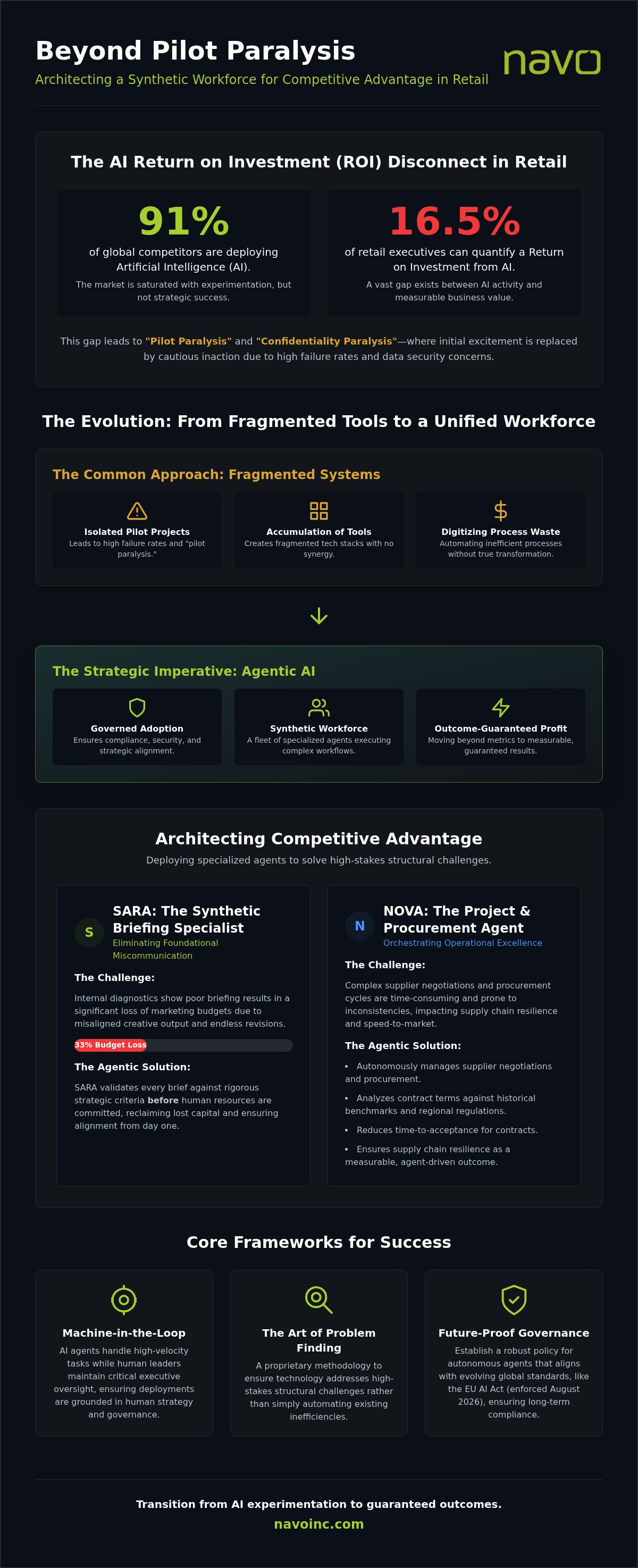
Architecting Competitive Advantage with a Synthetic Workforce
Traditional retail automation frequently focuses on task-level efficiency, yet securing a sustainable AI for competitive advantage in retail requires a transition toward a sophisticated workforce layer. This synthetic workforce operates as a fleet of specialized agents, each possessing defined roles, persistent memory, and the capacity for producing audit-ready outcomes. Deploying SARA, a Synthetic Client-Briefing Specialist, addresses the foundational friction of miscommunication by validating requirements at the point of origin. This systematic intervention eliminates the process waste that traditionally erodes enterprise value during the early stages of project initiation.
Consider the impact on marketing operations. Internal diagnostic data indicates that poor briefing often results in a 33% loss of marketing budgets due to misaligned creative output and repetitive revision cycles. A synthetic validation layer reclaims this capital by ensuring every brief meets rigorous strategic criteria before human resources are committed. This level of precision transforms Agentic Artificial Intelligence (AI) from a passive utility into a disciplined architect of profit, providing the structural stability necessary for high-stakes retail transformation.
The Role of Agentic AI in Operational Excellence
Orchestrating complex workflows requires agents capable of more than simple responses. Utilizing NOVA-style project agents allows for the seamless management of supplier negotiations and procurement cycles. These agents reduce time-to-acceptance by autonomously analyzing contract terms against historical benchmarks and regional regulatory requirements. This methodical approach ensures that supply chain resilience is a measurable outcome of agentic oversight. To explore how these frameworks can be integrated into your specific organizational structure, you may consult our strategic advisory team for a diagnostic session.
Hyper-Personalization at Global Scale
Managing individual customer journeys across diverse markets like Mumbai and Kuala Lumpur requires a "segment-of-one" strategy that transcends traditional collaborative filtering. Synthetic workers analyze real-time demand sensing data to tailor experiences at a scale impossible for human teams alone. This capability allows global retail enterprises to respect regional nuances while maintaining absolute brand integrity. It represents a shift from broad demographic targeting to a precise, data-driven understanding of individual consumer behavior in the Middle East and Asia.
The Art of Problem Finding: A Framework for Retail Transformation
The primary reason retail AI initiatives fail isn't a lack of technological capability but a failure in diagnostic precision. Many organizations apply sophisticated solutions to peripheral symptoms rather than addressing core structural inefficiencies. We advocate for "The Art of Problem Finding," a proprietary diagnostic approach designed for C-suite leaders who prioritize long-term resilience over temporary trends. This framework ensures that any investment in AI for competitive advantage in retail is rooted in a deep understanding of the organization's unique operational bottlenecks.
A 2026 Deloitte survey revealed that while 75% of retail executives consider AI a top strategic priority, only 16.5% can quantify a Return on Investment (ROI). This "quantification gap" often stems from a rush to deploy tools without a robust Corporate AI Governance Policy. In regions like the Gulf and Singapore, where data residency and cultural sensitivity are paramount, governance isn't just about compliance. It's a strategic necessity that balances aggressive innovation with rigorous risk mitigation. We align our frameworks with the National Institute of Standards and Technology (NIST) Privacy Framework to ensure global standards meet local requirements.
Diagnostic Tools for AI Readiness
Before deployment, we utilize specialized ROI calculators and readiness surveys to map the retail value chain. It's essential to distinguish between "High-Stakes" applications, such as autonomous supply chain orchestration, and "Low-Stakes" tasks like basic content generation. This distinction allows leaders in Dubai, Riyadh, and Mumbai to allocate capital where it generates the most significant systemic health and efficiency improvements.
Governance in the Agentic Era
As we move toward autonomous systems, implementing human-ownership mechanisms becomes critical. This "Machine-in-the-Loop" philosophy ensures that every action taken by a synthetic worker is traceable and aligned with executive intent. Our approach includes advanced data safeguards and anonymization protocols to protect sensitive consumer data, ensuring your strategy remains future-proof. For a deeper dive into these structures, explore Navo's Enterprise AI Governance Strategy.
Implementation Roadmap: From Strategy to Outcome-Guaranteed Profit
Moving from strategic intent to operational reality requires a disciplined, four-phase implementation roadmap. We don't view this as a simple software rollout. It's a fundamental structural shift. Phase 1, Clarify, utilizes our diagnostic frameworks to map your retail landscape and identify high-impact opportunities. Phase 2, Enable, builds leadership capability through Continuing Professional Development (CPD) UK-certified masterclasses. This ensures your executive team possesses the necessary thinking tools to manage a hybrid workforce effectively. Phase 3, Protect, embeds a robust Corporate AI Governance Policy and synthetic workforce oversight to mitigate risk. Finally, Phase 4, Evolve, scales the synthetic layer for continuous profit optimization. This methodical approach is the only way to secure a sustainable AI for competitive advantage in retail while ensuring long-term resilience.
The Six Lanes of Working for Retail Leaders
Our "Six Lanes of Working" framework allows leaders to position Generative Artificial Intelligence (GenAI) as a sophisticated co-thinking partner. You must bridge the gap between traditional management theory and synthetic workforce leadership. This shift is particularly critical for enterprises in Dubai and Singapore. The speed of market evolution in the Gulf demands a more agile, agentic approach to business strategy. We help you move away from viewing technology as a mere utility. Instead, we treat it as a core component of your organizational health and systemic stability.
Measuring What Matters: The ROI of Retail GenAI
True success isn't measured by "vanity metrics" like chat volume or the number of active bots. We focus on guaranteed net-profit increases and measurable reductions in process waste. Investing in CPD certified AI courses is the executive standard for future-proofing retail talent. It ensures your Return on Investment (ROI) is both quantifiable and sustainable. Your human capital must remain capable of directing autonomous systems toward strategic goals. We architect change that lasts.
Partner with Navo Inc. for outcome-guaranteed AI transformation
Orchestrating the Future of Retail Dominance
The transition from experimental pilots to a disciplined synthetic workforce layer is no longer a strategic option; it's a requirement for long-term survival. By adopting a "Machine-in-the-Loop" philosophy and utilizing our proprietary "Art of Problem Finding" framework, your organization can move beyond the quantification gap that currently hinders 83.5% of retail executives. This shift ensures that every technological deployment is rooted in structural excellence rather than mere industry hype.
Achieving a sustainable AI for competitive advantage in retail requires more than just sophisticated tools. It demands a fundamental transformation in leadership capability. Through our CPD UK-accredited (Continuing Professional Development) masterclasses, your team can gain the expertise needed to navigate high-stakes shifts while securing guaranteed profit or efficiency outcomes. We provide the steady, expert hand required to bridge the gap between traditional management and future technological frontiers.
The future belongs to leaders who view complexity not as a barrier but as a structured pathway to innovation. We look forward to partnering with you as you architect this new era of retail resilience and systemic health.
Strategic Intelligence: Frequently Asked Questions
How does AI for competitive advantage in retail differ from standard automation?
Securing a measurable AI for competitive advantage in retail requires moving beyond task-based execution to a layer of strategic reasoning. While standard automation follows rigid, pre-defined scripts, a synthetic workforce utilizes Agentic Artificial Intelligence (AI) to adapt to real-time market fluctuations. This orchestration allows for complex problem-solving and autonomous decision-making that traditional Robotic Process Automation (RPA) cannot achieve, transforming technology from a utility into a core strategic partner.
What are the risks of deploying autonomous AI agents in a retail environment?
The primary risks involve "confidentiality paralysis" and the potential for autonomous systems to operate outside of executive intent. Without a robust Corporate AI Governance Policy, agents may inadvertently violate data privacy standards or produce misaligned outcomes. We mitigate these risks through a "Machine-in-the-Loop" philosophy, ensuring human leaders maintain oversight of high-stakes decisions while agents handle high-velocity operational tasks with persistent memory and audit-ready precision.
How can retail leaders in the Gulf region ensure AI compliance with local regulations?
Leaders must prioritize data residency and cultural alignment within their Generative Artificial Intelligence (GenAI) frameworks to meet the standards of states like the United Arab Emirates (UAE) and Saudi Arabia. Compliance involves more than just technical security; it requires adhering to regional digital trust regulations and transparency obligations. Integrating global benchmarks, such as the European Union (EU) AI Act, provides a foundational architecture for trust in these high-growth Middle Eastern markets.
What is the expected timeline for seeing ROI from a synthetic workforce implementation?
The timeline for realizing a Return on Investment (ROI) follows a methodical four-phase roadmap: Clarify, Enable, Protect, and Evolve. While initial efficiency gains often emerge during the enablement phase, systemic profit optimization typically matures as the governance layer stabilizes and agents begin to manage complex value chain workflows. This disciplined progression ensures that improvements are sustainable and represent a permanent shift in the organization's structural health.
Can Generative AI truly guarantee a net-profit increase for large-scale retailers?
Net-profit increases are achievable when GenAI is deployed through a diagnostic, problem-first methodology rather than a tool-first approach. By utilizing "The Art of Problem Finding," retailers can identify and eliminate structural waste before automating workflows. This ensures that every deployment of a synthetic worker is tied to a specific business outcome, allowing for guaranteed efficiency improvements and a measurable impact on the enterprise's bottom line.
Disclaimer
The views and opinions expressed in this article are those of the author and do not represent any organisation, client, institution, or professional body with which he may be associated. The content is intended for general information, education, and thought leadership. Readers should seek appropriate professional advice before making legal, financial, investment, regulatory, technology, or business decisions.
The author has taken reasonable care to ensure the accuracy of the information and sources available at the time of publication. Technologies, regulations, market conditions, and industry practices may evolve, and readers are encouraged to verify current information independently. Any examples, cases, or scenarios may have been simplified, anonymised, or adapted to protect confidentiality. The author and publisher accept no liability for decisions or outcomes arising from the use of this content.
Generative AI tools may have been used to support research, structuring, or language refinement, with the final content, judgment, and editorial responsibility retained by the author.