

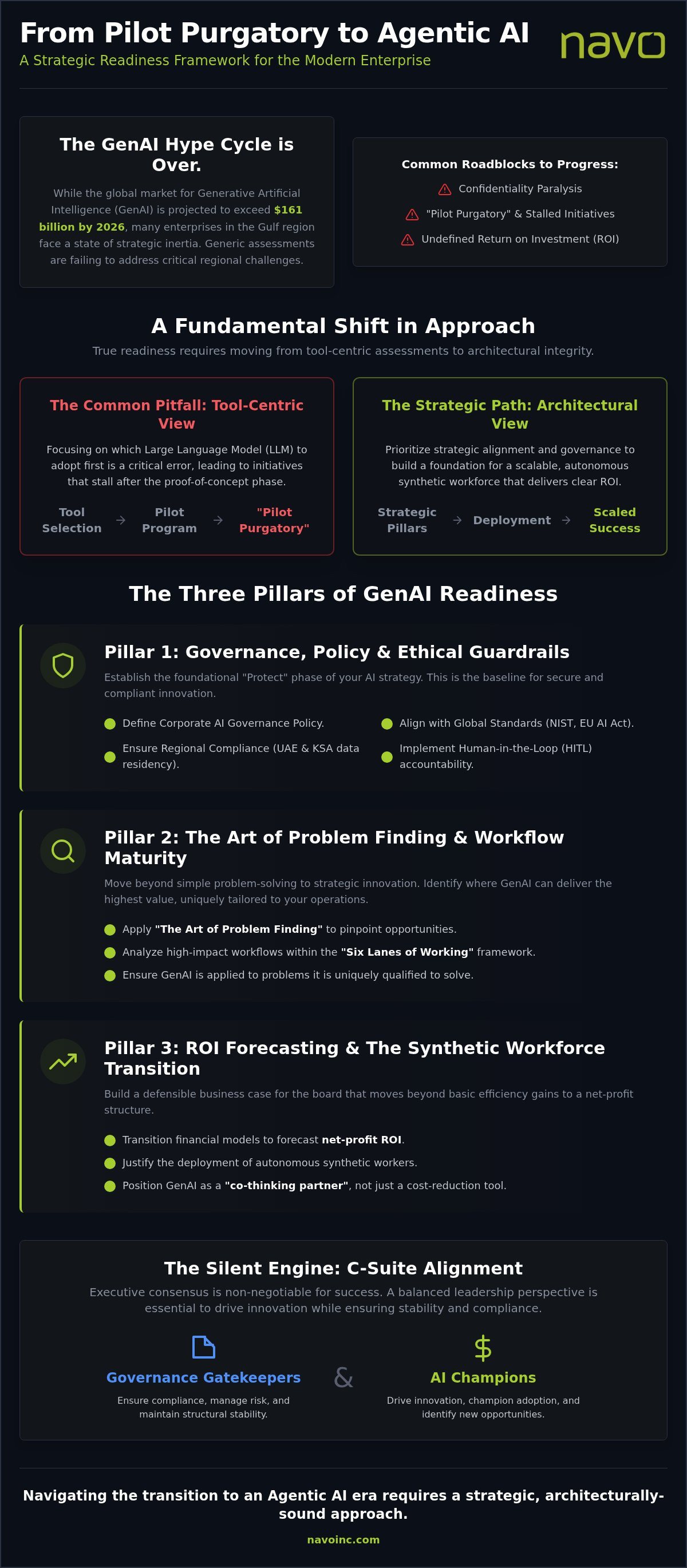
The current proliferation of Generative Artificial Intelligence (GenAI) pilot programs has reached a point of diminishing returns for the modern enterprise. While the global market for these technologies is projected to exceed 161 billion dollars in 2026, the reality for many leaders in Dubai and the broader Gulf region is a state of strategic inertia. You likely recognize that a generic generative AI readiness survey for my company is insufficient to address the complexities of confidentiality paralysis or the scarcity of specialized regional talent.
We acknowledge the difficulty of presenting a defensible Return on Investment (ROI) to a board that demands both rapid innovation and absolute structural stability. This diagnostic offers a sophisticated framework designed to move your organization beyond the initial hype cycle and into the era of Agentic AI. You'll gain a methodical roadmap for identifying governance gaps, aligning with global standards like the European Union (EU) AI Act, and preparing your infrastructure for the seamless deployment of autonomous synthetic workers.
Key Takeaways
- Shift your focus from tool adoption to strategic maturity by understanding why a comprehensive generative AI readiness survey for my company must prioritize organizational alignment over simple software procurement.
- Learn to establish robust ethical guardrails by aligning your Corporate Artificial Intelligence (AI) Governance Policy with both local Gulf state regulations and international privacy frameworks.
- Discover how "The Art of Problem Finding" allows you to identify high-impact workflows within the "Six Lanes of Working" framework, moving beyond simple problem-solving to strategic innovation.
- Transition your financial modeling from basic efficiency gains to a net-profit Return on Investment (ROI) structure that justifies the deployment of autonomous synthetic workers.
The Anatomy of a Strategic Generative AI Readiness Survey
True readiness for Generative artificial intelligence (GenAI) is rarely a question of processing power or cloud credits. It's a question of architectural integrity. Many organizations mistakenly view technical infrastructure as the primary driver of transformation; however, a sophisticated generative AI readiness survey for my company must prioritize strategic alignment over software selection. Without a clear understanding of how these systems integrate into existing value chains, technical deployment often leads to "Pilot Purgatory," where initiatives stall after the initial proof-of-concept phase.
A critical component of this diagnostic is the "Confidentiality Paralysis" metric. This measures the tension between an organization's risk appetite and its innovation drive. In the Gulf region, where data sovereignty and local regulations are evolving rapidly, this balance is delicate. A survey must identify whether your governance frameworks are robust enough to permit experimentation or if fear of data leaks is causing systemic inertia. This regional nuance is often missing from generic assessments designed for Western markets, which fails to account for the specific cultural and legal landscapes of Dubai, Singapore, or Mumbai.
The Problem with Tool-Centric Assessments
Surveying for which Large Language Model (LLM) to adopt is fundamentally the wrong starting point. Selection is a secondary concern that follows the "Clarify" stage of our proprietary Clarify-Enable-Protect-Evolve (CEPE) architecture. You first need to determine if the organization has identified high-value problems that GenAI is uniquely qualified to solve. If the diagnostic focuses solely on tools, it ignores the human and process-oriented barriers that determine long-term success. You can find more on this structural approach at Navo Inc., where we emphasize strategic clarity before technical enablement.
The Role of C-Suite Alignment
Consensus at the executive level is the silent engine of AI maturity. The survey must evaluate whether the C-suite views GenAI as a "co-thinking partner" or merely a cost-reduction tool. Identifying the distribution of "AI Champions" and "Governance Gatekeepers" is essential. While gatekeepers ensure compliance, an overabundance of them without champion-led counterweights can stifle progress. A balanced diagnostic reveals these internal dynamics, ensuring that the board is aligned on a unified vision for a synthetic workforce.
Pillar 1: Governance, Policy, and Ethical Guardrails
Establishing a Corporate Artificial Intelligence (AI) Governance Policy is the baseline of the "Protect" phase in any mature adoption strategy. While Bain's latest survey on generative AI readiness indicates that adoption is moving at a breakneck pace, many firms still lack clearly defined permitted-use boundaries. A robust generative AI readiness survey for my company must determine if employees understand which proprietary data can be safely shared with external Large Language Models (LLMs). Without these guardrails, your organization remains vulnerable to intellectual property leaks and significant regulatory non-compliance.
Data handling requires strict alignment with both the National Institute of Standards and Technology (NIST) Privacy Frameworks and local Gulf state regulations. In 2026, the United Arab Emirates (UAE) and the Kingdom of Saudi Arabia (KSA) have implemented more stringent data residency laws that demand localized processing for sensitive information. Your diagnostic should evaluate your current anonymization protocols to ensure they meet these high standards. Accountability is equally vital. We look for Human-in-the-loop (HITL) mechanisms that ensure a qualified professional remains responsible for autonomous outputs, preventing model hallucinations or data poisoning from affecting critical commercial decisions.
Regional Compliance Diagnostics
Your assessment must include specific inquiries regarding UAE and KSA data residency requirements. The transition to an "Agentic Era" requires governance that transcends simple chatbots and manages autonomous agents interacting with regional databases. Integrating a generative AI readiness survey for my company helps identify whether your current Information Technology (IT) stack can support localized hosting or federated learning models that keep data within sovereign borders.
Ethical and Bias Auditing
A sophisticated diagnostic establishes a baseline for "Responsible AI" judgment across your workforce. It's not enough for the C-suite to be aware of algorithmic bias; every employee must understand the transparency requirements of modern systems. We survey internal awareness to ensure that your future synthetic workforce operates within the ethical boundaries of your corporate culture and regional values. If you find your governance framework is lagging, you can consult with our strategists to build a resilient policy.
Pillar 2: The Art of Problem Finding and Workflow Maturity
While many organizations rush to solve problems with Generative Artificial Intelligence (GenAI), few have mastered the discipline of identifying which problems are actually worth solving. A comprehensive generative AI readiness survey for my company must move beyond the technical "how" and interrogate the strategic "why." This transition from reactive problem solving to the proactive "Art of Problem Finding" is the hallmark of a mature enterprise. By evaluating your operations through the proprietary "Six Lanes of Working" framework, you can pinpoint exactly where synthetic integration will drive the most significant net-profit increase rather than just marginal efficiency gains.
Workflow decomposition is a prerequisite for the Agentic AI era. You must determine if your existing processes are sufficiently structured for a synthetic worker to intervene successfully. The "SARA" approach provides a diagnostic lens to assess the quality of internal client-briefing and validation. If your team cannot articulate a clear, logical brief for a human colleague, they'll struggle to provide the precision required for an AI agent to execute complex tasks effectively. This lack of briefing clarity is a common roadblock in regional markets from Mumbai to Kuala Lumpur.
Identifying High-Impact Use Cases
A sophisticated diagnostic identifies "Cognitive Load" bottlenecks within your departments. We distinguish between simple task automation, which saves time, and strategic co-thinking, which expands the firm's intellectual capacity. By surveying for these specific pain points, you can avoid the trap of automating low-value tasks that contribute little to the bottom line. Strategic readiness requires an understanding of how GenAI alters the fundamental nature of departmental workflows.
Measuring "Synthetic Skills" Readiness
The transition to a synthetic workforce requires a baseline assessment of your team's current capabilities in prompting and machine-to-machine communication. Many regional leaders in Singapore and Dubai are finding that technical literacy is not enough. There is a profound need for CPD certified AI courses to bridge the gap between traditional management theory and synthetic leadership requirements.
Pillar 3: ROI Forecasting and the Synthetic Workforce Transition
The ultimate validation of any diagnostic tool is its capacity to forecast tangible financial outcomes. While many assessments focus on vague productivity metrics, a generative AI readiness survey for my company must facilitate a shift from simple "efficiency gains" to a measurable "net-profit increase." True Return on Investment (ROI) in the Generative Artificial Intelligence (GenAI) era isn't found in saving seconds on an email draft; it's found in the structural reduction of operational friction and the expansion of market reach. This requires a rigorous look at your current Information Technology (IT) stack to determine if it's capable of supporting NOVA-style project orchestration, where autonomous agents manage complex, multi-stage workflows with minimal human intervention.
Building a synthetic workforce roadmap involves a disciplined balancing act between human talent and digital agents. You aren't simply replacing headcount; you're re-architecting the very nature of work. The survey results should provide the data necessary to construct a Strategic AI Roadmap that aligns with your long-term commercial objectives. This transition ensures that your organization doesn't just adopt technology but evolves into a more resilient, AI-native entity capable of outperforming competitors in high-stakes markets like Dubai, Singapore, and Mumbai.
The Economics of AI Agents
We analyze the "Agentic Readiness" of your organization by evaluating the potential for automation in both customer-facing and back-office roles. A key metric in this diagnostic is the reduction in "time-to-acceptance" for complex projects. By deploying autonomous agents to handle the heavy lifting of data synthesis and initial drafting, your human experts can focus on high-level validation and strategic decision-making. This shift significantly lowers the cost of quality, directly impacting your bottom line.
From Diagnostic to Activation
The insights gathered from a generative AI readiness survey for my company serve as the evidentiary basis for GenAI Consulting & Coaching investments. It's the difference between a speculative pilot and a justified strategic initiative. We use these findings to transition your firm from a state of assessment into an intensive 5-week transformation journey. This methodical approach ensures that every step toward a synthetic workforce is backed by data, governed by policy, and optimized for maximum financial impact.
From Diagnostic Insight to Synthetic Excellence
The transition toward a mature synthetic workforce requires more than superficial technical curiosity. It demands a rigorous structural evolution of your entire operational architecture. We've explored how a sophisticated generative AI readiness survey for my company serves as the foundational diagnostic for this journey. You now recognize that true readiness is defined by governance integrity, the mastery of problem finding, and the ability to forecast net-profit increases through agentic orchestration.
Navo Management Consultants provides the expert hand required to navigate these high-stakes shifts. Our methodology is anchored in the insights of Vasudevan Kidambi, author of "Synth Worker," and is further validated by CPD (Continuing Professional Development) UK-certified masterclasses. We specialize in outcome-guaranteed consulting models that prioritize systemic health and sustainable profit increases for enterprises across the Gulf and broader Asian markets.
Your firm stands at the threshold of the Agentic AI era. By moving beyond technology hype and adopting a methodical framework, you'll secure your position as a visionary leader within the evolving digital landscape. It's time to transform your organizational potential into a disciplined reality of progress and resilience.
Frequently Asked Questions
What is the most critical question in a Generative AI readiness survey?
The most critical inquiry is whether your leadership has mastered "The Art of Problem Finding" to identify high-value use cases that justify the investment. It's not about the software; it's about the strategic objective. You must determine if a proposed solution addresses a genuine structural bottleneck within your "Six Lanes of Working" or if it's merely a redundant technical addition that offers no measurable net-profit increase.
How often should a company update its GenAI readiness assessment?
You should refresh a generative AI readiness survey for my company at least every six months. The velocity of the Agentic Artificial Intelligence (AI) era means that six months of technological progress can render an older assessment obsolete. Regular updates ensure your Corporate AI Governance Policy remains aligned with the latest Large Language Model (LLM) capabilities and evolving security standards across the Gulf region.
Can we conduct an AI readiness survey without a dedicated IT team?
You don't need a large internal Information Technology (IT) department to begin the assessment phase. Readiness is a management discipline that evaluates strategy, risk appetite, and process maturity rather than server capacity. Many firms use external GenAI Consulting & Coaching to establish their initial roadmap and governance guardrails before hiring specialized technical talent in regional hubs like Dubai or Singapore.
What are the specific AI governance requirements for companies in Dubai and Riyadh?
Organizations in Dubai and Riyadh must prioritize data residency and sovereign control to comply with the latest United Arab Emirates (UAE) and Kingdom of Saudi Arabia (KSA) digital sovereignty laws. Governance frameworks in these regions require explicit protocols for handling sensitive national or corporate data within localized cloud infrastructures. Your diagnostic must ensure that autonomous agents don't process protected information through unauthorized international servers.
How does a readiness survey differ from a standard IT audit?
A readiness survey is a forward-looking strategic diagnostic, whereas a standard Information Technology (IT) audit is a backward-looking compliance check. While an audit ensures existing systems meet current standards, the readiness assessment evaluates your organization's structural capacity to evolve. It focuses on the "Clarify" and "Enable" stages of the CEPE (Clarify-Enable-Protect-Evolve) architecture to prepare your workforce for the seamless integration of autonomous synthetic workers.
Disclaimer
The views and opinions expressed in this article are those of the author and do not represent any organisation, client, institution, or professional body with which he may be associated. The content is intended for general information, education, and thought leadership. Readers should seek appropriate professional advice before making legal, financial, investment, regulatory, technology, or business decisions.
The author has taken reasonable care to ensure the accuracy of the information and sources available at the time of publication. Technologies, regulations, market conditions, and industry practices may evolve, and readers are encouraged to verify current information independently. Any examples, cases, or scenarios may have been simplified, anonymised, or adapted to protect confidentiality. The author and publisher accept no liability for decisions or outcomes arising from the use of this content.
Generative AI tools may have been used to support research, structuring, or language refinement, with the final content, judgment, and editorial responsibility retained by the author.