

Why does the enterprise board continue to witness a proliferation of isolated pilot programs while the net-profit line remains largely indifferent to the purported AI revolution? Despite worldwide artificial intelligence spending projected to reach $2.59 trillion in 2026, many organizations remain trapped in a cycle of experimental stagnation where the ROI of generative AI is obscured by fragmented implementation and confidentiality paralysis. You likely recognize the frustration of managing high-value use cases that never transition from the sandbox to the balance sheet. It's a common reality where the distinction between a simple automation tool and a strategic co-thinking partner remains unquantified; this leaves leadership without a defensible narrative for capital allocation.
This article provides the analytical clarity required to move beyond the hype of previous cycles into a period of structural profitability. We'll outline a rigorous framework for transitioning from tool-based experimentation to a governed synthetic workforce that facilitates measurable gains. You'll discover a roadmap for aligning your strategy with the 2026 regulatory environment, including the transparency mandates of the European Union AI Act and relevant disclosure laws in California. We'll examine how to architect for profit in an era of collapsing model costs, ensuring your organization captures the 47% return senior executives now expect from agentic systems.
Key Takeaways
- Escape the inertia of "pilot purgatory" by shifting the primary focus from isolated tool adoption to a rigorous calculation of structural net-profit expansion.
- Establish a defensible ROI of generative AI (Return on Investment of generative Artificial Intelligence) by applying "The Art of Problem Finding" to ensure strategic investments address the correct organizational bottlenecks.
- Quantify the economic contribution of a "Synthetic Workforce Layer," positioning autonomous agents like NOVA as a strategic asset class for superior project orchestration.
- Deploy the "Six Lanes of Working" framework to systematically reclaim cognitive capacity and eliminate the technical friction hindering enterprise-wide scaling.
- Transition from confidentiality-induced paralysis to a model of governed value that ensures compliance with the complex global regulatory frameworks of 2026.
The Generative AI ROI Reality Check: Moving Beyond Pilot Purgatory
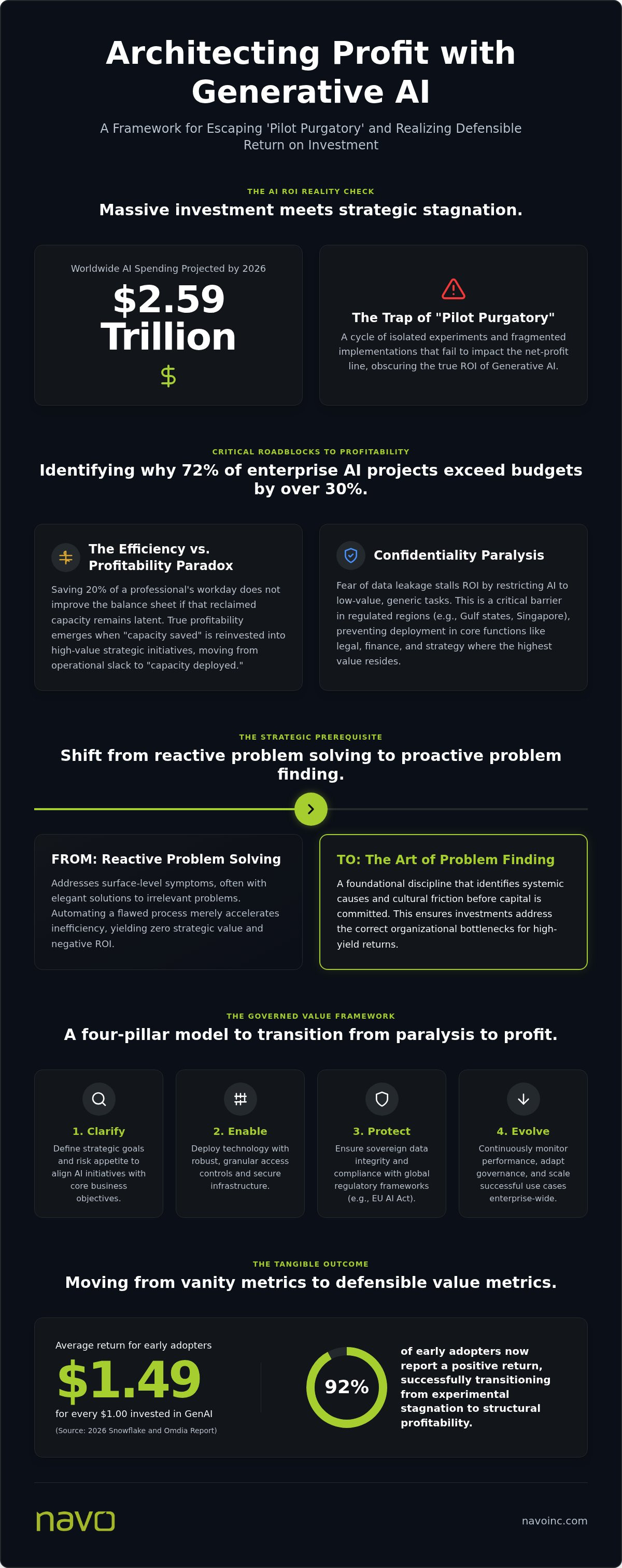
The traditional metric for success in digital transformation often relied on anecdotal efficiency gains, yet the 2026 enterprise environment demands a more clinical assessment. In this fiscal year, the ROI of generative AI (Return on Investment of generative Artificial Intelligence) is defined as the precise delta between the comprehensive costs of structural transformation and the realized expansion of net profit. While worldwide AI spending is projected to reach $2.59 trillion in 2026, a significant portion of this capital remains locked in "Pilot Purgatory." This state occurs when organizations deploy Generative artificial intelligence tools without adjusting the underlying operating model, resulting in experiments that fail to influence the bottom line.
Achieving measurable returns requires a shift from viewing AI as a simple automation tool to treating it as a sophisticated co-thinking partner. Soft ROI, characterized by nebulous time savings, serves as a poor proxy for the hard ROI required by the board. Hard ROI demands documented cost avoidance or direct revenue generation. According to the 2026 Snowflake and Omdia report, 92% of early adopters now report a positive return, with an average of $1.49 for every dollar invested. However, realizing these figures requires moving past vanity metrics, such as the number of active users or prompts generated, toward value metrics that track completed business outcomes.
The Efficiency vs. Profitability Paradox
Saving 20% of a professional's workday doesn't improve the balance sheet if that capacity remains latent or is consumed by administrative expansion. This paradox is the primary reason why 72% of enterprise AI projects exceed their original budgets by at least 30%, as noted by Deloitte in 2026. True profitability emerges when "Machine-in-the-Loop" thinking is used to reinvest reclaimed time into high-value strategic initiatives. Transitioning from "capacity saved" to "capacity deployed" is the only way to ensure that the ROI of generative AI translates into actual net-profit growth rather than hidden operational slack.
Addressing Confidentiality Paralysis
Fear of data leakage frequently stalls ROI by restricting implementations to low-value, generic tasks. This "confidentiality paralysis" is particularly prevalent in highly regulated regions like the Gulf states and Singapore, where sovereign data integrity is paramount. The economic cost of "safe but useless" AI is substantial; it prevents the deployment of agents in core functions like legal, finance, and strategy. Navo Inc. addresses this through a "governed value" framework that focuses on four pillars: Clarify, Enable, Protect, and Evolve. By establishing robust internal governance, leaders can move from paralyzed experimentation to the high-stakes use cases that drive genuine enterprise evolution.
The Art of Problem Finding: The Pre-requisite for Strategic ROI
The pursuit of technical excellence often blinds leadership to the fundamental reality that an elegant solution to an irrelevant problem yields zero value. While many competitors focus on model selection or cloud infrastructure, the most successful enterprises in 2026 prioritize a different discipline. This foundational framework, known as "The Art of Problem Finding," serves as the essential pre-requisite for any high-yield investment. It moves beyond the reactive nature of "Problem Solving," which typically addresses surface-level symptoms rather than systemic causes. If an organization automates a flawed process, it merely accelerates inefficiency; this is the primary reason why the ROI of generative AI frequently fails to materialize in traditional corporate structures.
In the Gulf states and across Asian markets, where capital allocation is increasingly scrutinized for long-term resilience, diagnostic readiness is paramount. Utilizing advanced readiness surveys allows firms to identify cultural and technical friction points before capital is committed. Central to this diagnostic phase is the "Question-Economy Protocol," a structured methodology that prioritizes the quality of inquiry over the volume of output. This protocol significantly improves brief quality and execution speed, ensuring that the strategic intent is clear from the outset. By focusing on the "what" and "why" before the "how," organizations can effectively bypass the generic implementations that plague the current market.
Identifying High-Stakes Use Cases
To avoid "Shiny Object Syndrome," leaders must adopt a rigorous scoring framework for potential AI agents. This involves evaluating each use case based on its strategic consequence and potential economic impact. By categorizing initiatives through this lens, organizations can bypass low-value experiments and focus on the structural shifts that drive net-profit expansion. You can learn more about Navo's strategic problem finding framework to see how this diagnostic rigor is applied in practice to ensure that every agentic deployment serves a defined commercial purpose.
Brief Validation and the SARA Protocol
Poorly defined briefs are a significant drain on enterprise resources, with global marketing reports indicating that up to 33% of budgets are wasted due to misaligned objectives. Navo addresses this through the SARA protocol, utilizing a proprietary synthetic client-briefing specialist to validate project parameters. SARA ensures a 95% classification accuracy before any operational work begins, acting as a critical filter for strategic clarity. This process is reinforced by a dual-approval lock, which mandates human ownership of every AI-generated strategic brief. This ensures that while the synthetic workforce drives speed, the seasoned consultant maintains final authority over the strategic direction. For leaders seeking to refine their internal briefing standards, it's beneficial to consult with our strategic advisors on establishing a governed briefing layer that maximizes the ROI of generative AI.
Quantifying the Synthetic Workforce: A New Unit of Economic Value
The conceptualization of artificial intelligence has matured beyond the simplistic view of a productivity enhancer for existing staff. In 2026, the most resilient enterprises have established a "Synthetic Workforce Layer" as a distinct, strategic asset class. This layer consists of autonomous agents capable of executing complex orchestration tasks that previously required high-level human oversight. When calculating the ROI of generative AI, leadership must transition from measuring individual tool usage to evaluating the economic output of this synthetic layer. For instance, the deployment of NOVA, a proprietary agent for workflow orchestration, allows for project management speeds that significantly outpace human-only management. This transition reduces orchestration cycles by substantial margins while maintaining the rigorous quality standards expected in high-stakes environments.
To ensure structural excellence, Navo employs a "Role Definition" protocol. This methodology subjects synthetic workers to the same performance audits and accountability standards as human employees. Such a disciplined approach is vital in high-growth economic hubs like Riyadh, Dubai, and Singapore, where the ability to scale operations rapidly without a linear increase in headcount is a competitive necessity. By treating the synthetic worker as a formal unit of economic value, organizations can move toward achieving the 47% return on investment that senior executives now expect from agentic AI solutions, according to the Snowflake and Omdia 2026 report. This shift ensures that the ROI of generative AI is rooted in systemic expansion rather than marginal gains.
Agentic AI Governance and Auditability
The realization of profit is inextricably linked to the mitigation of risk. Aligning agentic workflows with the NIST Privacy Framework and regional data regulations, such as the transparency obligations of the EU AI Act applicable from August 2026, is a non-negotiable requirement. Defensible outcomes require human-ownership mechanisms where every autonomous decision is subject to a governed audit trail. You may explore Navo's Corporate AI Governance Advisory to understand how to build these protective layers into your synthetic workforce architecture, ensuring compliance with local laws in the Gulf and beyond.
Measuring the Co-Thinking Partner Value
True value isn't found in the volume of emails generated but in the elevation of decision quality. A synthetic co-thinking partner enhances organizational resilience by providing a calm, analytical perspective on complex shifts. This systemic health is a critical component of value that traditional accounting often misses. For a deeper analysis of how these autonomous systems contribute to enterprise stability, refer to our Synthetic Workforce Development: The 2026 Executive Guide. Moving from "faster" to "better" is the hallmark of a mature AI strategy.
How to Realize ROI Across the Six Lanes of Working
The transition from fragmented experimentation to a disciplined operational cadence necessitates a rigorous, five-step methodology. This structured pathway is designed to optimize the ROI of generative AI (Return on Investment of generative Artificial Intelligence) by aligning technological capability with human strategic intent. The process begins with Step 1: Diagnostic Readiness. By deploying sophisticated surveys, leadership can identify the underlying cultural and technical friction points that often derail large-scale implementations. Step 2 follows with Capacity Reclaim, where autonomous agents assume responsibility for repetitive cognitive tasks, such as data synthesis and preliminary reporting. Once this cognitive load is transferred, Step 3 focuses on Strategic Re-investment. This involves the deliberate redeployment of human capital into high-stakes creative and strategic roles that machine intelligence cannot yet replicate.
Step 4, Governance Integration, establishes the necessary permitted-use boundaries and accountability protocols to ensure safe scaling within the organization. The cycle concludes with Step 5: Continuous Evolution. Utilizing a Continuing Professional Development (CPD) UK-certified model ensures that the workforce's skills remain aligned with technological progress for at least a 24-month horizon. This methodical approach ensures that the ROI of generative AI is not a one-time gain but a sustainable driver of enterprise profitability and systemic health.
The Six Lanes of Working Framework
The "Six Lanes of Working" provides a multi-dimensional perspective on how artificial intelligence integrates into core business strategy compared to support functions. This framework is particularly effective in high-growth markets where sectors like Banking, Financial Services, and Insurance (BFSI), Healthcare, and Retail are undergoing rapid modernization. By categorizing work into these distinct lanes, leadership can allocate resources with clinical precision, ensuring that synthetic workers are deployed where they generate the highest marginal utility. For a comprehensive analysis of this structural shift, consult our guide on Scaling Generative AI in Enterprise: The 2026 Shift.
Real-world ROI Benchmarks in 2026
Empirical evidence from the 2026 fiscal year demonstrates the efficacy of these structured pathways. Case study highlights from the Middle East indicate that organizations are successfully reclaiming substantial marketing budgets while reducing the time-to-acceptance for complex projects by 50%. The financial impact of Continuing Professional Development (CPD) accredited training is also evident in the accelerated pace of executive decision-making. The "Question-Economy Protocol" is a structured inquiry methodology that prioritizes high-quality briefing to achieve 70% knowledge-base hit rates. This protocol minimizes the iterative waste typically associated with poorly framed prompts, thereby directly enhancing the profitability of agentic deployments.
Architecting for Profit: Navo’s Outcome-Guaranteed Transformation
Navo Inc. operates at the intersection of traditional management theory and the vanguard of digital evolution. Unlike vendors primarily focused on hardware sales or cloud consumption, we act as a tool-agnostic partner for executive leaders who demand structural excellence. Our focus remains squarely on the net-profit expansion that defines a successful ROI of generative AI (Return on Investment of generative Artificial Intelligence). Through a disciplined, framework-led approach, we guide organizations through the complexities of the agentic era, ensuring that technology serves as a catalyst for systemic health rather than a source of operational noise.
The Navo Masterclass represents our flagship engagement, a five-week journey specifically engineered to transition enterprises from confidentiality paralysis to a state of governed value. This intensive program addresses the governance gaps and technical friction points identified earlier in this framework. It culminates in a resilient architecture where synthetic workers and human talent operate in a synchronized, high-performance layer. Central to our value proposition is the "Guaranteed Profit Increase" model, a definitive commitment that aligns our consulting success directly with your organization's bottom-line performance.
Beyond Consulting: A Partnership for the Agentic Era
The complexity of 2026 requires more than a standard vendor-client relationship; it demands a peer-to-peer executive partnership. Navo facilitates this through strategic coaching that helps leaders define new "Synthetic Skills" benchmarks for their talent pool. These benchmarks ensure that your workforce is prepared to manage the orchestration tasks performed by agents like NOVA and SARA. You can Consult with Vasudevan Kidambi on GenAI Leadership to explore how these high-stakes shifts can be managed with professional composure and analytical rigor.
Securing Your Organization's Future
Inaction in a synthetic-first world carries a heavy price. Organizations that fail to architect for profit today face rapid market erosion and the flight of top-tier talent to more technologically advanced competitors. The 2026 regulatory environment, including the European Union Artificial Intelligence Act and relevant disclosure mandates in the Gulf and Asian markets, leaves no room for unmanaged experimentation. Establishing a governed, profitable artificial intelligence strategy is the only way to ensure long-term resilience and a measurable ROI of generative AI.
Schedule your GenAI ROI Diagnostic with Navo Inc.
Securing the Strategic Advantage of a Governed Synthetic Workforce
The 2026 fiscal year marks the definitive end of the experimental era for artificial intelligence. Leaders must now prioritize structural net-profit expansion over the vanity metrics of isolated pilot programs that fail to move the needle. By integrating proprietary SARA and NOVA agentic frameworks into a disciplined "Six Lanes of Working" model, your organization can move beyond superficial automation. This shift ensures the ROI of generative AI is calculated through the lens of capital realized rather than mere hours saved.
Structural excellence requires more than just technical deployment; it demands the intellectual rigor of CPD UK-certified masterclasses and an unwavering commitment to guaranteed net-profit outcomes. Navo Inc. provides the visionary guidance and diagnostic tools necessary to navigate these shifts across the Gulf and Asian markets with professional composure. It's time to transition from a tool-based approach to a strategic synthetic workforce architecture that supports long-term systemic health.
We invite you to join the vanguard of enterprises defining the next era of structural profitability and resilient growth.
Frequently Asked Questions
What is the primary difference between productivity ROI and profit ROI in Generative AI?
Productivity Return on Investment (ROI) tracks the reduction in task duration, while Profit ROI measures the actual expansion of the bottom line. Most firms fail to realize value because they treat time saved as a vanity metric rather than a resource for strategic reinvestment; true profit ROI requires a structural shift to ensure that reclaimed capacity translates into hard currency or cost avoidance.
How does the 'Art of Problem Finding' framework impact the overall cost of AI implementation?
"The Art of Problem Finding" framework lowers implementation costs by preventing capital allocation toward irrelevant problems. This diagnostic approach helps organizations avoid the 33% budget waste typically caused by poor strategic alignment. By focusing on the correct business bottleneck first, you ensure that every dollar spent contributes directly to a measurable ROI of generative AI (Return on Investment of generative Artificial Intelligence).
Can Navo guarantee a net-profit increase for my organization?
Navo Inc. provides an outcome-guaranteed consulting model that links our strategic partnership directly to your organization's net-profit increase. We move beyond traditional service models to act as a disciplined architect of your enterprise's financial health. This approach gives C-suite leaders the certainty that their Artificial Intelligence (AI) investment will result in defensible, board-level financial gains.
How do synthetic workers like SARA and NOVA integrate into existing human teams?
Synthetic workers like SARA and NOVA integrate as a distinct orchestration layer that supports human teams; SARA handles strategic brief validation with 95% accuracy to ensure project clarity from the outset. NOVA manages workflow coordination, which allows human leaders to move away from administrative oversight and focus on high-stakes strategic decisions that drive enterprise value.
What are the regulatory requirements for GenAI ROI reporting in the UAE and Gulf states?
Regulatory requirements in the United Arab Emirates (UAE) and Gulf states center on data sovereignty and the transparency of autonomous systems. While specific ROI reporting isn't a legal mandate, implementations must align with the UAE National Strategy for Artificial Intelligence (AI) 2031. Organizations must maintain robust governance to protect data integrity while meeting the transparency standards expected by regional regulators.
How long does it take to see a measurable return on investment from a GenAI masterclass?
Measurable returns typically emerge within 60 to 90 days after the completion of a Navo masterclass. The program's five-week structure is specifically designed to transition teams from "confidentiality paralysis" to governed, operational action. By the end of the first post-training fiscal quarter, reclaimed capacity and enhanced decision speed provide a documented ROI of generative AI (Return on Investment of generative Artificial Intelligence).
Why is CPD UK accreditation important for Generative AI training ROI?
Continuing Professional Development (CPD) UK accreditation is important because it ensures your training investment meets international standards for professional rigor. In high-growth hubs like Singapore and Dubai, this certification guarantees that the skills acquired will remain relevant for at least 24 months. It provides a structured pathway for evolving your workforce from basic tool users into sophisticated co-thinking partners.
How do I calculate the cost of 'Confidentiality Paralysis' in my business?
You calculate the cost of "Confidentiality Paralysis" by quantifying the lost opportunity value of core business functions that remain unoptimized. When fear restricts Artificial Intelligence (AI) to low-value, generic tasks, the organization pays for the technology without capturing the high-stakes returns of proprietary use cases. This delta represents a significant hidden cost that stalls enterprise-wide profitability and long-term resilience.
Disclaimer
The views and opinions expressed in this article are those of the author and do not represent any organisation, client, institution, or professional body with which he may be associated. The content is intended for general information, education, and thought leadership. Readers should seek appropriate professional advice before making legal, financial, investment, regulatory, technology, or business decisions.
The author has taken reasonable care to ensure the accuracy of the information and sources available at the time of publication. Technologies, regulations, market conditions, and industry practices may evolve, and readers are encouraged to verify current information independently. Any examples, cases, or scenarios may have been simplified, anonymised, or adapted to protect confidentiality. The author and publisher accept no liability for decisions or outcomes arising from the use of this content.
Generative AI tools may have been used to support research, structuring, or language refinement, with the final content, judgment, and editorial responsibility retained by the author.