

His published works include One Page Communicator, The Art of Problem Finding, The Prompting Playbook, Corporate Conundrums & Confusions, Build Your Own AI Garage, The ESG Mindset, What Is Your &?, Synth Worker, and From Lines to Loops. Together, these books explore communication, critical thinking, leadership, business transformation, sustainability, Generative AI, Agentic AI, and the changing relationship between people, work, and intelligent machines.
His writing draws on more than three decades of corporate and consulting experience across India, the Middle East, Africa, and international markets. He combines real-world business insight with structured thinking, human judgment, and a strong emphasis on practical implementation.
Vasudevan is widely recognised for simplifying complex subjects while preserving their depth. Through his books, articles, masterclasses, and original frameworks, he encourages readers to challenge assumptions, identify the real problem, communicate with clarity, and use emerging technologies with confidence, responsibility, and purpose.
While 76% of organizations have formally integrated a leader into the C-suite as of 2026, the distance between establishing the role and realizing measurable net profit remains a formidable challenge for most global enterprises. The evolution of chief AI officer responsibilities has shifted decisively from speculative strategy toward the rigorous architectural design of a synthetic workforce that delivers definitive bottom-line results. You've likely navigated the friction of fragmented pilot projects while regulators in Dubai and Singapore introduce increasingly sophisticated oversight frameworks that demand transparency and systemic resilience.
This reference provides you with a clear roadmap to transcend the hype, offering a disciplined governance structure that satisfies both internal stakeholders and the Virtual Assets Regulatory Authority. We'll examine the transition from reactive management to the Art of Problem Finding. You'll discover how the orchestration of synthetic workers like SARA and NOVA can finally scale your operations across the Middle East and Southeast Asia, ensuring your organization masters the strategic and operational mandates required to lead in a high-performance, agentic economy.
Key Takeaways
- Learn to apply the proprietary Art of Problem Finding framework to identify the diagnostic gaps that prevent Artificial Intelligence from delivering measurable net profit.
- Master the evolving chief AI officer responsibilities by transitioning from a technical oversight role to becoming a strategic architect of a high-performance synthetic workforce.
- Understand the operational protocols required to integrate specialized synthetic workers like SARA and NOVA into complex enterprise workflows for enhanced production orchestration.
- Establish robust governance structures that satisfy the rigorous compliance standards of the Virtual Assets Regulatory Authority and other regional bodies across the Middle East and Southeast Asia.
- Develop a sustainable talent roadmap utilizing Continuing Professional Development United Kingdom certified masterclasses to bridge the skills gap between human leadership and agentic systems.
Strategic Architecture and the Art of Problem Finding
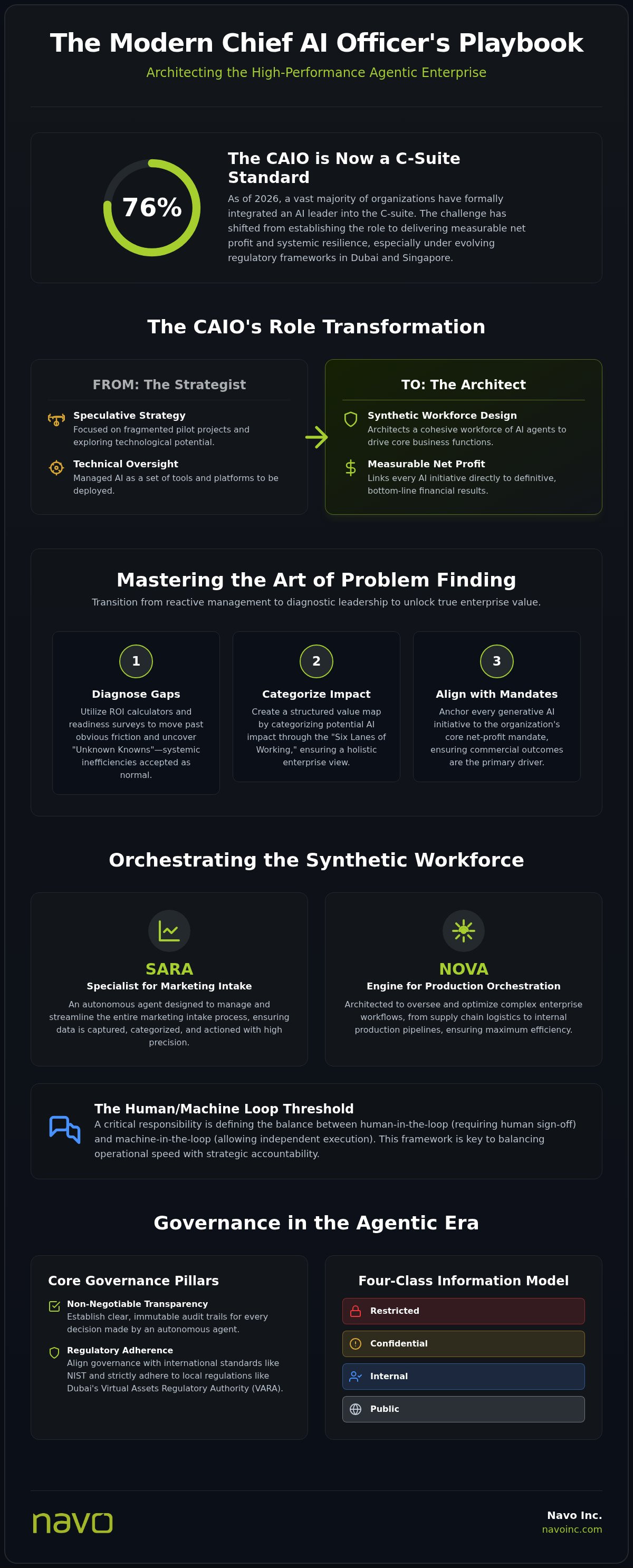
The evolution of the Chief AI Officer (CAIO) role has moved beyond the novelty of pilot projects. With 76% of organizations now employing this executive as of 2026, the focus has pivoted toward Strategic Consequence. This isn't about simple technology adoption; it's about diagnostic leadership. A primary pillar of chief AI officer responsibilities involves mastering the Art of Problem Finding. This framework requires leaders to look past obvious operational friction to uncover Unknown Knowns, those systemic inefficiencies that are often accepted as "just how things work" but drain enterprise value.
From Tool Deployment to Problem Discovery
Technical hype often masks a lack of business relevance. You can't solve a business problem you haven't properly diagnosed. Successful CAIOs prioritize commercial outcomes by using rigorous diagnostic tools like ROI calculators and readiness surveys. These aren't just administrative checklists. They're strategic anchors that ensure every generative AI initiative aligns with the organization's net-profit mandate, a core component of modern chief AI officer responsibilities. By categorizing impact through the Six Lanes of Working, the CAIO creates a structured map of where intelligence can drive the most significant value across the enterprise.
Defining the Strategic Co-Thinking Partner
Moving beyond static dashboards, the CAIO positions machine intelligence as a strategic co-thinking partner. This shift requires a tool-agnostic approach. It doesn't matter which large language model you use if the underlying commercial logic is flawed. By integrating agentic systems into the core operating model, the CAIO ensures that AI isn't an "add-on" but a foundational element of systemic health. This involves architecting a framework where human intuition and synthetic precision work in a continuous feedback loop, grounded in the legal and cultural sensitivities of markets from Dubai to Singapore. You're not just deploying software; you're redesigning the cognitive capacity of your entire organization.
Orchestrating the Synthetic Workforce and Agentic Governance
Managing a modern enterprise requires a new layer of leadership. The corporate Chief AI Officer isn't just supervising human teams anymore. They're architecting a synthetic workforce. This involves defining specific roles for autonomous agents, such as SARA for marketing intake or NOVA for production orchestration. It's about creating feedback loops where machine output is refined by human insight.
One of the most critical chief AI officer responsibilities is determining the threshold between human-in-the-loop and machine-in-the-loop operations. You have to decide where a human must sign off and where the machine can execute independently. It's a high-stakes balancing act between speed and accountability. Without a clear framework, autonomous agents can quickly become a liability rather than an asset.
Synthetic Worker Lifecycle Management
Effective agents need more than just a prompt. They require defined memory, specialized toolsets, and clear business outcomes. The CAIO oversees the entire lifecycle, from design to deployment. Transparency is non-negotiable. You must establish audit trails for every agentic decision. This ensures that when a synthetic worker like NOVA optimizes a supply chain, the logic remains visible to human auditors.
Governance in the Agentic Era
Governance must evolve to handle agentic autonomy. We recommend a four-class information model, ranging from Public to Restricted, to manage data desensitization. This protects your intellectual property while allowing agents to function. Your Corporate AI Governance Policy must align with international standards like NIST while strictly adhering to local regulations, such as the Virtual Assets Regulatory Authority requirements in Dubai. If your current framework lacks this level of precision, it's worth reviewing your governance strategy with a specialist to ensure long-term resilience.
Driving Measurable ROI and Enterprise Transformation in 2026
The final frontier for executive leadership in 2026 is the bridge between technological potential and realized capital. A defining aspect of chief AI officer responsibilities is the absolute mandate for net-profit guarantees. Organizations are no longer satisfied with vague efficiency gains that fail to appear on the balance sheet. You're now expected to orchestrate a synthetic workforce that directly impacts revenue through disciplined, diagnostic leadership.
Quantifying the Impact of Generative Artificial Intelligence
Moving beyond pilot projects requires a decisive shift toward commercial evidence discipline. Vanity metrics such as time saved or chat volume are insufficient for a high-performance executive reference. The Chief Artificial Intelligence Officer is personally responsible for ensuring that every agentic deployment translates into a verifiable, bottom-line increase in net profit.
Building Capability through Certified Coaching
Enterprise transformation isn't just about software; it's about the cognitive evolution of your leadership team. The CAIO acts as a primary educator, facilitating five-week transformation journeys that turn traditional managers into synthetic workforce architects. This involves deploying a CPD (UK) Certified Course to standardize skills across the entire organization. By utilizing these accredited masterclasses, you ensure that your human talent can effectively lead the agents they supervise, creating a unified and resilient operational model.
Regional leadership adds another layer of complexity to these chief AI officer responsibilities. Navigating the legal sensitivities of the Dubai Virtual Assets Regulatory Authority or the innovation mandates in Singapore requires a nuanced, diagnostic approach. Top-tier CAIOs utilize proprietary frameworks to outpace the generic models offered by legacy Big 4 consulting firms. This disciplined methodology ensures that your AI strategy is resilient, compliant, and commercially grounded in the specific realities of the Middle East and Southeast Asia. You're not just managing a department; you're safeguarding the future systemic health of the entire organization.
Architecting the Future of Agentic Leadership
The transition from speculative AI pilots to a high-performance synthetic workforce requires a fundamental shift in executive perspective. You've seen how the Art of Problem Finding serves as the diagnostic foundation for every commercially grounded initiative. By integrating specialized agents like SARA and NOVA, your organization can move beyond fragmented experimentation into a realm of systemic efficiency and architectural excellence. Mastering chief AI officer responsibilities in 2026 demands this level of intellectual rigor, where governance and innovation coexist to satisfy both regional regulators and the net-profit mandate.
Navo Inc. provides the steady hand needed to navigate these complex organizational shifts. We offer outcome-guaranteed strategy consulting and Continuing Professional Development United Kingdom certified masterclasses to ensure your leadership team is equipped for this new era. Our proprietary Synthetic Worker Architecture is designed to deliver resilient results in the Gulf states, Singapore, and India, outpacing traditional legacy consulting models. It's time to anchor your technological progress in structural excellence.
The path to agentic maturity is complex, but with a disciplined roadmap, your enterprise can achieve unprecedented strategic consequence and sustained commercial growth.
Frequently Asked Questions
What is the difference between a Chief Technology Officer and a Chief Artificial Intelligence Officer?
The Chief Technology Officer typically manages the foundational technology infrastructure and hardware, whereas the Chief Artificial Intelligence Officer focuses on the strategic orchestration of intelligence to drive business value. While the Chief Technology Officer ensures the systems are operational, the Chief Artificial Intelligence Officer is responsible for the cognitive architecture and the integration of synthetic workers into enterprise workflows. This distinction is critical for maintaining systemic health without overextending the technical team.
How does the Chief Artificial Intelligence Officer manage AI ethics and regional compliance in the Middle East?
Managing ethics in the Middle East requires a diagnostic alignment with local regulatory bodies such as the Virtual Assets Regulatory Authority in Dubai. The Chief Artificial Intelligence Officer utilizes a Corporate AI Governance Policy to balance innovation with regional legal sensitivities and cultural norms. This ensures that agentic systems remain compliant with local data sovereignty laws while pushing the boundaries of technological progress. It's about building trust through transparency and rigorous oversight.
What are the primary KPIs for a Chief Artificial Intelligence Officer in 2026?
The primary Key Performance Indicators for 2026 center on measurable net profit increases and the successful orchestration of the synthetic workforce. Success is no longer measured by pilot volume but by the commercial consequence of agentic deployments. Additionally, the Chief Artificial Intelligence Officer is evaluated on talent transformation, specifically the percentage of leadership that has completed Continuing Professional Development United Kingdom certified masterclasses. These metrics anchor chief AI officer responsibilities in hard financial and operational reality.
Can a Chief Artificial Intelligence Officer effectively manage a synthetic workforce without a technical background?
A technical background is not a prerequisite for effectiveness if the leader masters the Art of Problem Finding and strategic architecture. Many successful executives in this role come from business transformation or data science backgrounds. They succeed by focusing on diagnostic leadership and commercial outcomes rather than code. By utilizing proprietary frameworks and specialized coaching, a non-technical leader can effectively manage chief AI officer responsibilities and oversee complex agentic systems like SARA and NOVA.
Generative AI tools may have been used to support research, structuring, or language refinement, with the final content, judgment, and editorial responsibility retained by the author.*
Disclaimer
The views and opinions expressed in this article are those of the author and do not represent any organisation, client, institution, or professional body with which he may be associated. The content is intended for general information, education, and thought leadership. Readers should seek appropriate professional advice before making legal, financial, investment, regulatory, technology, or business decisions.
The author has taken reasonable care to ensure the accuracy of the information and sources available at the time of publication. Technologies, regulations, market conditions, and industry practices may evolve, and readers are encouraged to verify current information independently. Any examples, cases, or scenarios may have been simplified, anonymised, or adapted to protect confidentiality. The author and publisher accept no liability for decisions or outcomes arising from the use of this content.
Generative AI tools may have been used to support research, structuring, or language refinement, with the final content, judgment, and editorial responsibility retained by the author.