

What if your most valuable proprietary data isn't just powering your internal systems, but is silently training a competitor's next model through a public Large Language Model? As leadership teams across Riyadh, Dubai, and Singapore accelerate their digital roadmaps, data privacy concerns with enterprise GenAI have shifted from a peripheral IT hurdle to a central boardroom risk. It's clear that the efficiency gains of Large Language Models are undeniable, yet the lack of transparency in how autonomous agents handle confidential information remains a significant source of organizational anxiety.
You've likely felt the tension between the need for rapid innovation and the rigid mandates of the Saudi Personal Data Protection Law (PDPL) or the UAE Data Office regulations. This article provides an intellectually rigorous examination of these privacy risks; it introduces the proprietary governance frameworks required to transform data vulnerability into a managed strategic asset. We'll preview a roadmap for safe adoption, exploring how the Navo Classification Framework and Desensitisation Toolkit allow for the secure deployment of synthetic workers like SARA and NOVA. By the end of this analysis, you'll possess a clear path to leverage confidential data for a distinct competitive advantage without compromising on compliance or structural excellence.
Key Takeaways
- Shift from perimeter-based security to a governance-first model that addresses the collapse of the expertise barrier and accidental data leakage in the 2026 landscape.
- Mitigate data privacy concerns with enterprise GenAI by adopting the Navo Inc. Four-Class Information Model to distinguish between internal assets and restricted proprietary data.
- Apply the "Art of Problem Finding" to identify "Unknown Knowns" within your organization, transforming hidden data vulnerabilities into managed strategic assets.
- Establish rigorous governance for synthetic workers like SARA and NOVA, ensuring every autonomous decision is backed by human-ownership and a clear audit trail.
- Ensure seamless compliance with evolving regional regulations, including the Saudi Personal Data Protection Law (PDPL) and India’s Digital Personal Data Protection Act (DPDPA).
The Evolution of Data Privacy Concerns in Enterprise Generative Artificial Intelligence
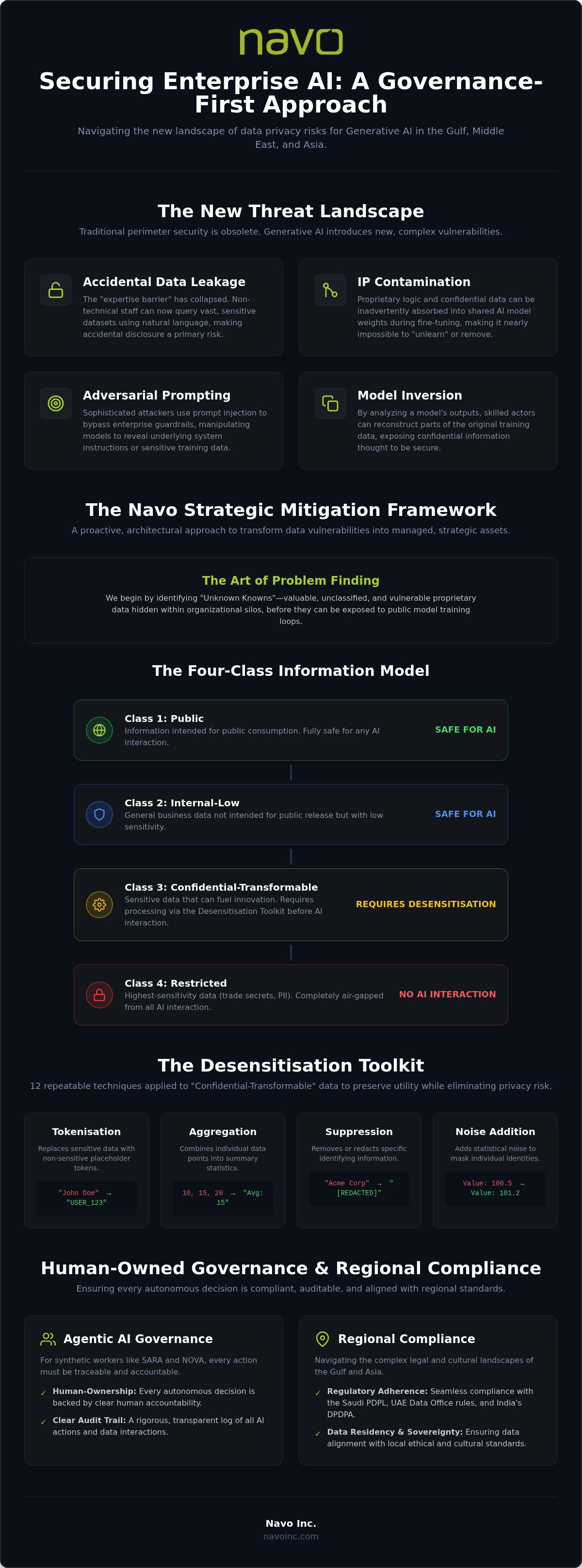
Traditional perimeter security was designed for a world where data stayed within structured databases. By 2026, it's clear that Generative artificial intelligence has effectively dissolved those walls. The primary challenge isn't just external hackers; it's the internal democratization of data access. When non-technical staff can interact with vast datasets using natural language, the "expertise barrier" that once protected sensitive intellectual property vanishes. This shift has amplified data privacy concerns with enterprise GenAI, as accidental leakage becomes a function of curiosity rather than malice.
We're also witnessing the rise of Intellectual Property contamination. This occurs when proprietary logic is inadvertently encoded into shared model weights during fine-tuning or interaction. Once that logic is absorbed, it's nearly impossible to "unlearn." For firms operating in Riyadh or Dubai, this isn't just a technical risk; it's a legal one. The Saudi Personal Data Protection Law (PDPL) and the UAE Data Office mandates require strict data residency and sovereignty. You can't simply send sensitive data to a server in a different jurisdiction and expect to remain compliant.
Beyond Data Leakage: The Risk of Prompt Injection and Model Inversion
Adversarial prompting has evolved into a sophisticated discipline. Attackers now use prompt injection to bypass enterprise guardrails, forcing models to reveal their underlying system instructions or sensitive internal training data. There's also the phenomenon of model inversion. In these scenarios, sophisticated actors reconstruct parts of the original training set by analyzing the model's outputs. These aren't theoretical risks; they're active threats that demand a governance framework far more robust than a standard firewall. Addressing data privacy concerns with enterprise GenAI requires a deep understanding of these technical vulnerabilities.
The Cultural and Legal Sensitivities of the Gulf and Asia
Sovereign AI is the new standard in the Gulf and across Asia. In Singapore, Malaysia, and the Middle East, there's a growing insistence on data residency to ensure alignment with local ethical standards. Governance must respect religious and cultural sensitivities, ensuring that AI agents don't just follow the letter of the law, but also reflect the values of the societies they serve. A steady, expert hand is needed to navigate these nuanced regional dynamics, ensuring that innovation doesn't come at the cost of cultural or legal integrity.
The Navo Strategic Mitigation Framework: Transforming Vulnerability into Discipline
Solving data privacy concerns with enterprise GenAI requires a shift from reactive patching to proactive architectural design. At Navo Inc., we apply "The Art of Problem Finding" to uncover "Unknown Knowns" within your organization. These are the deep pools of proprietary data that exist in silos, often unclassified and vulnerable to being sucked into public model training loops. By identifying these assets first, we move beyond simple technical fixes toward a fundamental governance discipline.
Our approach centers on a Four-Class Information Model. This framework categorizes data into Public, Internal-Low, Confidential-Transformable, and Restricted tiers. While Restricted data remains completely air-gapped from Artificial Intelligence interaction, the other tiers are managed through a proprietary Desensitisation Toolkit. This toolkit utilizes twelve repeatable techniques, such as tokenisation and aggregation, to ensure that the utility of the data remains intact while the privacy risk is eliminated. To justify the investment in this high-grade infrastructure, we employ precise ROI calculators that weigh the cost of governance against the catastrophic legal and reputational penalties prevalent in the Gulf and Asian markets.
The Classification Framework & Desensitisation Toolkit
The "Confidential-Transformable" class is the engine room of enterprise innovation. It allows you to safely use sensitive data for model fine-tuning by applying suppression and noise addition. These techniques mask individual identities while preserving the statistical patterns your models need to learn. By avoiding common data protection pitfalls, you can build custom models that are both highly intelligent and fully compliant with local residency laws.
Building a Human-in-the-Loop Governance Culture
Software alone won't secure your perimeter. True resilience requires a Corporate AI Governance Policy that defines "permitted-use" boundaries for every department, from Human Resources to finance. This is why we emphasize the necessity of Continuing Professional Development (CPD) United Kingdom-certified leadership training through the Navo Inc. Masterclass. When your executive team understands the "why" behind the guardrails, compliance becomes a strategic advantage rather than a bureaucratic hurdle. If you're ready to move from anxiety to authority, it's time to consult with our strategic advisors.
Agentic Artificial Intelligence Governance: Securing the Synthetic Workforce
The transition from passive chat interfaces to autonomous agents marks the beginning of the "Agentic Era." This shift introduces a new layer of complexity to data privacy concerns with enterprise GenAI, as these synthetic workers move beyond answering prompts to executing multi-step business processes. Unlike standard Large Language Models, agents like SARA and NOVA require deep access to internal systems to be effective. Without a rigorous governance structure, this level of autonomy could lead to unintended data overreach or the exposure of restricted proprietary logic.
To mitigate these risks, we implement the "Six Lanes of Working" framework. This model integrates Artificial Intelligence agents as co-thinking partners while maintaining strict boundaries. Every decision made by a synthetic worker must be auditable and tied to a human-ownership mechanism. This ensures that even as processes become automated, accountability remains with the leadership team. Transparency isn't just a compliance requirement in Dubai or Singapore; it's a structural necessity for maintaining organizational health and ensuring that autonomous actions don't bypass established privacy guardrails.
Synthetic Worker Architecture and Data Safeguards
Our architecture for SARA, who handles Marketing Intake, and NOVA, who manages Production, relies on restricted data environments. These agents operate within predefined approval gates. For instance, before an agent can finalize a procurement order or a marketing campaign, it must pass through a human feedback loop. These safeguards ensure that synthetic workers remain within their permitted-use boundaries, protecting the enterprise from accidental data leaks or unauthorized actions that could compromise sensitive intellectual property.
Next Steps for Executive Leadership
Moving from an experimental pilot to a profitable enterprise deployment requires more than just technical skill; it demands a visionary strategy. When Artificial Intelligence integration is governed correctly, it leads to guaranteed net-profit increases by optimizing high-stakes decision-making and reducing operational friction. To deepen your understanding of this transition, explore The Executive Guide to Generative Artificial Intelligence Consulting Services. For those requiring high-stakes strategic coaching to navigate these complex shifts, engaging directly with Vasudevan Kidambi provides the seasoned expertise necessary for battle-tested leadership.
Architecting a Secure Future for Autonomous Innovation
The evolution of data privacy concerns with enterprise GenAI from a technical checklist to a fundamental board-level discipline is now complete. As we've navigated the complexities of the 2026 landscape, it's evident that the transition from passive tools to autonomous agents requires a steady, expert hand. Success hinges on your ability to implement a rigorous governance framework that respects regional mandates while fostering radical innovation.
By integrating the Art of Problem Finding with our proprietary Classification Framework, your organization can move beyond fear and toward structural excellence. This isn't just about avoiding penalties under the Saudi Personal Data Protection Law (PDPL) or Singapore’s regulations; it's about converting your proprietary data into a secure engine for growth. The frameworks established today will define the market leaders of the next decade.
Your journey toward a managed, synthetic workforce begins with a single strategic decision. We're here to ensure that every step you take is battle-tested, compliant, and designed for maximum competitive advantage.
Frequently Asked Questions
What are the primary data privacy risks when using Generative Artificial Intelligence in a corporate setting?
The most critical risks involve intellectual property contamination and the accidental exposure of sensitive data through democratized access. When employees interact with public Large Language Models, proprietary logic can be absorbed into shared model weights, making it impossible to retrieve or delete. These data privacy concerns with enterprise GenAI are amplified by a lack of transparency in how third-party vendors utilize input data for future model training.
How does the Saudi Personal Data Protection Law (PDPL) affect AI deployment in Riyadh?
The Saudi Personal Data Protection Law (PDPL) mandates strict data residency, requiring that the personal information of citizens remains within the Kingdom unless specific regulatory exemptions are met. For organizations in Riyadh, this means Artificial Intelligence (AI) infrastructure must prioritize local hosting and sovereignty. Deploying models without ensuring compliance with these data residency requirements can result in significant legal penalties and reputational damage.
Can we use our confidential customer data to train or fine-tune a private Large Language Model safely?
Yes, you can safely utilize confidential data by applying a proprietary Classification Framework and Desensitisation Toolkit. This process involves stripping away individual identifiers through techniques like tokenization or aggregation before the data ever reaches the model. By transforming sensitive information into a "Confidential-Transformable" state, you address data privacy concerns with enterprise GenAI while still benefiting from the high performance of a customized model.
What is the difference between data leakage and prompt injection in an enterprise context?
Data leakage is typically an accidental exposure where a model reveals sensitive training information during a standard interaction. In contrast, prompt injection is a deliberate adversarial attack where a user manipulates the model's input to bypass security guardrails. While leakage is often a result of poor data sanitization, prompt injection requires robust system-level governance to prevent unauthorized access to internal instructions or restricted data silos.
How do synthetic workers like SARA and NOVA handle sensitive enterprise information?
Synthetic workers like SARA and NOVA operate within restricted data environments that utilize predefined approval gates and the "Six Lanes of Working" framework. They only access the specific datasets required for their tasks, such as marketing intake or production management, and every action is recorded in a transparent audit trail. This architecture ensures that autonomous agents remain under human ownership and never overstep the privacy boundaries established by your governance policy.
Is a CPD certified AI course necessary for my IT team to manage AI privacy?
A Continuing Professional Development (CPD) United Kingdom-certified course is vital because technical proficiency doesn't automatically translate to strategic governance. IT teams must understand the "Art of Problem Finding" to identify "Unknown Knowns" and hidden vulnerabilities within complex data structures. Certification provides a standardized, intellectually rigorous foundation that ensures your team can lead high-stakes transformations with a steady, expert hand.
Disclaimer
The views and opinions expressed in this article are those of the author and do not represent any organisation, client, institution, or professional body with which he may be associated. The content is intended for general information, education, and thought leadership. Readers should seek appropriate professional advice before making legal, financial, investment, regulatory, technology, or business decisions.
The author has taken reasonable care to ensure the accuracy of the information and sources available at the time of publication. Technologies, regulations, market conditions, and industry practices may evolve, and readers are encouraged to verify current information independently. Any examples, cases, or scenarios may have been simplified, anonymised, or adapted to protect confidentiality. The author and publisher accept no liability for decisions or outcomes arising from the use of this content.
Generative AI tools may have been used to support research, structuring, or language refinement, with the final content, judgment, and editorial responsibility retained by the author.