

The era of treating Artificial Intelligence (AI) as a mere drafting tool for property descriptions is officially over. You've likely observed that despite the initial hype, fragmented data across international portfolios and shifting regulations in the United Arab Emirates (UAE) continue to impede true scalability. By deploying sophisticated generative AI use cases in real estate, your organization can move beyond basic automation toward a governed synthetic workforce. This article provides a strategic framework for 2026, demonstrating how to deploy agents like SARA and NOVA to drive measurable net-profit increases.
We'll examine automated due diligence workflows and the "Art of Problem Finding" framework. You'll discover how to transform your technology investment into a sophisticated co-thinking partner for high-stakes investment decisions, ensuring your firm remains a disciplined architect of change in an increasingly complex global market.
Key Takeaways
- Learn to apply the "Art of Problem Finding" framework to identify hidden structural inefficiencies and "unknown unknowns" across complex international property portfolios.
- Discover high-impact generative AI use cases in real estate, including the deployment of the SARA synthetic worker to validate marketing briefs and eliminate budget waste in luxury developments.
- Transition from basic automation to agentic AI workflows that autonomously orchestrate due diligence and document review to secure measurable ROI on your technology investment.
- Establish a robust Corporate AI Governance Policy that ensures compliance with Dubai and Singapore regulatory standards while protecting sensitive property data.
Beyond the Hype: Strategic Problem Finding in Real Estate AI
Real estate enterprises in Dubai and Riyadh are currently transitioning from experimental Generative Pre-trained Transformer (GPT) wrappers toward architecturally sound implementations of generative artificial intelligence (GenAI). The strategic shift for 2026 demands a focus on measurable net-profit increases rather than open-ended experimentation. High-stakes property markets necessitate a commitment to outcome-based strategies that address systemic inefficiencies within international portfolios. This evolution moves the conversation toward the rigorous application of generative AI use cases in real estate that solve specific, high-value business challenges.
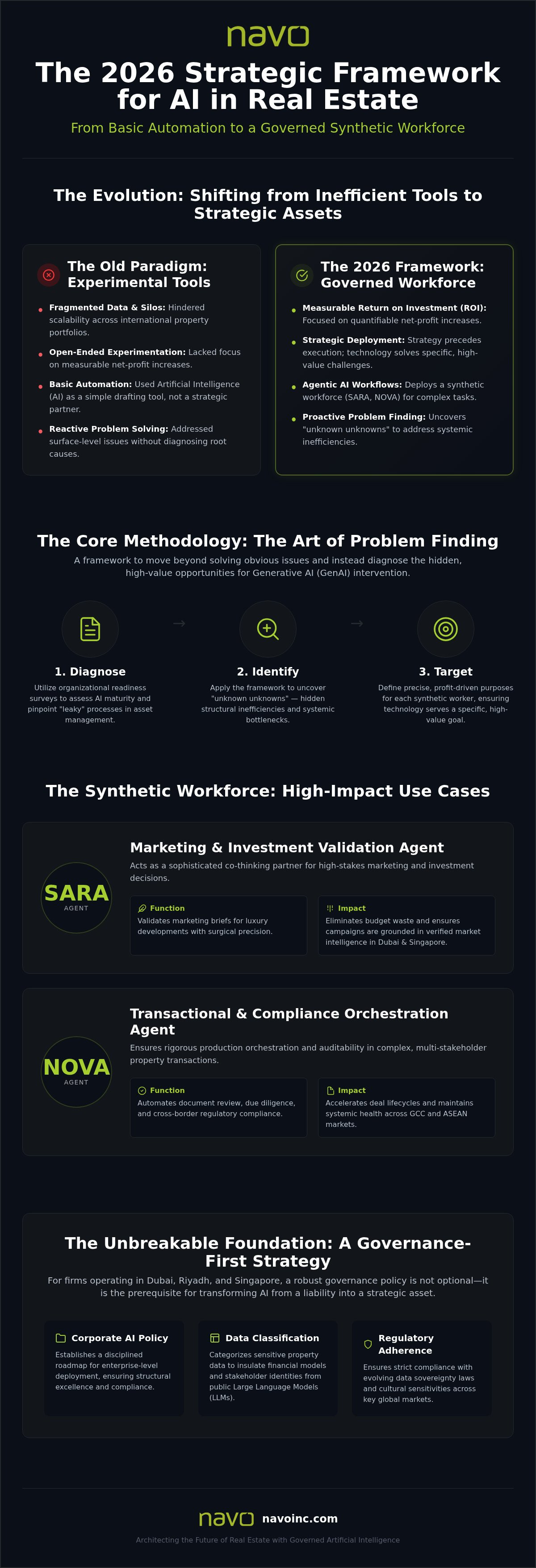
Effective leadership prioritizes the identification of structural bottlenecks before deploying technology. By utilizing the "Art of Problem Finding" framework, organizations can uncover the "unknown unknowns" that lead to marketing brief waste and misaligned investment decisions. Instead of solving for the obvious, this framework forces a diagnostic deep-dive into the underlying systemic health of the organization, ensuring that every synthetic worker deployed serves a precise, profit-driven purpose. Strategy must precede execution.
Diagnosing the 'Unknown Knowns' in Property Data
Strategic deployment begins with a rigorous diagnostic phase. Utilizing organizational readiness surveys allows firms to assess their Artificial Intelligence (AI) maturity and identify "leaky" processes in asset management where synthetic workers can recover substantial value. These tools highlight high-impact generative AI use cases in real estate that often remain hidden behind data silos in high-growth markets like Riyadh. Problem Finding serves as the essential diagnostic prerequisite for achieving a sustainable Return on Investment (ROI) in the 2026 technological landscape.
High-Impact Generative AI Use Cases for Global Property Markets
The transition from passive software to active synthetic workforces represents the next frontier for property developers. Deploying specialized agents like SARA allows firms to validate marketing briefs for luxury developments in Dubai and Singapore with surgical precision. This intervention mitigates wasted spend. It ensures every campaign alignment's grounded in verified market intelligence. Beyond marketing, the application of generative AI use cases in real estate extends to autonomous due diligence. Agentic Artificial Intelligence (AI) systems now orchestrate complex document reviews, moving beyond manual verification to identify structural risks or legal discrepancies across international portfolios.
While efficiency gains are evident, leaders must also weigh the risks of AI in property technology, particularly concerning algorithmic bias and data security. Generative Artificial Intelligence (GenAI) serves as a sophisticated co-thinking partner. It enables investment committees to model high-stakes scenarios and optimize yields with a level of granularity that's previously unattainable. Organizations seeking to implement these advanced architectures should consider a structured approach to integrating agentic workflows into their existing operations.
Synthetic Workers: Orchestrating the Transactional Lifecycle
The deployment of NOVA ensures rigorous production orchestration and auditability in multi-stakeholder property transactions. In the commercial leasing sector, agent-led brief validation has significantly reduced time-to-acceptance by pre-emptively addressing tenant requirements and regulatory hurdles. These generative AI use cases in real estate are increasingly vital for managing cross-border regulatory compliance across the Gulf Cooperation Council (GCC) and the Association of Southeast Asian Nations (ASEAN). By automating the alignment of local laws and international standards, firms maintain systemic health while accelerating the deal lifecycle in highly competitive global markets.
Implementing a Governance-First AI Strategy for Real Estate
Establishing a Corporate AI Governance Policy isn't optional for firms operating across Dubai, Riyadh, and Singapore. These jurisdictions demand strict adherence to evolving data sovereignty laws and cultural sensitivities. To safely deploy generative AI use cases in real estate, organizations must implement a robust Classification Framework. This system categorizes confidential property data, ensuring that sensitive financial models or stakeholder identities remain insulated from public Large Language Models (LLMs). A well-structured policy transforms AI from a liability into a strategic asset. Transitioning from isolated pilot programs to enterprise-level profit requires a disciplined roadmap that prioritizes structural excellence. The Navo Inc. transformation roadmap utilizes the "Art of Problem Finding" framework to ensure systemic health, ensuring every deployment of a synthetic worker contributes to a measurable net-profit increase while maintaining rigorous compliance standards.
Data Desensitization and Regional Regulatory Compliance
Operationalizing AI in the "Agentic Era" requires desensitization toolkits that scrub Personally Identifiable Information (PII) before data enters the processing pipeline. Board-level audit trails are now essential to maintain human-ownership mechanisms, especially when agents like NOVA orchestrate multi-stakeholder deals across international borders. These protocols ensure transparency and legal defensibility within the Gulf Cooperation Council (GCC) regulatory frameworks. By grounding generative AI use cases in real estate within these secure frameworks, firms prevent the leakage of proprietary asset valuations while enabling the high-speed analysis required in 2026. To secure your governance framework and navigate these complexities, you can learn more about Navo Inc. Strategic AI Consulting. This specialized guidance helps property leaders move beyond technical implementation toward a state of resilient, governed innovation that respects local legal nuances.
Architecting the Future of Real Estate Intelligence
The evolution of property technology toward 2026 demands a departure from superficial experimentation. Success requires a disciplined commitment to the "Art of Problem Finding" to identify structural leaks before they erode your competitive advantage. By integrating sophisticated generative AI use cases in real estate, your organization transitions from manual oversight to high-velocity, governed orchestration. Our proprietary SARA and NOVA agent architectures empower your teams to automate complex due diligence and eliminate marketing brief waste with clinical precision.
Navo Inc. provides the steady hand needed for this transformation, offering a net-profit increase guarantee and CPD UK-certified (Continuing Professional Development United Kingdom) AI leadership training to ensure your executive team remains ahead of the curve. Building a resilient, synthetic workforce that upholds the highest standards of the Dubai regulatory landscape is the definitive path to sustainable growth.
Frequently Asked Questions
What are the most profitable generative AI use cases in real estate for 2026?
The most profitable generative AI use cases in real estate center on autonomous due diligence and high-fidelity yield optimization. These applications directly impact the bottom line by orchestrating complex document reviews that previously required weeks of manual labor. By deploying agents to analyze multi-stakeholder property deals, firms secure measurable net-profit increases while maintaining rigorous, board-level audit trails.
How do synthetic workers differ from traditional real estate automation?
Synthetic workers represent a fundamental shift from rule-based scripts to agentic orchestration. Unlike traditional automation, which follows linear logic, agents like NOVA navigate ambiguity and manage multi-step transactional lifecycles autonomously. They act as sophisticated partners capable of reasoning through complex regulatory shifts in the Gulf Cooperation Council (GCC) rather than simply processing static, pre-defined data points.
Is generative AI safe for confidential property investment data?
Generative Artificial Intelligence (GenAI) is secure for confidential data when grounded in a robust Corporate AI Governance Policy. Organizations must utilize desensitization toolkits to scrub sensitive stakeholder information before it enters any processing pipeline. This classification framework ensures that proprietary investment models remain insulated from public systems while enabling the high-speed analysis required for modern property portfolios.
What is the 'Art of Problem Finding' in the context of real estate technology?
The "Art of Problem Finding" is a diagnostic framework designed to identify structural inefficiencies and "unknown unknowns" before any technological deployment. In real estate, this involves moving beyond obvious symptoms to uncover the root causes of process leakage. It ensures that every generative AI use cases in real estate deployment addresses a specific, high-value organizational challenge.
How can AI agents improve marketing ROI for property developers?
AI agents improve marketing Return on Investment (ROI) by performing clinical validation of creative briefs against real-time market data. SARA identifies misalignments in luxury development campaigns before capital is committed. This intervention reduces wasted spend and ensures that property developers in Dubai and Singapore achieve precise targeting based on verified buyer sentiment and local regulatory compliance.
Disclaimer
The views and opinions expressed in this article are those of the author and do not represent any organisation, client, institution, or professional body with which he may be associated. The content is intended for general information, education, and thought leadership. Readers should seek appropriate professional advice before making legal, financial, investment, regulatory, technology, or business decisions.
The author has taken reasonable care to ensure the accuracy of the information and sources available at the time of publication. Technologies, regulations, market conditions, and industry practices may evolve, and readers are encouraged to verify current information independently. Any examples, cases, or scenarios may have been simplified, anonymised, or adapted to protect confidentiality. The author and publisher accept no liability for decisions or outcomes arising from the use of this content.
Generative AI tools may have been used to support research, structuring, or language refinement, with the final content, judgment, and editorial responsibility retained by the author.