

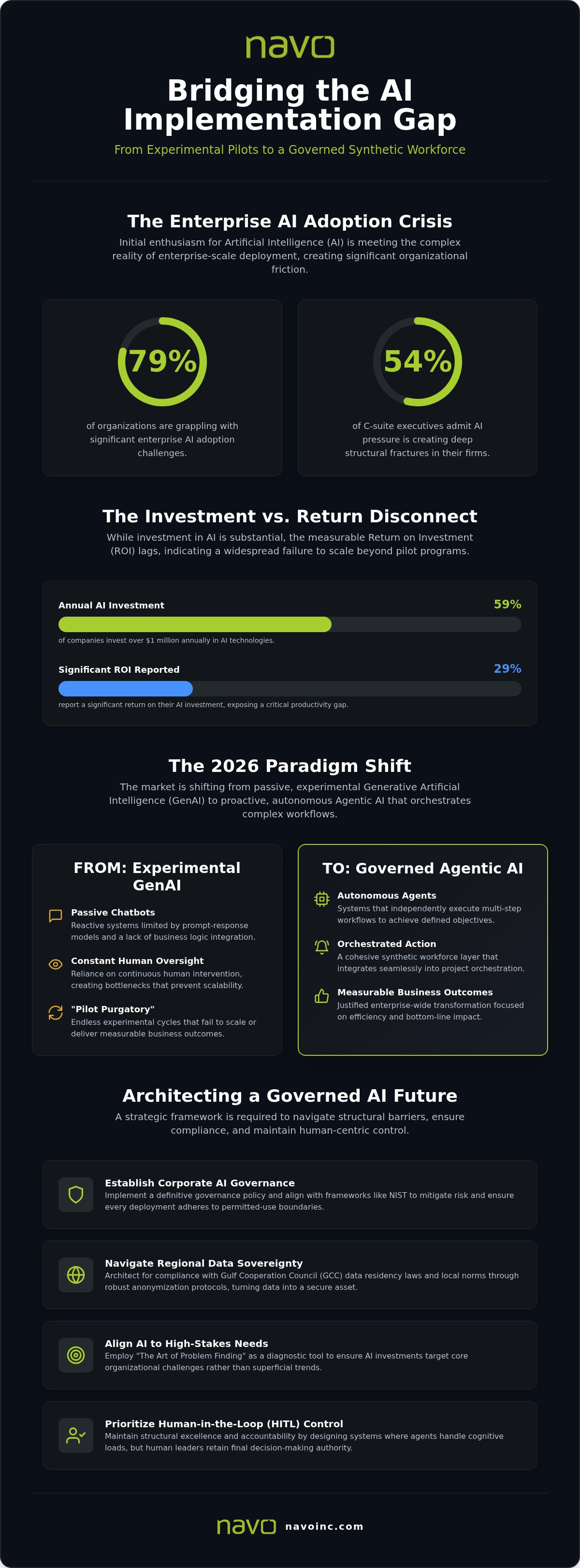
79% of organizations are currently grappling with enterprise AI adoption challenges, while 54% of C-suite executives admit the pressure of Artificial Intelligence (AI) integration is creating deep structural fractures within their firms. The transition from experimental Generative Artificial Intelligence (GenAI) to a functional, governed synthetic workforce has proven more volatile than many anticipated. You likely feel the weight of this shift as initial pilot programs fail to scale and confidentiality concerns stall your most ambitious data projects.
It's clear that the path to a seamless digital transformation often remains obstructed by technical debt and a widening human-to-machine skills gap. This analysis provides an authoritative framework for the 2026 strategic environment, moving beyond simple chatbots toward sophisticated agentic workflows. We'll examine the specific methodologies required to bridge the productivity-to-Return on Investment (ROI) disconnect and implement the governance standards necessary for leadership across the Middle East, India, and Singapore.
Key Takeaways
- Transition from passive chatbots to autonomous agentic systems to exit experimental cycles and secure measurable business outcomes.
- Resolve core enterprise AI adoption challenges by mitigating confidentiality paralysis and aligning with Gulf Cooperation Council (GCC) data residency laws.
- Employ "The Art of Problem Finding" as a diagnostic tool to ensure Artificial Intelligence (AI) investments target high-stakes organizational needs rather than superficial trends.
- Architect a governed synthetic workforce layer that seamlessly integrates specialized agents into your existing project orchestration workflows.
- Prioritize Human-in-the-Loop (HITL) mechanisms to maintain structural excellence and accountability as your organization scales autonomous systems.
The 2026 Paradigm Shift: From Generative Pilots to Agentic AI Realities
By 2026, the era of experimental curiosity has ended. Organizations that spent the previous two years in "pilot purgatory" are facing a stark reality: 79% of organizations now encounter significant enterprise AI adoption challenges as they attempt to scale. The shift from passive Generative Artificial Intelligence (GenAI) to autonomous, decision-making Agentic Artificial Intelligence (AI) represents the most significant structural transition since the dawn of the cloud. Success doesn't depend on the ability to generate text; it hinges on the ability to orchestrate action.
While 59% of companies invest over $1 million annually in these technologies, only 29% report a significant Return on Investment (ROI). This disconnect often stems from a reliance on superficial chatbots that lack the depth to handle complex business logic. Leaders must now deploy sophisticated ROI calculators to justify enterprise-wide transformation, moving beyond "show" strategies toward measurable efficiency outcomes that impact the bottom line.
Evolving Beyond Chatbots to Autonomous Agents
Traditional prompt-response models are inherently limited by their reactive nature. These systems require constant human intervention, creating a bottleneck that prevents true scalability across the enterprise. Agentic AI, by contrast, utilizes a foundational understanding of AI to coordinate multi-step workflows independently. These agents don't just answer questions; they execute tasks by accessing disparate data silos and making logical deductions to reach a defined objective without constant oversight.
The Leadership Imperative in AI Orchestration
Transformation is shifting from an IT-led initiative to a core C-suite mandate. This evolution requires a disciplined architect to oversee the integration of new operational layers that address persistent enterprise AI adoption challenges. The Synthetic Workforce is an operational layer that executes defined roles with memory and auditability. By treating these systems as co-thinking partners rather than simple toolsets, executives can bridge the gap between human intuition and machine precision while maintaining strict professional composure.
Navigating Structural Barriers: Data Readiness and Regional Governance
Confidentiality paralysis often cripples the momentum of high-stakes organizations. In regulated environments across the Middle East, the perceived risk of data leakage frequently outweighs the promise of efficiency. To resolve these enterprise AI adoption challenges, a firm must establish a definitive Corporate Artificial Intelligence (AI) Governance Policy. This document serves as a structural blueprint, ensuring that every deployment adheres to permitted-use boundaries without compromising systemic health.
Bridging the internal skills gap requires a methodical approach to human capital. Many executives are investing in Continuing Professional Development (CPD) UK-certified training to foster a deeper understanding of human-to-machine communication. Integrating these efforts with the National Institute of Standards and Technology (NIST) AI Risk Management Framework provides a steady hand for managing the inherent risks of autonomous systems.
Data Sovereignty and the GCC Regulatory Landscape
Maintaining compliance across Dubai, Riyadh, and Singapore demands more than just technical security. It requires an architectural commitment to Gulf Cooperation Council (GCC) data residency laws and local cultural norms. Successful firms implement robust anonymization protocols as a mandatory prerequisite. This ensures that data remains a strategic asset rather than a liability while navigating the complexities of regional sovereignty in markets like Malaysia and the wider Middle East.
Establishing Human-Ownership Mechanisms
Accountability cannot be outsourced to an algorithm. Even as we move toward a synthetic workforce, strategic control must remain human-centric. A "Machine-in-the-Loop" philosophy allows agents to handle the cognitive load while leaders retain the final decision-making authority. This balance is essential for maintaining professional composure during high-stakes shifts. If your organization is facing these hurdles, developing a customized governance framework can provide the clarity needed to proceed with confidence.
The Crisis of Strategic Alignment: The Art of Problem Finding
The primary friction in modern transformation isn't the software itself but the lack of diagnostic precision. 75% of executives admit their company's Artificial Intelligence (AI) strategy is "more for show" than actual internal guidance. This misalignment fuels the most persistent enterprise AI adoption challenges, as organizations often engage in "solution chasing"—deploying tools before defining the specific operational gaps they're meant to bridge.
By contrast, "The Art of Problem Finding" provides a disciplined framework for executive leaders to identify high-stakes use cases that impact the bottom line. This diagnostic precision is vital for overcoming the structural enterprise AI adoption challenges that often lead to expensive, low-impact failures. Utilizing readiness surveys allows a firm to map its organizational capability against the rapid pace of technological evolution, ensuring that investments result in measurable net-profit increases.
Diagnostic Precision Over Hype
Using the proprietary "Clarify-Enable-Protect-Evolve" architecture, leaders can conduct a rigorous audit of their current infrastructure. This methodical approach bypasses the typical "confidentiality paralysis" by defining clear, risk-based decision paths for data utilization. It's about establishing a steady hand that prioritizes systemic health over the temporary allure of industry hype, ensuring that every technological step is both secure and purposeful.
Strategic Co-Thinking Partners
Positioning AI within the "Six Lanes of Working" framework transforms it from a simple utility into a strategic co-thinking partner. This shift requires a fundamental business process redesign, where the operating model is reconstructed to leverage the cognitive strengths of a synthetic workforce. Linking AI outcomes directly to these redesigned workflows ensures that the technology serves the strategy, not the other way around, fostering a resilient environment for long-term growth.
Architecting the Future: Execution and the Synthetic Workforce Layer
The final phase of transformation involves the deployment of a robust synthetic workforce layer that functions as a seamless extension of your human capital. While previous sections addressed strategic alignment and governance, the actual execution remains where many enterprise AI adoption challenges become insurmountable. Success requires a sophisticated orchestration of specialized agents that can capture nuanced briefs and manage complex projects without the friction typical of traditional software implementations.
Specialized agents like SARA, a Synthetic Client-Briefing Specialist, are instrumental in reducing budget waste. By ensuring that project requirements are captured with surgical precision, SARA eliminates the ambiguity that often leads to scope creep. These workflows are designed with audit-ready outcomes in mind, utilizing dual-approval locks to maintain strict human oversight. This ensures that every Artificial Intelligence (AI) driven decision is validated by a Human-in-the-loop (HITL) mechanism before moving to the next gate.
Deploying AI Agents with Auditability
Integration isn't just about technical connectivity; it's about establishing trust through transparency. Every action taken by the agentic layer must be documented and retrievable, satisfying the rigorous standards of modern corporate governance. This level of auditability allows leadership to scale autonomous systems across the Gulf Cooperation Council (GCC) region with the confidence that systemic health is never compromised despite the inherent enterprise AI adoption challenges.
Continuous Evolution and Capability Building
Building a resilient organization requires a commitment to synthetic workforce development as a core competency. Navo Inc. facilitates this through a structured 5-week transformation journey, moving from initial preparation to full activation. This journey ensures that your team isn't just using tools but is evolving into a high-performance unit capable of navigating future technological frontiers with professional composure.
Partner with Navo Inc. for outcome-guaranteed AI strategy
Mastering the Orchestration of Agentic Intelligence
The transition from experimental chatbots to a governed synthetic workforce layer marks a definitive shift in organizational design. By mastering the orchestration of agentic systems, leaders can finally bridge the gap between individual productivity and enterprise-level Return on Investment (ROI). Success in this new paradigm requires a disciplined commitment to structural excellence and the diagnostic precision offered by "The Art of Problem Finding" framework.
Organizations that move beyond confidentiality paralysis to implement robust governance will thrive in the 2026 landscape. Navo Inc. provides the intellectually rigorous partnership needed to overcome persistent enterprise AI adoption challenges. Through Continuing Professional Development (CPD) UK-certified masterclasses and specialized expertise in the Gulf Cooperation Council (GCC) and Asian markets, we ensure your transformation results in measurable net-profit outcomes.
The future of business belongs to those who view Artificial Intelligence (AI) not as a tool, but as a strategic co-thinking partner. Your journey toward a resilient, automated operating model begins with the right architect of change.
Frequently Asked Questions
What is the primary reason enterprise AI adoption fails in 2026?
The primary cause of failure is a diagnostic crisis where organizations prioritize technological acquisition over strategic alignment. Many firms engage in "solution chasing," deploying tools without identifying specific operational gaps. This creates a disconnect between individual productivity gains and measurable enterprise-level Return on Investment (ROI), ultimately stalling transformation initiatives before they reach scale. These enterprise AI adoption challenges are often leadership issues rather than purely technical hurdles.
How do GCC regulations affect AI adoption for multinational firms?
Gulf Cooperation Council (GCC) regulations require multinational firms to adhere to strict data residency and sovereignty laws. In jurisdictions like Dubai and Riyadh, compliance involves more than technical security; it demands an architectural commitment to local data-handling standards. Firms must implement robust anonymization protocols to ensure that Artificial Intelligence (AI) deployments respect regional legal frameworks while maintaining operational efficiency. This disciplined approach ensures structural stability in volatile regulatory environments across the Middle East.
What is the difference between Generative AI and Agentic AI in a corporate context?
Generative Artificial Intelligence (GenAI) is primarily a reactive, prompt-response model used for content creation or information retrieval. In contrast, Agentic AI functions as an autonomous system capable of executing multi-step workflows and making logical decisions with limited human intervention. While GenAI acts as a tool for augmentation, Agentic AI operates as a synthetic worker layer that manages complex project orchestration independently. It's a shift from passive assistance to active operational execution.
How can organizations overcome the 'confidentiality paralysis' associated with GenAI?
Organizations can resolve confidentiality paralysis by establishing clear, risk-based decision paths through a formal governance framework. This involves defining permitted-use boundaries for various data tiers and utilizing anonymization safeguards. By replacing vague fears with structured protocols, leadership can address enterprise AI adoption challenges and unlock the potential of sensitive data without compromising organizational security. A steady hand in governance allows for the confident utilization of proprietary information within global markets.
What are the key components of a Corporate AI Governance Policy?
A comprehensive Corporate AI Governance Policy must include defined permitted-use boundaries, human-centric accountability mechanisms, and strict auditability standards. It should also incorporate Human-in-the-Loop (HITL) protocols to ensure human oversight in autonomous decision-making processes. Finally, the policy must align with regional standards, such as those within Singapore and Malaysia, to ensure long-term resilience. These components create a structured pathway for resolution when navigating complex technological shifts.
Disclaimer
The views and opinions expressed in this article are those of the author and do not represent any organisation, client, institution, or professional body with which he may be associated. The content is intended for general information, education, and thought leadership. Readers should seek appropriate professional advice before making legal, financial, investment, regulatory, technology, or business decisions.
The author has taken reasonable care to ensure the accuracy of the information and sources available at the time of publication. Technologies, regulations, market conditions, and industry practices may evolve, and readers are encouraged to verify current information independently. Any examples, cases, or scenarios may have been simplified, anonymised, or adapted to protect confidentiality. The author and publisher accept no liability for decisions or outcomes arising from the use of this content.
Generative AI tools may have been used to support research, structuring, or language refinement, with the final content, judgment, and editorial responsibility retained by the author.