

What if the primary obstacle to your technological evolution isn't the complexity of the code, but a fundamental misalignment of organizational architecture? Within the Gulf Cooperation Council (GCC) and major hubs like Singapore, the initial euphoria surrounding Generative Artificial Intelligence (GenAI) is rapidly meeting the cold reality of pilot purgatory. You've likely observed how unguided experiments fail to scale, often because of legitimate fears regarding sensitive data sovereignty. Understanding how to avoid AI implementation failure requires more than just better software; it demands a total recalibration of how business objectives intersect with machine intelligence.
We agree that the transition from fragmented tools to a cohesive, profit-driven strategy is the only path to resilience in a 2026 economy. This article provides a comprehensive roadmap for moving from experimental GenAI models to a sophisticated orchestration of synthetic workers. By integrating a disciplined framework like The Art of Problem Finding, you'll discover how to transform AI from a speculative expense into a strategic co-thinking partner. We'll explore the diagnostic steps necessary to ensure your deployment delivers structural excellence and measurable increases in net profit.
Key Takeaways
- Identify the structural disconnects and data sovereignty issues that trigger "Confidentiality Paralysis" within enterprise Generative Artificial Intelligence (GenAI) initiatives.
- Apply the "Art of Problem Finding" framework to prioritize the resolution of core business friction, providing a definitive roadmap for how to avoid AI implementation failure.
- Architect a governed synthetic workforce layer using agentic Artificial Intelligence (AI) to transform technology from a simple tool into a high-level strategic co-thinking partner.
- Transition from speculative pilots to measurable commercial outcomes by aligning organizational strategy with Continuing Professional Development (CPD) UK-certified executive training.
Diagnosing the Structural Causes of Generative Artificial Intelligence (GenAI) Implementation Failure
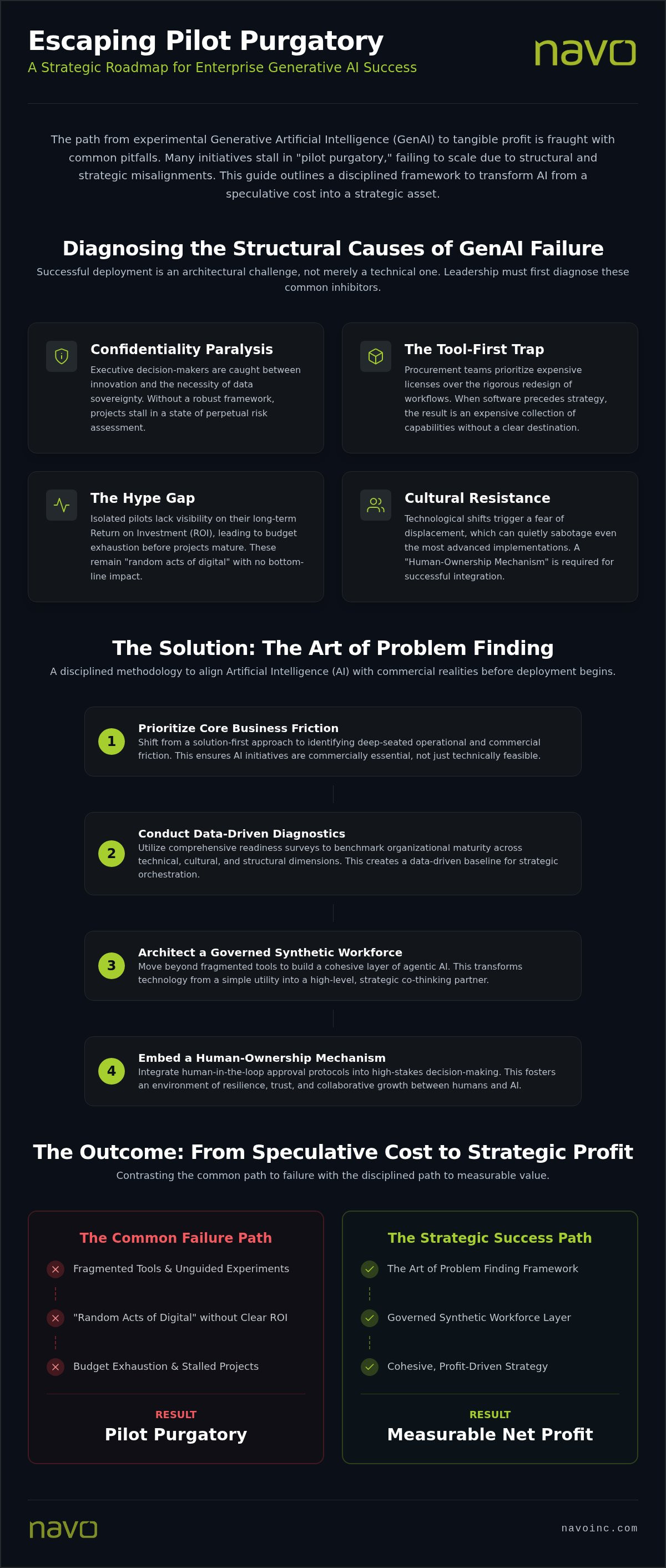
Enterprise failure in the deployment of Generative Artificial Intelligence (GenAI) is rarely a consequence of inferior code or insufficient processing power. Instead, it represents a profound disconnect between algorithmic capability and commercial intent. Many organizations treat GenAI as a modular software upgrade rather than a fundamental shift in their strategic operating model. This misalignment creates a vacuum where technical outputs fail to translate into tangible business value. To understand how to avoid AI implementation failure, leadership must first acknowledge that a successful deployment is an architectural challenge, not merely a technical one.
A primary inhibitor of adoption is what we define as Confidentiality Paralysis. In sophisticated markets like Dubai and Riyadh, executive decision-makers are often caught between the desire for innovation and the absolute necessity of data sovereignty. Without a robust framework for managing sensitive enterprise data, projects stall in a state of perpetual risk assessment. This hesitation is compounded by the Tool-First Trap, where procurement teams prioritize the acquisition of expensive licenses over the rigorous redesign of workflows. When software precedes strategy, the result is an expensive collection of capabilities without a clear destination.
Regional regulatory uncertainty also plays a significant role. As the United Arab Emirates (UAE) and the Kingdom of Saudi Arabia (KSA) continue to refine their digital governance standards, organizations must navigate shifting legal requirements. This environment demands a disciplined approach to governance that anticipates future compliance needs while maintaining the agility required for technological evolution.
The Hype Gap: Why Pilots Fail to Scale
The transition from a successful experiment to systemic business value is where most initiatives collapse. Isolated pilots often lack visibility regarding their long-term Return on Investment (ROI), leading to budget exhaustion before a project reaches maturity. Without a clear diagnostic phase to identify fundamental business friction, these projects remain "random acts of digital," providing novelty but failing to contribute to the bottom line. Scalability requires a transition from experimental curiosity to a governed, outcome-based strategy.
Cultural Resistance and the Human-Ownership Mechanism
Technological shifts of this magnitude inevitably trigger a fear of displacement within the existing workforce. This cultural friction can quietly sabotage even the most advanced implementations. Successful integration requires a Human-Ownership Mechanism, where human-in-the-loop approval protocols are embedded into high-stakes decision-making. By positioning GenAI as a strategic co-thinking partner rather than a replacement, organizations can foster an environment of resilience and collaborative growth.
The Art of Problem Finding: Aligning Artificial Intelligence (AI) with Commercial Realities
Transitioning from speculative pilot programs to enterprise-scale excellence requires a fundamental shift in intellectual inquiry. Conventional consulting often encourages a solution-first approach, seeking low-hanging fruit that rarely moves the needle on organizational resilience. True transformation begins with the Art of Problem Finding. This methodology prioritizes the identification of deep-seated business friction over the mere application of technical tools. By focusing on fundamental commercial realities, leaders can determine exactly how to avoid AI implementation failure before a single line of code is deployed.
In high-growth markets like Singapore and the United Arab Emirates (UAE), where the pace of digital change is relentless, the ability to discern the right problem is a competitive differentiator. We utilize diagnostic instruments, such as comprehensive readiness surveys, to benchmark an organization's maturity across technical, cultural, and structural dimensions. This data-driven baseline allows for the transition from reactive problem solving to proactive strategic orchestration. It ensures that Artificial Intelligence (AI) initiatives are not just technically feasible but commercially essential. This is the cornerstone of how to avoid AI implementation failure in a volatile market.
The Clarify-Enable-Protect-Evolve Adoption Architecture
The Navo adoption architecture provides a rigorous structural path for C-suite executives. The Clarify phase is the most critical; it involves the precise definition of measurable commercial outcomes. Without this clarity, technical deployment lacks a metric for success. By establishing these parameters early, the organization builds a foundation that supports the subsequent stages of enabling teams, protecting data assets, and evolving the business model. This structured approach prevents the budget waste common in unguided Generative Artificial Intelligence (GenAI) projects.
Expanding the Question Economy Protocol
The quality of an AI-generated output is a direct reflection of the intellectual rigor found in the initial brief. We implement the Question Economy Protocol to improve the precision of these inputs. By training leadership to ask better questions, organizations often see a 50% reduction in time-to-acceptance for strategic projects. This efficiency gain isn't a byproduct of faster processing, but of superior alignment between human intent and machine execution. If you're ready to audit your current trajectory, consult with our strategic advisors to refine your adoption roadmap.
Deploying a Governed Synthetic Workforce Layer
The deployment of a Synthetic Workforce represents the next frontier in enterprise orchestration. This isn't merely a collection of disconnected tools; it's a governed layer of Artificial Intelligence (AI) agents designed to execute specific, accountable roles within the organization. By treating agentic Artificial Intelligence (AI) as a strategic co-thinking partner, leadership can finally bridge the gap between technical capability and commercial outcomes. This structured approach is essential for understanding how to avoid AI implementation failure, as it moves the focus from individual prompts to systemic workforce health.
Within this layer, specialized agents like SARA manage the nuances of client-briefing, while NOVA handles the complexities of project orchestration. These entities operate under a framework of role-based accountability, ensuring that every output is audit-ready and aligned with enterprise standards. This level of discipline reduces budget waste by preventing the drift often seen in unguided pilots. It's about building a resilient architecture where every agent's contribution is measurable and governed.
Agentic AI Governance and Risk Mitigation
To maintain structural integrity, we implement a Machine-in-the-Loop Thinking framework. This ensures that human oversight remains the final arbiter for high-stakes decisions. Governance must align with international standards, such as the National Institute of Standards and Technology (NIST) Privacy Framework 2.0, while respecting regional mandates like the United Arab Emirates (UAE) Federal Decree-Law on the Protection of Personal Data. This dual-layered compliance strategy protects the organization from the confidentiality paralysis that often halts progress in the Gulf region.
Calculated Integration: The Six Lanes of Working
Integrating synthetic workers into existing human teams requires a methodical, five-step guide:
- Role Definition: Assign specific commercial frictions to the synthetic agent.
- Data Provisioning: Grant secure access to necessary enterprise datasets within governed silos.
- Gate Setting: Establish rigorous human-in-the-loop approval protocols.
- Pilot Phase: Test the agent within one of the "Six Lanes of Working" to validate logic.
- Performance Audit: Measure efficiency gains against established net-profit benchmarks.
These approval gates ensure that synthetic worker autonomy is earned through consistent, audit-ready performance. By following this sequence, organizations can scale their agentic capabilities without compromising operational stability.
From Pilot to Profit: Ensuring Long-Term AI Resilience
Moving beyond a successful pilot requires a shift from technical curiosity to a culture of Evidence Discipline. This standard mandates that every Artificial Intelligence (AI) driven profit increase is validated against rigorous commercial benchmarks rather than speculative projections. In the high-stakes environments of the Gulf Cooperation Council (GCC) and Southeast Asia, resilience isn't found in the software itself, but in the leadership’s ability to govern it. Navo Inc. serves as the steady hand for these shifts, ensuring that the transition from experimental labs to an outcome-based strategy results in guaranteed efficiency gains. Mastery of these diagnostic protocols is the final step in learning how to avoid AI implementation failure within complex global markets.
The Navo Masterclass: A 5-Week Transformation Journey
Our Continuing Professional Development (CPD) UK-certified masterclasses provide the definitive playbook for moving from Confidentiality Paralysis to governed value. Over five weeks, leadership teams engage in an intensive activation phase that turns theoretical insights into operational reality. This journey ensures that the intellectual foundation established through the Art of Problem Finding is fully integrated into the daily cadence of the enterprise. It's a structured transition that replaces speculative experimentation with a disciplined roadmap designed for the commercial realities of 2026. By the end of the program, executives possess the tools to orchestrate a synthetic workforce with confidence and precision.
Securing the Future: Corporate AI Governance Policy
Long-term resilience requires a Corporate AI Governance Policy that defines permitted-use boundaries at the board level. This framework must address data sovereignty and ethical alignment, providing a clear mandate for how synthetic workers interact with proprietary assets across different jurisdictions. Such policies provide the structural stability needed to withstand technological volatility while maintaining compliance with regional mandates like the Dubai Data Law. We invite forward-thinking leaders to consult with Navo Inc. for a strategic AI roadmap that prioritizes structural excellence and commercial longevity. By establishing these boundaries today, you ensure your organization remains an active leader rather than a passive observer in the evolving digital economy.
Architecting Your Strategic Advantage in the Agentic Era
The path to enterprise excellence requires a departure from speculative experimentation toward a disciplined, architected reality. By prioritizing the Art of Problem Finding and deploying specialized synthetic worker architects, organizations can finally align algorithmic potential with commercial intent. This transition ensures that every technological deployment serves as a strategic co-thinking partner rather than a source of budget waste. Integrating these rigorous frameworks is the definitive method for how to avoid AI implementation failure as we approach 2026.
Under the authoritative leadership of Vasudevan Kidambi, Navo Inc. provides the diagnostic clarity necessary to navigate the unique regulatory landscapes of the Middle East and Asia. Our Continuing Professional Development (CPD) UK-certified masterclasses empower your leadership to maintain a culture of Evidence Discipline, ensuring that every AI-driven initiative yields measurable increases in net profit. You now possess the governed roadmap required to transform your organizational architecture into a resilient, future-ready engine of innovation.
The future belongs to those who view technological shifts not as crises to be managed, but as structures to be mastered. We remain committed to your success as a battle-tested partner in this era of radical progress.
Frequently Asked Questions
Why do 80% of enterprise AI implementations fail to achieve their stated goals?
Failure typically stems from a fundamental disconnect between algorithmic capability and commercial intent. Most organizations fall into the "Tool-First Trap," where they prioritize software procurement over the rigorous redesign of their strategic operating model. By failing to address "Confidentiality Paralysis" and data sovereignty, projects often stall in perpetual risk assessment. Understanding how to avoid AI implementation failure requires shifting the focus from experimental novelty to measurable, outcome-based orchestration that aligns with core business objectives.
How does the Art of Problem Finding differ from traditional business analysis?
Traditional business analysis typically focuses on optimizing existing processes, whereas the Art of Problem Finding identifies the underlying friction points that prevent systemic growth. This methodology serves as the intellectual foundation for successful transformation. It moves the inquiry from "What can the technology do?" to "What fundamental commercial reality must be addressed?" This diagnostic depth ensures that every initiative is a strategic necessity rather than a speculative expense, facilitating true enterprise excellence.
What are the legal and cultural considerations for AI deployment in the Gulf region?
Deployment in the Gulf region requires strict adherence to data sovereignty laws, such as the United Arab Emirates (UAE) Federal Decree-Law on the Protection of Personal Data. Culturally, organizations must manage the fear of workforce displacement by positioning Artificial Intelligence (AI) as a strategic co-thinking partner. Navigating these regional nuances is critical for maintaining structural stability and ensuring that Generative Artificial Intelligence (GenAI) initiatives remain compliant with both local regulations and international standards like the National Institute of Standards and Technology (NIST) Privacy Framework.
Can synthetic workers operate autonomously without human intervention?
Synthetic workers are designed for governed execution, not unchecked autonomy. Within our framework, agents like SARA and NOVA operate under a "Machine-in-the-Loop Thinking" protocol, where human oversight remains the final arbiter for high-stakes decision-making. This role-based accountability ensures that every output is audit-ready and aligned with enterprise governance. Total autonomy is avoided to mitigate risk and ensure that the synthetic workforce layer remains a disciplined extension of human intent.
How do we calculate the Return on Investment (ROI) of a synthetic workforce layer?
Calculating the Return on Investment (ROI) involves measuring specific efficiency gains and net-profit increases against the cost of unguided budget waste. We utilize a culture of "Evidence Discipline" to validate the commercial impact of every agentic deployment. By comparing the performance of a governed synthetic workforce layer against traditional manual workflows, leadership can identify tangible reductions in time-to-acceptance for strategic projects. This methodical approach provides a clear financial justification for transitioning from experimental pilots to profit-driven orchestration.
Disclaimer
The views and opinions expressed in this article are those of the author and do not represent any organisation, client, institution, or professional body with which he may be associated. The content is intended for general information, education, and thought leadership. Readers should seek appropriate professional advice before making legal, financial, investment, regulatory, technology, or business decisions.
The author has taken reasonable care to ensure the accuracy of the information and sources available at the time of publication. Technologies, regulations, market conditions, and industry practices may evolve, and readers are encouraged to verify current information independently. Any examples, cases, or scenarios may have been simplified, anonymised, or adapted to protect confidentiality. The author and publisher accept no liability for decisions or outcomes arising from the use of this content.
Generative AI tools may have been used to support research, structuring, or language refinement, with the final content, judgment, and editorial responsibility retained by the author.