

The Evolution of Supply Chain Optimization in KSA’s Industrial Landscape
The Kingdom of Saudi Arabia (KSA), guided by the ambitious framework of Saudi Vision 2030, is undergoing a period of profound economic transformation. At the heart of this evolution lies the nation's supply chain and logistics sector, which is rapidly moving beyond traditional models to embrace a new era of intelligent orchestration. This shift is most evident in industrial powerhouses like Al Khobar, where proximity to global shipping lanes and the intricate demands of the energy sector create a unique set of competitive pressures.
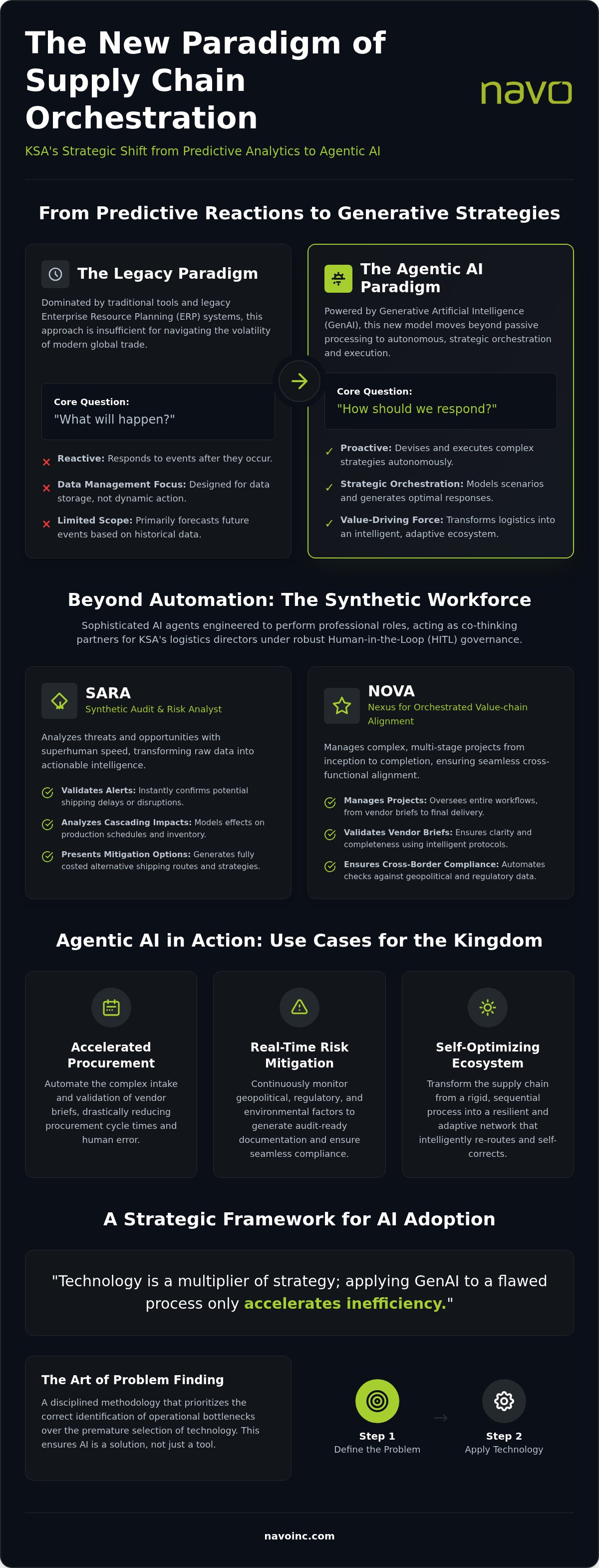
In this high-stakes environment, the adoption of Generative Artificial Intelligence (GenAI)—advanced AI systems capable of creating novel content and solutions—is becoming a strategic imperative. Unlike traditional predictive analytics that forecast future events, GenAI-powered systems can autonomously devise and execute complex operational strategies. The limitations of legacy predictive models have become clear; they are insufficient for navigating the volatility of modern global trade routes. For KSA’s logistics leaders, GenAI supply chain optimization represents a fundamental shift from passive data processing to autonomous strategic orchestration.
KSA as a Strategic Nexus for Agentic AI
The Kingdom's strategic geographic position, bridging continents, makes its logistics hubs critical nodes in the global economy. In the Eastern Province, the unique pressures of the Aramco-adjacent supply chain ecosystem demand unprecedented levels of agility and foresight. The proximity of industrial centers like Al Khobar to Dammam’s King Abdulaziz Port necessitates real-time, agentic decision-making to manage the immense flow of goods. Agentic AI, which involves autonomous agents that can reason, plan, and execute tasks, provides the necessary capabilities to manage this complexity, transforming logistics from a reactive function into a proactive, value-driving force.
From Predictive to Generative: The New Paradigm
For decades, supply chain management has been dominated by predictive tools that answer the question, "what will happen?" This paradigm, however, is no longer adequate. The critical question for 2026 and beyond is, "how should we respond?" Generative AI addresses this directly by modeling complex scenarios and generating optimal response strategies in real time. This capability exposes the inherent limitations of legacy Enterprise Resource Planning (ERP) systems, which were designed for data management, not for dynamic, intelligent action. In an AI-first world, these systems must be augmented by an agentic layer that can think, adapt, and execute with strategic intent.
Beyond Automation: Deploying Synthetic Workers for Agentic Supply Chain Orchestration
The next frontier in supply chain optimization extends beyond mere automation to the strategic deployment of a Synthetic Workforce. These are not simple chatbots but sophisticated AI agents engineered to perform defined professional roles, acting as co-thinking partners for KSA's logistics directors. This approach redefines the human-machine relationship, elevating it from a user-and-tool dynamic to a collaborative partnership between human experts and their synthetic counterparts.
For instance, a simple AI tool might flag a potential shipping delay, whereas a sophisticated synthetic agent like SARA (Synthetic Audit & Risk Analyst) could validate the alert, analyze its cascading impact on production schedules, model alternative shipping routes, and present a fully costed set of mitigation options to a human director. More complex agents, such as NOVA (Nexus for Orchestrated Value-chain Alignment), can manage entire projects, from vendor brief validation to cross-border compliance checks. Critically, this autonomous capability is governed by robust Human-in-the-Loop (HITL) frameworks, ensuring that human oversight and strategic judgment remain central to all operations.
Integrating Agentic AI into Existing Logistics Workflows
Many organizations face 'Confidentiality Paralysis'—a hesitation to adopt powerful AI due to data security and governance concerns. Overcoming this requires a structured, value-driven integration methodology. Frameworks like the 'Six Lanes of Working' help enterprises identify precise opportunities where agentic AI can deliver measurable value without compromising sensitive data. This involves mapping existing procurement, logistics, and compliance workflows to pinpoint bottlenecks and inefficiencies that are ideal candidates for synthetic worker intervention. The goal is not to replace human teams but to augment their capacity for high-level strategic work by delegating complex, data-intensive tasks. For a deeper understanding of this orchestration, executives can explore how to begin mastering agentic AI services.
Synthetic Workers in Action: Use Cases for the Kingdom
In the context of KSA's diverse industrial landscape, the applications are immediate and impactful. Synthetic workers can automate the complex intake and validation of vendor briefs using protocols that ensure clarity and completeness, drastically reducing procurement cycle times. For cross-border trade, they provide real-time risk mitigation by continuously monitoring geopolitical, regulatory, and environmental factors, generating audit-ready documentation that ensures seamless compliance. This agentic layer transforms the supply chain from a rigid, sequential process into a resilient, self-optimizing ecosystem.
A Strategic Framework for AI Adoption: The Art of Problem Finding in Logistics
The most common mistake in corporate AI adoption is a fixation on technology before a rigorous definition of the problem. The Art of Problem Finding, a disciplined strategic methodology, posits that identifying the correct operational bottleneck is far more critical than selecting the AI tool itself. For logistics enterprises across the Kingdom, this means resisting the allure of off-the-shelf solutions and instead committing to a deep diagnostic process. As a guiding principle, leaders should remember: Technology is a multiplier of strategy; applying GenAI to a flawed process only accelerates inefficiency.
This approach stands in stark contrast to the open-ended innovation labs favored by some large consultancies, which often yield interesting experiments but fail to deliver guaranteed outcomes. An outcome-based strategy, supported by diagnostic tools like Return on Investment (ROI) calculators and organizational readiness surveys, ensures that every AI initiative is directly tied to a specific, measurable improvement in profit or efficiency.
Diagnostic Excellence in Supply Chain Strategy
A sustainable transformation requires a structured adoption architecture. The Clarify – Enable – Protect – Evolve framework provides a clear pathway for KSA enterprises. It begins with clarifying the highest-value problem, then enabling the organization with the right synthetic skills and tools, protecting sensitive data through robust governance, and finally creating a culture of continuous evolution. This diagnostic excellence allows organizations to uncover 'Hidden Waste'—inefficiencies embedded in processes like procurement briefs or vendor management—that GenAI can systematically identify and reclaim.
Governance and Risk in the Gulf Region
Deploying AI within the Kingdom necessitates strict adherence to national regulations and a profound respect for data sovereignty. Any GenAI strategy must be aligned with the guidelines set forth by the Saudi Data and AI Authority (SDAIA), ensuring that all data handling and model training practices are fully compliant. Implementing a comprehensive Corporate AI Governance policy is not merely a legal requirement but a strategic necessity to protect sensitive industrial and commercial data. This policy should define data classification standards, establish ethical use guidelines, and create clear accountability structures for all agentic systems. A robust governance strategy is the foundation upon which trust in autonomous systems is built. For guidance on this, leaders can review the enterprise AI governance strategy for agentic AI.
Outcome-Guaranteed GenAI Transformation for KSA Enterprises
For the C-suite in Saudi Arabia, the transition to an AI-augmented enterprise cannot be an academic exercise; it must be a transformation that guarantees a tangible return. This requires a structured journey that combines executive education with practical, scalable implementation. Programs like the Navo Masterclass, a Continuing Professional Development (CPD) UK-certified course, are designed specifically for this purpose, equipping leadership teams with the strategic acumen to lead their organizations into the agentic era.
The ultimate objective is to move beyond isolated pilot projects to enterprise-scale AI that is directly linked to profitability. This involves building 'Synthetic Skills' within the existing workforce—the competencies required to manage, govern, and collaborate with agentic systems effectively. By investing in this human capital alongside the technology, KSA businesses can secure a decisive first-mover advantage in the hyper-competitive logistics market of 2026 and beyond.
The CPD UK-Certified Path to AI Leadership
A structured, evidence-based path to AI leadership ensures that transformation is both sustainable and effective. A typical five-week journey encompasses three critical phases: Preparation, where key problems are diagnosed; the Masterclass, where executive teams are immersed in strategic frameworks; and Activation, where initial synthetic workers are deployed against the diagnosed problems. This process, validated by CPD UK certification, provides the assurance of a globally recognized standard of professional excellence and ensures the entire workforce is prepared for the new operational reality.
Securing the Future of KSA's Supply Chains
The time for theoretical discussions about AI has passed. For C-suite leaders across the Kingdom, the next step is to initiate a rigorous, data-driven assessment of their organization's readiness for this transformation. The path to building a resilient, self-optimizing supply chain begins with understanding your current capabilities and identifying the highest-value opportunities for agentic AI intervention. Positioning your organization as a leader in the Agentic Era requires decisive action, strategic foresight, and a commitment to outcome-guaranteed transformation.
To begin this critical journey, C-suite leaders are encouraged to start with a formal assessment. You can take the first step by completing a GenAI Readiness Survey: 2026 Executive Diagnostic.
Secure your competitive edge with Navo’s outcome-guaranteed GenAI consulting.
Disclaimer
The views and opinions expressed in this article are those of the author and do not represent any organisation, client, institution, or professional body with which he may be associated. The content is intended for general information, education, and thought leadership. Readers should seek appropriate professional advice before making legal, financial, investment, regulatory, technology, or business decisions.
The author has taken reasonable care to ensure the accuracy of the information and sources available at the time of publication. Technologies, regulations, market conditions, and industry practices may evolve, and readers are encouraged to verify current information independently. Any examples, cases, or scenarios may have been simplified, anonymised, or adapted to protect confidentiality. The author and publisher accept no liability for decisions or outcomes arising from the use of this content.
Generative AI tools may have been used to support research, structuring, or language refinement, with the final content, judgment, and editorial responsibility retained by the author.