

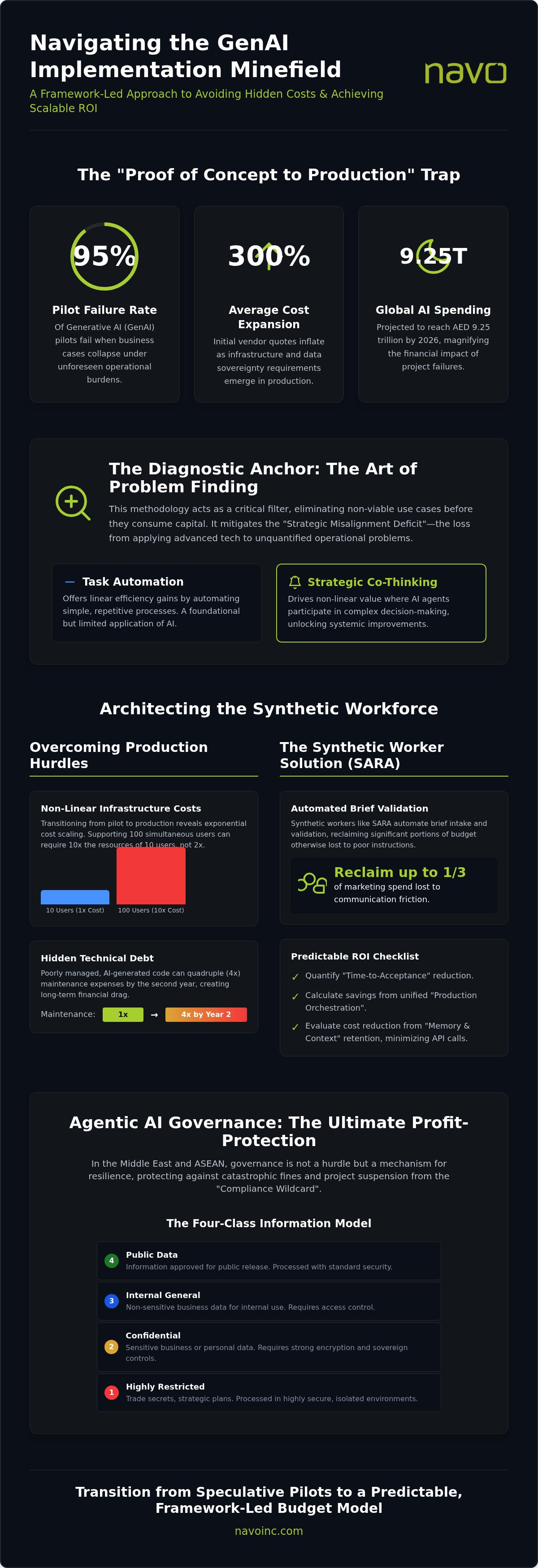
While global AI spending is projected to reach AED 9.25 trillion in 2026, a staggering 95% of Generative Artificial Intelligence (GenAI) pilots fail because their business cases collapse under the weight of unforeseen operational burdens. You likely recognize the 'Proof of Concept' (PoC) to production trap, where initial vendor quotes often expand by 300% as infrastructure and data sovereignty requirements emerge. Transitioning from an experimental phase to a scaled, agentic ecosystem requires more than technical optimism; it demands a sophisticated strategic response. This guide provides the diagnostic rigor necessary for avoiding hidden costs of AI projects, offering a framework-led budget model that ensures your initiatives drive net profit rather than technical debt. We will explore the 'Art of Problem Finding' to dismantle the '18-Month Wall' and establish a governance-first architecture, utilizing synthetic workers like SARA, designed to satisfy board-level risk requirements in the United Arab Emirates.
Key Takeaways
- Employ the "Art of Problem Finding" as a rigorous diagnostic anchor to identify and eliminate non-viable use cases before they incur substantial capital expenditure.
- Mitigate the risks associated with the Proof of Concept (PoC) to production transition by deploying synthetic workers like SARA to minimize operational friction.
- Implement a sophisticated four-class information model as a primary strategy for avoiding hidden costs of AI projects while maintaining compliance with Middle Eastern data sovereignty laws.
- Transition from speculative pilots to a predictable, framework-led budget model that prioritizes tangible net-profit gains and long-term systemic health.
The Art of Problem Finding: Mitigating the Strategic Misalignment Deficit
The "Strategic Misalignment Deficit" represents the substantial financial loss incurred when enterprises deploy sophisticated technology against "Unknown Knowns," which are existing operational inefficiencies that remain unquantified during the initial planning phase. Navo Inc. positions "The Art of Problem Finding" as a critical diagnostic anchor, filtering out non-viable use cases before they consume significant capital. This methodology is the first step in avoiding hidden costs of AI projects, ensuring that every dirham (د.إ) spent aligns with a verified business outcome. Executives must distinguish between simple "Task Automation," which offers linear efficiency, and "Strategic Co-Thinking," where Artificial Intelligence (AI) agents participate in complex decision-making processes to drive non-linear value. The "Clarify-Enable-Protect-Evolve" framework functions as a sophisticated financial safeguard, preventing budget leakage by establishing a clear value proposition and architectural feasibility during the initial discovery phase.
The Cost of "Unknown Unknowns" in Enterprise Strategy
Utilizing rigorous readiness surveys prevents the "Failure Epidemic" that currently claims 80% of enterprise AI projects. These diagnostics pinpoint "Machine-in-the-Loop" opportunities where synthetic workers offer the highest marginal utility, rather than deploying AI as a generic solution. Without this clarity, organizations often underestimate AI data center costs, leading to infrastructure waste that scales non-linearly as usage expands across the Gulf states. To build a resilient foundation, explore our strategic AI roadmap development services for expert guidance on Middle Eastern regulatory alignment. This diagnostic rigor ensures that project scopes remain bounded, allowing for outcome-guaranteed efficiency gains that satisfy both operational and board-level requirements.
Architecting the Synthetic Workforce: Operational Efficiency vs. Infrastructure Waste
Transitioning from a sandbox to a live environment is the primary catalyst for budget failure. While a pilot might appear cost-effective, the Total Cost of Ownership (TCO) often triples once real-world data volumes and user loads are introduced. This transition is where the strategy for avoiding hidden costs of AI projects becomes paramount. Infrastructure costs do not scale linearly; supporting 100 simultaneous users can require ten times the resources of ten users. Without a disciplined architecture, these non-linear spikes can derail even the most promising initiatives.
We utilize synthetic workers like SARA to automate brief validation, reclaiming up to one-third of marketing spend lost to poor instructions. Navo Inc. manages the production orchestration, providing a rigorous audit trail that prevents unmonitored "shadow AI" expenditures. Poorly managed technical debt, specifically the hidden costs of AI-generated code, can quadruple maintenance expenses by the second year. Tool-agnostic orchestration allows your architecture to evolve without being locked into expensive, proprietary ecosystems. For organizations seeking to optimize these workflows, we recommend a consultation on agentic architecture to ensure structural excellence.
The Synthetic Worker ROI Checklist
To ensure long-term systemic health, executives should follow a methodical evaluation process. First, quantify the "Time-to-Acceptance" reduction achieved through SARA’s automated brief intake. Second, calculate "Production Orchestration" savings by replacing fragmented legacy tools with unified agentic workflows. Finally, evaluate "Memory and Context" retention costs; state-aware agents reduce the need for expensive, repeated Application Programming Interface (API) calls required by stateless models, significantly lowering operational overhead in the long term. This structured approach transforms speculative spending into a predictable, outcome-guaranteed investment.
Agentic AI Governance: A Framework for Regulatory Resilience and Scalable ROI
Governance in the Middle East and the Association of Southeast Asian Nations (ASEAN) is often mischaracterized as a bureaucratic hurdle, yet it serves as the ultimate profit-protection mechanism. The "Compliance Wildcard" encompasses complex data safeguards and sovereign cloud requirements that, if ignored, can result in catastrophic fines and project suspension. By implementing a "Classification Framework," enterprises utilize a four-class information model to categorize and safely process confidential data. This strategic rigor is essential for avoiding hidden costs of AI projects, particularly when navigating the evolving regulatory landscapes of Dubai and Riyadh. A governance-first approach ensures that every Artificial Intelligence (AI) initiative operates within a predefined ethical and financial boundary.
Our "Desensitisation Toolkit" provides twelve repeatable techniques, including tokenization and data aggregation, to significantly lower the cost of data preparation. This methodology reduces the operational drag associated with manual review while ensuring strict compliance with local data residency laws. Beyond legal risks, unmanaged scaling contributes to the environmental costs of generative AI, which eventually manifest as increased infrastructure levies. By treating governance as a profit-protection layer, organizations can scale their agentic ecosystems without the fear of unpredictable regulatory interventions or ballooning resource consumption.
Future-Proofing for the "Agentic Era" in 2026
Aligning corporate AI policy with National Institute of Standards and Technology (NIST) and Information Commissioner’s Office (ICO) privacy guidance prevents expensive retroactive restructuring as regulations tighten. Establishing "Human-Ownership" mechanisms ensures accountability and mitigates algorithmic drift, which can otherwise erode Return on Investment (ROI) over an eighteen-month horizon. This disciplined oversight is a core pillar for avoiding hidden costs of AI projects in high-stakes environments. To achieve this level of structural excellence, learn more about Vasudevan Kidambi’s leadership in Synthetic Workforce Architecture. This proactive stance transforms governance from a cost center into a definitive competitive advantage for visionary leaders across the Gulf states.
Building a Resilient Architecture for Sustained AI Profitability
Success in 2026 requires moving beyond speculative pilots toward a disciplined, framework-led budget model. By anchoring your strategy in the diagnostic rigor discussed today, you eliminate the infrastructure waste that often triples initial estimates. It's the most effective strategy for avoiding hidden costs of AI projects while ensuring compliance with regional data residency requirements across the Gulf states.
Navo Inc., led by Vasudevan Kidambi, author of "Synth Worker," provides a steady, expert hand for navigating these complex organizational shifts. Our approach includes a guaranteed net-profit increase for enterprise clients and Continuing Professional Development (CPD) UK-certified masterclasses for leadership teams. You don't have to face technological frontiers alone; structural excellence is within reach through rigorous, battle-tested consultancy.
Transform your visionary goals into a predictable reality and establish a position of leadership in the evolving Middle Eastern digital economy.
Frequently Asked Questions
What are the most common hidden costs in Generative Artificial Intelligence (GenAI) projects?
The primary hidden expenses involve non-linear infrastructure scaling and unmanaged technical debt. While a pilot may seem affordable, moving to production often triples the Total Cost of Ownership (TCO) due to cloud egress fees and idle compute time. A focus on avoiding hidden costs of AI projects requires identifying these "Unknown Knowns" during the diagnostic phase to prevent budget ballooning.
Why do most AI Proof of Concepts (PoCs) fail to deliver a measurable Return on Investment (ROI)?
Most Proof of Concepts (PoCs) fail because they prioritize technical feasibility over strategic alignment. Without a clear diagnostic anchor, organizations often automate inefficient processes rather than redesigning workflows for higher marginal utility. This lack of structural excellence leads to a business case collapse once the actual operational costs of scaling the Artificial Intelligence (AI) model are realized.
How does the "Art of Problem Finding" framework reduce enterprise AI project expenses?
The "Art of Problem Finding" serves as a rigorous diagnostic filter that eliminates non-viable use cases before significant capital is committed. By identifying hidden operational inefficiencies and distinguishing between simple task automation and strategic co-thinking, this framework ensures that investment is only directed toward initiatives with a guaranteed net-profit impact. This disciplined approach is a cornerstone for avoiding hidden costs of AI projects.
What is the "Classification Framework" and how does it lower compliance costs in the GCC and Singapore?
The "Classification Framework" is a four-class information model designed to categorize data based on sensitivity and regulatory requirements. In the Gulf Cooperation Council (GCC) and Singapore, this model lowers compliance costs by preventing expensive retroactive restructuring and mitigating the risk of regulatory fines. It allows organizations to utilize confidential data safely while maintaining strict alignment with local data residency laws.
Disclaimer
The views and opinions expressed in this article are those of the author and do not represent any organisation, client, institution, or professional body with which he may be associated. The content is intended for general information, education, and thought leadership. Readers should seek appropriate professional advice before making legal, financial, investment, regulatory, technology, or business decisions.
The author has taken reasonable care to ensure the accuracy of the information and sources available at the time of publication. Technologies, regulations, market conditions, and industry practices may evolve, and readers are encouraged to verify current information independently. Any examples, cases, or scenarios may have been simplified, anonymised, or adapted to protect confidentiality. The author and publisher accept no liability for decisions or outcomes arising from the use of this content.
Generative AI tools may have been used to support research, structuring, or language refinement, with the final content, judgment, and editorial responsibility retained by the author.