

The assumption that Generative Artificial Intelligence (GenAI) is merely a tool for incremental efficiency is a strategic miscalculation that risks organizational obsolescence. While many firms in the United Arab Emirates (UAE) have accelerated their digital adoption, stagnant growth and elusive Return on Investment (ROI) remain pervasive challenges. You likely recognize that current implementations lack the structural depth required to impact net profit significantly. This analysis explores AI-driven business model innovation examples that shift the focus from basic task automation to the deployment of agentic architectures. You'll discover how synthetic workforce models are fundamentally restructuring value creation through the lens of The Art of Problem Finding. We provide a rigorous framework for aligning autonomous agents with corporate governance, ensuring your transition from a traditional labor-based cost structure to a high-performance, agentic enterprise is both secure and profitable.
Key Takeaways
- Shift from the "Productivity Trap" to structural business model innovation by redesigning how your organization captures value, moving beyond simple task automation.
- Analyze high-impact AI-driven business model innovation examples, specifically the transition toward "Outcome-as-a-Service" where revenue is tied to measurable results rather than labor hours.
- Discover how to deploy a synthetic workforce architecture, utilizing agentic models like SARA and NOVA to create a scalable, autonomous operational layer within your firm.
- Establish a robust framework for corporate AI governance and data desensitization to navigate the unique regulatory and cultural landscapes of the UAE and the broader Gulf region.
The Evolution from AI Integration to Structural Business Model Innovation
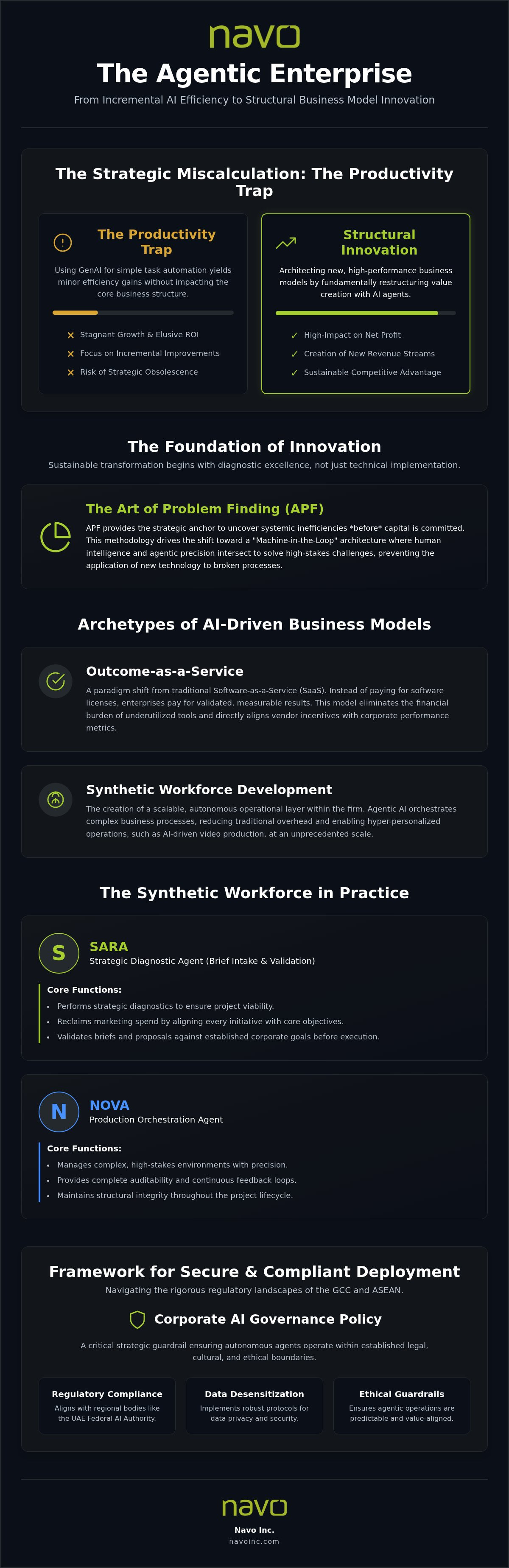
True AI-driven business model innovation examples involve the radical restructuring of value creation, delivery, and capture mechanisms. Many enterprises in the United Arab Emirates (UAE) currently suffer from the "Productivity Trap," where Generative Artificial Intelligence (GenAI) adoption yields minor efficiency gains without altering the underlying competitive position. In contrast, structural innovation utilizes GenAI to architect new revenue streams that were previously impossible. By integrating GenAI as an intellectually rigorous co-thinking partner, executives can navigate the complex organizational shifts required for 2026 leadership. Standard consulting frameworks often stumble here; they lack the specialized tools to manage the "unknown unknowns" inherent in autonomous agentic systems. A successful business model must now account for synthetic labor as a primary operational pillar rather than a peripheral digital tool.
The Art of Problem Finding: The Foundation of Innovation
Sustainable innovation begins with diagnostic excellence rather than technical implementation. The Art of Problem Finding (APF) provides the necessary strategic anchor, uncovering systemic inefficiencies before capital is committed. This methodology drives the shift toward a "Machine-in-the-Loop" architecture, where human intelligence and agentic precision intersect to solve high-stakes challenges. We employ the proprietary Six Lanes of Working framework to audit enterprise readiness, ensuring every organizational layer is prepared for AI-driven business model innovation examples at scale. This diagnostic rigor prevents the common pitfall of applying cutting-edge technology to broken processes. It instead fosters a resilient ecosystem capable of navigating the high-stakes shifts of the Middle Eastern market while maintaining professional composure and structural excellence.
Archetypes of AI-Driven Models: Outcome-as-a-Service and Synthetic Labor
Modern AI-driven business model innovation examples represent a departure from traditional Software-as-a-Service (SaaS) toward results-oriented paradigms. As highlighted in research on AI-Driven Business Models, the "Outcome-as-a-Service" model allows enterprises to pay for validated results rather than seat-based licenses. This shift eliminates the financial burden of underutilized software and aligns vendor incentives with corporate performance. Central to this evolution is the implementation of Synthetic Workforce Development, a scalable operational layer where Agentic Artificial Intelligence (AI) orchestrates complex business processes. This architecture reduces traditional overhead while enabling hyper-personalized AI Video Production for corporate identity and internal communication at an unprecedented scale.
Synthetic Workers in Practice: SARA and NOVA
The deployment of specialized agents provides a concrete pathway for structural change. SARA (Brief Intake & Validation) functions as a strategic diagnostic agent, reclaiming marketing spend by ensuring every initiative aligns with core organizational objectives before execution. In more complex, high-stakes environments, NOVA (Production Orchestration) provides the necessary auditability and feedback loops to maintain structural integrity. These AI-driven business model innovation examples are explored in depth within the 2026 publication "Synth Worker - A Whole New Workforce Layer," which serves as the definitive practitioner’s guide for this transition. Establishing these autonomous layers requires a disciplined approach to organizational design. To determine the optimal agentic configuration for your firm, you may consult with our strategic advisors for a tailored diagnostic session.
Implementing AI Innovation: Governance and ROI in the GCC and ASEAN
Executing AI-driven business model innovation examples within the rigorous regulatory frameworks of the GCC (Gulf Cooperation Council) and ASEAN (Association of Southeast Asian Nations) requires more than technical proficiency; it demands a robust Corporate AI Governance Policy. This policy acts as a definitive strategic guardrail, ensuring that autonomous agents operate within the legal and cultural boundaries established by the UAE (United Arab Emirates) Federal AI Authority and other regional regulatory bodies. A critical component for Middle Eastern and Indian markets is the implementation of a desensitization toolkit for Confidential-Transformable data. This ensures that proprietary intelligence is leveraged safely without compromising national sovereignty or corporate security. By adopting these AI-driven business models, organizations can transition from experimental pilot projects to sustained structural profitability. To justify these high-stakes shifts to the Board, we utilize the Navo Inc. ROI (Return on Investment) calculator, which prioritizes net-profit guarantees over speculative efficiency gains, providing the analytical composure required for executive buy-in.
The Navo Inc. Masterclass: From Pilot to Profit
Our CPD (Continuing Professional Development) UK-certified masterclasses bridge the "synthetic skill" gap by providing a structured five-week transformation journey designed for senior leadership. This evolution includes a rigorous Pre-prep phase, an Intensive Masterclass, and a final Activation Arc to ensure systemic health. During this process, agentic AI services are seamlessly integrated into existing governance structures, ensuring that synthetic workers enhance rather than disrupt established operational workflows. These AI-driven business model innovation examples demonstrate that resilient growth is a byproduct of disciplined orchestration rather than tool adoption. We invite leadership teams to complete our customized diagnostic readiness survey on the Navo Inc. contact page to begin their evolution toward an outcome-guaranteed future in the Middle Eastern and ASEAN markets.
Architecting the Agentic Future: Beyond Incremental Gains
The transition from digital integration to structural excellence requires a disciplined departure from the productivity trap. By analyzing the AI-driven business model innovation examples explored here, it's clear that 2026 leadership depends on the seamless orchestration of synthetic labor within rigorous governance frameworks. Organizations that prioritize the Art of Problem Finding over superficial tool adoption will secure a decisive competitive advantage in the Middle Eastern and ASEAN markets. We provide outcome-guaranteed strategy consulting and CPD (Continuing Professional Development) UK-certified executive coaching to ensure your transformation delivers measurable financial resilience. Aligning agentic architectures with systemic health is no longer an optional evolution but a prerequisite for sustained corporate relevance.
We look forward to partnering with your leadership team to navigate these complex organizational shifts with confidence and analytical precision.
Frequently Asked Questions
What is the difference between AI automation and AI-driven business model innovation?
AI automation focuses on optimizing existing tasks to reduce labor hours and operational costs. In contrast, AI-driven business model innovation examples involve the fundamental redesign of value capture, such as transitioning from seat-based licensing to outcome-based revenue models. This shift transforms Generative Artificial Intelligence (GenAI) from a utility tool into a core strategic engine that generates entirely new revenue streams.
How does the Art of Problem Finding framework assist in AI strategy?
The Art of Problem Finding (APF) framework serves as a diagnostic anchor that identifies systemic organizational gaps before technology is deployed. It prevents the common error of automating flawed processes. By utilizing APF, leadership teams can pinpoint high-impact areas for agentic orchestration, ensuring that AI investments solve critical structural challenges rather than addressing surface-level symptoms or redundant workflows.
Can synthetic workers like SARA and NOVA be integrated into existing HR policies?
Synthetic workers such as SARA and NOVA are integrated into organizational structures as a scalable workforce layer rather than traditional employees. While they don't fall under standard labor laws, they must be governed by a Corporate AI Governance Policy. This ensures their outputs are auditable and that their interactions align with existing internal accountability standards and performance metrics without disrupting human-centric Human Resources (HR) policies.
What are the legal considerations for AI-driven business models in Dubai and the GCC?
Legal considerations in the Gulf Cooperation Council (GCC) center on data sovereignty and the mandates of the United Arab Emirates (UAE) Federal AI Authority established in June 2026. Organizations must implement desensitization toolkits for Confidential-Transformable data to remain compliant with regional security standards. Navigating AI-driven business model innovation examples in Dubai requires a deep understanding of these evolving, risk-based regional regulations.
Disclaimer
The views and opinions expressed in this article are those of the author and do not represent any organisation, client, institution, or professional body with which he may be associated. The content is intended for general information, education, and thought leadership. Readers should seek appropriate professional advice before making legal, financial, investment, regulatory, technology, or business decisions.
The author has taken reasonable care to ensure the accuracy of the information and sources available at the time of publication. Technologies, regulations, market conditions, and industry practices may evolve, and readers are encouraged to verify current information independently. Any examples, cases, or scenarios may have been simplified, anonymised, or adapted to protect confidentiality. The author and publisher accept no liability for decisions or outcomes arising from the use of this content.
Generative AI tools may have been used to support research, structuring, or language refinement, with the final content, judgment, and editorial responsibility retained by the author.