

If your organization spent the last five years perfecting Robotic Process Automation (RPA) only to find your digital workforce paralyzed by a single user interface update, you are facing a structural crisis. In the high-stakes environment of Dubai’s digital economy, the "brittleness" of traditional scripts has become a liability that few executives can afford. When evaluating synthetic worker vs robotic process automation, the distinction lies between a bot that follows a rigid map and an agent that understands the destination. You've likely recognized the mounting costs of maintaining legacy automations that lack the cognitive reasoning to handle unstructured data. This article examines why the transition to synthetic workers, such as our SARA and NOVA architectures, represents the defining shift for enterprise resilience in 2026. Using the Art of Problem Finding framework, we will analyze the move toward outcome-guaranteed intelligence that aligns with the rigorous standards of the Dubai Electronic Security Center (DESC).
Key Takeaways
- Transition from the rigid, rule-based execution of traditional Robotic Process Automation (RPA) to cognitive agents that operate at the reasoning layer of Large Language Models (LLMs).
- Identify why the debate of synthetic worker vs robotic process automation is the key to solving "broken bot" syndrome and maintaining operational resilience during User Interface (UI) updates.
- Apply "The Art of Problem Finding" framework to ensure your automation strategy addresses root-cause organizational challenges rather than merely accelerating inefficient legacy processes.
- Establish a robust Corporate AI Governance Policy that balances agentic autonomy with human accountability, specifically tailored to the regulatory landscapes of Dubai and the Gulf states.
Defining the Paradigm Shift: From Scripted Execution to Cognitive Agency
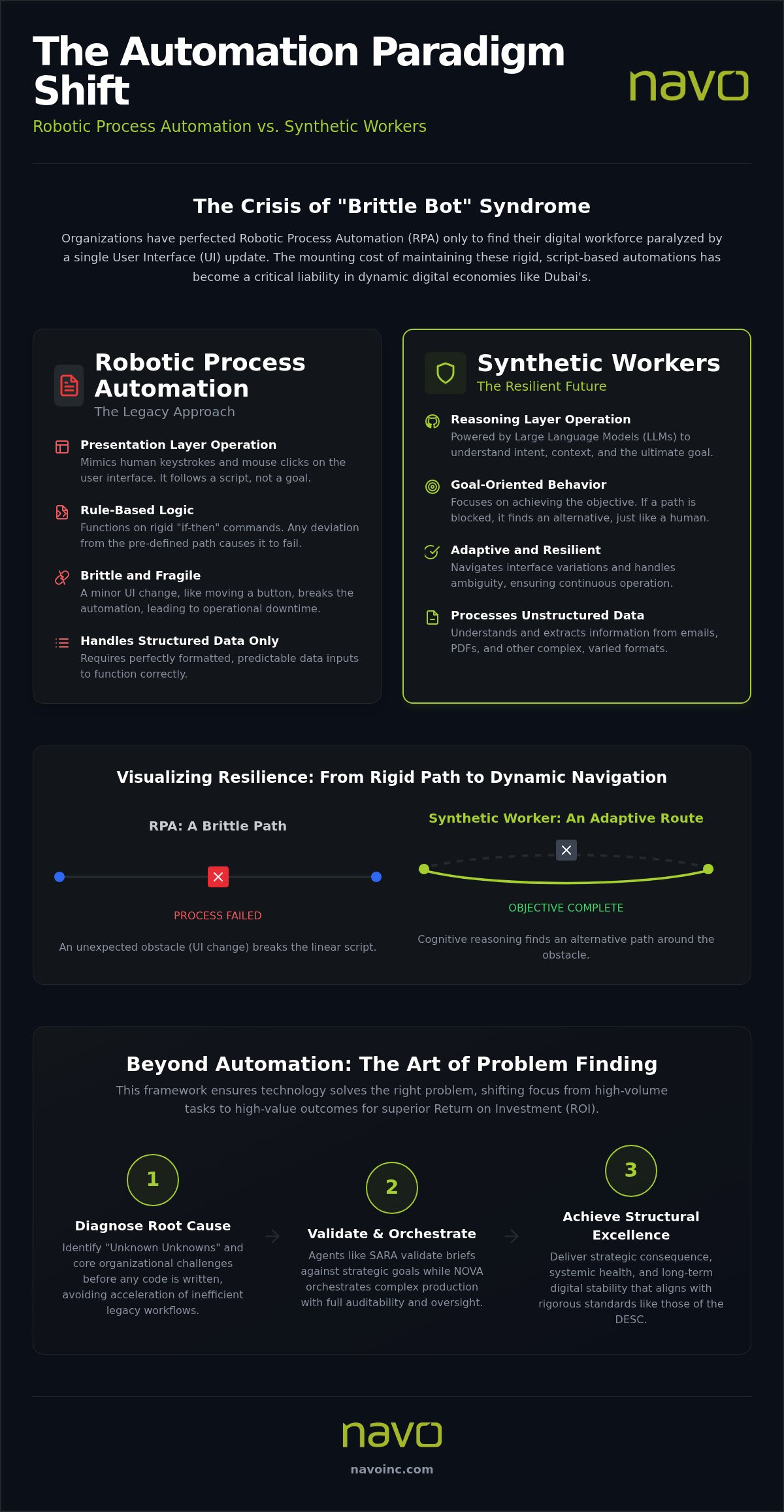
The current organizational landscape in 2026 exhibits a fundamental departure from the era of superficial task automation. For over a decade, Robotic process automation (RPA) has served as a reliable, albeit limited, digital executor. It operates primarily at the presentation layer, mimicking human keystrokes through rigid, pre-defined scripts. The inherent limitation of this approach is its fragility; when a user interface changes, the script inevitably fails. This "brittle bot" syndrome has historically cost Dubai firms millions in maintenance and operational downtime, necessitating a more resilient solution.
The strategic discourse surrounding synthetic worker vs robotic process automation has shifted toward a total architectural pivot. Synthetic workers operate at the reasoning layer, powered by Large Language Models (LLMs). They don't just execute; they adapt. This move toward cognitive agency allows for a digital workforce that possesses memory and navigates the ambiguity of unstructured data. Productivity is no longer measured by hours saved but by strategic consequence and the "co-thinking" value provided to leadership. It's a transition from simple efficiency to systemic health.
The Core Differentiators: Rules vs. Reasoning
Traditional RPA relies on "if-then" logic, a binary pathway that collapses under complexity. The proprietary synthetic architecture championed by Navo Inc., which includes SARA for brief validation and NOVA for orchestration, utilizes goal-oriented behavior. While an RPA bot might stall if a form field moves, a synthetic worker uses cognitive reasoning to locate the necessary data point and complete the objective. This evolution allows organizations to move beyond mere efficiency toward structural excellence and long-term digital stability.
The Architecture of Autonomy: Why Synthetic Workers Outperform Brittle RPA
The persistent failure of traditional bots when faced with minor User Interface (UI) adjustments remains the primary drain on automation budgets. When comparing a synthetic worker vs robotic process automation, the architectural resilience of the former becomes evident through its ability to interpret intent rather than just coordinates. While RPA requires manual reprogramming for every pixel shift, synthetic workers leverage cognitive reasoning to process unstructured data and navigate interface variations. This shift is explored in academic frameworks for integrating AI with RPA, where the focus moves from rigid execution to adaptive intelligence.
Applying 'The Art of Problem Finding' to Automation
Deploying technology to solve the wrong problem is a common strategic failure. We utilize "The Art of Problem Finding" to identify "Unknown Unknowns" before any code is written. This diagnostic approach ensures that firms in the Gulf region don't simply accelerate inefficient legacy workflows. By focusing on high-value outcomes instead of high-volume tasks, organizations achieve a superior Return on Investment (ROI).
Our specific agents, SARA and NOVA, exemplify this evolution. SARA, the Synthetic Assistant for Research and Analysis, reclaims marketing spend by validating project briefs against strategic goals before execution begins. Once validated, NOVA orchestrates production with a level of auditability that traditional RPA cannot match. This dual-layer approach provides the structural excellence needed to manage complex organizational shifts. Understanding the nuances of a synthetic worker vs robotic process automation deployment is essential for long-term systemic health. Organizations seeking to audit their current automation stack should consider a consultation on agentic transition to ensure their digital workforce remains unfazed by complexity.
Strategic Orchestration: Integrating Synthetic Workers into the Enterprise
Successful integration of a synthetic workforce requires a rigorous Corporate AI Governance Policy. This is especially true in the United Arab Emirates (UAE) and Singapore, where data sovereignty and security standards are non-negotiable. While the evolution of automation in government has paved the way for digital efficiency, private enterprises must now adopt a "Machine-in-the-Loop" philosophy. This ensures that while agents handle the cognitive heavy lifting, human accountability remains the anchor. It's a key distinction in the synthetic worker vs robotic process automation debate; RPA is a tool, but a synthetic worker is a partner that requires defined boundaries.
Our approach leverages a specialized Classification Framework to handle restricted data securely. This allows firms to utilize Generative Artificial Intelligence (GenAI) without compromising sensitive organizational intelligence. By moving toward an outcome-based strategy, we align technological deployment with a net-profit guarantee. This ensures that every dirham (د.إ) invested in automation translates into measurable systemic health rather than just temporary cost reduction.
Governance and Cultural Sensitivity in the GCC and ASEAN
Navigating the regulatory landscapes of the Gulf Cooperation Council (GCC) and the Association of Southeast Asian Nations (ASEAN) requires more than technical skill. It demands cultural alignment. Leadership teams must bridge the "synthetic skills" gap through Continuing Professional Development (CPD) UK-certified masterclasses. This training empowers executives to manage high-stakes transitions with professional composure. At Navo Inc., we provide the steady hand needed to architect these changes, ensuring that your AI workforce strategy respects local sensitivities while driving radical progress.
Architecting the Future of Enterprise Intelligence
The transition from rule-based scripts to cognitive agency isn't just a matter of technical preference; it's a requirement for organizational survival. By moving beyond the debate of synthetic worker vs robotic process automation, leaders replace brittle bots with resilient architectures like SARA and NOVA. This shift ensures your digital workforce adapts to complexity rather than collapsing under it. Integrating these agents through a robust Corporate AI Governance Policy secures your data while driving measurable systemic health. Our approach combines CPD UK-certified masterclasses with a net-profit increase guarantee, ensuring your strategic evolution remains grounded in financial performance and cultural sensitivity across the GCC.
The path to a resilient, agentic future begins with a single, disciplined step toward structural excellence.
Frequently Asked Questions
What is the primary difference between a synthetic worker and a standard RPA bot?
RPA (Robotic Process Automation) is a rule-based digital executor while synthetic workers are cognitive agents. RPA follows fixed scripts at the presentation layer, but synthetic workers use Large Language Models (LLMs) to reason through ambiguity. This fundamental shift in the synthetic worker vs robotic process automation landscape allows for goal-oriented behavior that adapts to process changes without manual reprogramming or operational downtime.
Can synthetic workers integrate with our existing legacy RPA systems?
Synthetic workers integrate seamlessly as an orchestration layer above legacy systems. They manage complex reasoning while triggering existing bots for routine execution. In the strategic comparison of a synthetic worker vs robotic process automation, this hybrid model allows firms to preserve legacy investments while introducing the cognitive flexibility required to handle modern, high-stakes organizational shifts and process variations.
How do we ensure data privacy when deploying synthetic workers in the UAE or Singapore?
Data privacy is maintained through a Corporate AI Governance Policy that adheres to the Dubai Electronic Security Center (DESC) standards. We utilize a specialized desensitization toolkit and classification framework to process restricted data securely. This approach ensures that Generative Artificial Intelligence (GenAI) capabilities are leveraged within a controlled environment that respects the legal and cultural sensitivities of the region.
What are the typical ROI metrics for a synthetic workforce vs. traditional automation?
While RPA metrics often center on Full-Time Equivalent (FTE) reduction, synthetic workers prioritize strategic outcomes and net-profit increases. We focus on reducing the high maintenance costs associated with brittle scripts that break during interface changes. Our engagements include a net-profit guarantee, ensuring that the deployment of cognitive agents delivers a measurable Return on Investment (ROI) that reflects systemic organizational health.
How does 'The Art of Problem Finding' framework prevent automation failure?
"The Art of Problem Finding" prevents failure by diagnosing the root cause of organizational friction before automation begins. It identifies "Unknown Unknowns" to ensure that firms don't merely accelerate inefficient legacy processes. By validating the strategic relevance of a task, this framework ensures that synthetic workers are deployed toward high-value outcomes rather than high-volume, low-impact activities that drain enterprise resources.
Is there a certification for leaders managing a synthetic workforce?
Leadership teams can obtain CPD (Continuing Professional Development) UK-certified masterclasses to manage the transition into the agentic era. These sessions empower executives with the intellectually rigorous tools needed to orchestrate agents like SARA and NOVA. This training bridges the "synthetic skills" gap, ensuring that human ownership and accountability remain central to the long-term strategic alignment of AI and business goals.
Disclaimer
The views and opinions expressed in this article are those of the author and do not represent any organisation, client, institution, or professional body with which he may be associated. The content is intended for general information, education, and thought leadership. Readers should seek appropriate professional advice before making legal, financial, investment, regulatory, technology, or business decisions.
The author has taken reasonable care to ensure the accuracy of the information and sources available at the time of publication. Technologies, regulations, market conditions, and industry practices may evolve, and readers are encouraged to verify current information independently. Any examples, cases, or scenarios may have been simplified, anonymised, or adapted to protect confidentiality. The author and publisher accept no liability for decisions or outcomes arising from the use of this content.
Generative AI tools may have been used to support research, structuring, or language refinement, with the final content, judgment, and editorial responsibility retained by the author.