

What if the primary obstacle to your organization's digital evolution isn't the complexity of the technology, but a fundamental misalignment between technical capability and strategic intent? Many executive leaders in the United Arab Emirates (UAE) find themselves paralyzed by the dual pressures of maintaining strict data confidentiality and the urgent mandate to modernize workflows. It's a common frustration to see substantial capital allocated to Generative Artificial Intelligence (GenAI) pilots that never reach full production due to shifting regulatory requirements. Executing a rigorous GenAI readiness assessment in Dubai is no longer a peripheral Information Technology (IT) task; it's a core requirement for structural excellence that begins with the Art of Problem Finding.
You've likely navigated the tension between the ambitious pillars of the UAE AI Strategy 2031 and the practical reality of local data residency laws. This guide provides a framework-led checklist designed to audit your organizational maturity and move beyond experimental curiosity. We'll explore how to align your technical infrastructure with specific business outcomes, facilitating a transition from human-only workflows to a machine-in-the-loop operating model. By the end of this analysis, you'll have a clear, audit-ready map to ensure your GenAI integration is both resilient and profitable.
Key Takeaways
- Define organizational readiness as the strategic intersection of cognitive architecture and workflow discipline to move past confidentiality paralysis and toward governed value creation.
- Implement a rigorous GenAI readiness assessment in Dubai to align your technical infrastructure with the projected Return on Investment (ROI) of cognitive labor.
- Navigate the complex regulatory landscape of the Gulf Cooperation Council (GCC) by embedding data residency requirements directly into your corporate AI governance framework.
- Accelerate the transition to a machine-in-the-loop operating model by deploying synthetic workers like SARA to manage the intake and orchestration of enterprise-wide AI use cases.
The Strategic Imperative: Defining Generative Artificial Intelligence (GenAI) Readiness in Dubai
Generative Artificial Intelligence (GenAI) readiness in the Dubai corporate sector is frequently mischaracterized as a purely technical milestone. In reality, it represents the sophisticated intersection of cognitive architecture, rigorous workflow discipline, and institutional governance. For the modern executive, a GenAI readiness assessment in Dubai serves as the diagnostic tool required to transition from "Confidentiality Paralysis", where sensitive data concerns stifle progress, to "Governed Value Creation". This shift is essential to align with the United Arab Emirates (UAE) AI Strategy 2031, which demands a move from experimental use cases toward outcome-guaranteed integration. Engaging a GenAI consultant today means securing a strategic co-thinking partner who prioritizes structural resilience over temporary technological trends.
The Failure of Pilot-First Thinking
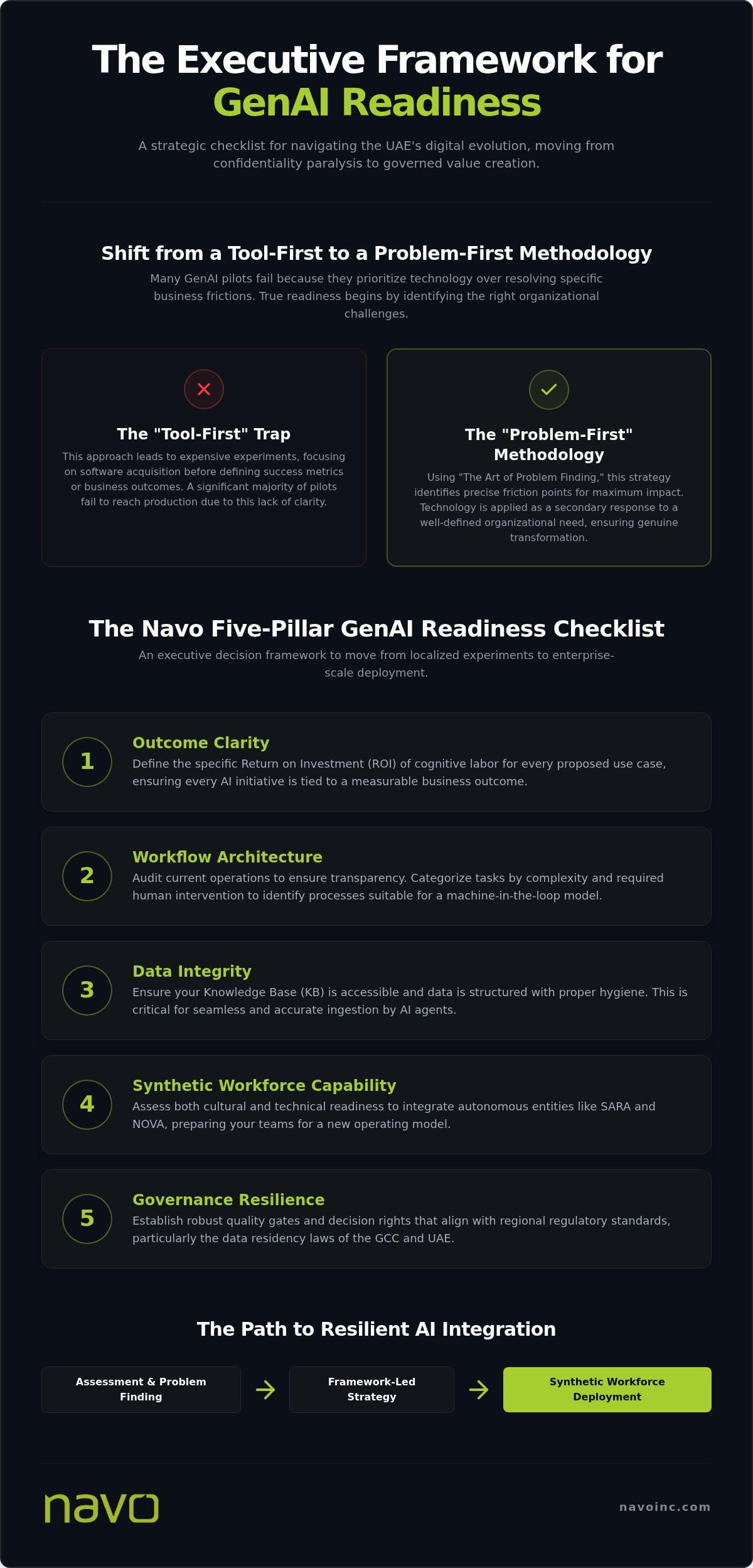
Many organizations rush into the deployment phase without establishing clear success metrics. Some industry reports indicate that a significant majority of enterprise AI pilots fail to reach production because they lack outcome clarity. This "Tool-First" approach prioritizes the acquisition of software over the resolution of specific business frictions. Strategic alignment requires a "Problem-First" methodology where the technological application is a secondary response to a well-defined organizational need. Without this foundation, investments often result in expensive experiments rather than systemic improvements.
The Art of Problem Finding as a Readiness Precursor
True readiness begins before a single line of code is written. Navo utilizes a proprietary approach known as "The Art of Problem Finding" to identify the precise friction points where machine-in-the-loop models can generate the highest yield. This diagnostic phase prevents "Solutionism", which is the tendency to apply AI to non-critical areas simply because the capability exists. By focusing on identifying the right organizational challenges first, the GenAI readiness assessment in Dubai becomes a roadmap for genuine transformation rather than a superficial tech upgrade. This disciplined inquiry ensures that every synthetic worker or automated workflow is architected for maximum impact and measurable efficiency.
The Navo Five-Pillar GenAI Readiness Checklist: An Executive Decision Framework
A comprehensive GenAI readiness assessment in Dubai requires a transition from qualitative assumptions to quantitative architectural benchmarks. Building upon the Art of Problem Finding, this framework provides the structural density needed to move from localized experiments to enterprise-scale deployment. We evaluate readiness through five distinct pillars that ensure your organization doesn't just adopt technology, but evolves its operating model. These pillars include:
- Outcome Clarity: Defining the specific Return on Investment (ROI) of cognitive labor for every proposed use case.
- Workflow Architecture: Utilizing the "Six Lanes of Working" framework to categorize tasks by complexity and human intervention requirements.
- Data Integrity: Ensuring Knowledge Base (KB) accessibility and structured data hygiene for seamless ingestion by AI agents.
- Synthetic Workforce Capability: Assessing the cultural and technical readiness to integrate autonomous entities like SARA and NOVA.
- Governance Resilience: Establishing quality gates and decision rights that align with regional regulatory standards.
Assessing Workflow Architecture
Success in a machine-in-the-loop environment depends on the transparency of your current operations. You must ask: are inputs, decision rights, and quality gates documented for every high-value process? If a human workflow is opaque, it's impossible to architect a synthetic counterpart. Identifying processes suitable for machine-in-the-loop thinking requires a granular audit of where cognitive friction exists. You can consult with our strategists to map these decision rights and ensure your architecture is ready for automation.
Synthetic Workforce and Agentic AI Readiness
True readiness involves defining specific, measurable roles for synthetic workers rather than treating Generative Artificial Intelligence (GenAI) as a generic productivity tool. This level of sophisticated orchestration is central to Mastering Agentic AI Services. Your organization's maturity is reflected in its ability to provide the necessary guardrails and API (Application Programming Interface) access for agentic systems to operate autonomously. A successful GenAI readiness assessment in Dubai determines if your infrastructure can support agents like SARA in briefing roles or NOVA in complex orchestration tasks without compromising security.
Navigating the Dubai Regulatory and Cultural Landscape: Governance as a Readiness Pillar
Governance within the Gulf Cooperation Council (GCC) is not a secondary consideration; it is a fundamental pillar of structural health. A rigorous GenAI readiness assessment in Dubai must prioritize the nuances of UAE Federal Decree-Law No. 45 of 2021 regarding the Protection of Personal Data. Organizations operating within the Dubai International Financial Centre (DIFC) or the Abu Dhabi Global Market (ADGM) face specific cross-border data transfer rules that dictate how Large Language Models (LLMs) process sensitive information. Readiness requires a sophisticated integration of the NIST (National Institute of Standards and Technology) Privacy Framework and ICO (Information Commissioner’s Office) anonymization guidance into local operating procedures.
Cultural sensitivity and ethical alignment remain non-negotiable for Middle Eastern enterprises. Generative Artificial Intelligence (GenAI) systems must be architected to respect regional norms in communication and content generation. High-stakes decision-making necessitates a strict Human-in-the-loop (HITL) requirement to ensure that autonomous outputs remain aligned with organizational values and societal expectations. This disciplined approach transforms governance from a restrictive barrier into a competitive advantage for governed value creation.
Schedule a Corporate Governance Consultation.
Corporate AI Governance Policy
A mature readiness profile includes a clearly defined Corporate AI Governance Policy that establishes permitted-use boundaries for LLMs. You must determine if your organization has implemented accountability mechanisms for autonomous AI agents. This involves setting quality gates that prevent data leakage and ensuring that every machine-generated outcome has a designated human owner. Accountability is the cornerstone of resilience in an automated environment.
The Role of CPD UK-Certified Training
Effective governance requires more than policy; it demands executive competence. Leadership must possess the intellectual rigor to oversee complex synthetic workflows, a standard often validated through professional accreditation. Our CPD Certified AI Course provides the necessary framework for C-suite leaders to govern GenAI with confidence. A GenAI readiness assessment in Dubai is incomplete without a plan for Continuing Professional Development (CPD) that addresses the evolving technological frontier. It's about building a team that understands the gravity of the shift.
Executing the Transition: From Assessment to Synthetic Workforce Deployment
The conclusion of a GenAI readiness assessment in Dubai marks the transition from diagnostic inquiry to a structured, 90-day execution roadmap. At Navo Inc., we serve as the architects for this evolution, ensuring that every technological shift is rooted in structural excellence and outcome-guaranteed results. This phase isn't about incremental change; it's about deploying a sophisticated Synthetic Workforce Layer that redefines how cognitive labor is distributed within the enterprise.
Execution begins with SARA (Synthetic Client-Briefing Specialist), an autonomous agent designed to streamline the intake of complex use cases by ensuring every project aligns with the Art of Problem Finding. Once the strategic parameters are established, NOVA takes over as the orchestration engine, managing the deployment and performance of synthetic workers across the organization. This dual-agent approach ensures that Generative Artificial Intelligence (GenAI) integration is both methodical and scalable.
Building the Synthetic Workforce Layer
Integrating AI agents as co-thinking partners requires a fundamental shift in leadership perspective. These synthetic workers don't replace human intelligence; they amplify it by handling high-frequency cognitive tasks. By automating these processes, your human teams are liberated to focus on high-stakes strategic initiatives. To understand the full scope of this partnership, consult The Executive Guide to GenAI Consulting Services for a detailed look at the 2026 landscape.
Measuring Success: Efficiency vs. Net Profit
The ultimate validation of a GenAI readiness assessment in Dubai is its impact on the bottom line. While many organizations settle for "Efficiency Gains", we advocate for "Measurable Net Profit Increases" as the primary Key Performance Indicator (KPI). True maturity is found when the machine-in-the-loop model directly contributes to the financial health and competitive resilience of the organization. This focus on tangible outcomes ensures that your GenAI strategy remains a driver of growth within the competitive Gulf Cooperation Council (GCC) landscape rather than a drain on resources.
Administer a GenAI Readiness Diagnostic with Navo Inc.
Architecting the Machine-in-the-Loop Enterprise
The shift toward a machine-in-the-loop operating model is a strategic imperative that demands more than superficial technical updates. It requires a disciplined commitment to structural excellence and the Art of Problem Finding. By prioritizing workflow architecture and resilient governance, your organization can move beyond experimental pilots toward governed value creation that aligns with the UAE AI Strategy 2031. This transition is not merely about adoption; it is about the evolution of systemic health.
Executing a comprehensive GenAI readiness assessment in Dubai provides the diagnostic clarity needed to deploy a synthetic workforce layer with confidence. Navo Inc. offers the sophisticated, Dubai-based executive expertise required to navigate this complex shift. Our approach utilizes CPD UK (Continuing Professional Development United Kingdom) accredited frameworks to ensure your leadership is equipped for the 2026 landscape. We stand as a steady, expert partner, offering outcome-guaranteed consulting that transforms organizational friction into measurable net profit.
Take a Strategic GenAI Readiness Assessment for your Organization
The future of the Gulf enterprise belongs to those who architect their digital evolution with precision and foresight. It's time to move from curiosity to a governed, high-yield reality.
Frequently Asked Questions
What are the primary indicators of GenAI readiness for a Dubai-based enterprise?
Primary indicators include the existence of a permitted-use boundary for Large Language Models (LLMs) and the documentation of decision rights within high-value workflows. A successful GenAI readiness assessment in Dubai also evaluates the accessibility of the organizational Knowledge Base (KB) for potential synthetic workers. Readiness is marked by a shift from experimental curiosity to a machine-in-the-loop operating model where quality gates are clearly defined and measurable.
How does the UAE Data Protection Law affect Generative AI (GenAI) implementation?
UAE Federal Decree-Law No. 45 of 2021 establishes strict parameters for the processing of personal data, necessitating localized hosting or specific consent for cross-border transfers. Organizations must ensure that Generative Artificial Intelligence (GenAI) systems comply with these residency requirements to avoid significant legal exposure. This regulatory framework demands that data integrity and anonymization protocols are embedded directly into the corporate AI governance policy to ensure governed value creation.
Can we conduct a GenAI readiness assessment without exposing sensitive corporate data?
A rigorous assessment prioritizes the evaluation of structural frameworks and workflow logic over the ingestion of live, sensitive datasets. The diagnostic process focuses on auditing your governance resilience and the "Six Lanes of Working" to identify where automation is feasible without compromising confidentiality. This approach ensures that your GenAI readiness assessment in Dubai remains a secure, diagnostic exercise that respects regional data privacy standards while identifying high-yield friction points.
What is the difference between technical AI readiness and strategic "Problem Finding" maturity?
Technical readiness focuses on the availability of Application Programming Interfaces (APIs) and the stability of computational infrastructure. Strategic maturity involves the "Art of Problem Finding", which is the ability to identify the precise friction points where machine-in-the-loop models can generate a measurable Return on Investment (ROI). True maturity ensures that technology serves as a sophisticated response to a well-defined business challenge rather than an expensive, aimless experiment.
How long does a comprehensive GenAI readiness assessment typically take for a large organization?
A comprehensive diagnostic typically requires a period of four to eight weeks for a large enterprise, depending on the complexity of its internal workflows and decision-making structures. This timeline allows for a deep audit of cognitive labor distribution and the establishment of a 90-day execution roadmap. The duration ensures that the resulting strategy is not a superficial checklist but a resilient architect's plan for systemic transformation and long-term profitability.
Generative AI tools may have been used to support research, structuring, or language refinement, with the final content, judgment, and editorial responsibility retained by the author.*
Disclaimer
The views and opinions expressed in this article are those of the author and do not represent any organisation, client, institution, or professional body with which he may be associated. The content is intended for general information, education, and thought leadership. Readers should seek appropriate professional advice before making legal, financial, investment, regulatory, technology, or business decisions.
The author has taken reasonable care to ensure the accuracy of the information and sources available at the time of publication. Technologies, regulations, market conditions, and industry practices may evolve, and readers are encouraged to verify current information independently. Any examples, cases, or scenarios may have been simplified, anonymised, or adapted to protect confidentiality. The author and publisher accept no liability for decisions or outcomes arising from the use of this content.
Generative AI tools may have been used to support research, structuring, or language refinement, with the final content, judgment, and editorial responsibility retained by the author.