

The traditional methodology for evaluating Return on Investment (ROI) will inevitably fail when applied to the 2026 synthetic workforce. While many executives across the Gulf Cooperation Council (GCC) recognize the transformative potential of automation, a pervasive confidentiality paralysis often stalls progress before it reaches the boardroom. You've likely found that quantifying the tangible impact of a digital labor force feels elusive amidst shifting regional regulations and the sheer velocity of technological change. Utilizing a sophisticated generative AI business case template is no longer a matter of administrative preference; it's a requirement for structural resilience and strategic clarity.
This article provides a rigorous, outcome-oriented framework designed to secure executive buy-in by linking Artificial Intelligence (AI) agents directly to net profit increases. We'll explore how to move beyond superficial tool selection by applying a diagnostic focus to your investment strategy, ensuring every technological deployment serves a measurable organizational goal. By the end of this analysis, you'll possess a governance-first adoption architecture that satisfies both the analytical demands of the board and the unique regulatory landscape of the Middle East. It's time to transition from passive observation to the disciplined orchestration of a high-performance synthetic workforce.
Key Takeaways
- Shift from traditional Information Technology (IT) investment models to a diagnostic framework that treats Generative Artificial Intelligence (GenAI) as a strategic evolution rather than a simple software procurement.
- Utilize a generative AI business case template that integrates the "Six Lanes of Working" to ensure every synthetic worker deployment is anchored in structural excellence and operational resilience.
- Quantify the economic shift from mere efficiency gains to substantial net profit increases while evaluating the Cost of Inaction (COI) within the high-stakes markets of the Gulf and Southeast Asia.
- Navigate the path to board approval by conducting a diagnostic readiness survey and structuring your proposal around the Clarify-Enable-Protect-Evolve architecture for secure, scalable adoption.
- Define the specific contributions of synthetic workers like SARA or NOVA to provide executive leadership with a clear, granular vision of the future human-AI partnership.
The Strategic Anatomy of a Generative Artificial Intelligence Business Case
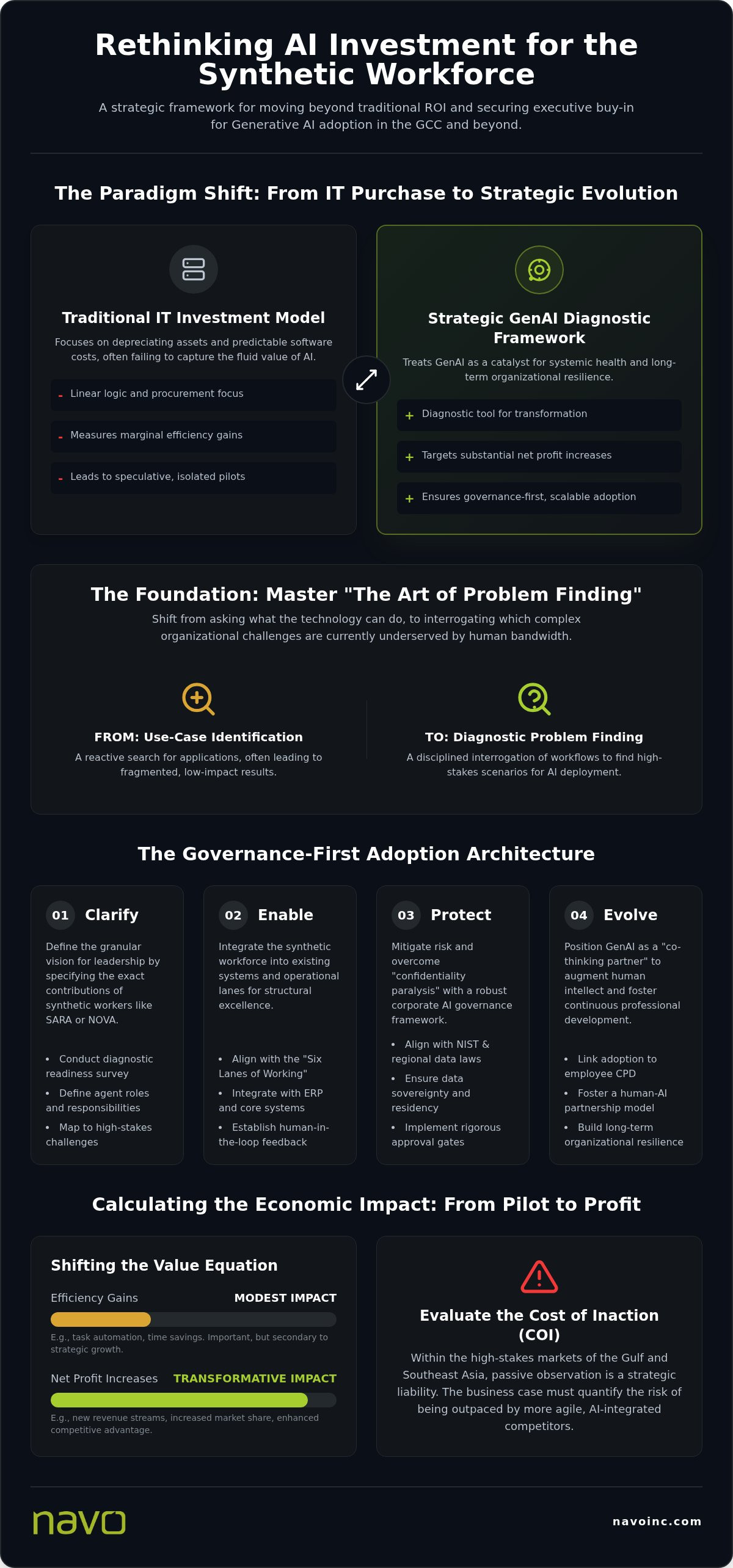
Constructing a robust generative AI business case template requires a departure from the linear logic of traditional technology procurement. Standard Information Technology (IT) investment models typically prioritize infrastructure depreciation and software licensing costs; however, these metrics fail to capture the fluid value of a synthetic workforce. A strategic business case functions as a diagnostic tool for enterprise transformation. It identifies where Generative Artificial Intelligence (GenAI) can serve as a catalyst for systemic health rather than just a marginal efficiency gain. This transition demands a shift from speculative experimental pilots to outcome-guaranteed profit increases that align with long-term organizational resilience.
The Art of Problem Finding: Beyond Use-Case Identification
Most organizations rush to identify use cases without first mastering the Art of Problem Finding. This diagnostic foundation utilizes the Question Economy Protocol to interrogate existing workflows. It uncovers the specific gap between your current operational reality and your ultimate synthetic potential. Instead of asking what the technology can do, we ask which complex organizational challenges are currently underserved by human bandwidth. This disciplined interrogation ensures the business case focuses on high-stakes scenarios where AI can deliver measurable results. It moves the conversation from "what is possible" to "what is necessary" for market leadership.
Executive Alignment and the Co-Thinking Partner Model
Securing board approval necessitates a vision where GenAI is positioned as a co-thinking partner rather than a mere replacement for human intellect. This alignment links adoption to Continuous Professional Development (CPD) and the broader evolution of your workforce. Using a structured generative AI business case template ensures these strategic links are explicitly documented for stakeholders. In the Gulf region, where regulatory frameworks are maturing rapidly, a governance-first approach is vital for long-term stability. By integrating these elements into your GenAI strategy, you move from speculative experimentation to a disciplined architecture for growth.
Core Components of the Navo Synthetic Workforce Template
The Navo generative AI business case template is built upon the "Six Lanes of Working" framework, ensuring that every technological intervention is mapped to a specific operational lane. Unlike generic templates that focus on isolated use cases, this strategic document requires a comprehensive definition of the synthetic workforce layer. It moves beyond superficial tool selection to define the technical architecture and integration points within existing Enterprise Resource Planning (ERP) systems. By aligning with this structured approach, organizations can move from fragmented experimentation to a cohesive, board-ready adoption strategy that prioritizes structural excellence and systemic health.
Defining the Synthetic Worker Layer
A successful proposal must document the specific tasks and responsibilities of AI agents such as SARA or NOVA. It's not enough to suggest broad automation; the board requires a granular role definition that mirrors human job descriptions. This involves establishing feedback loops and rigorous approval gates to maintain human oversight of agentic outcomes. Integrating these synthetic workers into existing human teams allows for unprecedented scalability while ensuring that human expertise remains at the center of the decision-making process. For those looking to refine their orchestration strategy, Mastering Agentic AI Services provides an essential executive reference for this level of enterprise coordination.
Corporate AI Governance and Risk Mitigation
Confidentiality paralysis often stems from a lack of clear boundaries regarding data sovereignty. Our template incorporates alignment with the National Institute of Standards and Technology (NIST) Privacy Framework and the specific data residency laws prevalent across the Gulf Cooperation Council (GCC). By establishing permitted-use boundaries, organizations can protect their proprietary intellectual property while empowering employees to utilize these advanced tools safely. If you require a tailored approach to these regional complexities, you might consider consulting with our strategic advisors to finalize your governance architecture. This disciplined approach ensures that accountability remains firmly with human owners, even as synthetic agents operate with increasing autonomy.
Calculating the Economic Impact: From Pilot to Profit
Measuring the success of a synthetic workforce requires a rigorous transition from tracking "hours saved" to auditing net profit increases. Traditional Return on Investment (ROI) models often stall at the pilot stage because they fail to account for the systemic compounding of digital labor. A comprehensive generative AI business case template must include specific performance benchmarks, such as classification accuracy and time-to-acceptance for autonomous outputs. In the hyper-competitive corridors of Dubai and Singapore, the Cost of Inaction (COI) represents a tangible erosion of market share as competitors achieve superior operational margins through early adoption.
ROI Metrics for the Agentic Era
Quantifying the impact of Artificial Intelligence (AI) agents involves measuring the reduction in "brief waste" through automated validation systems. This waste occurs when human-to-human communication gaps lead to misaligned outputs and costly rework. By deploying synthetic workers to validate project requirements before execution, organizations can secure a direct link between technological deployment and bottom-line health. Calculating the scalability of these agents reveals a profound advantage; unlike traditional hiring, which scales linearly with cost, synthetic labor scales exponentially with minimal marginal expenditure.
Regional Economic Considerations
Navigating the unique economic landscapes of Riyadh, Dubai, and Singapore requires alignment with local digital transformation mandates. These regions aren't merely adopting technology; they're architecting new economic realities. Your business case should explicitly factor in the investment required for Continuous Professional Development (CPD) UK-certified training to ensure your human workforce can orchestrate these new tools effectively. For a deeper analysis of these shifts, our guide on Synthetic Workforce Development explores the 2026 executive landscape in detail. Success in these markets depends on demonstrating how AI agents support regional goals of resilience and systemic evolution.
Implementing the Framework: Your Path to Board Approval
The transition from strategic design to board-level execution requires a methodical, four-step approach. Initially, you must conduct a diagnostic readiness survey to establish a clear baseline of your current operational maturity. This data ensures your generative AI business case template is grounded in reality rather than theoretical potential. Following this, the drafting process utilizes the Clarify, Enable, Protect, and Evolve architecture. This structure allows you to define intent, prepare infrastructure, implement governance, and plan for long-term scaling in a single, cohesive document. To ensure safety, we integrate Human-In-The-Loop (HITL) approval protocols, establishing dual-acceptance locks that maintain human oversight over all agentic outcomes.
Moving from Confidentiality Paralysis to Governed Value
Board members across the Gulf Cooperation Council (GCC) often hesitate due to confidentiality paralysis, fearing that data sovereignty might be compromised. Overcoming this requires presenting risk-based decision paths that demonstrate how regional regulations are satisfied. By securing budget for outcome-guaranteed consulting and coaching, you shift the board's focus from the cost of technology to the certainty of profit. This disciplined approach provides non-technical stakeholders with the professional composure they expect from a strategic partner. For a deeper look at managing these high-level relationships, see our Executive Guide to GenAI Consulting.
The Navo Masterclass: Activating the Business Case
Once board approval is secured, the focus moves from documentation to activation through a Continuing Professional Development (CPD) UK-accredited masterclass journey. This five-week transformation process ensures that your workforce doesn't just receive tools but masters the orchestration of a synthetic labor force. We utilize evidence-based certification to validate that your team can maintain the systemic health of your Generative Artificial Intelligence (GenAI) ecosystem. This journey transforms the business case from a static proposal into a dynamic engine for net profit increase and organizational resilience.
Securing Your Position in the Synthetic Workforce Era
The transition toward a synthetic workforce is not merely a technological upgrade; it's a fundamental shift in enterprise architecture. By prioritizing the Art of Problem Finding over superficial tool adoption, organizations can transform their operational baseline into a resilient engine for growth. Utilizing a sophisticated generative AI business case template allows you to articulate this shift with the intellectual rigor and strategic clarity that boards demand. It's about moving beyond simple efficiency metrics to secure outcome-guaranteed profit increases through a disciplined, governance-first framework.
Success in the Gulf and Asian markets requires more than just vision. It demands a battle-tested roadmap. Integrating proprietary synthetic worker architecture and Continuing Professional Development (CPD) UK-accredited leadership coaching ensures your team is equipped to navigate the complexities of the 2026 landscape. You've now seen how to bridge the gap between pilot programs and systemic transformation. The architecture for your future is ready for deployment.
Download the Navo GenAI Business Case Framework
Take the decisive step toward structural excellence and lead your organization into its next phase of evolution.
Strategic Frequently Asked Questions
How do I calculate the Return on Investment (ROI) for a Generative AI business case?
Calculating Return on Investment (ROI) requires shifting from tracking "time saved" to auditing net profit increases. A robust generative AI business case template should quantify the reduction in "brief waste" and the exponential scalability of synthetic labor compared to traditional human hiring. This diagnostic approach ensures that every technological deployment is linked directly to the bottom line, providing the board with the financial clarity necessary for high-stakes approval.
What is the "Art of Problem Finding" and why is it critical for AI strategy?
The Art of Problem Finding is a diagnostic methodology used to identify underserved organizational challenges before selecting a technological solution. It's critical because most Generative Artificial Intelligence (GenAI) initiatives fail due to misaligned objectives rather than technical limitations. By interrogating existing workflows first, you ensure that AI agents are deployed where they can provide the most significant systemic impact and structural resilience.
How does the Navo template handle Corporate AI Governance in the Middle East?
Our framework incorporates strict alignment with regional data residency laws and the National Institute of Standards and Technology (NIST) Privacy Framework. This approach prevents confidentiality paralysis by establishing clear permitted-use boundaries for all synthetic workers. It addresses the specific regulatory landscape of the Gulf Cooperation Council (GCC) to ensure that your adoption strategy remains both legally compliant and ethically sound.
Can I use this template for both internal productivity and client-facing AI agents?
Yes, the template is designed to architect a comprehensive synthetic workforce layer that serves both internal operations and external client interactions. Whether you're deploying internal agents for data synthesis or external workers like SARA or NOVA for customer engagement, the framework provides the necessary governance and role definitions. This versatility allows for a unified strategy that scales across the entire enterprise ecosystem.
What are the most common reasons boards reject Generative AI business cases?
Boards typically reject proposals that lack a clear link between technology and profit or fail to address regional regulatory uncertainties. Many business cases are too speculative or focus on experimental pilots rather than outcome-guaranteed transformations. Utilizing a structured generative AI business case template helps mitigate these risks by providing a governance-first architecture and a disciplined pathway to measurable organizational health.
How long does it take to move from a business case to a deployed synthetic worker?
The transition from board approval to active deployment typically follows a five-week transformation journey. This period includes a Continuing Professional Development (CPD) UK-accredited masterclass to ensure your human teams can effectively orchestrate the new synthetic workforce. This methodical pace values depth over speed, ensuring that the integration is both structurally stable and capable of delivering long-term strategic value.
Disclaimer
The views and opinions expressed in this article are those of the author and do not represent any organisation, client, institution, or professional body with which he may be associated. The content is intended for general information, education, and thought leadership. Readers should seek appropriate professional advice before making legal, financial, investment, regulatory, technology, or business decisions.
The author has taken reasonable care to ensure the accuracy of the information and sources available at the time of publication. Technologies, regulations, market conditions, and industry practices may evolve, and readers are encouraged to verify current information independently. Any examples, cases, or scenarios may have been simplified, anonymised, or adapted to protect confidentiality. The author and publisher accept no liability for decisions or outcomes arising from the use of this content.
Generative AI tools may have been used to support research, structuring, or language refinement, with the final content, judgment, and editorial responsibility retained by the author.