

If your board views Artificial Intelligence (AI) as a speculative expense rather than a structural asset, the failure isn't in the technology; it's in the translation of its systemic value. You likely face a leadership team weary of the initial Generative Artificial Intelligence (GenAI) hype, particularly when confronted with the complexities of regional data residency and the perceived intangibility of synthetic labor. Mastering how to convince board to invest in AI requires a departure from technical enthusiasm toward a disciplined, outcome-guaranteed business case that prioritizes organizational resilience.
This article provides the executive-level persuasion techniques and proprietary frameworks necessary to secure firm buy-in for sophisticated AI initiatives. We will examine a structured pitch deck architecture that addresses the specific Return on Investment (ROI) metrics of synthetic workers while ensuring strict alignment with the evolving regulatory landscape of the Gulf Cooperation Council (GCC). By the end of this guide, you'll possess a clear roadmap for governed adoption that transforms AI from a boardroom risk into a catalyst for scalable efficiency.
Key Takeaways
- Pivot the executive dialogue toward Strategic Artificial Intelligence (AI) Resilience to overcome the skepticism often triggered by Generative Artificial Intelligence (GenAI) hype cycles.
- Apply the "Art of Problem Finding" framework by Navo Inc. to isolate high-value organizational friction points that warrant board-level capital allocation.
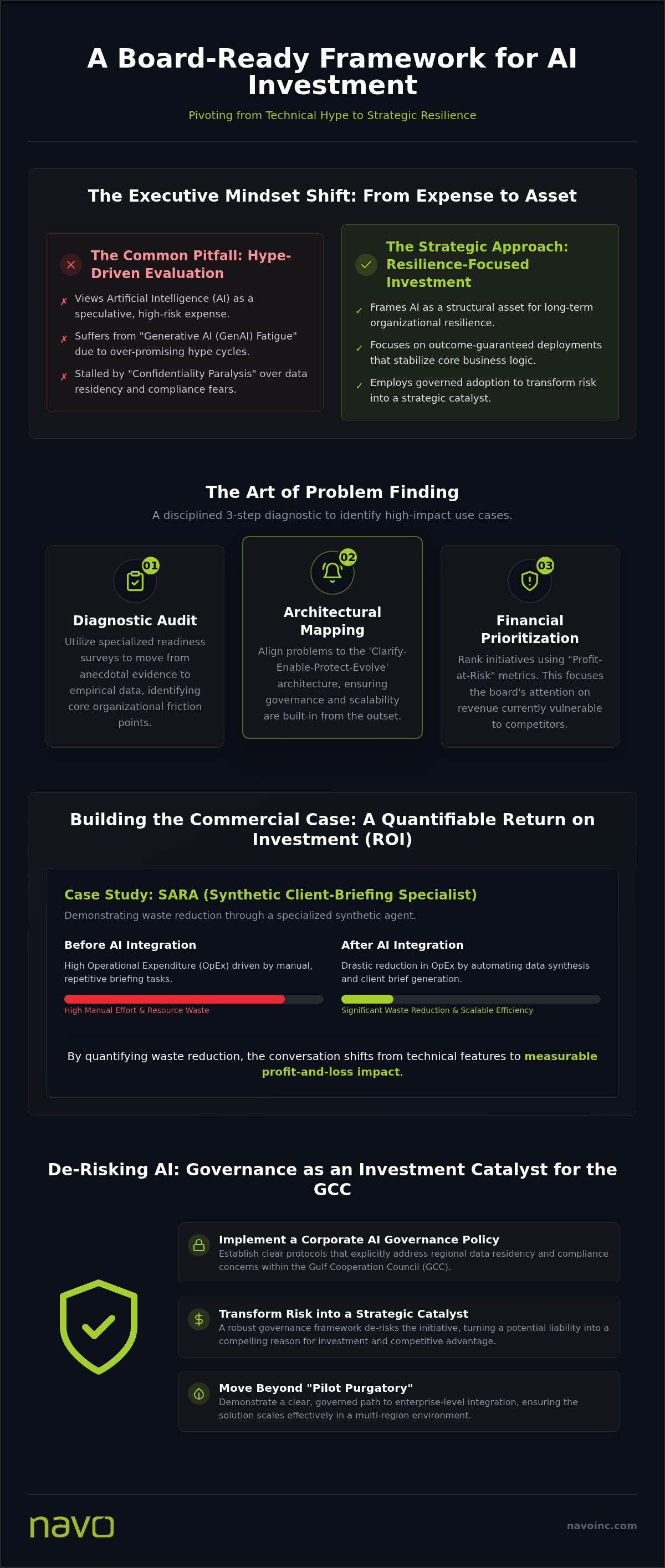
- Demonstrate the Return on Investment (ROI) of a Synthetic Workforce by quantifying the waste reduction achieved through specialized agents like SARA (Synthetic Client-Briefing Specialist).
- Adopt a Corporate AI Governance Policy aligned with Gulf Cooperation Council (GCC) regulations to transform risk management into a strategic catalyst for investment.
- Master the precise persuasion techniques for how to convince board to invest in AI by anchoring every proposal in rigorous business logic and profit-at-risk metrics.
Reframing the AI Narrative: From Technical Experimentation to Strategic Resilience
Boards often view Generative Artificial Intelligence (GenAI) through the lens of hype fatigue. When leadership teams hear about technical capabilities, they see a volatile experiment rather than a structural asset. To succeed, you must shift the conversation toward Strategic AI Resilience. This concept defines the integration of machine intelligence into core business logic as a means of ensuring long-term structural stability. Understanding how to convince board to invest in AI requires a departure from the "Tool-First" mindset that prioritizes software novelty over systemic utility.
A sophisticated strategy focuses on "Outcome-Guaranteed" deployments. While technical teams might advocate for specific platforms, executive leadership requires proof of resilience. This is achieved through the "Six Lanes of Working" framework, which visualizes AI as a co-thinking partner. This model categorizes organizational tasks into distinct streams, showing where machine intelligence can augment human decision-making without compromising the firm’s structural integrity. By presenting AI as a stabilizer rather than a disruptor, you align the initiative with the board’s primary mandate: the preservation and growth of the enterprise.
The Language of the Board: Risk, Return, and Reputation
Effective persuasion involves translating technical milestones into commercial outcomes like net-profit increases and the reduction of Operational Expenditure (OpEx). In the Gulf Cooperation Council (GCC) region, many boards experience "Confidentiality Paralysis." This is a state where legitimate concerns over data residency and regional compliance stall innovation. You can move past this by utilizing governed frameworks that explicitly address local regulations. This approach shifts the narrative from a discussion about technology to a discussion about de-risking the future of the organization while securing a measurable return on investment.
The Art of Problem Finding: Identifying High-Impact Use Cases for Board Approval
Securing capital for intelligence systems begins with a fundamental shift in perspective. Most organizations fail because they attempt to solve "noisy" problems, which are minor operational inconveniences that lack systemic impact. To master how to convince board to invest in AI, you must apply the proprietary "Art of Problem Finding" framework. This methodology distinguishes between superficial inefficiencies and "strategic" problems: those deep-seated structural frictions that jeopardize the firm’s competitive standing and long-term viability.
The transition from identifying a need to securing an investment follows a disciplined diagnostic path. This structured approach ensures that every proposed initiative is anchored in business logic rather than technical curiosity:
- Step 1: Diagnostic Audit. Utilize specialized readiness surveys from Navo Inc. to identify organizational friction points. This baseline assessment moves the conversation from anecdotal evidence to empirical data.
- Step 2: Architectural Mapping. Align identified problems with the "Clarify-Enable-Protect-Evolve" architecture. This ensures the solution addresses governance and scalability from the outset.
- Step 3: Financial Prioritization. Rank use cases based on "Profit-at-Risk" metrics. This focuses the board's attention on the specific revenue or market share currently vulnerable to competitors who adopt machine intelligence faster.
By presenting a case built on Profit-at-Risk, you speak the language of fiduciary responsibility. For leaders seeking a tailored diagnostic of their current infrastructure, engaging with a strategic advisor can accelerate the identification of these high-value friction points.
Moving Beyond the Pilot: Scaling What Matters
Many Artificial Intelligence (AI) initiatives stall in "Pilot Purgatory" because they lack a clear path to enterprise-level integration. In the Gulf Cooperation Council (GCC) region, this stagnation is often compounded by concerns over regional data residency and cultural alignment. You must use diagnostic tools to prove that a solution is not just a localized success but is ready for the rigors of a governed, multi-region environment. Demonstrating this readiness early is essential to convince a board that the investment is a scalable asset rather than a temporary experiment.
Quantifying the Inevitable: Building a Commercial Case for a Synthetic Workforce
The transition from tactical experimentation to enterprise-wide adoption requires a fundamental redefinition of labor. A Synthetic Workforce represents a permanent layer of organizational productivity that operates with persistent memory and audit-ready outcomes. When discussing how to convince board to invest in AI, you must emphasize that these systems don't just perform tasks; they eliminate systemic inefficiencies that human-only processes often overlook. This is a shift from purchasing software to investing in a scalable, high-fidelity productivity architecture.
Consider the economic impact of specialized agents like SARA, a Synthetic Client-Briefing Specialist. Industry data suggests that approximately 33% of marketing budgets are wasted due to poor briefing processes. By deploying an agentic specialist to standardize and optimize these inputs, a firm recovers lost capital while ensuring strategic alignment across all departments. This is further supported by the Question-Economy Protocol, a method designed to improve executive decision-making speed by prioritizing the quality of inquiry over the volume of data. This approach allows leadership to navigate complex market shifts with superior clarity.
To maintain structural stability, we utilize a Machine-in-the-Loop Thinking model. This framework ensures that while machine intelligence provides agentic speed and analytical depth, human leadership retains absolute ownership of the final strategic output. This balance preserves the firm’s intellectual property and cultural integrity while leveraging the efficiency of autonomous systems.
The Economics of Agentic AI
Traditional labor models rely on a cost-per-hour metric, which is often disconnected from the quality of the final result. In contrast, the economics of a Synthetic Workforce prioritize a cost-per-outcome model. This allows for more accurate financial forecasting and a direct correlation between investment and measurable business value. For a more granular analysis of these metrics, you can explore our guide on synthetic workforce development.
Request a custom ROI analysis for your organization
De-Risking AI: Governance as an Investment Catalyst
Boards often hesitate to authorize large-scale intelligence initiatives due to perceived legal and reputational vulnerabilities. To master how to convince board to invest in AI, you must position a Corporate AI Governance Policy as a strategic enabler rather than a bureaucratic hurdle. This policy acts as a structured "green light," providing the safety parameters necessary for the board to exercise its fiduciary duties with confidence. By aligning internal protocols with the National Institute of Standards and Technology (NIST) Privacy Framework and specific Gulf Cooperation Council (GCC) regulations, the organization transforms risk management into a competitive advantage.
True governance requires more than technical safeguards; it demands "Human-Ownership Mechanisms." These protocols ensure that every autonomous system has a clear line of human accountability, preventing the "black box" effect that often triggers executive skepticism. To support this structural shift, Continuing Professional Development (CPD) UK-certified masterclasses are essential. These programs ensure that the workforce isn't just using tools but is fundamentally AI-literate. This creates a culture of safe and informed innovation that protects the firm’s long-term health and systemic integrity.
Regional Compliance: Dubai, Riyadh, and Singapore
Operating across diverse jurisdictions such as Dubai, Riyadh, and Singapore necessitates a sophisticated methodology for data handling and anonymization. Within the Middle East and Southeast Asia, the rapid evolution of regulatory frameworks demands strict adherence to localized residency requirements. Navo Inc. facilitates the establishment of "Permitted-Use Boundaries," specifically for high-stakes sectors like Banking, Financial Services, and Insurance (BFSI). These boundaries delineate the precise operational scope of machine intelligence versus mandatory human intervention. The implementation of such granular controls serves as a definitive catalyst for how to convince board to invest in AI, ensuring that innovation remains synchronized with institutional compliance and security.
Architecting Your Strategic AI Mandate
The transition toward enterprise-wide intelligence is defined by rigorous logic and structural governance. Success requires shifting the executive dialogue from technical novelty to strategic resilience, ensuring that every initiative aligns with the board's primary fiduciary mandates. By utilizing the Art of Problem Finding to identify high-impact friction points and quantifying the commercial value of a Synthetic Workforce, you replace speculative interest with a roadmap for scalable efficiency. This framework provides the definitive strategy for how to convince board to invest in AI while maintaining systemic integrity.
Navo Management Consultants, led by Vasudevan Kidambi, a certified Independent Director and author, provides the authoritative guidance required for these high-stakes shifts. Our outcome-guaranteed strategy consulting is supported by Continuing Professional Development (CPD) UK-certified masterclasses, ensuring your organization is both technologically capable and culturally prepared for the future of work. We assist in managing regional complexities to turn governance into your strongest investment catalyst.
Your organization stands at the threshold of a fundamental evolution. It's a transition that requires a steady, expert hand. With the right frameworks and a disciplined approach to adoption, you can lead your enterprise into an era of unprecedented structural excellence and sustained growth.
Frequently Asked Questions
What is the #1 reason boards reject AI investment proposals?
Boards primarily reject Artificial Intelligence (AI) proposals when the initiative is presented as a technical experiment rather than a structural asset. This skepticism often stems from "hype fatigue," where leadership perceives Generative Artificial Intelligence (GenAI) as a volatile trend that lacks clear alignment with fiduciary responsibilities. To address this, your strategy for how to convince board to invest in AI must focus on Strategic AI Resilience, demonstrating how machine intelligence stabilizes core business logic against market volatility.
How do I calculate the ROI of an AI agent for my business?
Calculating the Return on Investment (ROI) for an AI agent requires shifting from traditional labor metrics toward a "cost-per-outcome" model. You should measure the reduction in "Profit-at-Risk" (PaR) by identifying specific systemic inefficiencies. For instance, deploying a synthetic specialist to optimize marketing briefs can recover significant capital by eliminating the estimated 33% budget waste typical in unmanaged briefing processes. This empirical approach provides the fiscal clarity required for executive approval.
Does our organization need a Corporate AI Governance Policy before investing?
A Corporate AI Governance Policy is a mandatory prerequisite for secure investment because it establishes the "Permitted-Use Boundaries" required for legal and reputational safety. This is particularly critical in the Gulf Cooperation Council (GCC) region, where regional data residency and compliance standards are strictly enforced. Establishing a governed framework early ensures that autonomous systems remain accountable, transforming risk management into a proactive investment catalyst rather than a bureaucratic obstacle.
What is the difference between a "pilot" and a "synthetic workforce transition"?
A pilot is a localized, temporary test designed to prove a technical concept; a synthetic workforce transition is a permanent, systemic integration of machine intelligence into the organization’s operational layer. Unlike pilots, which often stall in "purgatory," a transition focuses on creating a persistent layer of productivity that operates with memory and audit-ready outcomes. This structural shift ensures that machine intelligence becomes a co-thinking partner that scales with the enterprise.
How does Navo’s "Art of Problem Finding" differ from traditional consulting?
Traditional management consulting typically focuses on solving "noisy" problems, which are superficial operational inconveniences. Navo’s "Art of Problem Finding" framework is a diagnostic methodology that identifies "strategic" problems; those deep-seated structural frictions that threaten long-term viability. By isolating these high-impact issues, we ensure that AI deployments are anchored in business logic. This methodology is a core component of how to convince board to invest in AI, as it prioritizes systemic health over technical novelty.
Generative AI tools may have been used to support research, structuring, or language refinement, with the final content, judgment, and editorial responsibility retained by the author.*
Disclaimer
The views and opinions expressed in this article are those of the author and do not represent any organisation, client, institution, or professional body with which he may be associated. The content is intended for general information, education, and thought leadership. Readers should seek appropriate professional advice before making legal, financial, investment, regulatory, technology, or business decisions.
The author has taken reasonable care to ensure the accuracy of the information and sources available at the time of publication. Technologies, regulations, market conditions, and industry practices may evolve, and readers are encouraged to verify current information independently. Any examples, cases, or scenarios may have been simplified, anonymised, or adapted to protect confidentiality. The author and publisher accept no liability for decisions or outcomes arising from the use of this content.
Generative AI tools may have been used to support research, structuring, or language refinement, with the final content, judgment, and editorial responsibility retained by the author.